
I used to think good copywriters were the ones who could write the most.
Long sales pages. Endless blog posts. More words meant more value. At least that’s what I believed when I started.
Then I noticed something strange.
Some of the best-performing pages I studied were… short. Not lazy short. Tight. Focused. Every line had a job. Nothing felt extra. And those pages converted better than the long ones I spent hours trying to perfect.
That’s when it hit me.
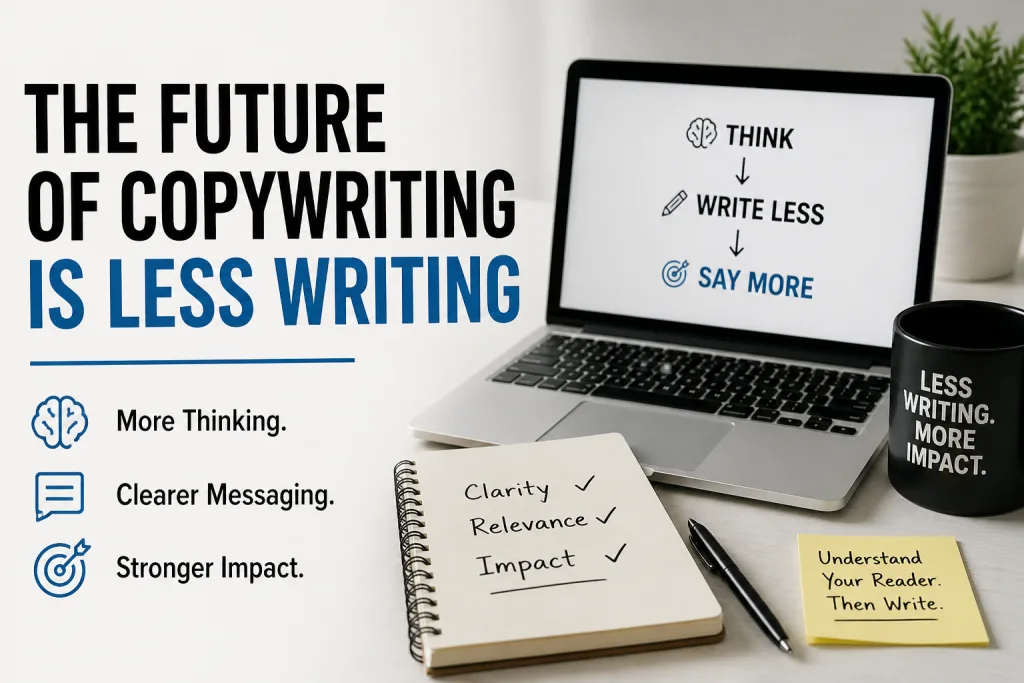
The future of copywriting is less writing. Not less effort. Not less skill. Just fewer words that do more work.
Now with AI tools everywhere, this shift is even more obvious. Anyone can generate content. But not everyone can think clearly, structure ideas, and say something that actually moves a reader.
That’s the real game now.
Let’s break it down.
What Does “The Future of Copywriting Is Less Writing” Mean?
The future of copywriting is less about writing more words and more about thinking clearly before you write. As AI tools make content creation faster, the real advantage shifts to strategy, audience understanding, and message clarity.
- Fewer words with stronger impact
- Clear, simple messaging that is easy to follow
- Strategic thinking before writing
- Editing and guiding AI-generated content
- Writing that drives action, not just fills space
In short, successful copywriters today win by communicating ideas clearly and directly, not by writing longer content.
Table of Content
- What Does “The Future of Copywriting Is Less Writing” Mean?
- What “Less Writing” Actually Means in Copywriting?
- Why AI Is Changing Copywriting Forever?
- The Rise of Strategic Copywriting Skills
- Why Clarity Beats Creativity Today?
- The New Role of a Copywriter
- How to Adapt to the Future of Copywriting?
- Common Mistakes Writers Will Make (And Why They’ll Fall Behind)
- Key Takeaways: The Future of Copywriting Is Less Writing
- Conclusion
What “Less Writing” Actually Means in Copywriting?
When people hear “less writing,” they assume it means doing less work.
That’s not what it means at all.
In fact, I spend more time on copy now than I did before. Just not in the writing phase.
I sit longer before I write a single sentence. I think about the reader. I map the message. I remove anything that feels unclear before it even becomes a paragraph.
Because once you understand the idea properly, you don’t need many words to explain it.
I learned this the hard way.
I used to write long intros that sounded smart but said nothing. I thought adding more lines made it stronger. It didn’t. It just made it harder to read.
Then I started cutting.
At first, it felt painful. Like I was deleting good work. But once I saw how much cleaner the message became, I couldn’t go back.
Less writing means:
- You remove fluff before it shows up
- You say things in plain language
- You focus on one idea at a time
- You stop trying to impress
And here’s the key part.
You respect the reader’s time.
People don’t read like they used to. They scan. They jump. They decide in seconds if something is worth their attention.
So if your copy takes too long to get to the point, you lose them.
That’s why less writing works.
Not because it’s shorter. Because it’s easier to follow.
Why AI Is Changing Copywriting Forever?
I’ll be honest. When AI writing tools started getting popular, I felt uneasy.
It felt like the thing I spent years learning could be done in seconds.
And in a way, that’s true.
AI can write fast. It can produce decent structure. It can even sound human if you tweak it right.
But here’s what I noticed after using it a lot.
AI is great at writing. It’s not great at thinking.
If you give it a weak idea, it will still produce a full article. It looks good on the surface. But when you read it closely, it feels empty. Like something is missing.
That “something” is direction.
AI doesn’t know your reader. It doesn’t understand the emotional struggle behind a search. It doesn’t feel confusion or hesitation.
You do.
That’s why the role of a copywriter is shifting. You’re not just writing anymore. You’re guiding.
You decide:
- What angle to take
- What problem matters most
- What to include and what to remove
- How the message should flow
Then AI helps you execute faster.
But if you skip the thinking part and rely on AI completely, your content becomes generic. And generic content is everywhere now.
So it gets ignored.
The writers who win in this new space are not the ones who write everything from scratch.
They are the ones who can direct the process. They know what to say before anything gets written.
The Rise of Strategic Copywriting Skills
This is where things get interesting.
Because if writing itself is no longer the main advantage, what is?
Strategy.
I didn’t pay much attention to this when I started. I thought strategy was something marketers talked about, not writers.
Big mistake.
Strategy is what makes copy work.
You can write a beautiful paragraph. But if it speaks to the wrong problem, it won’t convert. I learned this after publishing an article that I thought was great.
Clean writing. Good structure. Helpful tips.
It got traffic. But no one signed up.
Why?
Because I missed the real problem the reader cared about. That’s when I started spending more time on research. Not complicated research. Just simple observation.
- Reading comments
- Looking at questions people ask
- Noticing patterns
You start to see what people struggle with. Not what they say they want, but what actually bothers them.
And once you understand that, writing becomes easier. Because you’re not guessing anymore.
Strategic copywriting means:
- You know who you’re talking to
- You understand what they feel
- You position your message clearly
- You guide the reader step by step
The words come after that.
Why Clarity Beats Creativity Today?
I used to chase clever lines.
You know the type. Smart phrasing. Play on words. Something that makes you pause and think.
I thought that’s what good copy looked like.
But here’s what I noticed.
Clever copy slows people down. And when people slow down, they leave. Most readers don’t want to figure things out. They want to understand things quickly.
So clarity wins.
I remember rewriting a headline once.
The original version sounded creative. It had rhythm. It felt like something you’d see in a big campaign.
But it wasn’t clear.
So I rewrote it in the most basic way possible. Almost boring.
The result?
Better clicks. More engagement. More conversions.
That changed how I write.
Now I ask myself:
Is this easy to understand on first read?
If not, I fix it.
Clarity means:
- Short sentences when needed
- Simple words instead of complex ones
- Direct statements
- No unnecessary twists
It doesn’t mean your copy has to be dull. It means it has to make sense fast. And in today’s environment, that matters more than eve
The New Role of a Copywriter
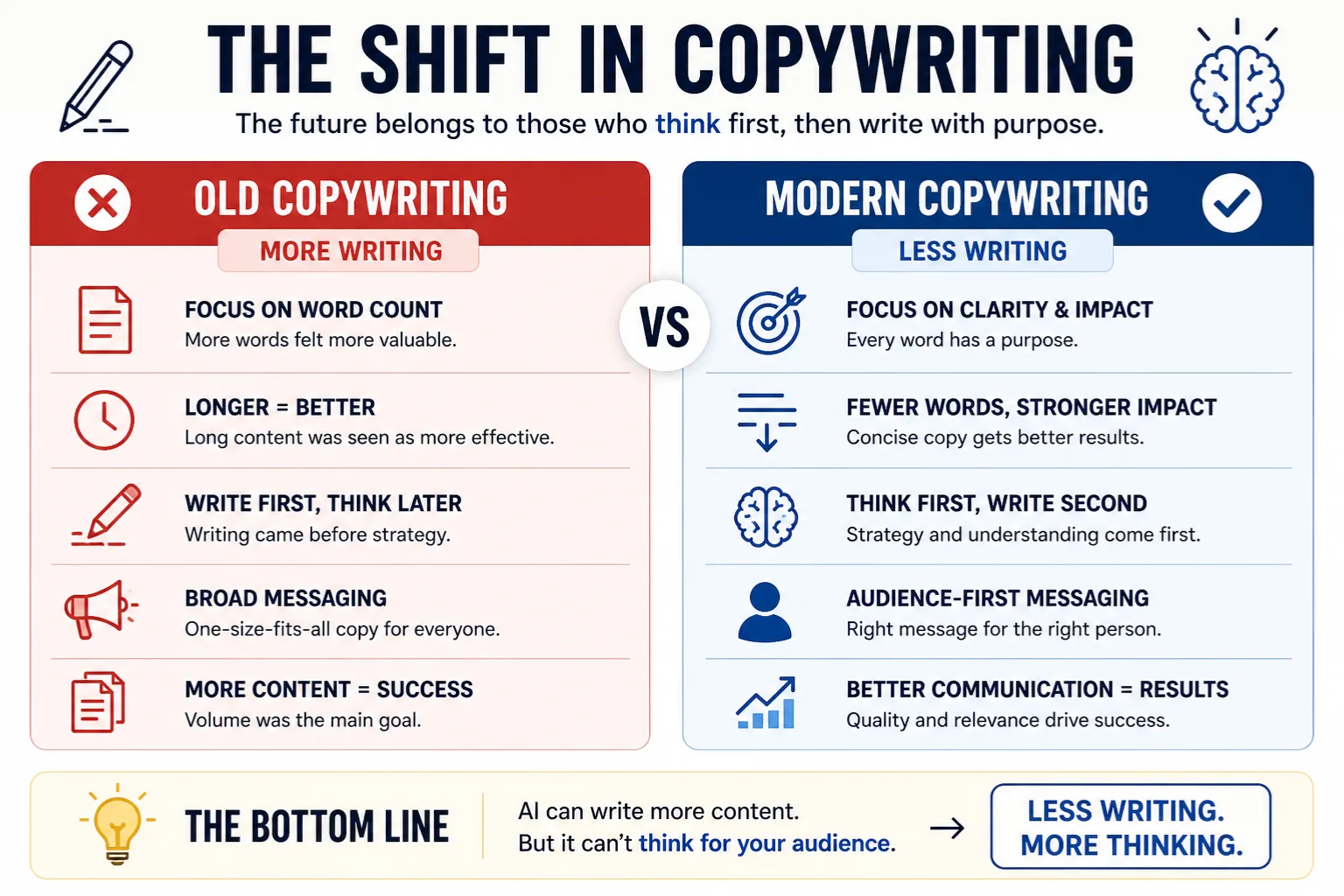
If you look at how copywriting used to work, the focus was clear.
Write more. Write better. Write faster.
Now the role looks different.
You spend less time typing and more time thinking. You sketch ideas before writing them. You organize thoughts into a simple flow. You decide what matters before anything gets drafted.
Then you write. Or you let AI help you write. But the structure comes from you.
I see this as a shift from “writer” to “builder.”
You’re building a message.
Each part has a role:
- The hook grabs attention
- The middle explains
- The ending moves the reader
And if one part is weak, the whole thing falls apart.
So instead of asking “how do I write this,” you start asking:
- What does the reader need to understand first?
- What’s confusing here?
- What can I remove?
That’s a different way of thinking. And it makes your work stronger.
How to Adapt to the Future of Copywriting?
This part matters.
Because knowing the shift is one thing. Adjusting your process is another.
Here’s what helped me.
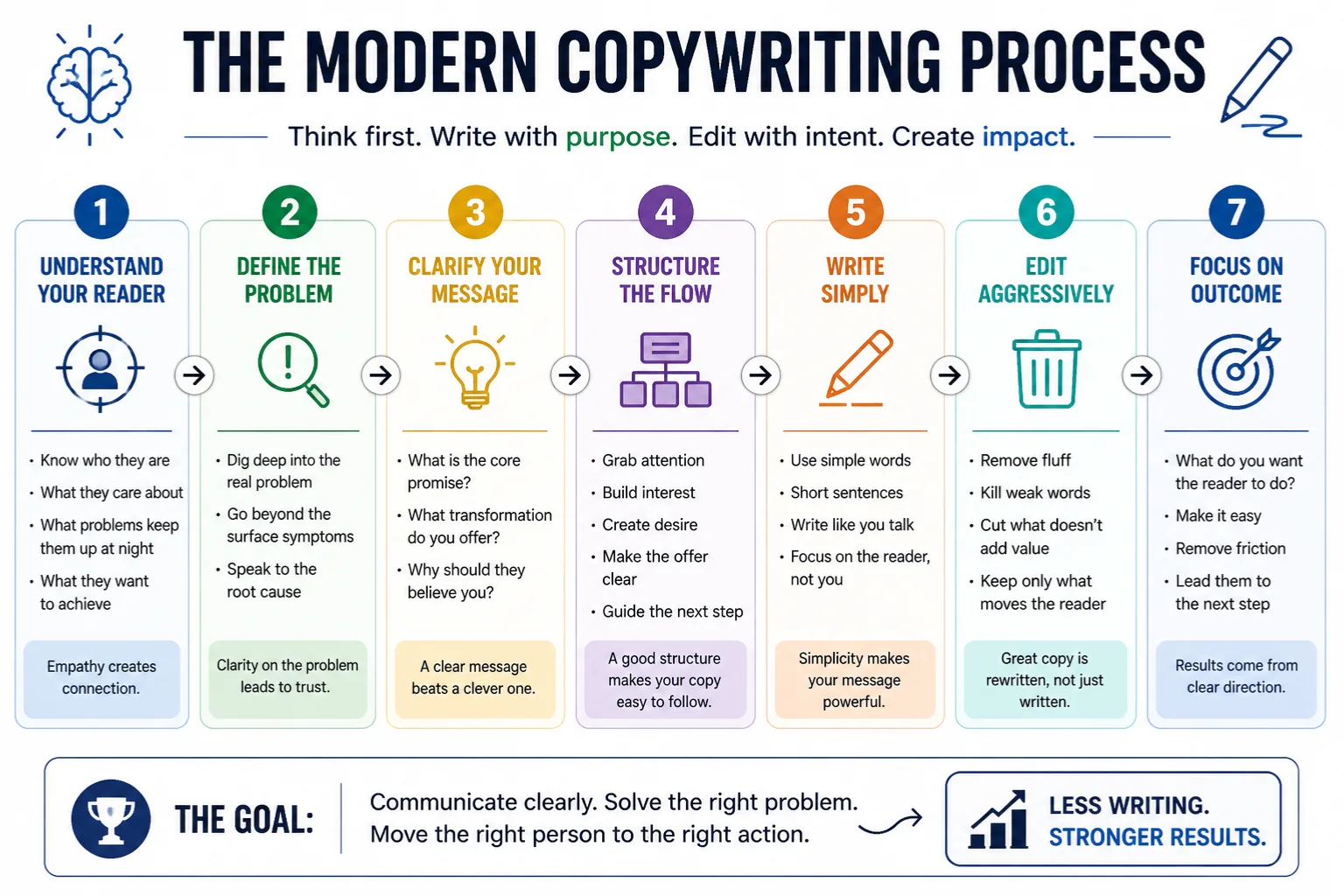
First, I stopped rushing into writing.
I used to open a document and start typing right away.
Now I pause. I write down the core idea in one sentence. If I can’t do that, I know I’m not ready to write.
Second, I practice simplifying.
I take a complex idea and try to explain it in plain language. Like I’m talking to someone with no background in the topic.
This feels harder than writing long paragraphs. But it trains your thinking.
Third, I use AI differently.
Not as a replacement, but as a helper. I give it direction. I shape the output. I edit heavily.
That way, it speeds up the process without taking over.
Fourth, I focus on outcomes.
Not word count. Not how long the article is. But what it does.
Does it help the reader understand something? Does it move them to take action?
If yes, it works. If not, adding more words won’t fix it.
Common Mistakes Writers Will Make (And Why They’ll Fall Behind)
I see this happening already. Writers reacting to change in the wrong way.
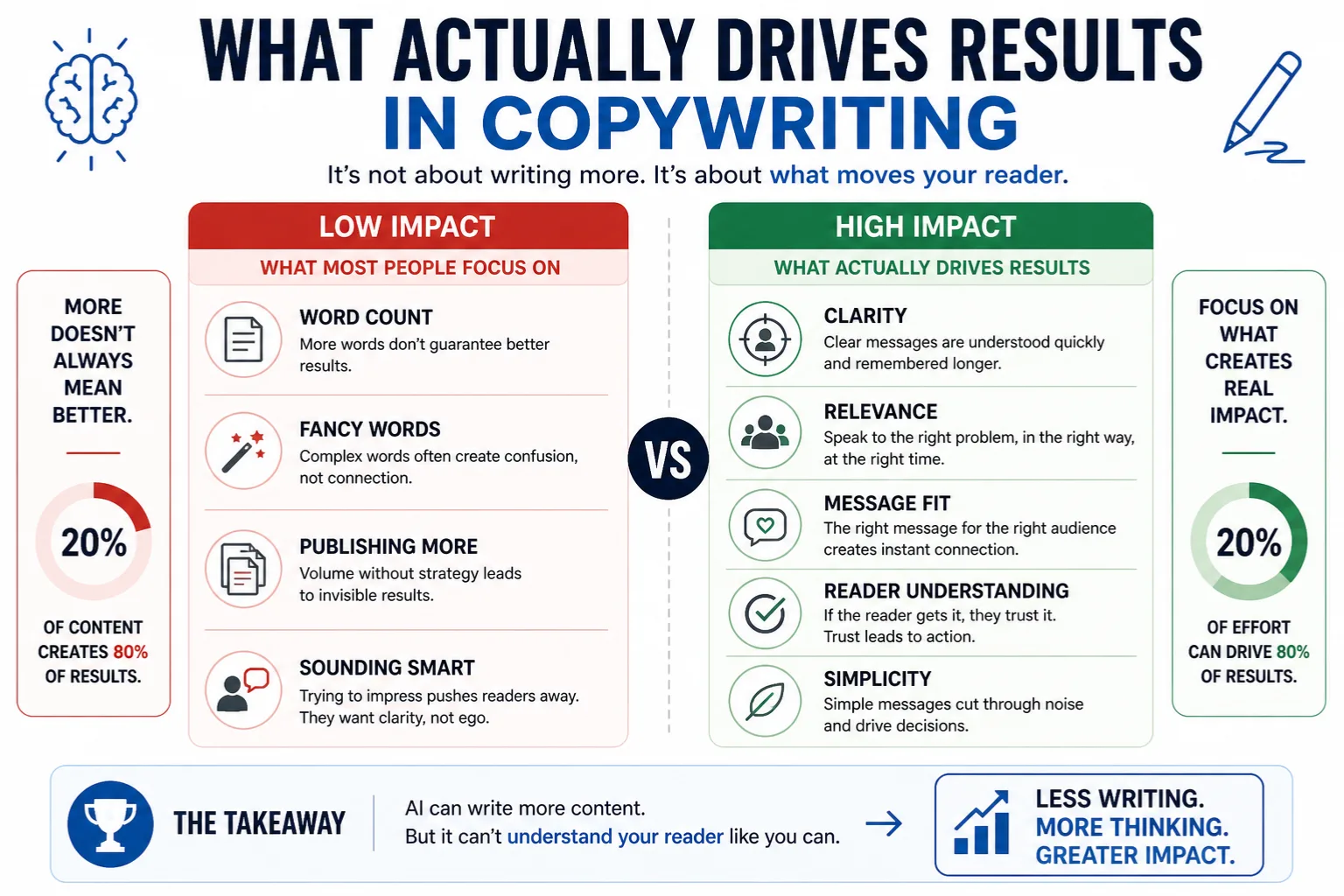
The first mistake is writing more.
They think if AI creates content fast, they need to produce even more to compete. That leads to burnout and low-quality work.
The second mistake is trusting AI too much.
They generate content, do light edits, and publish. It looks fine. But it lacks depth. And readers can feel that.
The third mistake is ignoring the reader.
Focusing on keywords. Structure. Output. But not on what the reader actually needs. That disconnect kills performance.
Another mistake is overcomplicating things.
Trying to sound advanced. Using big words. Adding layers that are not needed. This creates distance between the message and the reader.
And then there’s the biggest one.
Confusing activity with progress.
Publishing more does not mean growing. Writing faster does not mean improving. If the thinking is weak, the output will always be weak.
Key Takeaways: The Future of Copywriting Is Less Writing
- The future of copywriting is less writing and more thinking before you write
- AI can generate content fast, but it cannot replace clear strategy and direction
- Strong copy focuses on clarity, not cleverness or word count
- Fewer words work better when each sentence has a clear purpose
- Understanding the reader matters more than writing skill alone
- Editing and structuring ideas are now more valuable than drafting from scratch
- Simple, direct language improves engagement and conversions
- Writing more content does not guarantee better results
- Copywriters are shifting from writers to strategic thinkers
- The goal is not to write more, but to communicate better and drive action
Conclusion
The future of copywriting is not about writing more. It’s about thinking better.
That’s the shift.
Anyone can generate words now. That part is easy. What’s not easy is knowing what to say, how to say it, and why it matters.
That’s where you come in.
If you can understand your reader, simplify your message, and guide attention in a clear way, you will stand out.
Not because you write more. But because you write with purpose. And that’s what will matter moving forward.
Reading about this shift is one thing. Applying it is where it starts to click.
The fastest way to improve is to practice writing with focus, not volume.
Start here:
Copywriting Practice System →