
If you’ve ever published a blog post that felt solid… but got no traffic, I know how that feels.
I’ve done it more times than I’d like to admit. You sit there thinking, “This is good.” Then nothing happens. No clicks. No impressions. Just silence.
At first, I thought I needed to write better. Turns out, I needed to write differently.
SEO writing isn’t about sounding smart or using big words. It’s about understanding what someone is searching for and giving them exactly what they need in a way that’s easy to read.
This hub will walk you through that. Step by step. No fluff.
On this page:
- What Is SEO Writing
- How SEO Writing Works
- Core SEO Writing Skills
- SEO Writing Process
- SEO Content Optimization
- Writing for AI Search
- How to Measure Your SEO Content
- Common SEO Writing Mistakes
- SEO Writing Articles
What Is SEO Writing? (Quick Summary)
SEO writing is the process of creating content that matches search intent and is structured in a way that helps it rank in search engines.
- Focus on what the reader is searching for
- Match content to search intent
- Use simple structure and clear headings
- Write in a way that is easy to read
- Use internal links to build authority
- Optimize content for both traditional search and newer AI search experiences
What Is SEO Writing?
SEO writing is the process of creating content that ranks in search engines while still being useful and easy to read.
When I started, I made the classic mistake. I focused too much on keywords. I would repeat the same phrase over and over, thinking that would help me rank.
It didn’t.
What actually made a difference was learning how to match search intent.
If someone searches “how to write better online,” they don’t want theory. They want simple steps they can follow right away. If your content doesn’t give them that, they leave.
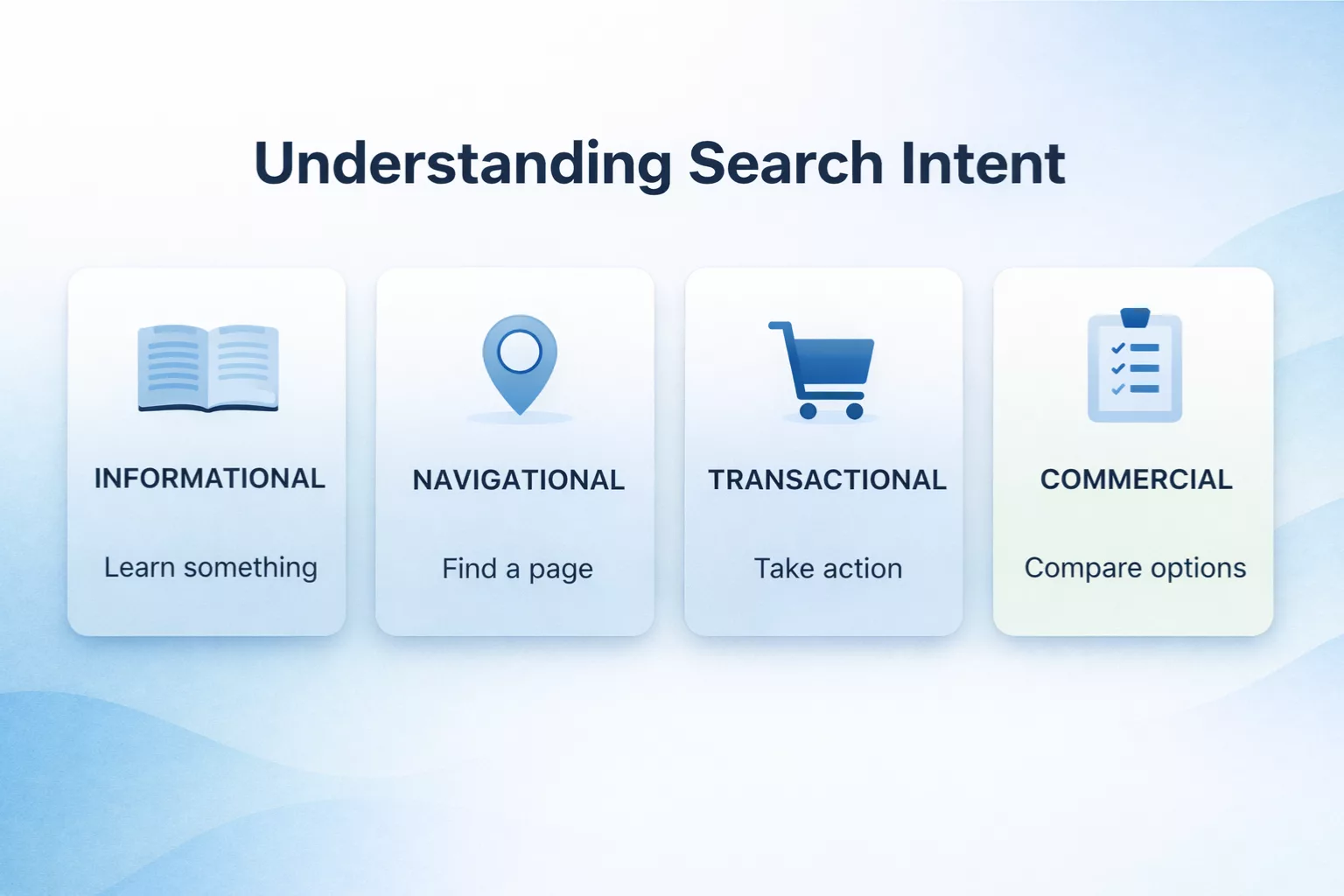
SEO writing is really about three things:
- Understanding what the reader expects
- Answering that clearly
- Structuring your content so it’s easy to follow
Once you get that right, everything else becomes easier.
How SEO Writing Works
Most beginners overcomplicate this. I did too.
But the process is simple once you see it clearly.
Every piece of content follows the same flow:
- Someone searches for something
- Google looks for the best match
- It ranks the content that answers the question best
Your job is to become that “best match.”
That means:
- Choosing the right keyword
- Understanding what the reader wants
- Writing content that solves that problem
- Making it easy to read and scan
I used to skip the intent part. I would pick a keyword and start writing right away.
That’s where things break.
Now, I always stop and ask:
“What is this person actually trying to do?”
That one question changed everything for me.
Core SEO Writing Skills You Need
You don’t need to master everything at once. That’s where most people get stuck.
Focus on these core skills first:
1. Keyword Research
You need to know what people are searching for.
Not guesses. Not ideas. Actual search terms.
Start simple. Look for phrases that are clear and specific. Long-tail keywords are easier to rank and usually bring better traffic.
Learn more in Keyword Research for Writers.
2. Search Intent
This is the part most writers ignore.
Every keyword has intent behind it. Someone is trying to learn something, fix something, or decide something.
If your content doesn’t match that intent, it won’t rank.
See Search Intent for Writers for a deeper look.
3. Content Structure
Good structure makes your content easy to read.
That means:
- Clear headings
- Short paragraphs
- Logical flow
When I improved structure, my time on page increased almost instantly.
4. Readability
If your content feels hard to read, people leave.
Simple language works better. Short sentences help. One idea per paragraph keeps things clear.
5. Internal Linking
This is how you build authority across your site.
Each article should connect to others. Your hub pages become the center of that structure.
This is where real growth starts to happen.
Feeling stuck with your writing direction?
Take the quiz and get a clear path you can follow.
Start the QuizSEO Writing Process (Step by Step)
This is the process I follow now for every article.
It’s simple, but it works.
For a complete step-by-step process, see How to Write an SEO Blog Post.

Step 1: Pick a Keyword
Choose something specific. Avoid broad topics at the start.
For example:
Instead of “writing,” go with “how to write blog posts faster.”
Step 2: Understand Search Intent
Look at what’s already ranking.
Ask yourself:
- Are these guides, lists, or tutorials?
- What angle are they using?
- What do they all have in common?
That tells you what Google expects.
Step 3: Create a Simple Outline
Before writing, map your structure.
I used to skip this. Big mistake.
Now I outline first, and writing feels much easier.
Step 4: Write the First Draft
Focus on helping the reader.
Don’t worry about perfection. Just get the ideas down.
Step 5: Optimize Structure
After writing, clean it up:
- Break long paragraphs
- Improve headings
- Make it easier to scan
Step 6: Add Internal Links
Link to related articles on your site.
This helps readers and search engines understand your content better.
Step 7: Edit for Readability
This is where the content improves the most.
I usually cut sentences, simplify words, and make everything easier to follow.
SEO Content Optimization
Writing the first draft is only part of the job. You also need to make sure the finished article is easy for readers and search engines to understand.
Start With On-Page SEO
On-page SEO covers the elements you control on the page. That includes your title, headings, URL, content structure, internal links, images, and other page elements.
Use the On-Page SEO for Writers guide when you want to check the page before publishing.
Think Beyond One Keyword
A useful article usually covers a topic rather than repeating one keyword. Related questions, subtopics, examples, and supporting information help create a more complete resource.
This connects with Topical Authority, where individual articles work together to demonstrate depth around a subject.
Optimize the Content, Not Just the Keyword
Your goal is not to place a keyword in every possible location. Your goal is to create the best useful answer for the searcher.
For another perspective, see SEO Optimization Strategies.
Keep Your Writing Goal Clear
SEO should support the purpose of the article. Decide what you want the reader to understand or do, then make the content work toward that goal.
Writing for AI Search
Search is changing. People now use AI search tools to find answers, compare ideas, and discover sources.
That creates another reason to focus on clear, useful, well-structured content.
The fundamentals still matter. Understand the question. Answer it clearly. Provide useful context. Make your content easy to understand.
Optimize Content for AI Search Tools
Learn how to structure and improve your content for newer AI-driven search experiences in How to Optimize Content for AI Search Tools.
Build AI Search Visibility
Traditional rankings are not the only way people discover information. AI Search Visibility looks at how your content can become more visible in AI-powered discovery.
This does not mean abandoning traditional SEO. It means creating content that is useful enough to work across different search experiences.
How to Measure Whether Your SEO Writing Is Working
Ranking is useful, but it is not the only thing that tells you whether your writing is working.
Look at what happens after people find your content.
- Are impressions increasing?
- Are people clicking from search?
- Which pages attract organic traffic?
- Which topics perform better than others?
- Are readers moving to other pages on your site?
- Are older articles losing visibility?
Your answers can show you what to improve next.
Watch for Content Decay
An article can perform well for months and then start losing traffic. That does not always mean the article failed. The search results, reader expectations, and information around the topic may have changed.
When that happens, review the article instead of starting from scratch.
You can also use the fastest way to know if your writing is working to build a better feedback loop around your content.
Common SEO Writing Mistakes
I’ve made most of these myself.
That’s why I know how much they slow you down.
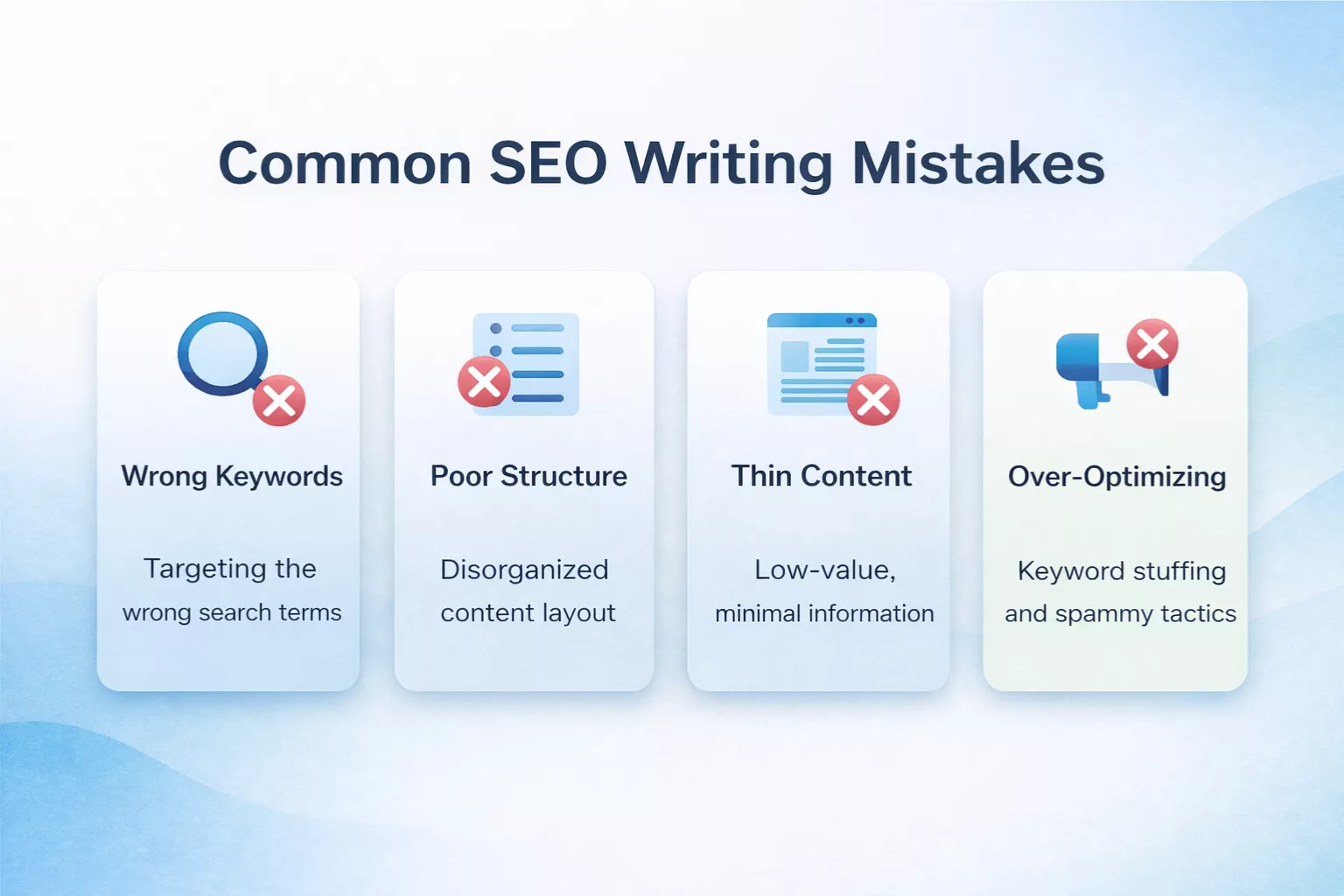
Writing Without Checking Intent
You pick a keyword and start writing.
But if your content doesn’t match what people expect, it won’t rank.
Overusing Keywords
This used to be common advice. It doesn’t work anymore.
It makes your writing feel unnatural and hard to read.
Poor Structure
Big blocks of text are hard to read.
If someone lands on your page and feels overwhelmed, they leave.
Ignoring Internal Links
This is a big one.
Without internal links, your content stays isolated. It doesn’t build authority.
Trying to Sound Too Smart
Simple writing wins.
You don’t need complex words to sound credible. You need to be easy to understand.
Ignoring AI Search
Search behavior is changing. Focusing only on traditional rankings can leave part of the discovery journey out of your strategy.
SEO Writing Articles in This Hub
These articles cover the main parts of SEO writing, from research and intent to optimization, topical authority, and AI search.
Start here for the complete SEO writing guide.
Follow the complete process for planning, writing, optimizing, publishing, and improving an SEO blog post.
Learn how to find useful search terms and topics.
Understand what searchers want before you write.
Improve the SEO elements you control on the page.
Explore practical SEO optimization strategies.
Connect your writing goals with your SEO strategy.
Learn how related content can work together to build topical depth.
Explore content optimization for AI-powered search.
Learn about visibility in AI-driven search experiences.
Use feedback and performance signals to understand what works.
Each one focuses on a specific part of the process.
Start with one. Apply it. Then move to the next.
That’s how you build real progress without feeling overwhelmed.
SEO writing is not about tricks.
It’s about helping the reader in a way that search engines can understand.
Once you stop trying to “do SEO” and start focusing on what the reader actually needs, things begin to shift.
Your content feels better. It becomes easier to write. And over time, it starts to rank.
That’s when it gets interesting.
Not sure what kind of writing you should focus on?
Take this quick quiz and find your best writing path based on your strengths.
Take the QuizSEO Writing FAQs
What is SEO writing?
SEO writing is the process of creating content that is optimized to rank in search engines while still being helpful and easy to read for users.
How do I start SEO writing?
Start by choosing a keyword, understanding search intent, creating an outline, and writing content that clearly answers the reader’s question.
Do I need to use keywords a lot?
No. Use keywords naturally. Focus on clarity and usefulness instead of repeating the same phrase.
Why is search intent important?
Search intent helps you understand what the reader expects. If your content does not match that expectation, it will not satisfy the search.
How long should SEO content be?
Content should be long enough to fully answer the topic. Focus on completeness and clarity instead of word count.
Does SEO writing still matter with AI search?
Yes. Clear, useful, well-structured content remains important as people use both traditional search engines and AI-powered search tools to find information.
What should I optimize after writing an article?
Review the search intent, structure, headings, keyword use, internal links, readability, and overall usefulness of the content.