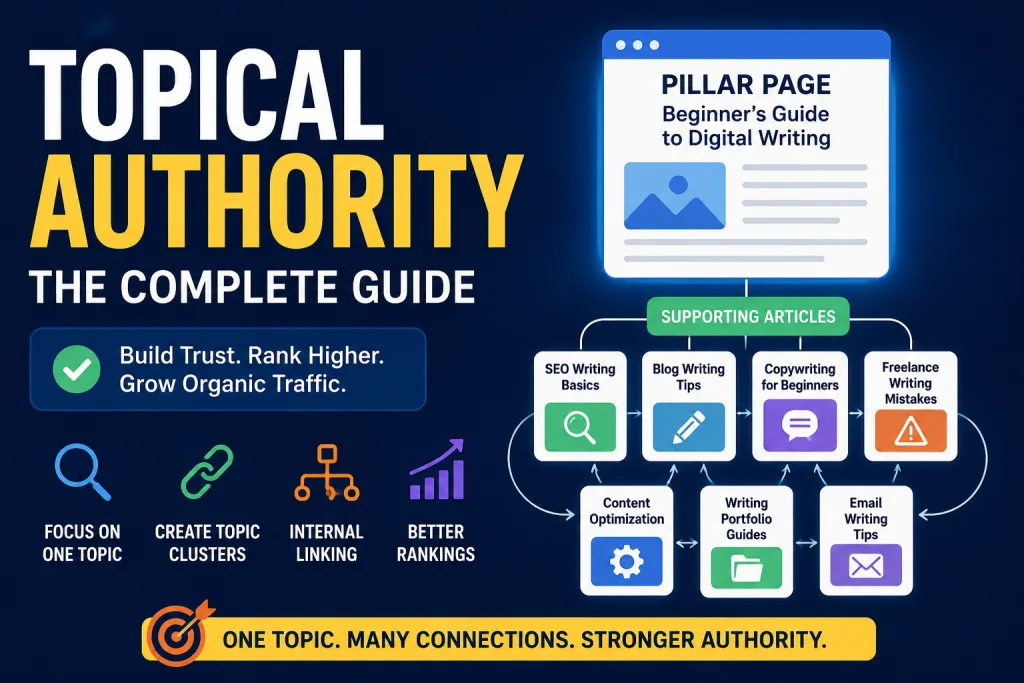

A lot of new website owners think SEO is about publishing random articles and hoping Google notices them.
That used to work years ago. Not anymore.
Today, search engines want to see depth, expertise, and consistency. They want proof that your website understands a topic better than most sites online. That is where topical authority comes in.
If you have ever wondered why some small websites suddenly explode with traffic while others stay invisible for years, topical authority is often the reason.
The good news is that you do not need a giant team or a huge budget to build it. You just need the right structure, the right content strategy, and patience.
In this beginner’s guide, you will learn:
- What topical authority means
- Why it matters for SEO
- How Google evaluates expertise
- How to structure your content
- Common mistakes beginners make
- A simple framework for building authority in your niche
Topical authority is one part of building a strong SEO strategy. Explore the SEO Writing Hub for related guidance on content planning, keyword research, and search-focused writing.
What Is Topical Authority? (Quick Summary)
Topical authority is an SEO strategy where a website builds trust and rankings by publishing high-quality, connected content around one specific subject. Instead of writing random articles on unrelated topics, websites create topic clusters that cover a niche deeply and comprehensively.
Google uses topical authority to understand whether a website demonstrates expertise, relevance, and trustworthiness within a subject area. Websites with strong topical authority often rank higher because they provide complete answers, strong internal linking, and helpful user-focused content.
- Focus on one niche or core topic
- Create pillar pages and supporting articles
- Use internal linking to connect related content
- Cover topics deeply instead of broadly
- Match search intent and answer reader questions clearly
- Publish consistently and update content regularly
- Build trust through helpful, experience-based writing
Examples of topical authority content include beginner guides, tutorials, FAQs, glossaries, case studies, and supporting topic clusters that work together to strengthen SEO relevance over time.
Table of Content
- What Is Topical Authority?
- Why Topical Authority Matters for SEO?
- How Google Understands Topical Relevance
- What Is a Topic Cluster?
- How to Choose a Niche for Topical Authority?
- How to Build Topical Authority Step by Step?
- Best Content Types for Building Topical Authority
- Common Topical Authority Mistakes Beginners Make
- How Long Does It Take to Build Topical Authority?
- Topical Authority vs Keyword Stuffing
- Tools That Help Build Topical Authority
- Simple Topical Authority Example for Beginners
- Signs Your Website Is Building Topical Authority
- Topical Authority Content Plan for Beginners
- Key Takeaways
- Related Guides
- Conclusion
- Frequently Asked Questions About Topical Authority
What Is Topical Authority?
When I first started learning SEO, I thought ranking on Google was mostly about keywords and backlinks. So I did what a lot of beginners do. I published random articles on completely different topics hoping something would stick.
One week I wrote about blogging.
The next week I wrote about productivity apps.
Then freelance writing.
Then AI tools.
Traffic stayed flat for months because my website looked scattered. There was no clear focus. Google could not easily understand what my site was actually about.
That is usually the first big lesson people learn with SEO.
Topical authority matters more than most beginners realize.
In simple terms, topical authority means your website becomes trusted for a specific subject because you consistently publish helpful, connected, high-quality content around that topic.
Instead of publishing one article about SEO and disappearing, you build an entire ecosystem around SEO.
For example, a website about digital writing might publish articles about:
- SEO writing
- Blog structure
- Keyword research
- Content optimization
- Writing tools
- Freelance writing
- Content strategy
Over time, search engines begin connecting those articles together. Your site starts looking like a reliable source instead of a random collection of blog posts.
A lot of people confuse topical authority with domain authority, but they are different things.
Domain authority is mostly a third-party SEO metric that estimates how strong a website is based on backlinks and overall reputation.
Topical authority is about depth and relevance.
A smaller website with focused, deeply connected content can sometimes outrank larger websites that only touch the topic briefly. I have seen this happen many times, especially in niche industries.
Google prefers topic-focused websites because they usually create a better user experience.
Think about it from Google’s perspective.
If someone searches for “how to optimize blog posts,” Google would rather show a site that has dozens of detailed writing and SEO articles than a general website that talks about recipes, gaming, fitness, and marketing all at once.
Focused websites tend to answer questions more completely.
They also keep readers on the site longer because related content naturally connects together.
That is one reason topical authority helps rankings.
When your articles support each other through internal links and semantic relevance, Google gains more confidence in your expertise. Your pages become easier to crawl, easier to understand, and often easier to rank.
You can see strong topical authority in action with websites like:
- HubSpot for inbound marketing
- Healthline for health content
- NerdWallet for personal finance
- Backlinko for SEO education
These websites do not publish random content just to chase traffic.
Their articles stay tightly connected around core themes.
That consistency builds trust.
And honestly, this is where many beginners struggle. They think more topics means more traffic opportunities. Sometimes it actually weakens the website because there is no clear expertise signal.
Covering one topic deeply usually works better than publishing shallow content across twenty unrelated subjects.
Google wants to see:
- expertise
- consistency
- relevance
- depth
- trustworthiness
All of these work together.
Topical authority is really the connection between expertise, trust, and content relevance. The more helpful and connected your content becomes, the more likely search engines are to treat your site like a reliable resource.
That process takes time, but once it starts compounding, rankings often become much easier to sustain.
Google’s Search Quality Evaluator Guidelines explain how expertise, authoritativeness, and trustworthiness influence content quality evaluations.
Search engines want proof that your website consistently publishes helpful content around one clear topic, especially in areas like SEO writing.
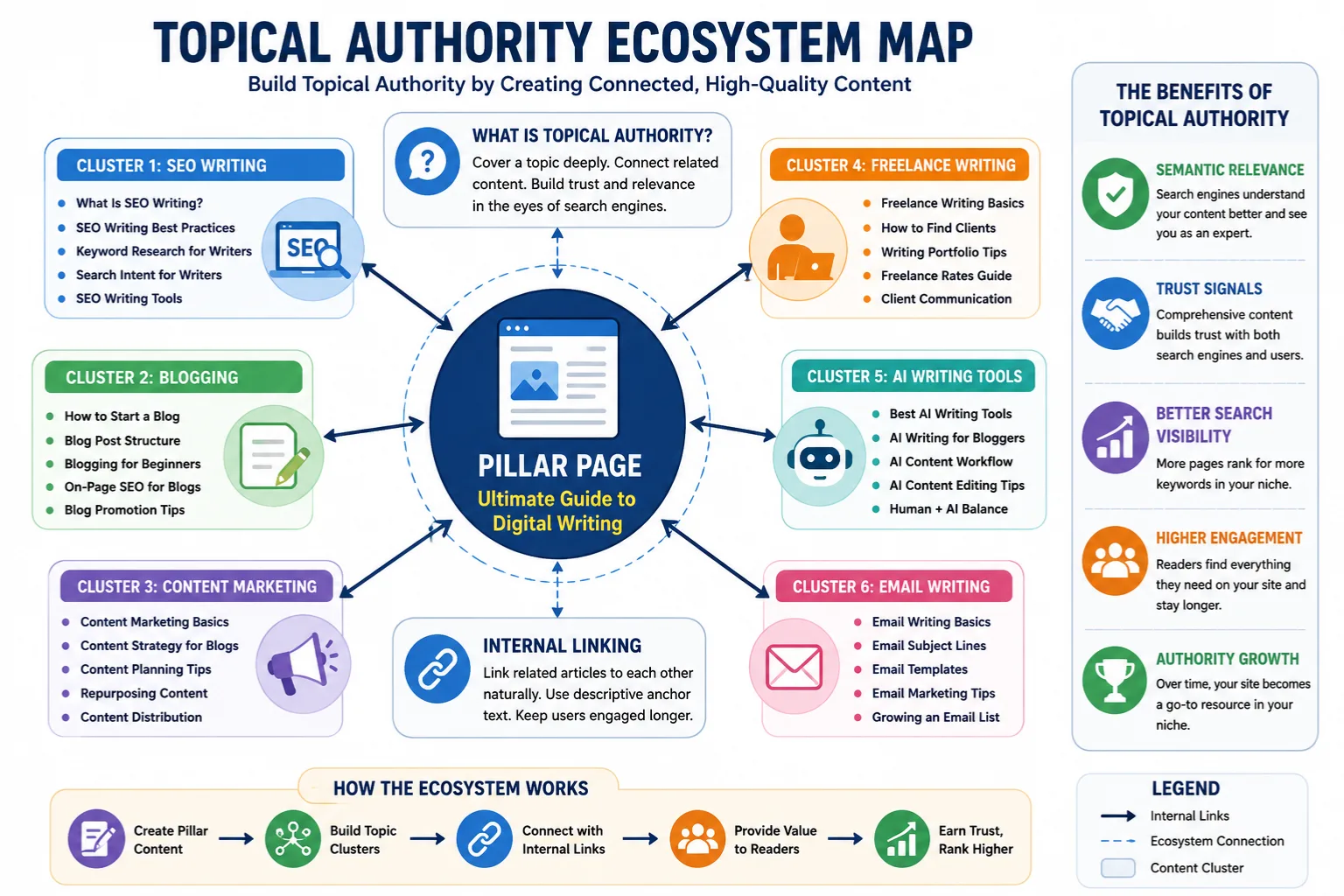
Why Topical Authority Matters for SEO?
I used to think every article ranked independently. Write a good post, target keywords, build backlinks, and Google rewards you.
SEO is more interconnected than that.
Google evaluates how well a website covers a topic across its content. A site with useful, related content can build stronger topical relevance than one publishing isolated articles.
For example, someone searching for “how to start a blog” may also need answers about:
- How domains work
- Which blogging platform to use
- How to write articles
- How SEO works
- How blogs make money
A site with topical authority can address these questions across multiple related articles. Each page covers part of the broader topic while helping users discover the next relevant resource.
Topical Authority Creates Connected Content
As you publish more relevant content around a topic, your website can become associated with a wider range of related searches.
For example:
SEO basics → keyword research → content optimization → internal linking
Each article addresses a specific search need while contributing to the broader SEO topic.
Internal linking strengthens these relationships. It helps search engines discover related pages and understand how your content fits together. It also gives readers a clear path to more relevant information.
It Helps You Target Long-Tail Searches
Topical authority also gives smaller, specific searches a place within your content strategy.
Instead of targeting only broad terms, you can cover related long-tail topics such as:
- “best blog structure for SEO”
- “how to organize topic clusters”
- “beginner internal linking strategy”
Each keyword may represent a small amount of traffic. Together, a broad set of relevant long-tail searches can contribute significant organic traffic.
It Supports E-E-A-T
Topical authority also connects with Google's E-E-A-T framework:
- Experience
- Expertise
- Authoritativeness
- Trustworthiness
Publishing useful, relevant content consistently can demonstrate expertise and provide stronger context around what your website covers.
However, topical authority does not replace the need for accurate information, useful content, sound SEO, or other quality signals.
Authority Builds Over Time
Topical authority is not a shortcut to instant rankings. A new article may still need time to gain visibility, even when it sits within a well-developed topic cluster. But a website with established coverage has more supporting content and internal relationships around the subject.
That creates a stronger foundation for continued content growth.
The key idea is simple:
- Don't treat every article as an isolated page.
- Build connected content around the topics your audience needs.
Once you know which topics support your site's topical authority, you need a repeatable process for turning them into useful search-focused content.
This guide explains how to write an SEO blog post step by step.
How Google Understands Topical Relevance
When people hear “semantic SEO,” they often assume it is a complicated technical strategy. It is simpler than it sounds.
Semantic SEO is about helping Google understand meaning, relationships, and context, not just matching exact keywords.
Older SEO often focused heavily on repeating target phrases. Modern search engines can understand how topics, questions, entities, and search intent relate to one another.
For example, an article about topical authority may naturally cover:
- Internal linking
- Content clusters
- Semantic keywords
- Search intent
- SEO strategy
- Content relevance
- E-E-A-T
- Keyword relationships
You do not need to force these terms into the article. They appear naturally when you cover the subject thoroughly.
Topic Clusters Build Context
Topic clusters are another important part of topical relevance.
A topic cluster connects multiple related articles around a central subject. For example, a topical authority cluster might include:
- Beginner's Guide to Topical Authority
- How to Build Topic Clusters
- Beginner Internal Linking Guide
- What Is Semantic SEO?
- SEO Content Planning for Beginners
- How Search Intent Works
These pages support one another through relevant internal links.
Instead of seeing isolated articles, search engines can identify a connected group of content covering different aspects of the same subject.
I noticed this shift on smaller websites years ago. Pages that barely ranked on their own sometimes gained visibility after I built supporting content around the same topic. In some cases, the original article improved without major changes because the surrounding content strengthened the site's topical structure.
Search Intent Changes Relevance
Search intent also affects how Google interprets a query.
Someone searching for “best email marketing software” may want:
- Comparisons
- Pricing
- Pros and cons
- Features
- Recommendations
Someone searching for “what is email marketing” is more likely looking for a basic explanation.
The topics overlap, but the intent is different. Matching that intent helps you create content that answers the question behind the search.
Entities Add Context
Entities are recognizable concepts such as people, brands, tools, organizations, and topics.
For example:
- Ahrefs
- Semrush
- Search engine optimization
When related entities appear naturally in your content, they provide additional context about the subject.
This is one reason shallow articles can struggle. An article that targets one keyword without addressing related questions, concepts, and problems may provide less complete coverage than a well-structured resource.
Comprehensive Coverage Matters
People rarely have only one question about a topic.
Someone learning SEO writing may also need information about:
- Keyword research
- Headings
- Readability
- Search intent
- Internal linking
- Content structure
Strong topical coverage addresses these related needs instead of answering one narrow question and stopping there.
This creates a more useful resource for readers and a clearer topical structure for search engines.
The Bigger Picture
Topical relevance comes from how the pieces of your content work together.
Your keywords, related concepts, entities, search intent, internal links, and supporting articles all contribute to the context surrounding a topic.
The goal is not to mention every related keyword. It is to build connected, useful content that demonstrates genuine coverage of a subject.
That is the foundation of topical relevance.
Modern SEO relies heavily on semantic relevance and topic relationships instead of exact keyword repetition. Both Ahrefs and Semrush have published detailed research on semantic SEO and topic clustering strategies.
What Is a Topic Cluster?
The first time I heard the phrase “topic cluster,” I honestly thought it sounded more complicated than it really is.
But once I understood it, SEO started making way more sense.
A topic cluster is simply a group of related articles connected around one main topic.
Instead of publishing random standalone posts, you organize your content into connected themes that help both readers and search engines understand your expertise.
Think of your website like a library.
If books were scattered everywhere with no categories, finding information would feel frustrating. But when books are grouped by subject, everything becomes easier to navigate.
Topic clusters work the same way for websites.
At the center of a topic cluster is something called pillar content.
A pillar page is usually a comprehensive guide that covers a broad subject at a high level.
Then supporting articles dive deeper into smaller subtopics connected to that main subject.
For example:
Pillar Article: “Beginner’s Guide to SEO Writing”
Supporting Articles:
- How to Write SEO Headlines
- Beginner Keyword Research Tips
- How Internal Linking Works
- SEO Blog Structure Guide
- Common SEO Writing Mistakes
The supporting articles all connect back to the main pillar page through internal links. The pillar page also links back out to those articles.
That structure creates a connected content ecosystem.
Google loves this because it helps organize information clearly.
Instead of isolated pages competing against each other, your content starts working together.
This is one reason topic clusters have become such a major SEO strategy.
They help search engines understand:
- what your website focuses on
- how articles relate together
- which pages are most important
- how deeply you cover a topic
I noticed a huge difference once I stopped publishing disconnected content and started clustering articles intentionally.
Traffic became more stable.
Pages indexed faster.
Older articles started ranking better without major updates because newer supporting content reinforced the topic.
That is the power of topical organization.
Here are a few beginner-friendly examples of topic clusters.
SEO Writing Cluster
Pillar Page: Beginner’s Guide to SEO Writing
Supporting Content:
- How to Use Keywords Naturally
- SEO Writing Tools
- Blog Formatting Tips
- Search Intent Explained
- On-Page SEO Basics
Freelance Writing Cluster
Pillar Page: How to Start Freelance Writing
Supporting Content:
- Freelance Writing Niches
- How to Find Clients
- Writing Portfolio Examples
- Beginner Cold Pitch Templates
- Freelance Writing Rates
Blogging Cluster
Pillar Page: Beginner Blogging Guide
Supporting Content:
- Blog Post Structure
- WordPress Basics
- Blog SEO Tips
- Blog Monetization
- Common Blogging Mistakes
Email Marketing Cluster
Pillar Page: Beginner Email Marketing Guide
Supporting Content:
- Lead Magnet Ideas
- Email Welcome Sequences
- Email Subject Line Tips
- Email Copywriting Basics
- Newsletter Content Ideas
Affiliate Marketing Cluster
Pillar Page: Beginner Affiliate Marketing Guide
Supporting Content:
- Best Affiliate Programs
- Affiliate SEO Tips
- Product Review Writing
- Affiliate Funnel Basics
- Affiliate Disclosure Guide
AI Writing Tools Cluster
Pillar Page: Best AI Writing Tools for Beginners
Supporting Content:
- AI Content Editing Tips
- AI SEO Optimization
- AI Prompt Writing
- AI Blogging Workflows
- Humanizing AI Content
Internal linking is what makes all of this work properly.
Without internal links, your articles stay disconnected.
Internal links help Google discover pages faster, understand content relationships, and determine which articles are most important within the cluster.
They also improve the reader experience because users can naturally continue learning through related content.
This improves engagement signals too.
People stay on the site longer.
They visit multiple pages.
They interact more deeply with the topic.
All of that reinforces topical relevance.
Topic clusters also improve crawling and indexing efficiency.
Google’s crawlers follow links to discover content. When your pages connect logically, search engines can map your website structure more effectively.
That structure helps Google build confidence in your expertise.
And honestly, that is really what topical authority is about.
The stronger your clusters become, the stronger your authority becomes too.
Each supporting article strengthens the pillar page.
Each internal link reinforces relevance.
Each connected topic deepens expertise.
Over time, your website starts looking less like a collection of articles and more like a trusted educational resource around a specific subject.
That shift is where real SEO momentum usually begins.
How to Choose a Niche for Topical Authority?
One of the biggest mistakes beginners make with SEO is choosing a niche that is way too broad.
I did this myself years ago.
I thought casting a wide net would bring more traffic, so I tried covering everything connected to online business:
- SEO
- social media
- web design
- email marketing
- productivity
- branding
- copywriting
- entrepreneurship
It became a mess fast.
The website had no clear identity. Articles competed against massive established websites, and Google had no strong reason to trust my site in any specific area.
That is usually what happens with broad niches.
The wider your niche becomes, the harder it is to build topical authority because you are competing against giant websites with entire teams creating content across dozens of categories.
A beginner website rarely wins that game early.
This is why niche specificity matters so much.
Smaller, focused topics make it easier for Google to understand your expertise.
They also make content planning easier because every article naturally supports the larger topic.
For example, “digital marketing” is extremely broad.
But “SEO writing for beginners” is much more focused.
Instead of competing with huge marketing brands on every topic imaginable, you build authority within one clearly defined area.
That focused approach usually creates faster momentum.
It also helps readers understand exactly what your website is about.
When someone lands on a tightly focused site, trust builds faster because the content feels intentional and specialized.
Another thing beginners overlook is long-term demand.
Some niches explode temporarily because of trends, then disappear six months later.
Others stay useful for years.
When building topical authority, long-term topics are usually safer because authority compounds slowly over time.
Good evergreen niches often include:
- writing
- personal finance
- fitness
- productivity
- career growth
- education
- marketing
- software tutorials
- business systems
These subjects continue generating searches year after year.
Trend-based niches can still work, but relying only on trends often creates unstable traffic.
You also want a niche that matches your experience or genuine interest.
This matters more than people think.
Topical authority requires publishing a lot of interconnected content. If you hate the topic after three articles, consistency becomes painful.
You do not need to be the world’s leading expert either.
Honestly, many successful beginner sites are built by people who are simply a few steps ahead of their audience.
That perspective often creates better beginner-friendly content because you still remember the confusion, mistakes, and learning process.
I have found that practical experience usually creates more useful content than pure theory.
Readers can tell when advice comes from actual trial and error.
Commercial potential matters too.
A niche with traffic but no monetization opportunities can become frustrating later.
For example, some topics generate huge traffic but very low income potential because there are few products, services, or affiliate opportunities connected to the audience.
This is where balancing traffic potential and commercial potential becomes important.
You ideally want topics that have:
- search demand
- audience problems
- products or services connected to solutions
- long-term interest
- content expansion opportunities
Choosing a focused writing niche can help you develop deeper subject expertise and build authority, so learn how to choose a freelance writing niche before defining your content focus.
Beginners who are still learning the fundamentals should start with how to start digital writing the right way before building larger topic clusters.
Example of Strong Niche Structure
Main Niche: Digital writing
Subtopics:
- SEO writing
- freelance writing
- blogging
- AI writing tools
- email writing
Monetization:
- affiliate tools
- writing courses
- templates
- coaching
- services
That structure creates both topical depth and business potential.
Beginners should narrow their focus more than feels comfortable at first.
Seriously.
Most people try to go too wide too early.
A focused niche often performs better because every article reinforces the same expertise signal.
You can always expand later once authority grows.
Think of it like building layers.
Start small.
Build depth.
Then branch outward gradually into adjacent topics.
Some good beginner-friendly niche structures look like this:
- Broad Topic: Fitness
- Better Niche: Home workouts for busy parents
- Broad Topic: Marketing
- Better Niche: SEO writing for beginners
- Broad Topic: Technology
- Better Niche: AI tools for content creators
- Broad Topic: Finance
- Better Niche: Budgeting for freelancers
Smaller positioning creates clearer authority.
And honestly, Google seems to reward that clarity heavily now.
There are also several niche mistakes beginners repeat constantly.
One is chasing trends without strategy.
Another is choosing niches only because they appear profitable while having zero interest in the topic.
Some people also pick niches that are too broad simply because the search volume looks bigger.
But bigger search volume usually means stronger competition too.
Another common mistake is constantly switching niches after a few months because traffic is slow.
Topical authority takes time to build.
Changing direction repeatedly resets momentum.
That is why choosing the right niche matters so much in the beginning.
A focused niche gives your website structure.
Structure builds topical relevance.
And topical relevance is what eventually helps websites earn long-term search visibility and trust.
How to Build Topical Authority Step by Step?
When people first learn about topical authority, they often assume it requires publishing hundreds of articles immediately.
That mindset usually leads to burnout fast.
The reality is much simpler.
Topical authority is built gradually through structure, consistency, and connected content. You do not need to become the biggest website in your niche overnight. You just need to become increasingly useful around one clear topic.
This is the exact shift that helped me stop creating scattered content and start building real SEO momentum.
Step 1: Pick One Core Topic
The first step is choosing one primary subject area for your website.
Not five.
Not twenty.
One.
This is where many beginners struggle because they worry narrowing down will limit traffic opportunities. Ironically, the opposite often happens.
Focused websites usually grow faster because Google understands them more clearly.
For example, instead of targeting “digital marketing,” narrow it to something like:
- SEO writing
- blogging for beginners
- freelance writing
- affiliate SEO
- email copywriting
A clear topic creates stronger relevance signals.
It also makes content planning much easier because every article supports the larger theme.
Try not to chase trends too early either.
I made this mistake constantly.
Whenever a new topic exploded online, I would abandon my content strategy and start publishing unrelated trend articles hoping for quick traffic. Most of those articles died within weeks and weakened the overall focus of the site.
Evergreen topics usually build stronger long-term authority because people continue searching for them year after year.
Step 2: Research Supporting Subtopics
Once you have a core topic, the next step is finding related subtopics your audience cares about.
This is where semantic SEO starts taking shape.
You want to uncover all the smaller questions connected to the larger subject.
Some of the easiest ways to do this are:
- Google autocomplete
- People Also Ask boxes
- Related searches at the bottom of Google
- SEO tools like Ahrefs and Semrush
- Forum discussions
- Reddit conversations
- YouTube comment sections
For example, if your main topic is SEO writing, supporting subtopics could include:
- keyword research
- blog formatting
- internal linking
- content optimization
- search intent
- meta descriptions
The goal is to build a complete ecosystem around the topic instead of isolated pages.
Tools like AnswerThePublic and AlsoAsked can help you discover real questions people search for around your topic.
Step 3: Create Pillar Content
Now you build your pillar pages.
A pillar article is usually a long-form guide covering a broad topic comprehensively.
These pages act as the central hub for your content cluster.
Good pillar content is:
- comprehensive
- evergreen
- beginner-friendly
- easy to navigate
- internally linked to supporting articles
For example:
“Beginner’s Guide to SEO Writing”
That single guide can connect to dozens of related supporting articles later.
I usually recommend beginners start with foundational content first because it creates structure for future articles.
Without strong pillar pages, your content can start feeling disconnected.
Step 4: Publish Supporting Articles
This is where topical depth starts building.
Supporting articles answer smaller questions connected to the main topic.
Instead of trying to cram everything into one giant article, you create focused content around individual subtopics.
For example:
Pillar Page:
- Beginner’s Guide to Freelance Writing
Supporting Articles:
- How to Find Freelance Writing Clients
- Best Freelance Writing Niches
- Beginner Writing Portfolio Tips
- Freelance Writing Rates Explained
Each article strengthens the larger cluster.
This also helps semantic relevance because Google begins seeing strong topical relationships between your pages.
One thing I learned over time is that detailed supporting articles often outperform broader content because they answer very specific search intent.
Step 5: Interlink Content
Internal linking is honestly one of the most overlooked parts of topical authority.
A lot of beginners publish articles but never connect them properly.
That weakens the entire content ecosystem.
Strategic internal linking helps:
- users discover related content
- Google understand topic relationships
- authority flow between pages
- crawling and indexing efficiency
Anchor text matters too.
Instead of generic phrases like “click here,” use descriptive anchor text naturally connected to the topic.
For example:
- beginner SEO guide
- internal linking strategy
- topical authority tips
You also want links to support the user journey logically.
If someone reads about keyword research, linking them toward content optimization or SEO writing makes sense naturally.
Good internal linking feels helpful, not forced.
Step 6: Update Content Regularly
One thing many people forget is that topical authority is not static.
Content ages.
Information changes.
Search intent evolves.
Refreshing old content helps maintain relevance and trust.
This can include:
- updating statistics
- improving formatting
- adding missing sections
- expanding thin articles
- fixing outdated information
- improving internal links
I have seen old articles gain major traffic increases just from expanding shallow sections and improving structure.
Sometimes the page was not “bad.” It was simply incomplete compared to newer competitors.
Google rewards freshness when updates genuinely improve usefulness.
You can monitor impressions, indexing, and keyword growth inside Google Search Console to identify pages that need updates or stronger internal linking.
Step 7: Build Trust Signals
This final step ties everything together.
Topical authority is not only about keywords and content quantity. Trust matters heavily too.
Google wants to see signals that your website is genuinely helpful and credible.
Some important trust signals include:
- clear author information
- transparent writing
- helpful explanations
- original insights
- consistent publishing
- clean website structure
- reader-focused content
User-focused writing matters more than people realize.
A technically optimized article that feels robotic usually performs worse than content that genuinely helps readers understand the topic.
This is why experience and clarity matter so much.
When users trust your content, they stay longer, explore more pages, and return later. Those engagement signals reinforce authority over time.
And honestly, that is how topical authority compounds.
Not through shortcuts.
Not through publishing random AI articles endlessly.
But through building a structured ecosystem of genuinely useful content around one clear topic.
That process takes patience, but once momentum builds, SEO growth often becomes much more predictable.
Strong on-page SEO helps search engines understand your content structure and topical relevance more clearly.
Best Content Types for Building Topical Authority
One mistake I made early with SEO was thinking every article needed to target massive keywords.
So I kept trying to publish huge competitive posts while ignoring the smaller content pieces that actually help build authority.
Over time, I realized topical authority grows from content variety just as much as content depth.
Google wants to see that your website can explain a topic from multiple angles. Different content types help cover different stages of the reader journey, different search intents, and different semantic relationships.
That variety strengthens your overall topical relevance.
Some content types are especially powerful for building authority because they naturally create trust, internal linking opportunities, and long-term search visibility.
Beginner Guides
Beginner guides are honestly one of the best starting points for topical authority.
These articles target people who are completely new to a subject and searching for foundational information.
Examples:
- Beginner’s Guide to SEO Writing
- Beginner Affiliate Marketing Guide
- How to Start Freelance Writing
- Blogging Basics for Beginners
Beginner guides often work well as pillar content because they cover broad topics and naturally connect to supporting articles.
They also tend to generate strong internal linking opportunities since almost every related article can point back to the guide.
Another benefit is longevity.
Good beginner guides can stay relevant for years with occasional updates.
Tutorials
Tutorials help build practical expertise signals.
Instead of explaining theory alone, tutorials walk readers through specific processes step by step.
Examples:
- How to Optimize a Blog Post
- How to Build Topic Clusters
- How to Create Internal Links in WordPress
- How to Find Long-Tail Keywords
Google tends to reward tutorials because they solve clear user problems.
They also improve engagement because readers spend more time following instructions and moving between related pages.
I have noticed tutorial content often attracts backlinks naturally too, especially when the explanations are simple and actionable.
Case Studies
Case studies are underrated for topical authority.
A lot of websites publish generic advice, but real-world examples create stronger trust signals because they demonstrate experience instead of repeating theory.
Examples:
- How I Increased Blog Traffic With Topic Clusters
- SEO Results After Updating Old Content
- Building a Niche Site From 0 to 10,000 Visitors
- Affiliate Marketing Case Study for Beginners
Even simple case studies help separate your content from generic AI-generated articles because they include practical lessons, mistakes, and observations.
Google’s EEAT principles heavily favor content that demonstrates actual experience.
Comparison Articles
Comparison content works well because people naturally search for options before making decisions.
Examples:
- Semrush vs Ahrefs
- Best AI Writing Tools for Bloggers
- MailerLite vs ConvertKit
- Best Blogging Platforms for Beginners
Comparison articles also tend to attract commercial-intent traffic, which helps monetize authority later through affiliate marketing, products, or services.
These articles work especially well when they stay honest and practical instead of overly promotional.
Glossaries
Glossary content helps strengthen semantic relevance.
A glossary page defines important industry terms in beginner-friendly language.
Examples:
- SEO Terms Explained
- Blogging Glossary for Beginners
- Affiliate Marketing Vocabulary
- Content Writing Definitions
Glossaries help Google understand your site covers the topic comprehensively.
They also create dozens of internal linking opportunities across the site.
And honestly, beginners love this kind of content because industry jargon can feel overwhelming at first.
Checklists
People love checklists because they simplify complicated tasks.
Examples:
- Blog Post SEO Checklist
- Freelance Writing Client Checklist
- Website Launch Checklist
- Content Optimization Checklist
Checklist content often performs well because it is easy to scan, easy to save, and highly actionable.
It also supports cognitive ease, which improves readability and user experience. That aligns closely with the psychological engagement principles from the uploaded content checklist document.
Resource Pages
Resource pages help establish your site as a helpful hub within the niche.
Examples:
- Best SEO Tools for Writers
- Recommended Blogging Resources
- Best Freelance Writing Websites
- AI Writing Tool Directory
These pages naturally attract backlinks and internal links because they become useful reference points for readers.
They also support monetization through affiliate recommendations.
FAQ Articles
FAQ content is extremely valuable for topical authority because it targets highly specific search intent.
Examples:
- What Is Semantic SEO?
- How Long Does SEO Take?
- Is Affiliate Marketing Still Worth It?
- How Many Blog Posts Should Beginners Publish?
FAQ articles help cover gaps that broader pillar content may miss.
They also strengthen semantic relationships around the main topic cluster.
I have seen small FAQ articles rank surprisingly well because they directly answer narrow user questions.
Problem-Solving Content
This is honestly one of the strongest content types for modern SEO.
Problem-solving articles target real frustrations users experience.
Examples:
- Why Your Blog Is Not Ranking
- Why SEO Traffic Dropped Suddenly
- How to Fix Thin Content
- Why Internal Links Matter
Google increasingly rewards content that genuinely helps users solve problems instead of simply defining concepts.
This type of content often creates stronger emotional connection too because readers feel understood.
Evergreen Educational Content
Evergreen content forms the foundation of long-term topical authority.
These are articles that stay useful regardless of trends or temporary industry shifts.
Examples:
- SEO Basics
- How Search Intent Works
- Beginner Blogging Tips
- Email Marketing Fundamentals
Evergreen articles continue generating traffic month after month when maintained properly.
That stability is important because topical authority compounds over time. A website built entirely around temporary trends often struggles to maintain momentum long term.
And honestly, this is why content diversity matters so much.
Topical authority is not built through one article type alone.
It grows when your website consistently educates, solves problems, answers questions, and guides readers through an entire topic ecosystem from multiple angles.
That combination creates stronger relevance, stronger trust, and stronger long-term SEO performance.
Common Topical Authority Mistakes Beginners Make
Most beginners do not fail at topical authority because they lack effort.
They fail because they build their websites without structure.
Honestly, I made nearly every mistake on this list myself at some point. I wasted months publishing content that never gained traction because I did not understand how search engines evaluate expertise and relevance.
The good news is that most of these mistakes are fixable once you recognize them early.
Publishing Random Unrelated Articles
This is probably the most common mistake beginners make.
A new website starts with one niche, then slowly drifts into completely unrelated topics because every new keyword looks like a traffic opportunity.
One article is about SEO.
The next is about productivity.
Then crypto.
Then AI tools.
Then fitness apps.
Eventually the website loses topical focus entirely.
Google struggles to understand what the site actually specializes in, which weakens authority signals across the board.
I used to think more topics meant more opportunities.
In reality, it often diluted the entire website.
Focused websites usually outperform scattered websites because every article reinforces the same expertise area.
Ignoring Internal Linking
A lot of beginners publish articles but never connect them properly.
This creates isolated content instead of a content ecosystem.
Internal linking helps search engines:
- discover pages
- understand relationships between topics
- distribute authority
- identify important pages
It also improves the user experience because readers can naturally continue learning through related content.
I have seen websites with decent content struggle simply because their internal linking structure was weak.
Sometimes adding strategic internal links alone improved rankings without rewriting the content itself.
Chasing High Competition Keywords Too Early
This one destroys motivation fast.
Beginners often target massive keywords immediately because the search volume looks exciting.
The problem is those keywords are usually dominated by huge websites with years of authority, massive backlink profiles, and entire content teams.
Trying to rank for ultra-competitive terms too early is like opening a tiny coffee shop beside Starbucks and expecting instant dominance.
It rarely works.
Smaller long-tail keywords are usually smarter starting points because they:
- have lower competition
- match specific search intent
- build topical relevance faster
- create momentum gradually
Those smaller wins compound over time.
Writing Shallow Content
Thin content is one of the fastest ways to weaken topical authority.
A lot of beginner articles barely scratch the surface of the topic. They define a concept quickly, repeat generic advice, and end without solving the reader’s actual problem.
Google has become very good at recognizing shallow content.
If your article ignores related questions, missing context, or practical explanations, it often looks incomplete compared to stronger competitors.
Comprehensive does not mean adding fluff either.
It means fully helping the reader understand the topic.
Copying Competitors
I understand why beginners do this.
You look at ranking articles and assume copying their structure will help you rank too.
The problem is cloned content rarely builds authority.
Google already has the original version.
Simply rewriting competitor articles without adding experience, insight, examples, or better explanations creates forgettable content.
What usually works better is studying competitors for topic coverage while adding your own perspective and clarity.
Experience-based insights matter more now than many people realize.
Publishing Without Strategy
This is honestly how most websites operate early on.
People wake up, search random keywords, publish whatever seems interesting, and repeat the process endlessly.
There is no topical map.
No cluster planning.
No content hierarchy.
Without strategy, websites grow slowly because articles fail to support each other properly.
Topical authority requires intentional structure.
Each article should strengthen the larger ecosystem around the niche.
Targeting Traffic Instead of Reader Needs
This mistake took me a while to understand.
High traffic does not automatically mean high value.
Some articles attract visitors but never truly help them.
Google increasingly prioritizes helpful content because user satisfaction matters heavily now.
If your content focuses only on clicks instead of solving problems, engagement signals usually suffer.
Helpful websites build trust.
Trusted websites build authority.
That relationship matters far more than chasing empty pageviews.
Creating Too Many Categories
This sounds small, but it creates major structural problems.
Some beginner blogs launch with fifteen categories before they even have enough content to support them.
The result is usually thin category pages and fragmented topical relevance.
A tighter structure works better.
A few strong categories with deeply connected content often outperform bloated site structures.
Smaller organization creates clearer topical signals.
Neglecting Content Updates
Many beginners think publishing is finished once the article goes live.
But SEO content ages.
Information changes.
Competitors improve their pages.
Search intent evolves.
Older articles sometimes lose rankings simply because they become outdated or incomplete.
Updating content helps maintain authority because it shows ongoing relevance and usefulness.
Simple improvements like:
- expanding weak sections
- improving readability
- adding internal links
- refreshing examples
- updating statistics
can significantly improve performance.
Expecting Quick Results
This is probably the hardest mistake emotionally.
Most people expect SEO growth within weeks.
When traffic stays low for months, they assume the strategy failed.
But topical authority compounds slowly.
Google needs time to:
- crawl content
- understand relationships
- evaluate quality
- build trust signals
- observe user behavior
I have seen websites feel invisible for six months, then suddenly gain strong momentum once enough connected content existed.
That delayed growth frustrates many beginners because authority building rarely feels linear.
And honestly, this is why patience matters so much with SEO.
Topical authority is less like flipping a switch and more like building reputation gradually.
Each useful article adds another layer of trust.
Each internal link strengthens relevance.
Each update reinforces quality.
Over time, those signals compound into stronger visibility, stronger rankings, and stronger long-term growth.
How Long Does It Take to Build Topical Authority?
This is usually the question people ask once they understand how topical authority works.
And honestly, the answer frustrates a lot of beginners.
Because the truthful answer is:
It depends.
Some websites gain traction within a few months.
Others take a year or longer before Google starts rewarding the content consistently.
That uncertainty makes SEO emotionally difficult for many people, especially in the beginning when traffic feels invisible.
I remember publishing article after article on smaller sites and seeing almost nothing happen for months. It felt like screaming into the void sometimes.
Then suddenly a few pages would start ranking.
Then more pages.
Then impressions would climb across the entire site instead of just one article.
That gradual compounding is how topical authority usually works.
It rarely happens overnight.
Realistic Expectations Matter
One of the biggest problems in SEO is unrealistic timelines.
A lot of YouTube videos and marketing threads make it sound like websites explode instantly with the right “hack.”
Most real websites do not grow that way.
For beginners building topical authority from scratch, realistic expectations often look more like:
- 3 to 6 months for initial indexing and early rankings
- 6 to 12 months for noticeable traffic momentum
- 12+ months for stronger authority signals and consistent growth
Some niches move faster.
Others are brutally competitive and take longer.
The important thing is understanding that SEO is cumulative.
Each article strengthens the foundation over time.
Why SEO Compounds Slowly?
Google does not fully trust new websites immediately.
Think about it logically.
Anyone can publish 20 articles in a week.
That does not automatically prove expertise or reliability.
Search engines need time to evaluate:
- content quality
- topical consistency
- user engagement
- internal linking structure
- content depth
- update frequency
- trust signals
Google also needs time to understand how your articles connect together semantically.
That process builds slowly as your content ecosystem expands.
This is why topical authority feels gradual at first.
Every article acts like another signal reinforcing your expertise.
Content Consistency Timeline
Consistency matters more than speed for most beginners.
Publishing 100 rushed articles usually works worse than publishing consistent high-quality content over time.
A realistic beginner publishing schedule might look like:
Months 1–2
- Build foundational pillar pages
- Publish supporting content
- Set up internal linking structure
Months 3–4
- Expand topic clusters
- Improve topical depth
- Start seeing impressions grow
Months 5–6
- Rankings improve for long-tail keywords
- Older content strengthens
- Internal pages gain traction
Months 6–12
- Authority compounds
- Traffic becomes more stable
- New articles rank faster
This timeline is not exact, but it reflects how many content-focused websites grow naturally.
Authority Growth vs Traffic Growth
This part confuses beginners a lot.
Authority growth and traffic growth are not always synchronized.
Sometimes your authority improves before traffic visibly increases.
For example, you might notice:
- faster indexing
- more keywords ranking
- impressions rising
- pages appearing in search sooner
before major traffic spikes happen.
Those are usually early authority signals.
Google is testing your site more frequently and gaining confidence in your content.
Traffic often catches up later once enough interconnected content exists.
Publishing Momentum Matters
Momentum is important because topical authority strengthens through consistency.
When you publish related content regularly, Google keeps discovering new contextual signals around your niche.
I noticed this heavily on focused websites.
A steady flow of connected articles created stronger growth than random bursts of publishing followed by long inactivity.
Momentum also improves:
- internal linking opportunities
- semantic relevance
- crawl frequency
- content freshness
- user engagement pathways
The key is sustainable consistency, not burnout publishing.
Factors That Influence Growth Speed
Several factors affect how quickly topical authority develops.
Some of the biggest include:
- niche competition
- content quality
- topical focus
- internal linking
- publishing consistency
- search intent alignment
- website age
- user engagement
- backlink profile
- technical SEO health
A focused niche with strong content can grow surprisingly fast compared to broad unfocused websites.
That is one reason smaller niche sites sometimes outperform larger general websites in specific topics.
Why Trust Takes Time Online?
Trust is really what topical authority measures underneath everything else.
Google wants confidence that your website consistently helps users.
That confidence is earned gradually through patterns.
One helpful article does not prove much.
Fifty deeply connected helpful articles create a much stronger expertise signal.
The same thing happens with readers too.
People trust websites more after repeatedly finding useful content there over time.
That familiarity builds authority naturally.
Examples of Gradual Authority Growth
I have seen many websites follow similar growth patterns.
At first:
- almost no traffic
- low impressions
- slow indexing
- inconsistent rankings
Then after enough connected content:
- impressions rise steadily
- long-tail keywords begin ranking
- pages support each other
- traffic stabilizes
- authority compounds faster
One article ranking often helps related articles rank too.
That interconnected growth is usually a sign topical authority is developing properly.
And honestly, this is why patience matters so much with SEO.
Most websites fail before authority has enough time to compound.
People quit too early.
They switch niches constantly.
Or they abandon the structure before momentum builds.
But websites that stay focused, continue publishing helpful content, and strengthen their topic clusters usually gain stronger visibility over time.
Topical authority is slow to build, but once established, it often becomes one of the most durable SEO advantages a website can have.
Topical Authority vs Keyword Stuffing
A lot of beginners still approach SEO like it is 2010.
They hear that keywords matter, so they start forcing the same phrase into every sentence hoping Google will reward it.
I used to do this too.
Some of my early articles sounded ridiculous once I reread them later. The keyword appeared everywhere:
- headings
- paragraphs
- image alt text
- awkward sentences
- repeated phrases every few lines
At the time, it felt like optimization.
In reality, it made the content worse.
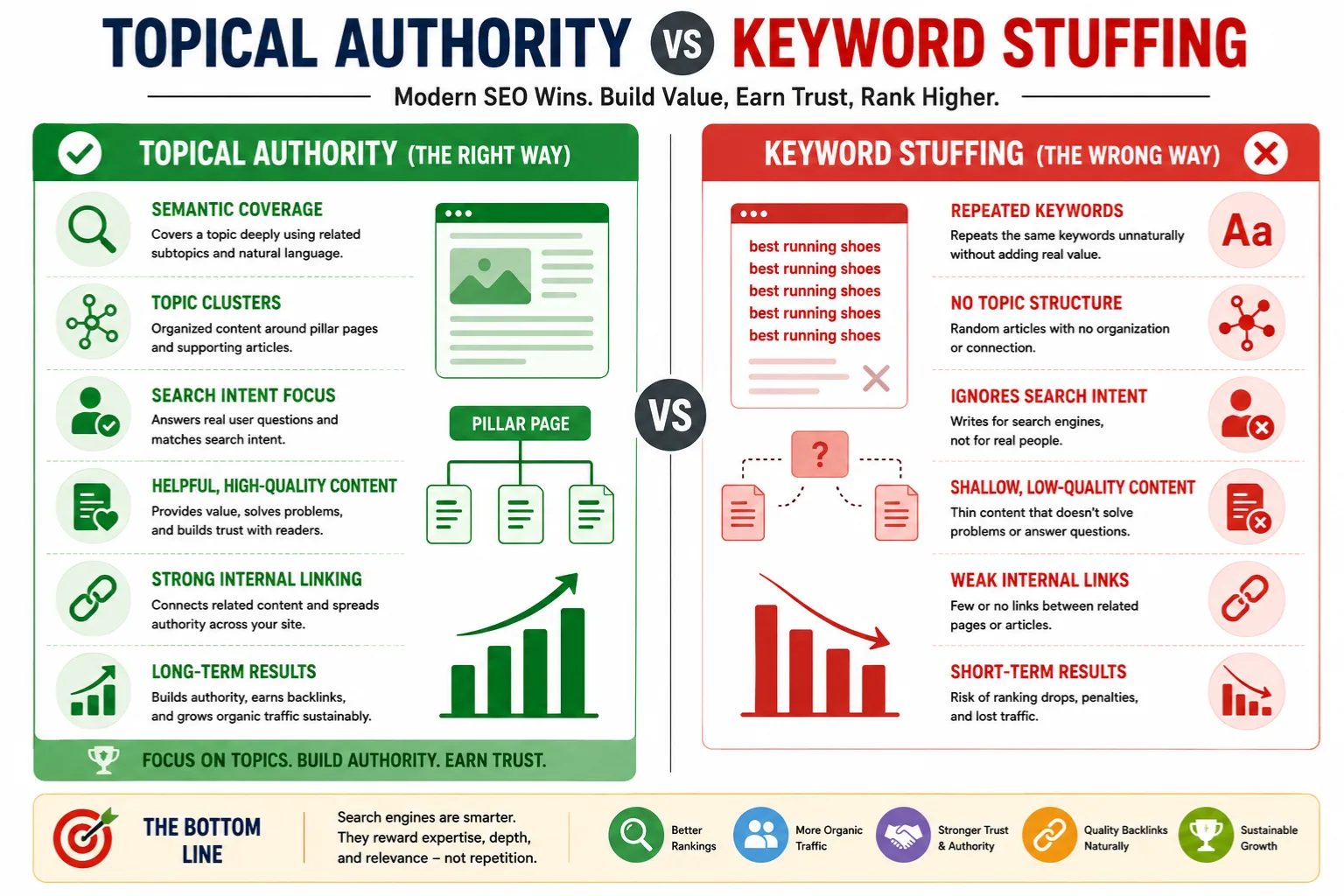
This is the difference between keyword stuffing and topical authority.
Keyword stuffing tries to manipulate search engines.
Topical authority tries to genuinely cover a topic well.
Modern SEO heavily favors the second approach.
Why Old SEO Tactics Fail?
Years ago, search engines relied much more on exact keyword matching.
If a page repeated a keyword enough times, it sometimes ranked even when the content itself was poor.
That created terrible search results.
People landed on robotic articles written more for algorithms than humans.
So search engines evolved.
Today, Google focuses much more on understanding meaning, context, expertise, and user satisfaction instead of counting exact keyword repetitions.
That is why old-school keyword stuffing often fails now.
In some cases, it can even hurt rankings because the content feels unnatural and low quality.
Google’s systems have become much better at recognizing whether content genuinely helps readers.
Natural Keyword Use Matters More
Keywords still matter.
That part confuses people sometimes.
SEO is not about ignoring keywords completely.
The difference is how they are used.
Instead of forcing the same phrase repeatedly, modern SEO focuses on natural language and topic relevance.
For example, if you are writing about topical authority, related phrases naturally appear:
- semantic SEO
- content clusters
- internal linking
- search intent
- topic relevance
- content depth
You do not need to mechanically repeat “topical authority” fifty times.
When you fully explain the topic, semantic relationships develop naturally.
That is how people actually communicate too.
Semantic Coverage vs Repetition
This is one of the biggest shifts in modern SEO.
Search engines now care more about semantic coverage than exact repetition.
Semantic coverage means addressing the broader context around a topic.
For example, a strong article about freelance writing might naturally discuss:
- clients
- rates
- portfolios
- pitching
- niches
- contracts
- content writing
Those related concepts help Google understand the article deeply covers the subject.
A weak article might repeat “freelance writing” endlessly while barely explaining anything useful.
One demonstrates expertise.
The other looks manipulative.
That difference matters heavily now.
User-First Writing Wins Long Term
Honestly, one of the simplest SEO improvements is writing like an actual human instead of writing for a robot.
When people obsess over keyword density, content often becomes awkward and exhausting to read.
User-first writing focuses on:
- clarity
- usefulness
- readability
- structure
- solving problems
- answering real questions
Google increasingly measures how users interact with content too.
If readers quickly leave because the article feels spammy or repetitive, that sends poor engagement signals over time.
Helpful content tends to keep readers engaged longer because it genuinely answers what they searched for.
Search Intent Optimization Matters More Than Density
This is another major shift many beginners miss.
Search intent matters more than stuffing keywords.
Google wants the content type that best matches what users expect to find.
For example: Someone searching for what is topical authority..
probably wants:
- beginner explanations
- definitions
- examples
- educational content
But someone searching:
“best SEO tools for topical authority”
likely wants:
- tool comparisons
- recommendations
- features
- pricing information
Even though the topics overlap, the intent changes the type of content Google prioritizes.
Matching intent properly usually matters far more than repeating keywords excessively.
Helpful Content Is the Real Goal
Google’s entire direction keeps moving toward helpfulness.
That sounds vague at first, but it really means:
- does the content solve the problem?
- is it easy to understand?
- does it satisfy the search?
- does it demonstrate expertise?
- would users trust it?
This is why shallow AI-generated filler content often struggles long term.
It may contain keywords, but it lacks depth, experience, structure, and genuine usefulness.
Helpful content creates stronger engagement signals because readers actually benefit from it.
Modern SEO Rewards Expertise, Not Manipulation
This is honestly the biggest mindset shift beginners need to understand.
SEO used to reward manipulation more heavily.
Now it increasingly rewards expertise, trust, and relevance.
That is why topical authority matters so much.
When your website consistently publishes deeply connected helpful content around one subject, Google gains confidence in your expertise naturally.
You are no longer trying to “trick” the algorithm.
You are building a trustworthy content ecosystem.
And honestly, that approach is much more sustainable anyway.
Algorithms constantly change.
Manipulative shortcuts eventually stop working.
But genuinely useful content around a focused topic tends to survive updates much better because it aligns with what search engines actually want to reward.
That is why modern SEO is less about gaming rankings and more about building credibility over time.
Industry publications like Search Engine Land and Search Engine Journal regularly discuss how modern search algorithms prioritize helpful content and expertise over manipulative SEO tactics.
Modern SEO focuses more on expertise and semantic relevance than manipulation, which is why proper SEO optimization now revolves around helpful, user-focused content.
Tools That Help Build Topical Authority
When I first started building websites, I thought successful SEO was mostly about writing more content.
Over time, I realized the real advantage often comes from organization, research, and understanding how topics connect together.
That is where SEO tools become useful.
You do not need expensive software to build topical authority, especially in the beginning. Honestly, some beginners waste money on too many tools before they even publish enough content to justify them.
Still, the right tools can help you:
- discover subtopics
- understand search intent
- organize topic clusters
- improve content depth
- find internal linking opportunities
- track authority growth
The key is using tools strategically instead of relying on them blindly.
Google Search Console
Google Search Console is one of the best free SEO tools for tracking keyword visibility, indexing, impressions, and internal page performance.
If I had to recommend one completely free SEO tool for beginners, it would probably be Google Search Console.
Search Console shows how Google actually sees your website.
You can track:
- impressions
- clicks
- indexed pages
- keyword visibility
- internal page performance
- crawling issues
One thing I love about Search Console is how it reveals hidden keyword opportunities.
Sometimes an article starts appearing for related searches you never intentionally targeted. Those keywords often become excellent supporting content ideas for expanding topical clusters.
It is also useful for identifying weak pages that need updates or stronger internal linking.
Ahrefs
Ahrefs offers detailed tutorials and keyword research resources that help beginners understand topic clusters and SEO content planning.
You can use it to:
- research keywords
- analyze competitors
- find backlink opportunities
- discover low-competition topics
- identify related subtopics
I especially like using it for topical expansion.
For example, if you search “SEO writing,” Ahrefs reveals dozens of related questions and keyword variations that naturally fit into a topic cluster.
This helps build semantic relevance without guessing randomly.
Semrush
Semrush provides keyword clustering, competitor analysis, and content strategy tools useful for building topical authority.
Semrush works similarly to Ahrefs but has strong content planning features too.
It is useful for:
- keyword clustering
- topic research
- content gap analysis
- SEO audits
- tracking rankings
Their keyword grouping tools can help beginners visualize how related topics connect together inside a niche.
That makes building content ecosystems much easier.
Honestly, both Ahrefs and Semrush are powerful. Most people do not need both early on.
Surfer SEO
Surfer SEO focuses heavily on content optimization.
It analyzes ranking pages and suggests related semantic keywords, headings, and topic coverage areas.
Some beginners rely on Surfer too mechanically, though.
The goal is not stuffing every suggested keyword unnaturally.
The real value comes from understanding what subtopics high-ranking pages commonly cover.
I usually see Surfer as a topical completeness tool more than a keyword density tool.
NeuronWriter
NeuronWriter is another optimization platform focused on semantic relevance and NLP terms.
It helps identify:
- missing topic coverage
- semantic keyword opportunities
- content structure improvements
- search intent alignment
For beginners building topical authority, this can help avoid shallow content that misses important supporting concepts.
AlsoAsked
AlsoAsked is honestly underrated for topic cluster planning.
It pulls question relationships directly from Google’s “People Also Ask” data.
This helps uncover:
- supporting article ideas
- search intent variations
- content hierarchy opportunities
- related user questions
Sometimes one keyword branch alone can generate an entire topic cluster naturally.
AnswerThePublic
AnswerThePublic is useful for understanding how people phrase questions around a topic.
Instead of showing only keywords, it visualizes real search patterns and user curiosity.
For example, searching “blogging” may reveal questions like:
- why blogging matters
- how blogging works
- when to start blogging
- blogging for beginners
- blogging mistakes
This helps create more user-focused content instead of guessing what readers want.
OpenAI ChatGPT for Content Planning
Honestly, AI tools have become very useful for topical planning when used correctly.
I mainly use OpenAI ChatGPT for:
- generating topic cluster ideas
- organizing article structures
- brainstorming supporting subtopics
- identifying semantic relationships
- simplifying complex topics
The important part is using AI for structure and ideation, not blindly publishing raw AI output without editing.
Human insight still matters heavily for authority building.
Internal Linking Tools
Internal linking becomes harder as websites grow.
Several tools help identify linking opportunities automatically.
These tools can:
- find orphan pages
- suggest relevant internal links
- improve crawl pathways
- strengthen topical relationships
Good internal linking reinforces authority because it helps Google understand how content clusters connect together.
Honestly, many websites have enough content already. They simply lack proper structural linking.
Topical Map Generators
Topical map tools help organize large content ecosystems visually.
They are useful for:
- planning content hierarchies
- mapping supporting articles
- identifying content gaps
- organizing semantic relationships
This becomes especially helpful once a website expands beyond a small handful of articles.
Without structure, large websites can become messy fast.
And honestly, this is the biggest thing tools help with overall.
Not shortcuts.
Not “hacking” Google.
Structure.
Topical authority grows when content connects logically, covers subjects deeply, and solves reader problems comprehensively. The right tools simply make organizing that process easier and more efficient over time.
Simple Topical Authority Example for Beginners
Sometimes topical authority sounds complicated until you see a real example.
That is why I usually tell beginners to imagine their website like a small educational library instead of a collection of random blog posts.
Every article should support the larger topic in some way.
Let’s use a digital writing blog as an example.
The main focus of the website is helping beginners learn digital writing skills online.
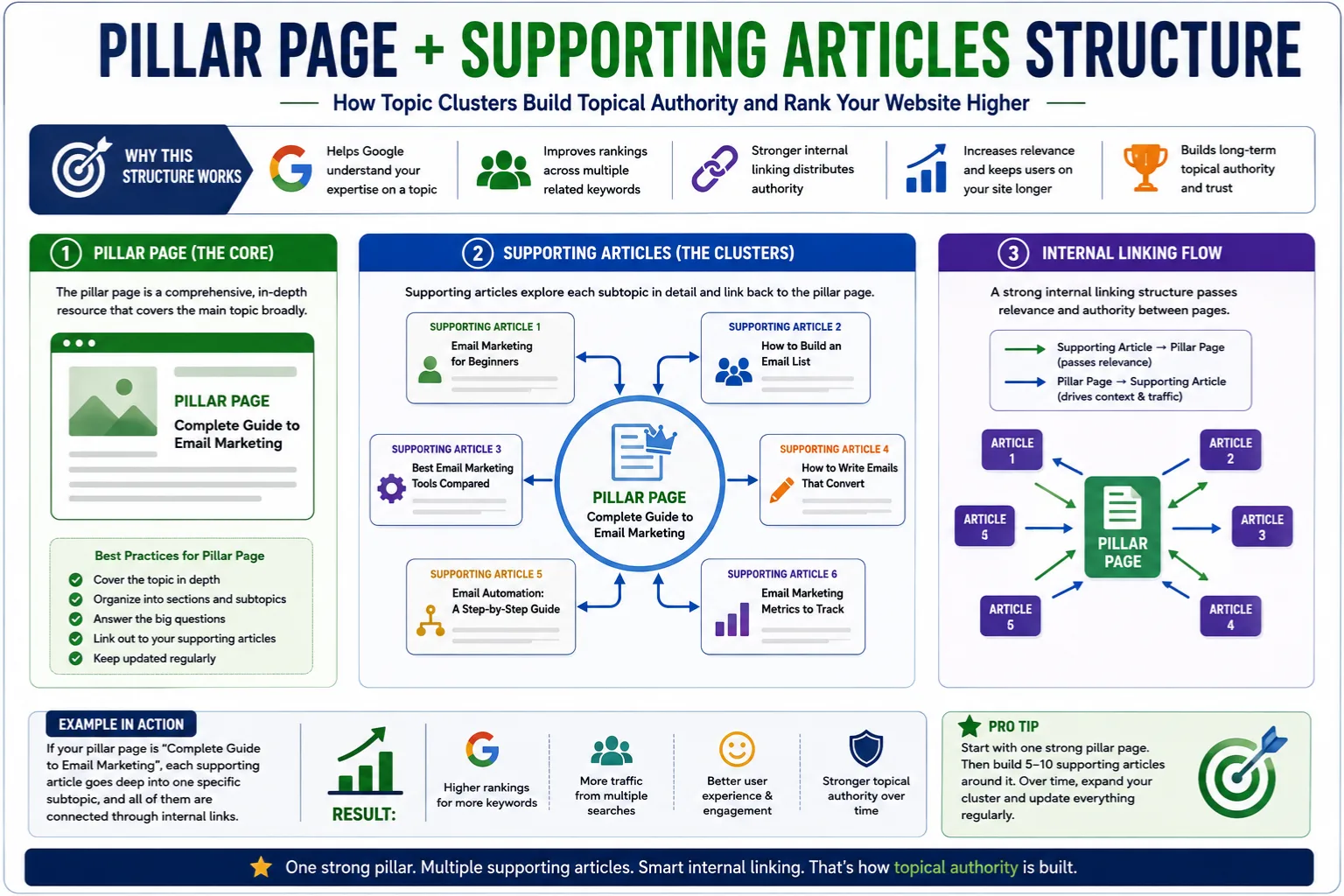
At the center of the website sits a pillar page:
Pillar Page: "Beginner’s Guide to Digital Writing”
This article acts as the foundation of the entire topic cluster.
It explains digital writing broadly, introduces important concepts, and links readers toward more detailed supporting articles.
The pillar page might briefly mention:
- SEO writing
- blogging
- copywriting
- freelance writing
- email writing
- content optimization
- writing portfolios
But instead of explaining everything deeply inside one giant article, each topic branches into its own supporting article.
For example:
Supporting Articles
- SEO Writing Basics
- Blog Writing Tips
- Copywriting for Beginners
- Freelance Writing Mistakes
- Content Optimization Guide
- Writing Portfolio Tips
- Email Writing Tips
This is where topical authority starts building naturally.
Each supporting article covers one subtopic in much greater depth than the pillar page alone could.
For example:
The “SEO Writing Basics” article might explain:
- keyword research
- search intent
- headings
- internal links
- readability
Meanwhile, the “Freelance Writing Mistakes” article could focus on:
- pricing errors
- client communication
- portfolio problems
- unrealistic expectations
Even though these articles target different keywords, they all connect back to the larger subject of digital writing.
That relationship matters heavily for SEO.
Google starts understanding:
“This website consistently publishes deeply connected content about digital writing.”
That repeated relevance strengthens topical authority.
One thing beginners often miss is that the supporting content actually helps the pillar page rank better too.
A lot of people assume only the pillar article matters.
But topical authority works more like a network.
Each supporting article reinforces the expertise of the entire cluster.
For example:
- “SEO Writing Basics” strengthens relevance around writing optimization
- “Copywriting for Beginners” reinforces persuasive writing expertise
- “Content Optimization Guide” deepens semantic SEO coverage
- “Email Writing Tips” expands authority into communication-focused writing
Together, the cluster creates a much stronger expertise signal than one isolated article ever could.
This is also where internal linking becomes powerful.
The pillar page links outward to supporting articles.
The supporting articles link back to the pillar page.
Supporting articles can also link to each other naturally when topics overlap.
For example:
- SEO Writing Basics links to Content Optimization
- Blog Writing Tips links to SEO Writing
- Freelance Writing Mistakes links to Writing Portfolio Tips
These internal links help Google understand the relationships between pages.
They also distribute authority throughout the website.
Think of internal links like roads connecting cities.
Without roads, locations stay isolated.
With strong connections, everything becomes easier to navigate.
Google’s crawlers work similarly.
Internal links help search engines:
- discover pages faster
- understand topical relationships
- identify important content
- crawl the site more efficiently
Readers benefit too.
Instead of leaving after one article, users naturally continue exploring related content. That increases engagement signals and reinforces trust over time.
Honestly, this is why topic clusters work so well long term.
They turn scattered articles into structured ecosystems.
And structured ecosystems are much easier for both users and search engines to understand.
The websites that build strong topical authority usually do not publish disconnected content randomly.
They build organized networks of useful information around one clear subject.
That clarity is what eventually creates stronger rankings, stronger trust, and stronger long-term SEO growth.
Studying real digital writing examples can help beginners understand how topic clusters and content structure work in practice.
Signs Your Website Is Building Topical Authority
One of the hardest parts of SEO is that growth often happens quietly before it becomes obvious.
A lot of beginners expect some dramatic moment where traffic suddenly explodes overnight.
Usually, topical authority builds through smaller signals first.
That is why many people quit too early. They focus only on pageviews while ignoring the early indicators that Google is actually starting to trust the website more.
I have seen this happen many times.
At first, almost nothing moves.
Then impressions slowly increase.
A few long-tail keywords rank.
Pages start indexing faster.
Then eventually the whole site begins gaining momentum together.
Those small shifts are usually signs topical authority is developing properly.
More Keywords Ranking
This is often one of the first noticeable signs.
Instead of ranking for only one exact keyword, your pages begin appearing for dozens or even hundreds of related searches.
For example, an article targeting “SEO writing basics” might also begin ranking for:
- beginner SEO writing
- how to write SEO articles
- SEO content tips
- SEO blog structure
- content optimization basics
This happens because Google starts understanding the broader topical relevance of the page.
Semantic coverage expands naturally as authority grows.
Sometimes you will discover keywords ranking that you never intentionally targeted. Honestly, that is usually a good sign because it means Google sees deeper topical relationships in the content.
Increased Impressions in Google Search Console
Impressions are one of the clearest early authority signals.
Even before clicks rise significantly, you may notice impressions climbing steadily inside Google Search Console.
This means Google is testing your content more often in search results.
I actually pay attention to impressions before traffic sometimes because impressions show visibility growth earlier.
A website with growing topical authority often sees:
- more pages receiving impressions
- wider keyword coverage
- impressions spreading across clusters
- older articles resurfacing
Those trends usually indicate Google’s confidence is increasing gradually.
Faster Indexing
New websites often experience slow indexing early on.
Sometimes articles take days or weeks before appearing properly in search.
But as topical authority grows, Google tends to crawl trusted websites more frequently.
That means:
- new articles index faster
- updates appear sooner
- refreshed content gets recognized more quickly
I noticed this heavily on focused niche websites.
At first, indexing felt painfully slow. Later, new supporting articles sometimes appeared in search results within hours because the site already had strong topical consistency.
That faster recognition is often a trust signal.
More Internal Pages Ranking
Another strong sign is when supporting articles begin ranking alongside pillar pages.
At first, many websites rely heavily on one or two successful articles.
But topical authority spreads visibility across the site gradually.
You may start noticing:
- multiple articles ranking together
- supporting pages gaining traffic
- cluster content strengthening collectively
- deeper pages attracting impressions
This is where topic clusters become powerful.
Each article reinforces the others.
The site starts functioning like a connected expertise ecosystem instead of isolated pages competing independently.
Growing Topical Relevance
Sometimes you can almost feel Google understanding the site better over time.
For example:
- related keywords start grouping naturally
- semantically connected pages improve together
- topic clusters gain momentum collectively
This usually means your content structure is working properly.
Google increasingly associates the website with specific subjects instead of isolated keywords.
That broader relevance is one of the strongest long-term SEO advantages.
Better Click-Through Rates
As authority grows, click-through rates often improve too.
Part of this comes from stronger rankings.
But another part comes from familiarity and trust.
When users repeatedly see useful content from the same site around a topic, they become more likely to click future results.
Clear titles, strong meta descriptions, and helpful content positioning also improve CTR naturally.
And honestly, trust influences clicks more than many people realize.
Longer Session Durations
User behavior can reinforce authority signals too.
If visitors:
- stay longer
- read multiple pages
- continue exploring topic clusters
- engage deeply with the content
that suggests the website is genuinely helping users.
Internal linking plays a huge role here.
A strong topic cluster naturally guides readers from one article to another because the subjects connect logically.
That creates longer sessions and stronger engagement pathways.
Increased Trust From Readers
This part becomes visible outside analytics too.
As topical authority grows, readers often:
- return repeatedly
- subscribe to newsletters
- mention your site online
- share content
- trust recommendations more
I have noticed this especially on focused websites.
When readers consistently find useful information around one topic, the website starts becoming mentally associated with expertise in that area.
That trust compounds slowly over time.
Natural Backlinks Appearing
One of the strongest long-term authority signals is earning backlinks naturally.
At first, new websites often struggle getting links because there is little trust or visibility yet.
But as your content ecosystem expands, people begin referencing useful articles organically.
This usually happens with:
- detailed guides
- tutorials
- case studies
- resource pages
- data-driven content
The important thing is that topical authority often attracts backlinks indirectly because useful content becomes easier to discover and reference.
And honestly, this is why topical authority becomes such a durable SEO advantage over time.
The signals reinforce each other.
More helpful content creates more trust.
More trust creates stronger engagement.
Stronger engagement reinforces authority.
Authority improves visibility.
Visibility attracts backlinks and readers.
That compounding cycle is usually how sustainable SEO growth actually happens.
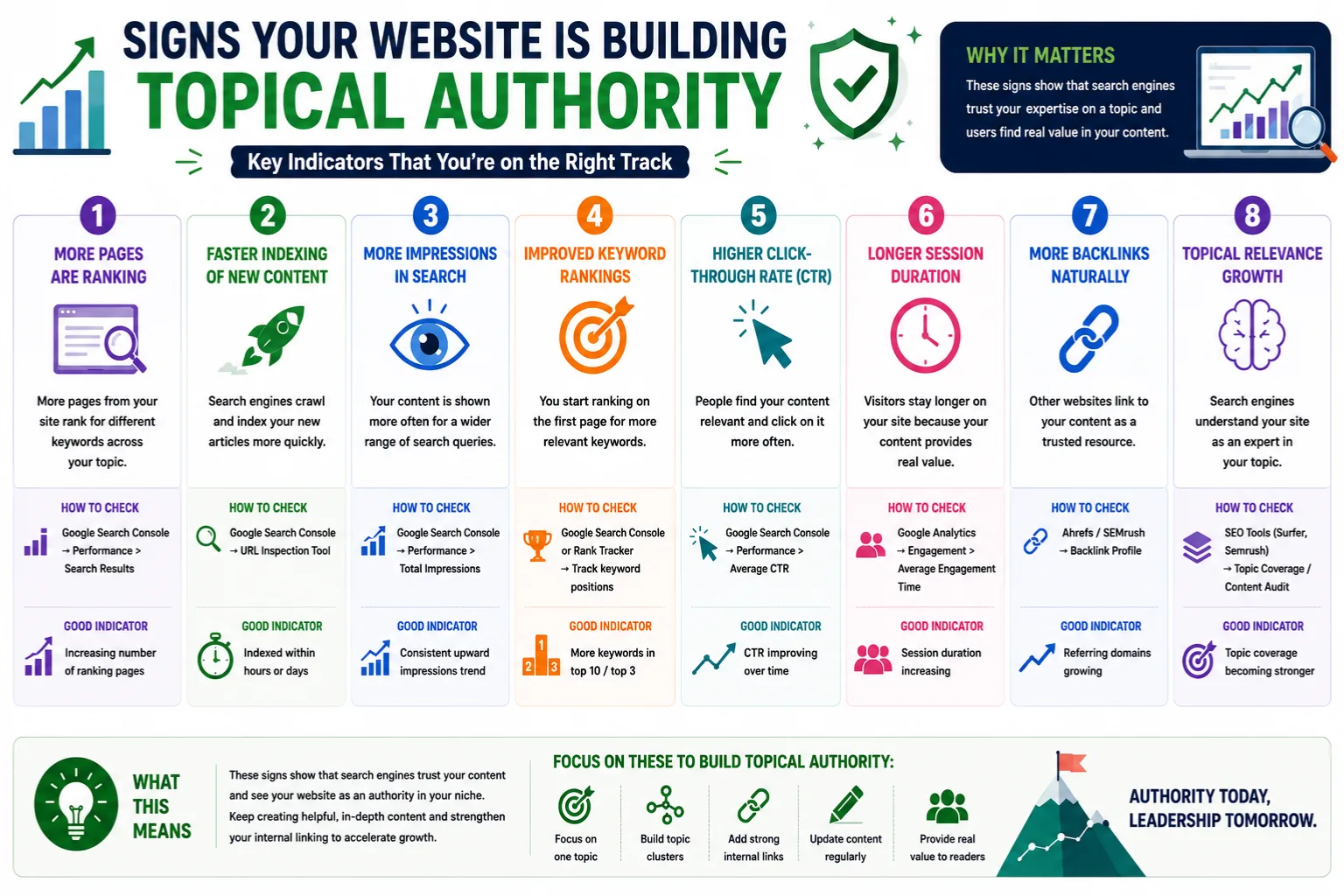
Topical Authority Content Plan for Beginners
One reason many beginners struggle with SEO is that they publish content without a long-term structure.
They write a few articles, see little traffic, lose motivation, then abandon the site before authority has time to build.
I honestly think having a simple roadmap changes everything because topical authority grows through consistency and accumulation, not random bursts of publishing.
You do not need 300 articles immediately.
You need connected content published steadily over time.
This beginner roadmap keeps things simple while still building a strong foundation for long-term SEO growth.
Month 1: Publish Foundational Content
The first month should focus on building the core structure of the website.
This is where you create your foundational pillar content around the main topic.
For example, if your niche is digital writing, foundational articles could include:
- Beginner’s Guide to Digital Writing
- What Is SEO Writing?
- Beginner Blogging Guide
- Freelance Writing Basics
- How Content Marketing Works
These articles establish the main themes of the website.
Think of them like the structural pillars holding everything together later.
At this stage, the goal is not chasing traffic aggressively.
The goal is clarity.
You want Google and readers to immediately understand:
“This website focuses on digital writing.”
A realistic publishing schedule here is:
- 1 to 2 quality articles per week
Honestly, consistency matters much more than volume early on.
Month 2: Build Supporting Clusters
Once the foundational content exists, start expanding supporting topic clusters.
This is where semantic depth starts building.
Take each pillar topic and branch into smaller focused articles.
For example:
Pillar Page:
- Beginner Blogging Guide
Supporting Articles:
- Blog Post Structure Tips
- Common Blogging Mistakes
- How to Write Better Blog Intros
- SEO Formatting for Blogs
- Blog Writing Workflow Tips
This creates stronger topical relevance because the articles begin supporting each other naturally.
One thing I learned the hard way is that smaller supporting articles often become powerful traffic drivers later because they target specific search intent.
Month 3: Improve Internal Linking
Most beginners ignore this step completely.
They publish articles but never connect them properly.
Month three should focus heavily on internal linking optimization.
Go through existing articles and:
- connect related pages
- improve anchor text
- strengthen topic pathways
- remove orphan pages
For example:
- SEO writing articles should link to keyword research
- Keyword research articles should link to content optimization
- Blogging guides should connect to SEO structure content
Internal linking helps both users and search engines understand topical relationships.
Honestly, this step alone can improve rankings significantly on smaller websites.
Month 4: Update Weak Pages
By month four, some patterns usually begin appearing inside tools like Google Search Console.
You may notice:
- pages with impressions but low clicks
- thin articles
- weak engagement
- incomplete topic coverage
Instead of only publishing new content endlessly, improve existing content too.
This can include:
- expanding sections
- improving readability
- adding examples
- refreshing outdated information
- strengthening internal links
- matching search intent more clearly
I have seen updated articles outperform brand-new content many times because the page already had some topical relevance established.
Month 5: Add Commercial Intent Articles
Once the informational foundation exists, start introducing commercial content naturally.
This helps monetize authority while staying aligned with the niche.
Examples:
- Best SEO Writing Tools
- Best Blogging Platforms for Beginners
- Semrush vs Ahrefs
- Best AI Writing Tools for Freelancers
- Email Marketing Tools for Writers
Commercial articles work better once topical trust already exists because readers and search engines view the recommendations more credibly.
This is also where affiliate opportunities often begin fitting naturally into the ecosystem.
Month 6: Expand Into Adjacent Subtopics
By month six, the website should have a stronger topical foundation.
Now you can begin carefully expanding into closely related subtopics.
For example:
Main Topic: Digital writing
Adjacent Subtopics:
- email marketing
- content strategy
- AI writing workflows
- audience building
- affiliate blogging
The key word here is adjacent.
Do not suddenly jump into completely unrelated topics.
Expansion should still reinforce the overall niche identity.
That gradual widening helps grow traffic while preserving topical clarity.
Simple Publishing Frequency Recommendations
A lot of beginners obsess over publishing massive amounts of content.
Honestly, most people would benefit more from publishing less content with better structure and consistency.
A sustainable schedule usually works better long term.
For most beginners:
- 1 quality article weekly is enough
- 2 weekly articles can accelerate growth
- consistency matters more than volume
Publishing consistently trains both readers and search engines to expect ongoing value from the site.
That consistency compounds over time.
Why Consistency Matters More Than Volume?
I learned this lesson after burning myself out trying to publish constantly.
Massive content bursts often create:
- lower quality
- weaker structure
- inconsistent strategy
- burnout
- abandoned projects
Topical authority grows through accumulated trust signals.
Each article strengthens the ecosystem gradually.
A focused site publishing useful connected content steadily for a year usually outperforms websites that publish random high-volume content inconsistently.
That is because Google increasingly rewards:
- expertise
- consistency
- relevance
- structure
- user satisfaction
Not simply raw article count.
And honestly, that should encourage beginners more than intimidate them.
You do not need to become a giant publisher immediately.
You just need to keep building connected helpful content consistently enough for authority to compound over time.
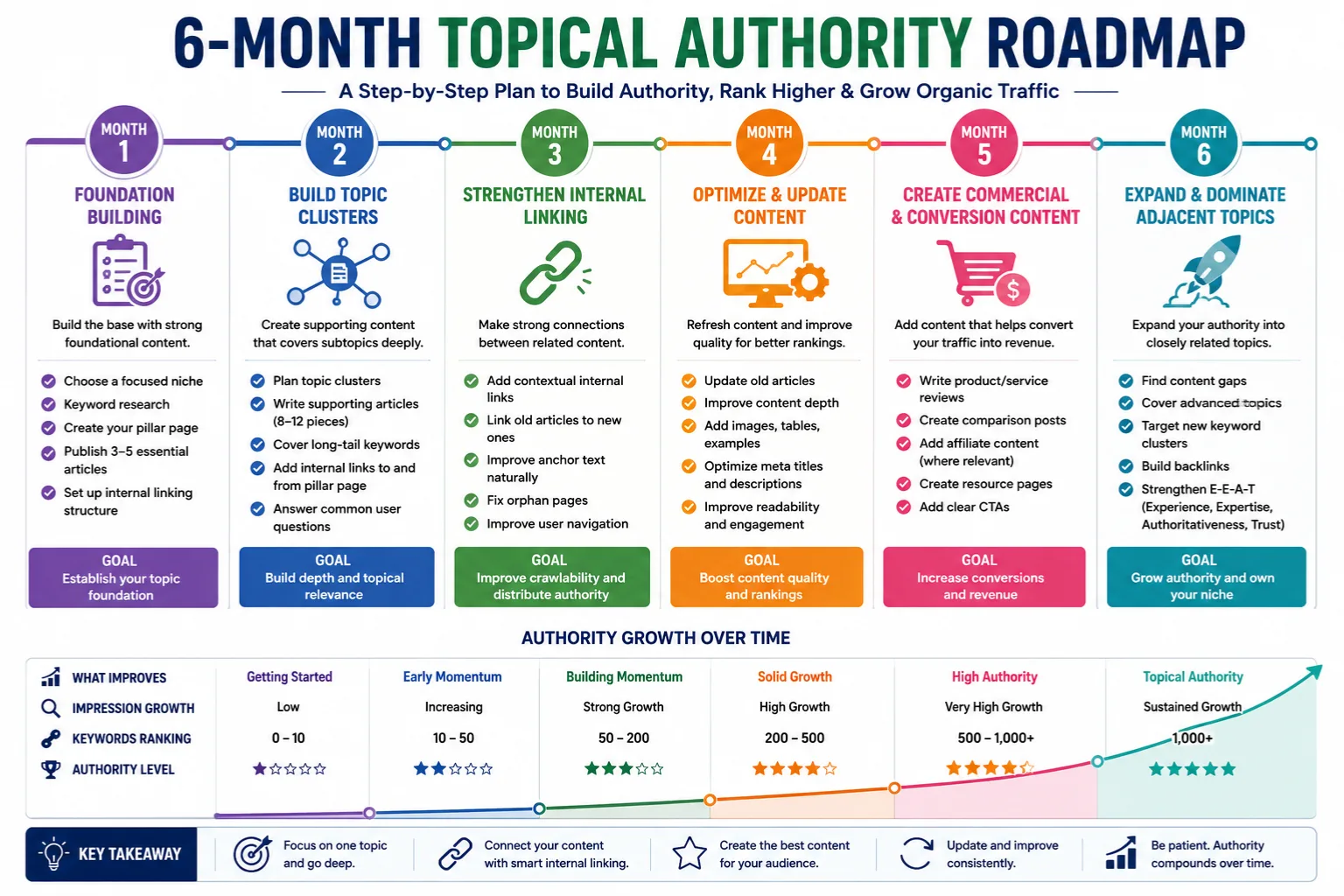
Key Takeaways
- Topical authority means building expertise around one specific subject through connected, high-quality content.
- Google prefers websites that cover topics deeply instead of publishing random unrelated articles.
- Topic clusters help organize content by connecting pillar pages with supporting articles.
- Internal linking strengthens topical relevance and helps search engines understand content relationships.
- Semantic SEO focuses on topic meaning and context, not repeating the same keyword excessively.
- Search intent matters more than keyword stuffing in modern SEO.
- Beginner guides, tutorials, FAQs, case studies, and resource pages help strengthen authority.
- Long-tail keywords are often easier for beginners to rank for than highly competitive terms.
- Topical authority builds slowly through consistency, trust, and content depth.
- Updating older articles helps maintain relevance and improve rankings over time.
- Strong topical authority can lead to:
- better rankings
- more organic traffic
- faster indexing
- increased reader trust
- natural backlinks
- Publishing one or two high-quality articles consistently is usually more effective than chasing high-volume low-quality content.
- The websites that grow steadily with SEO usually focus on helpful content, clear structure, and long-term expertise instead of shortcuts or manipulation.
Conclusion
Topical authority is not about gaming Google.
It is about becoming genuinely useful around one topic.
When your website consistently answers related questions, solves reader problems, and connects content logically, search engines begin to trust your site more. Readers do too.
Most beginners fail because they try to cover everything at once. The smarter approach is smaller and more focused.
Start with one topic.
Build depth slowly.
Create connected content that helps real people.
That is how topical authority grows over time.
And honestly, once momentum starts building, SEO becomes much easier.
Frequently Asked Questions About Topical Authority
What is topical authority in SEO?
Topical authority is an SEO strategy where a website builds expertise and trust around one subject by publishing deeply connected, high-quality content. Google uses topical authority signals to determine whether a website covers a topic comprehensively enough to rank well in search results.
Why is topical authority important?
Topical authority helps improve:
- search visibility
- keyword rankings
- internal linking strength
- reader trust
- organic traffic growth
Websites with strong topical authority often rank more easily because Google sees them as reliable sources within a specific niche.
How do you build topical authority?
You build topical authority by:
- choosing one clear niche
- creating pillar content
- publishing supporting topic cluster articles
- using internal linking
- covering related subtopics deeply
- updating content regularly
- focusing on helpful user-first writing
Consistency matters more than publishing huge amounts of content quickly.
How long does it take to build topical authority?
Most websites need several months before topical authority begins showing noticeable SEO results. Smaller signs like increased impressions, faster indexing, and more keyword rankings often appear before major traffic growth happens. For many beginner websites, stronger authority often takes 6 to 12 months or longer.
What is the difference between topical authority and domain authority?
Domain authority measures overall website strength, usually based on backlinks and reputation. Topical authority focuses on expertise and relevance within one specific subject area. A smaller niche website with strong topical authority can sometimes outrank larger websites with higher domain authority.
What are topic clusters?
Topic clusters are groups of related articles connected around one main pillar topic.
Example:
- Pillar Page: Beginner’s Guide to SEO Writing
- Supporting Articles:
- keyword research
- blog formatting
- search intent
- content optimization
- internal linking
Topic clusters help Google understand topical relationships between pages.
Does internal linking help topical authority?
Yes. Internal linking is one of the most important parts of topical authority.
- connects related articles
- improves crawling and indexing
- distributes authority between pages
- guides readers through the website
Strong internal linking creates clearer topical relevance signals for search engines.
Can small websites build topical authority?
Yes. Small websites often build topical authority faster when they stay focused on one niche instead of covering broad unrelated topics. A focused niche site can outperform larger general websites within specific subject areas because the content ecosystem is more specialized.
What content types help build topical authority?
Some of the best content types include:
- beginner guides
- tutorials
- FAQs
- glossaries
- case studies
- checklists
- resource pages
- comparison articles
- evergreen educational content
Does keyword stuffing help topical authority?
No. Keyword stuffing is an outdated SEO tactic.
Modern SEO focuses on:
- semantic relevance
- search intent
- content quality
- user experience
- expertise
Google rewards content that naturally covers topics comprehensively instead of repeating keywords excessively.