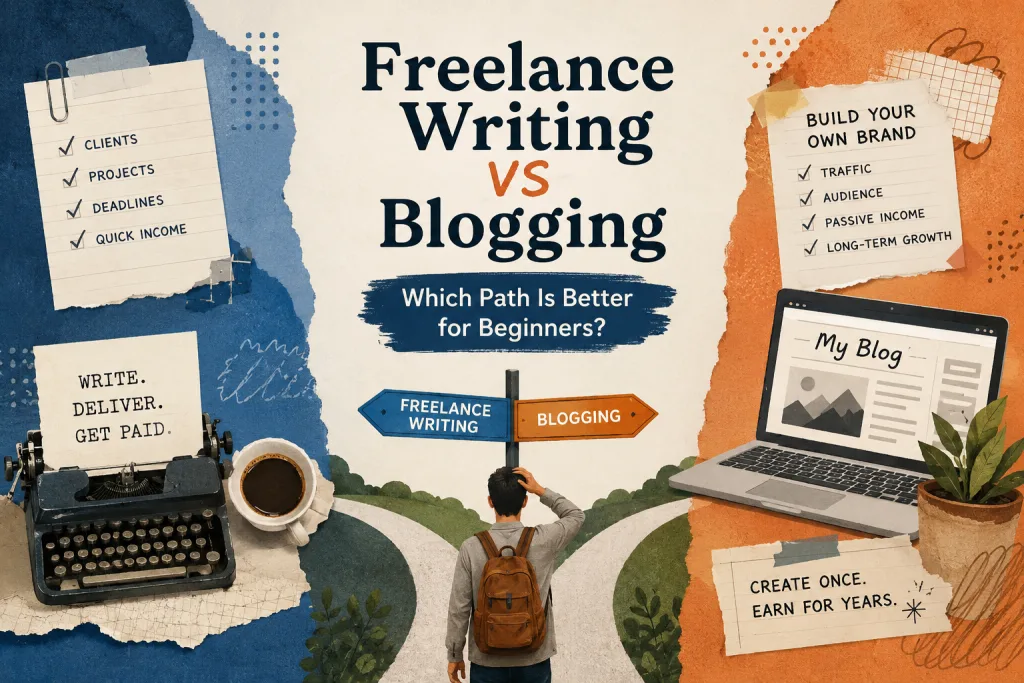

A few years ago, I remember sitting in front of my laptop with about twelve browser tabs open trying to figure out whether I should focus on freelance writing or blogging.
Every YouTube video made both sound easy. One person said blogging creates passive income while another said freelance writing pays immediately.
Honestly, that made things worse.
Because when you are new, you do not just want motivation. You want direction. You want somebody to explain what these paths actually look like once the excitement wears off and real work begins.
That confusion is common. Beginner writers hear terms like content writing, blogging, SEO writing, affiliate marketing, copywriting, and freelance writing used interchangeably. But these paths can lead to very different business models and outcomes.
Freelance writing and blogging both involve writing online, but the business models are different.
Freelance writers create content for clients. Bloggers who build their own sites create content for their own platforms and audiences. One model can produce income sooner, while the other focuses more on building an owned content asset over time.
Neither path is perfect.
I have seen people burn out chasing freelance clients nonstop. I have also seen bloggers quit months before their traffic started growing. That is why this decision matters more than people think.
This guide breaks down freelance writing vs blogging in simple language so you can understand the differences and decide which starting point fits your goals, situation, and preferred way of working.
If you want to explore freelance writing in more depth, start with the Freelance Writing Hub, where I cover the skills, niches, clients, rates, and systems that help writers build a freelance career.
Freelance Writing vs Blogging: Which Is Better for Beginners?
Freelance writing and blogging both involve creating content online, but the business models are different. Freelance writers create content for clients and get paid for completed work. Bloggers who build their own websites create content for their own platforms and can monetize traffic through affiliate marketing, ads, digital products, sponsorships, services, or email marketing.
- Freelance writing can produce income sooner because you are paid directly by clients.
- Blogging usually takes longer because you first need to build content, traffic, and an audience.
- Freelancers depend mainly on client relationships and available work.
- Bloggers depend more on traffic, audience growth, and monetization systems.
- Freelance writing is relatively easy to start with a portfolio and basic writing skills.
- Blogging gives you more ownership over your content, platform, and audience.
- Both paths benefit from strong writing, research, and SEO skills.
- Many writers combine both models instead of choosing only one.
If you need income sooner, freelance writing may be a practical starting point. If you want to build an owned website and audience over time, blogging may fit your longer-term goals better.
Table of Content
- Freelance Writing vs Blogging: Which Is Better for Beginners?
- What Is Freelance Writing?
- What Is Blogging?
- Freelance Writing vs Blogging: The Core Difference
- Which Makes Money Faster?
- Income Potential: Freelance Writing vs Blogging
- Skills You Need for Freelance Writing
- Skills You Need for Blogging
- Pros and Cons of Freelance Writing
- Pros and Cons of Blogging
- Can You Combine Freelance Writing and Blogging?
- Which Path Is Better for Beginners?
- Common Mistakes Beginners Make
- Best Tools for Freelance Writers and Bloggers
- Not Sure What to Do Next as a Writer?
- Key Takeaways
- Final Thoughts on Freelance Writing vs Blogging
- Related Guides
- Frequently Asked Questions About Freelance Writing vs Blogging
What Is Freelance Writing?
Freelance writing means you write content for businesses, websites, or clients instead of publishing everything on your own platform.
You get paid for delivering work.
That work could include:
- Blog posts
- SEO articles
- Product descriptions
- Email newsletters
- Landing pages
- Website copy
- Ghostwritten content
- Social media posts
When I first learned about freelance writing, I thought clients only hired expert writers with journalism degrees or massive portfolios. That turned out to be completely wrong. Many businesses simply want somebody reliable who can write clear content that helps them get traffic or customers.
That realization changed everything for me.
A small business owner usually does not care whether you sound fancy. They care whether you can help them solve a problem. Can you write a blog post that serves a searcher's needs? Can you explain something clearly? Can you meet deadlines without disappearing halfway through the project?
Those skills matter far more than perfect grammar.
One thing beginners often misunderstand about freelance writing is this:
You are not building your own audience first. You are helping somebody else build theirs.
That changes the entire business model.
Instead of waiting for your own website to build traffic, freelance writers can start earning once they land clients and complete paid work. That is why many beginners choose freelance writing first. It gives you direct feedback from the market and a way to turn writing skills into income.
The downside is that freelance writing is often tied closely to your time.
If you stop working, your active client income usually stops too.
I learned this the hard way after juggling too many client projects at once. At first, getting more clients felt exciting. Then suddenly every day turned into revisions, deadlines, Slack messages, and constant context switching. It can become exhausting if you do not create boundaries.
Still, freelance writing remains a relatively accessible way for beginner writers to start earning online because the startup costs can be very low.
You do not need a huge audience.
You do not need thousands of followers.
You mostly need writing skills, consistency, and patience while learning how client work actually operates.
Freelance work is also a significant part of the writing profession. According to the U.S. Bureau of Labor Statistics, 65% of writers and authors were self-employed in 2025.
Freelance writing offers many paths, and choosing a clear niche can help you decide where to focus your skills. Learn how to choose a freelance writing niche and find an area you can build your writing career around.
If you are completely new to online writing, this guide on digital writing explains how modern writing works online and why it matters today.
What Is Blogging?
Blogging means publishing content on your own website or platform and building your own audience. Writing blog posts for a business or another website is usually a form of freelance writing, even when the assignment itself is called freelance blogging.
When you build your own blog, you own the platform and decide what to publish.
You choose the topics.
You decide how the content gets monetized.
This is where blogging becomes useful as a long-term business model.
A blog can generate traffic from search engines when useful content earns visibility. That traffic can then support income through affiliate marketing, ads, digital products, sponsorships, services, or email marketing.
But blogging is usually slower than most beginners expect.
Way slower.
I think this is one reason beginners quit blogging too early. They publish five articles, check Google Analytics every six hours, then assume blogging does not work because traffic stays flat.
SEO does not move that fast.
One of my older articles barely received visitors for months. Then one day it started ranking and brought steady traffic afterward. That experience changed how I viewed blogging. Good content can continue attracting visitors long after publication when it matches what people search for and remains useful.
That is the core difference.
Publishing a blog post does not guarantee search traffic. Google explains how Search works, including how its systems discover, index, and rank pages based on relevance and other factors.
Freelance writing pays for completed work.
Blogging focuses on building content assets and an audience over time.
A blog is basically a long-term content asset. Each useful article becomes another doorway into your website.
The tricky part is that blogging requires many skills beyond writing itself.
You need to learn:
- SEO
- Keyword research
- Internal linking
- Content strategy
- WordPress basics
- Email marketing
- Audience psychology
At first that can feel overwhelming. I remember spending an entire afternoon trying to understand why one blog post ranked while another disappeared into page seven of Google. Honestly, SEO can feel confusing in the beginning because there are so many opinions online.
But blogging becomes easier once you realize that useful content, consistency, and search intent matter more than chasing secret tricks.
Understanding search intent helps writers create articles that match what readers actually want to find online.
If you want to start a blog, these hosting recommendations for writers can help you choose a reliable platform without overspending.
If you want your blog to grow steadily over time, this beginner guide to topical authority explains how SEO trust and content depth work together.
Freelance Writing vs Blogging: The Core Difference
The easiest way to explain freelance writing vs blogging is this:
Freelancers build client relationships.
Bloggers build audiences.
Everything else grows from that difference.
Freelance writers exchange their skills for direct payment. Bloggers create content assets designed to attract traffic and build an audience over time.
This changes how money flows into each model.
A freelance writer might earn $150 from a client article.
A blogger might earn nothing from an article at first and later generate affiliate commissions, leads, or product sales from the same piece of content.
That delayed payoff is what scares many beginners away from blogging. Humans naturally want fast results. Waiting months for search traffic feels frustrating, especially when bills exist in the real world.
But blogging can offer leverage that freelance writing usually does not.
One useful article can continue attracting traffic after it is published.
One article can support affiliate commissions, email signups, or product sales when the content and offer match the reader's needs.
Freelance writing usually scales by raising rates, specializing, increasing efficiency, or building systems. Blogging can scale through traffic, audience growth, and multiple monetization channels.
Neither model is automatically better.
They simply reward different strengths.
Freelance writing tends to fit people who:
- Need income sooner
- Enjoy client work
- Prefer structure
- Like clear deadlines
- Want direct payment for completed work
Blogging often fits people who:
- Think long term
- Enjoy building brands
- Like creative freedom
- Want ownership
- Can tolerate delayed results
I know writers who hated blogging because they felt isolated waiting for traffic growth. I also know bloggers who hated freelance writing because clients constantly changed project requirements halfway through assignments.
That is why your preferred way of working matters here more than most comparison articles admit.
| Factor | Freelance Writing | Blogging |
|---|---|---|
| Who Owns the Content? | Usually the client controls the finished work according to the agreement. | You own and control the content on your platform. |
| Primary Income Source | Client payments. | Ads, affiliate marketing, products, sponsorships, services, and other audience-based offers. |
| How Quickly You Can Earn | Can be relatively soon after finding and completing paid work. | Usually requires time to build content, traffic, and an audience. |
| Income Dependency | Depends heavily on clients and available projects. | Depends more on traffic, audience growth, and monetization. |
| Creative Freedom | You write according to the client's requirements. | You choose your topics, style, and publishing schedule. |
| Startup Costs | Very low. A portfolio and basic tools can be enough to begin. | Low to moderate if you build your own website and content platform. |
| Long-Term Asset | Your portfolio, reputation, skills, and client relationships. | Your website, content library, audience, and email list. |
| Best Fit | Writers who want to earn through client work. | Writers who want to build an owned content business. |
Which Makes Money Faster?
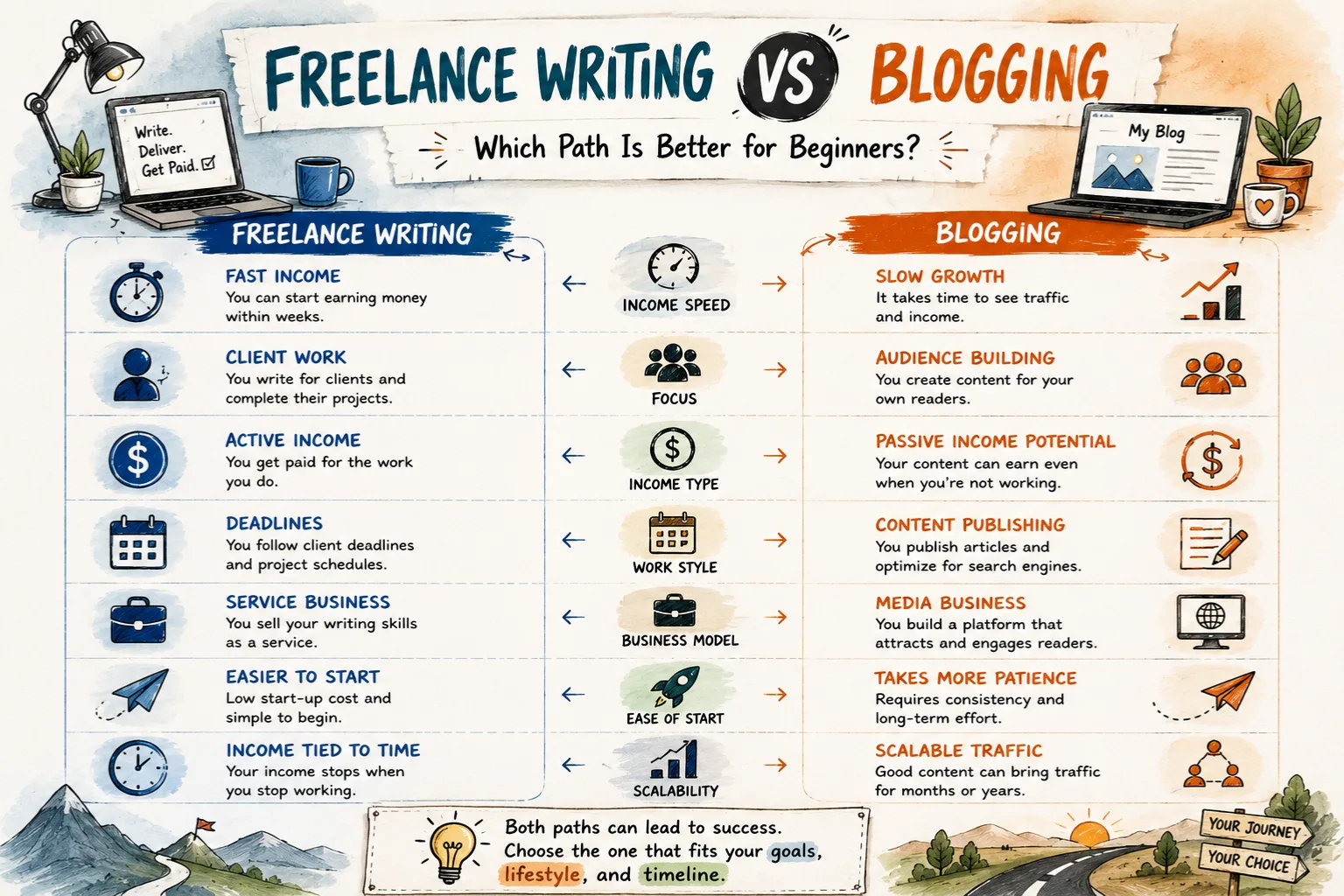
For many beginners, freelance writing can produce income sooner.
A beginner freelance writer can sometimes land small projects within weeks by actively pitching businesses or applying for suitable opportunities. Results vary, though, and finding clients still requires consistent effort.
Blogging rarely works that quickly.
Most new blogs need time to build content, earn search visibility, and attract an audience. Even strong SEO articles can take months before they generate meaningful traffic.
That delay frustrates beginners.
I remember publishing article after article while seeing almost no traffic. Honestly, it felt like shouting into an empty room some days. Meanwhile freelance writers around me were already earning money from client projects.
That comparison can mess with your motivation if you are not careful.
But there is another side to this conversation.
Freelance writing can produce faster income because businesses already have customers, audiences, and content needs. You are plugging your writing skills into an existing business model.
Bloggers have to build their own content platform and audience.
That takes patience.
Once a blog gains traction, however, its content can continue attracting visitors without requiring you to produce a new piece of work for every unit of income.
Freelance writing is often the faster route to active income.
Blogging is often the slower route to building an owned content asset.
Understanding that difference early helps set realistic expectations.
Blogging can take more work than beginners expect. Data from Orbit Media's blogger survey, reported by the Content Marketing Institute, found that 20% of bloggers reported strong results, while 53% said attracting visitors from search engines had become harder.
Income Potential: Freelance Writing vs Blogging
This part surprises many people.
Freelance writing often depends on your available time unless you raise rates, specialize, increase efficiency, build systems, or expand beyond individual client work.
Blogging can scale differently because traffic and content are not directly tied to the hours you work on a specific day.
A single article that ranks well can continue attracting visitors and supporting affiliate commissions, leads, or product sales. Some bloggers also combine ads, affiliate marketing, sponsorships, courses, memberships, and digital products.
That diversification matters.
Freelance income usually depends on active client work. Blogging income can come from several channels working together.
But blogging income is also less predictable in some ways.
Search visibility changes.
Traffic fluctuates.
Affiliate programs can change commission rates or terms.
I have seen websites lose traffic because they depended too heavily on one strategy. That is why bloggers benefit from diversifying their traffic sources, audience channels, and monetization methods.
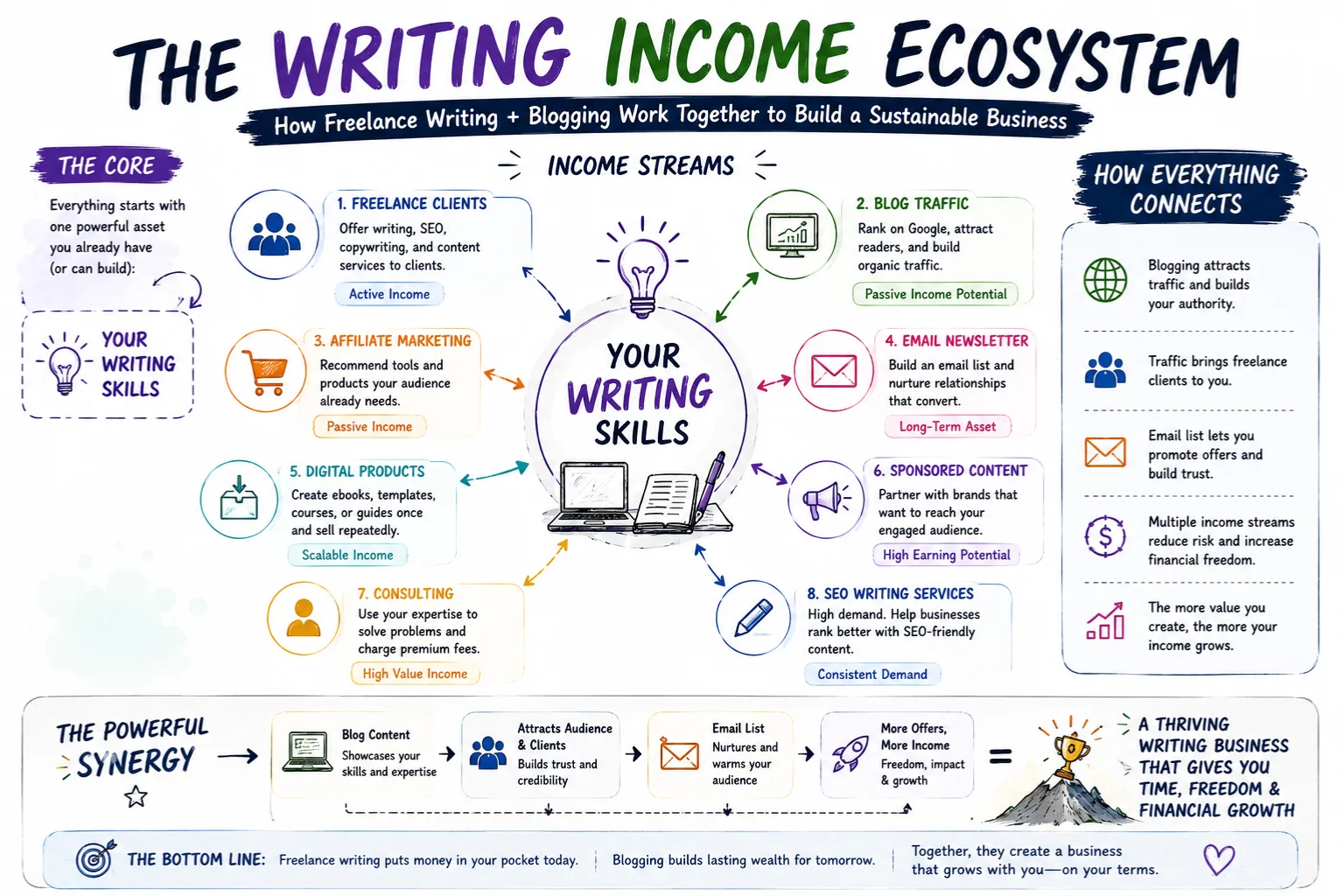
Many experienced writers combine freelance writing and blogging because the two models can support each other.
Freelance work creates active cash flow.
Blogging builds an owned platform, content library, and audience over time.
That combination can reduce the pressure of expecting one model to do everything.
Writing can also be a well-paid professional skill. The U.S. Bureau of Labor Statistics reports a median annual wage of $76,910 for writers and authors in May 2025, although this wage data does not include self-employed workers.
If you are struggling to find freelance work, this article on getting writing clients breaks down a beginner-friendly outreach system.
Many beginner writers undercharge at first, so this guide to freelance writing rates can help you understand common pricing approaches.
Skills You Need for Freelance Writing
Freelance writing is not just about writing well.
You also need communication skills, organization, and the ability to understand business goals.
Clients care about outcomes.
A business hiring an SEO writer usually wants:
- More relevant traffic
- Better search visibility
- More leads
- More conversions
- Stronger online visibility
That means beginner freelance writers should learn basic SEO as early as possible.
You do not need to become an advanced technical SEO expert overnight. But understanding keywords, search intent, headings, and readability gives you a useful advantage.
Research skills matter too.
A lot of freelance writing involves explaining topics clearly even when you are not an expert initially. I spent hours researching subjects I barely understood when I started. Over time you become much faster at organizing information and simplifying it for readers.
That skill alone becomes valuable.
Another underrated skill is reliability.
Seriously.
Many clients care more about dependable communication than perfect prose. Responding on time, meeting deadlines, and following instructions already separates you from many beginners.
This complete guide to on-page SEO shows writers how to optimize blog posts for better rankings and readability.
Skills You Need for Blogging
Blogging requires broader skills because you are building an entire online business rather than simply delivering client work.
SEO becomes important here.
You need to understand:
- Keyword research
- Search intent
- Internal linking
- Content clusters
- On-page SEO
- Content optimization
When I first learned blogging SEO, I focused too much on keywords and not enough on helping readers. That mistake wasted months. Modern SEO works better when you focus on useful content that matches what people actually want.
That shift changed blogging completely.
Bloggers also need patience. Probably more patience than they expect.
Unlike freelance writing, blogging often gives delayed feedback. Sometimes you will publish content without seeing results for weeks or months. That emotional gap makes consistency difficult for many beginners.
Email marketing matters too.
One thing I regret is not building an email list earlier. Traffic comes and goes. An email list gives you direct access to readers without depending entirely on search engines or social platforms.
That becomes valuable over time.
Good blogging starts with strong keyword research because the right topics can bring steady traffic when the content satisfies the search intent.
Learning basic SEO writing skills can help both bloggers and freelance writers create content that serves readers and performs well in search.
Pros and Cons of Freelance Writing
Pros of Freelance Writing
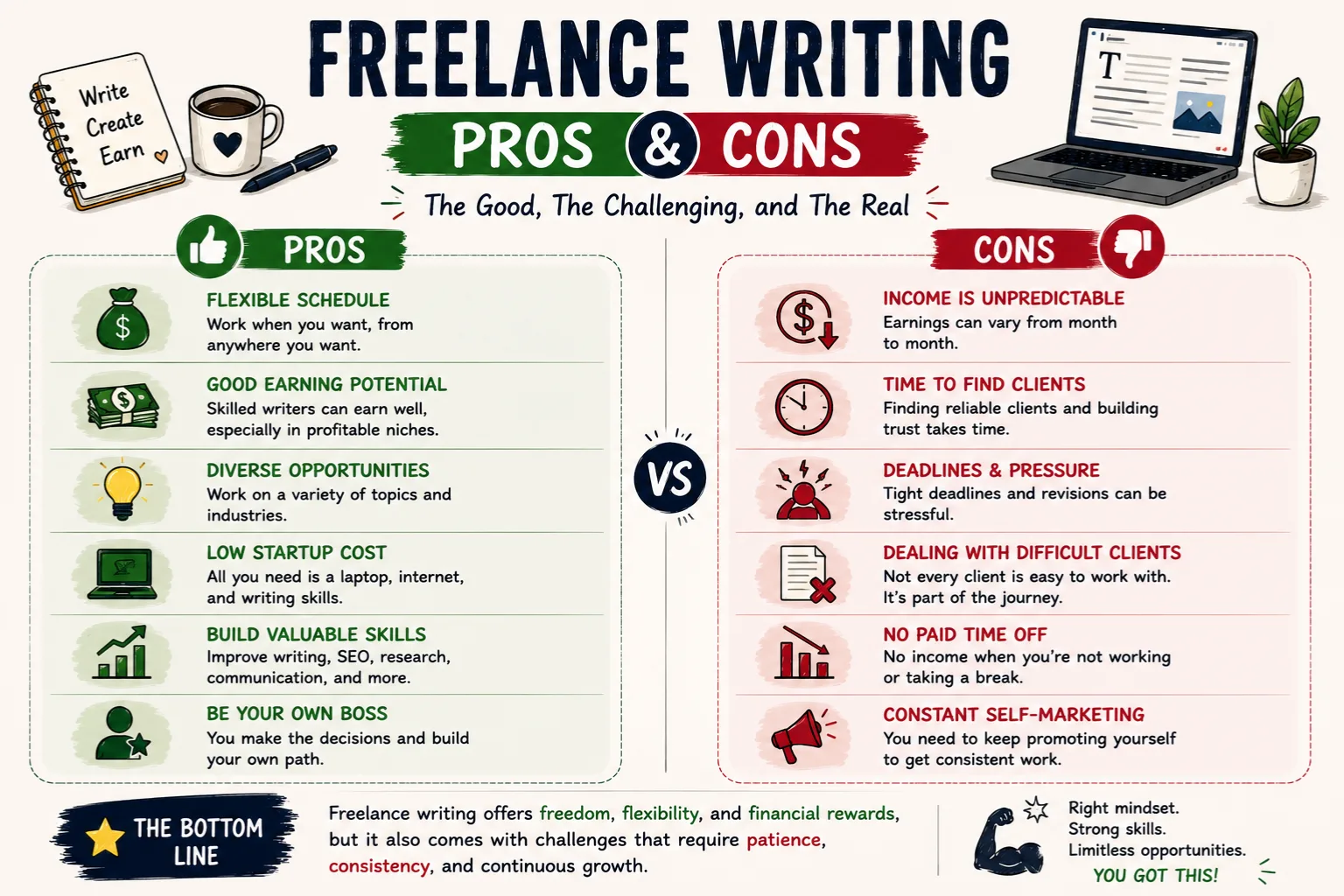
Freelance writing has a relatively low barrier to entry compared with many online businesses.
You can start with basic writing skills and improve while gaining experience.
The startup costs can stay low too. Many freelancers begin with nothing more than a laptop, internet connection, and basic writing tools.
Another advantage is speed.
Freelance writing can produce income relatively quickly compared with building a new blog. That matters for beginners who need practical results rather than waiting for search traffic to develop.
Flexibility is another benefit.
You can choose niches, clients, schedules, and project types over time.
Cons of Freelance Writing
The biggest downside is client dependency.
Clients can disappear suddenly. Budgets change. Projects end unexpectedly. That instability creates stress if you rely too heavily on only one or two clients.
Burnout can happen fast too.
Writing nonstop for multiple clients while handling revisions and communication can drain mental energy faster than many beginners expect.
There is also a limit to how much individual client work you can complete in a given week unless you change the business model.
That reality eventually pushes some freelancers toward higher-value services, products, consulting, blogging, or agencies.
Pros and Cons of Blogging
Pros of Blogging
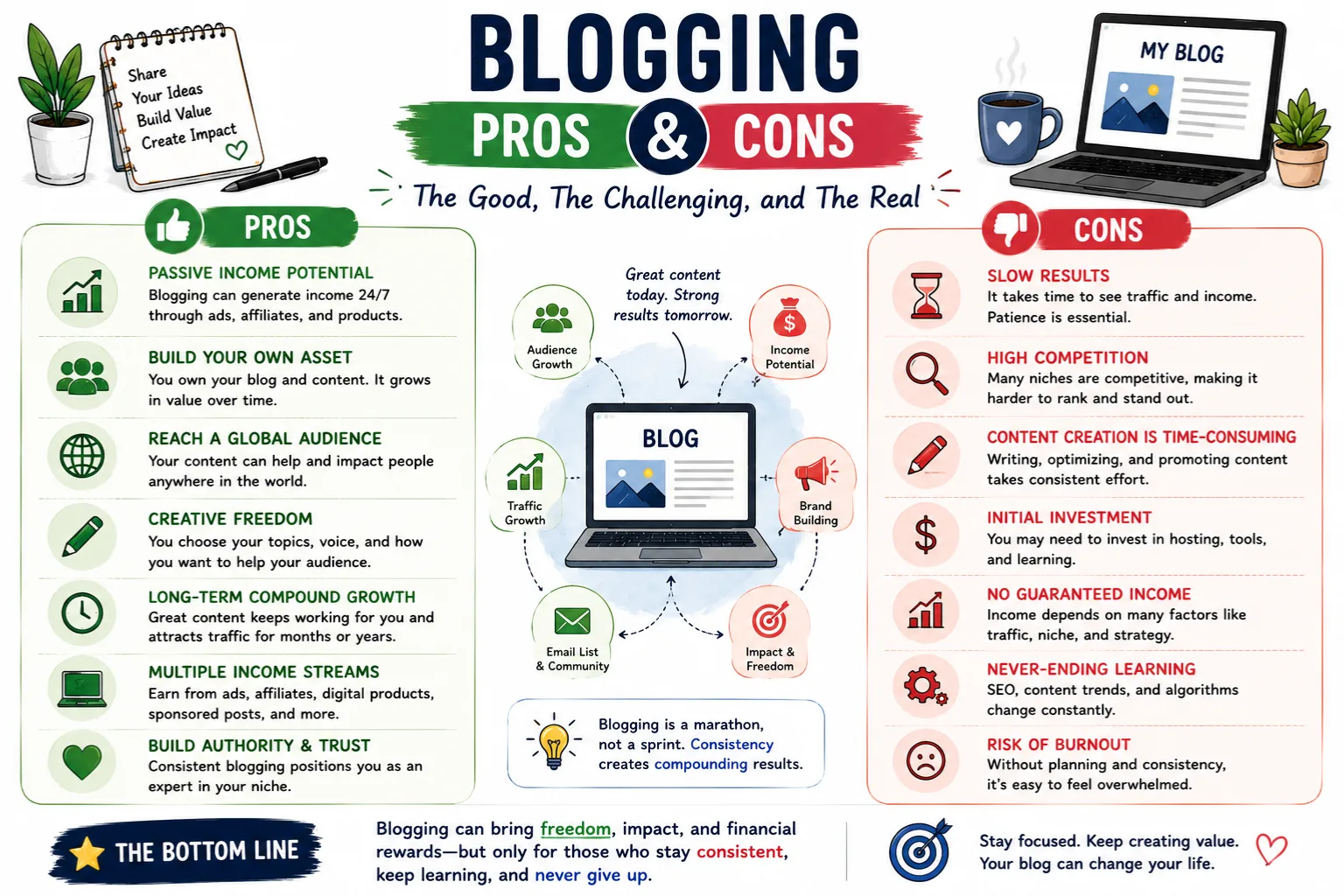
Blogging creates ownership.
That matters more than beginners realize.
You own the content you publish on your platform, along with the website and audience you build around it. Over time those assets can support one another.
Blogging also supports multiple income streams naturally:
- Affiliate marketing
- Ads
- Digital products
- Sponsorships
- Coaching
- Memberships
A useful article can continue generating traffic after publication. That long-term leverage is one of blogging's biggest strengths.
Cons of Blogging
The hardest part of blogging is delayed results.
Most beginners expect traffic too quickly. When results do not appear immediately, motivation drops fast.
SEO also changes over time.
Bloggers need to keep improving content, understanding search behavior, and paying attention to changes in how people discover information online.
Blogging can feel lonely too.
You often work for months before seeing visible momentum. That psychological challenge does not get discussed enough online.
Can You Combine Freelance Writing and Blogging?
Yes. This can be a practical approach for many beginners.
Freelance writing can provide active income while your website grows in the background.
Meanwhile your blog can become:
- A portfolio
- A credibility asset
- A lead generation system
- A personal brand platform
Some freelance writers attract clients directly through blog posts that rank in search. That can create another source of opportunities beyond direct outreach.
This hybrid model can also reduce pressure.
Instead of expecting your blog to make money immediately, freelance income can help support you while your content library and audience grow.
That balance can make it easier to stay consistent.
Which Path Is Better for Beginners?
If you need income sooner, freelance writing can be a practical starting point.
If you want long-term ownership of a website, content library, and audience, blogging may fit your goals better.
But the right starting point depends on your situation.
Some beginners thrive with client structure and deadlines. Others prefer building something they control even if growth takes longer.
There is no universal answer.
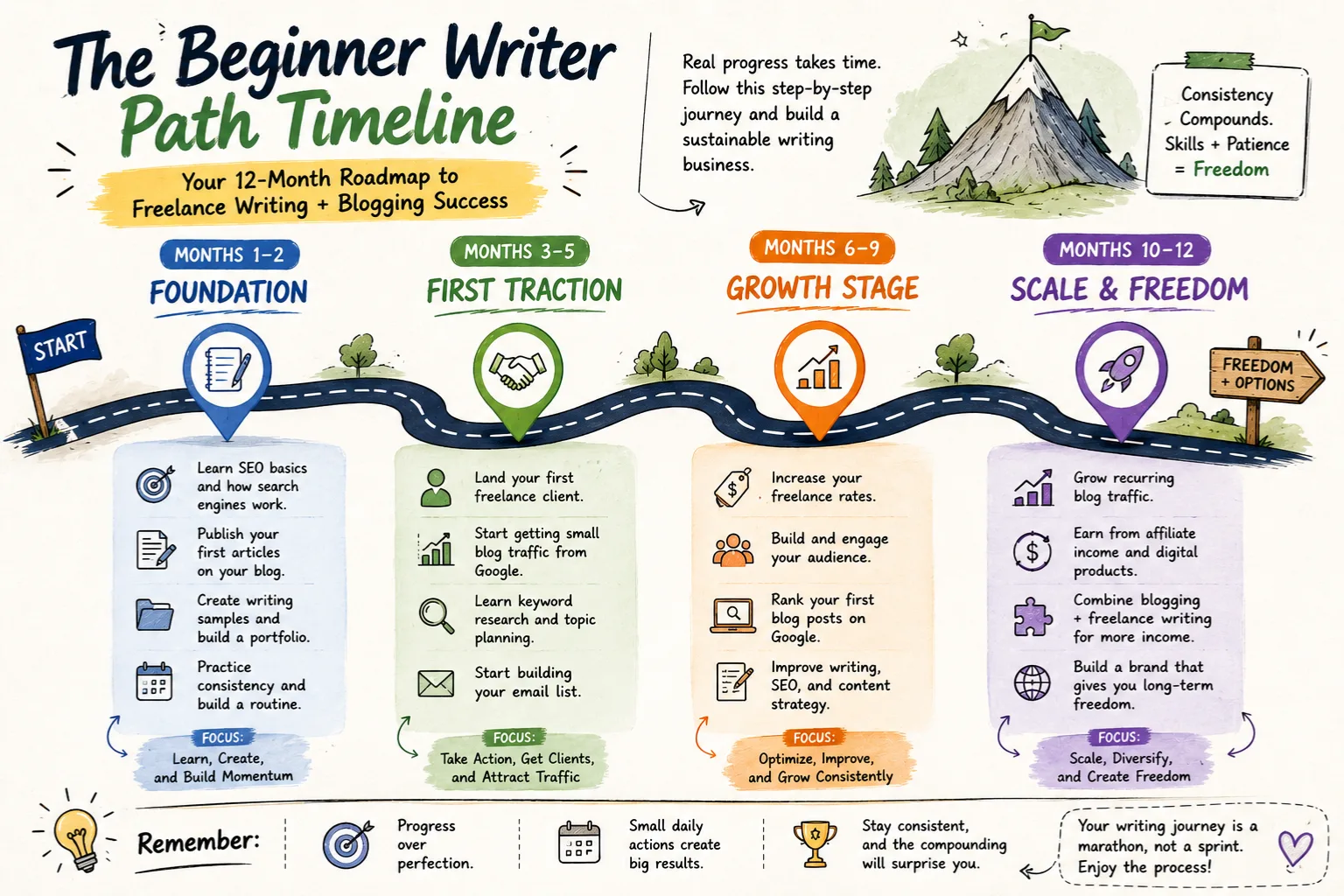
I think beginners make this decision harder than necessary sometimes. You do not need to commit to one model forever. Skills from freelance writing transfer into blogging extremely well.
The important thing is starting.
A writer who publishes consistently learns faster than someone who spends six months researching the perfect path.
That lesson took me way too long to understand.
Common Mistakes Beginners Make
One huge mistake is expecting instant success.
Freelancers expect clients immediately.
Bloggers expect traffic immediately.
Both expectations usually create disappointment.
Another mistake is jumping between niches constantly. Beginners often switch topics every few weeks because they assume the niche is the problem when consistency is actually the issue.
Ignoring SEO can hurt too.
Search intent matters whether you freelance or blog. Understanding what readers actually want changes how you research, structure, and write content.
Underpricing is another common issue for freelance writers. Charging extremely low rates can attract difficult clients while creating burnout.
And honestly, quitting too early can do more damage than a lack of talent.
Best Tools for Freelance Writers and Bloggers
Writers today have access to tools that can make research, drafting, editing, publishing, and organization easier.
Some useful tools include:
- WordPress for blogging
- Grammarly for editing
- MailerLite for email marketing
- Surfer SEO for content optimization
- Ahrefs for keyword research
- Google Docs for drafting
- Notion for organization
- ChatGPT for brainstorming and outlining
But tools are not magic.
I wasted a lot of time chasing new software instead of improving my actual writing and SEO skills. Tools can help, but consistent execution matters much more.
Not Sure What to Do Next as a Writer?
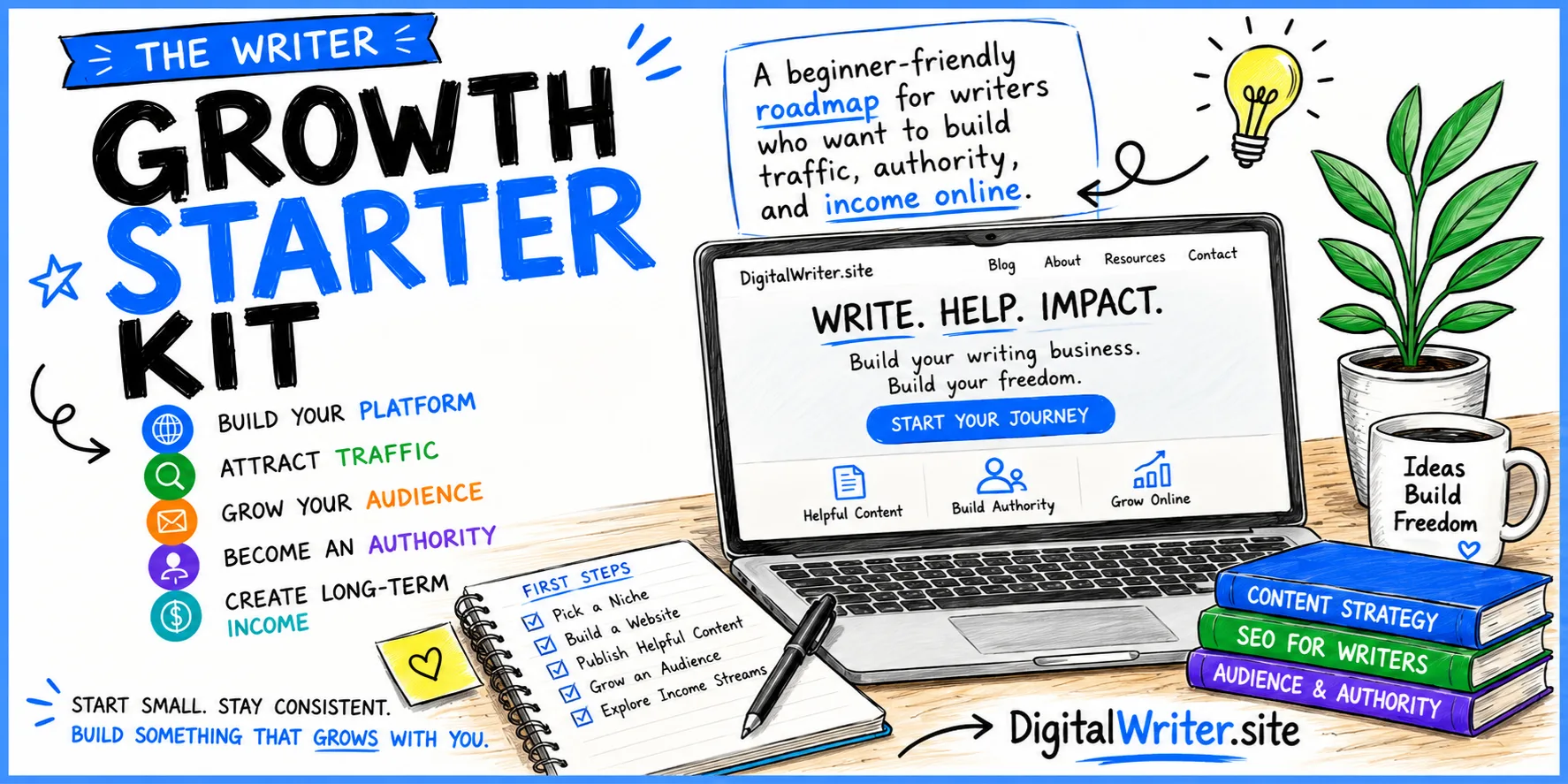
The Writer Growth Starter Kit gives you a beginner-friendly roadmap for choosing a direction and building traffic, authority, and income online.
Get the Free Starter Kit →Key Takeaways
- Freelance writing means creating content for clients in exchange for payment.
- Blogging focuses on building your own website, content library, and audience.
- Freelance writing can generate income sooner because clients pay for completed work.
- Blogging usually takes longer because you first need to build content and traffic.
- Freelancers depend mainly on client work while bloggers depend more on traffic and audience growth.
- Both paths benefit from strong writing, research, and SEO skills.
- Freelance writing has low startup costs and can be accessible to beginners.
- Blogging creates an owned content asset that can continue attracting traffic over time.
- Many writers combine freelance writing and blogging.
- The right starting point depends on your goals, financial needs, preferred work style, and patience for delayed results.
Final Thoughts on Freelance Writing vs Blogging
Freelance writing vs blogging is not really about choosing the perfect path.
It is about choosing a starting point that fits your current situation.
Freelance writing can provide faster access to active income and practical client experience.
Blogging focuses more on building an owned website, content library, and audience over time.
Both paths can work when you give yourself enough time to learn and improve.
And honestly, many online writers eventually blend the two together.
The important thing is avoiding paralysis. Start writing. Publish consistently. Learn SEO gradually. Improve with each article.
That steady process matters far more than finding the perfect strategy on day one.
Frequently Asked Questions About Freelance Writing vs Blogging
Is blogging better than freelance writing?
Not necessarily. Freelance writing can produce income sooner, while blogging focuses more on long-term ownership and audience growth. The right option depends on your goals, financial situation, preferred work style, and patience for delayed results.
Is freelance writing the same as blogging?
No. Freelance writing usually means creating content for clients in exchange for payment. Blogging, as discussed in this guide, means publishing content on your own platform and building your own audience.
Can you do freelance writing without a blog?
Yes. Many beginners start freelance writing without a blog by creating samples in Google Docs, building a simple portfolio, or guest posting on other websites.
How long does blogging take to make money?
There is no fixed timeline. Many new blogs need several months or longer to build meaningful search traffic, depending on the niche, competition, content quality, site authority, and consistency.
Do bloggers need SEO skills?
SEO is useful for bloggers who want to attract organic search traffic. Basic keyword research, search intent, on-page optimization, internal linking, and content structure are useful skills to learn.
Can I start blogging while working as a freelance writer?
Yes. Freelance writing can provide active income while you build your own website and content library. Your blog can also become a portfolio and a source of inbound leads over time.
Can blogging help freelance writers get clients?
Yes. A blog can demonstrate your writing ability, subject knowledge, and SEO skills. Content that attracts the right audience can also create opportunities for potential clients to discover your services.