
AI search is rewriting the rules of online visibility. Your articles are no longer competing for page-one rankings, they’re competing for recognition inside AI-generated answers.
Tools like ChatGPT, Gemini, and Perplexity don’t just list results. They summarize them. They pull snippets, cite sources, and present information in seconds, often quoting websites that explain things clearly and credibly.
So how do you get your articles chosen?
That’s what this guide will teach you. You’ll learn how AI search works, how to structure content for readability, and how to build trust signals that make AI want to quote you.
All based on first-hand lessons I learned the hard way.
AI search optimization builds on many established SEO practices. The SEO Writing Hub covers related topics, including search intent, keyword research, on-page SEO, and content optimization.
To optimize content for AI search tools, write clear answers early, structure content so it can be extracted, focus on context instead of keywords, support trust with visible E-E-A-T signals, test your visibility, and keep the content clear, current, and human.
Table of Content
- The Night My Blog Got Quoted by AI
- From Keywords to Context (A Quick History of SEO Evolution)
- How AI Search Works? (and Why It’s Not Google 2.0)
- How to Write for AI Readability?
- Optimize for Context, Not Keywords
- Build AI Trust Through E-E-A-T
- Match Conversational Queries
- Structure That AI Can Parse
- Case Study: My AI SEO Rewrite Experiment
- What are the Best Tools to Test and Improve AI Visibility?
- The AI Visibility Framework
- Test and Track Your Visibility
- Keep It Fresh and Human
- From Ranking to Recognition
- Quick Reference Checklist
- Free Resource: AI-Optimized Article Template
- Key Takeaways
- Related Guides
- Conclusion: The Future Belongs to the Clear, Credible, and Consistent
- FAQs
The Night My Blog Got Quoted by AI
I wasn’t even trying to get noticed.
One late night, I was testing Perplexity for research when I saw something strange in its summary. A sentence that looked too familiar. It was mine. My article. Quoted by an AI search engine.
No backlinks. No ranking. No fanfare. Just my words, extracted, paraphrased, and linked inside a machine-generated answer. For a minute, I thought it was a fluke. But when I checked again the next morning, there it was, cited again, right beside well-known marketing sites.
That’s when I realized I’d stumbled into something bigger. Search wasn’t about rankings anymore. It was about recognition. AI search engines like ChatGPT, Gemini, and Perplexity, don’t “rank” content. They read it, understand it, and summarize it.
They decide what gets quoted based on clarity, authority, and trust. Not just backlinks and keywords. That moment changed how I write everything. Because once you understand how AI search engines actually work, you can make your content stand out. Not just on page one, but inside the answers people see first.
This isn’t a technical guide filled with jargon or hacks. It’s a practical playbook built from real experience. What I changed, what worked, and how you can do it too.
So, let’s start at the beginning. Before we optimize anything, we need to understand how AI search thinks, and what it’s really looking for in your articles.
From Keywords to Context (A Quick History of SEO Evolution)
If you’ve been around digital marketing for a while, you know SEO never sits still.
Every few years, the rules shift, the tools change, and the strategies that once worked suddenly feel outdated.
But the last three years? They’ve been a complete reset.
Let’s rewind for a second.
Back in 2010, ranking was simple, or at least, we thought it was. Stuff a few keywords into your title, repeat them a dozen times in the body, sprinkle in some backlinks, and you were good to go.
Then semantic SEO arrived. Google started understanding meaning, not just words. It could tell when you were talking about “cars” even if you used “vehicles.”
Writers had to think in concepts instead of repetitions.
By 2020, expertise became the new differentiator. The acronym E-E-A-T (Experience, Expertise, Authority, Trust) started showing up in every SEO conversation. And for good reason, Google wanted to make sure content came from real humans with real experience, not faceless keyword machines.
Fast-forward to 2025, and we’ve entered the era of AI Search. It’s not just about what you write anymore. It’s about how well your content can be read, interpreted, and summarized by machines.
Think about it like this:
| Era | Focus | What Worked | What Failed |
|---|---|---|---|
| Keyword SEO (2008–2015) | Exact match phrases | Keyword density, backlinks | Overstuffed text, robotic tone |
| Semantic SEO (2016–2020) | Topical relevance | Entities, synonyms, content clusters | Thin content, no topical depth |
| E-E-A-T SEO (2021–2023) | Credibility & trust | Author bios, sources, case studies | Anonymous or outdated pages |
| AI SEO (2024) | Understanding & clarity | Structured writing, context, freshness | Long, vague, or confusing posts |
AI search doesn’t just look for words, it connects ideas. It finds the most complete, well-structured, and trustworthy explanations, and then uses them as building blocks in its answers. That’s why content written for clarity, context, and credibility wins.
The writers who adapt to this shift and who understand how AI thinks, are the ones who’ll dominate in the next wave of search.
And that starts with understanding how AI actually processes your content.
Before optimizing content for AI search systems, writers need to understand search intent and how different queries require different types of content.
How AI Search Works? (and Why It’s Not Google 2.0)
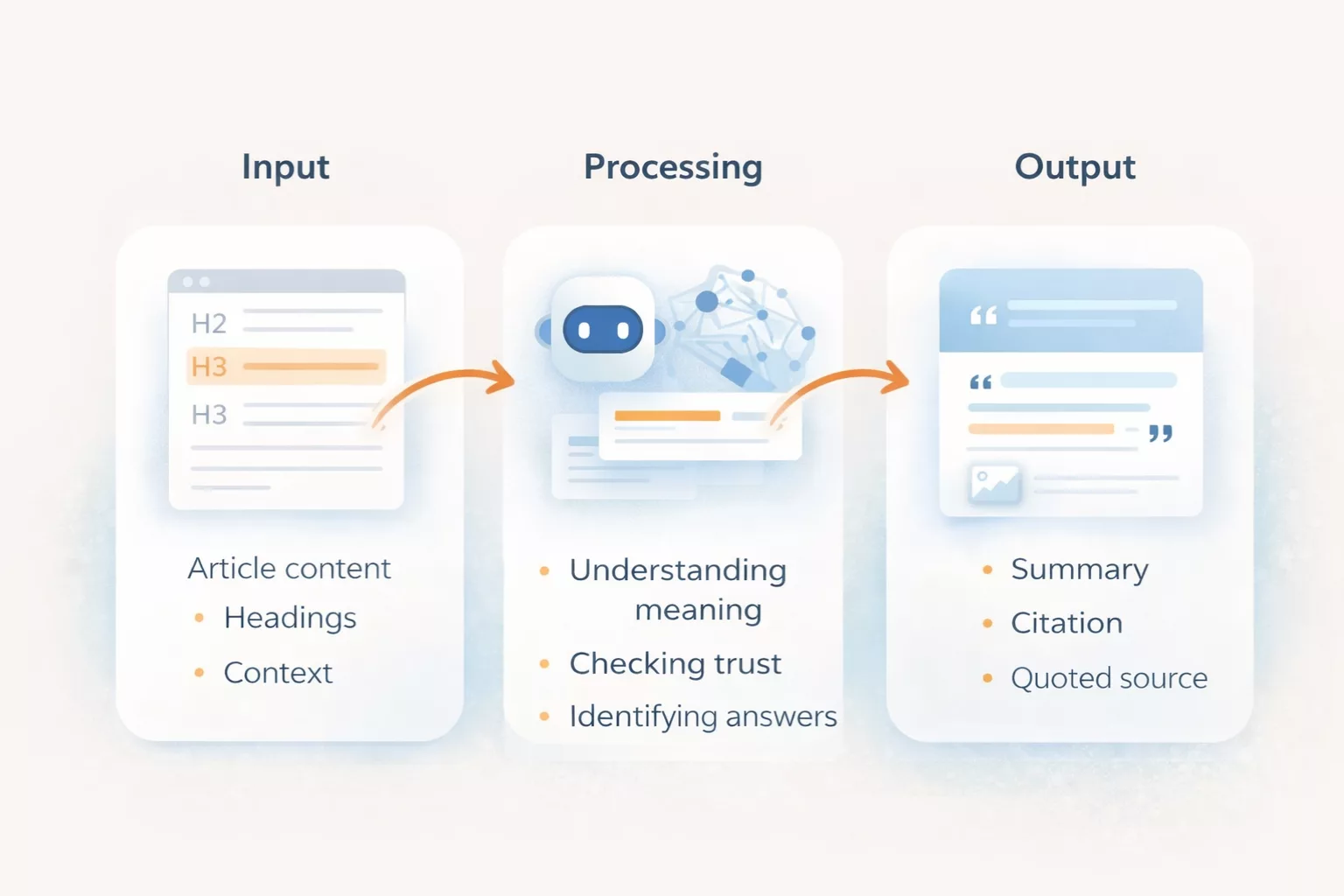
Here’s the thing most writers miss: AI search doesn’t “rank” pages, it reads them. Traditional search engines like Google crawl web pages, index them, and score them based on backlinks, dwell time, and hundreds of hidden factors.
AI search engines such as ChatGPT, Perplexity, Gemini, and Claude work differently. They use a process called retrieval-augmented generation (RAG).
That’s a fancy way of saying:
The AI looks for the best-explained answers, learns from them, and then writes its own version.
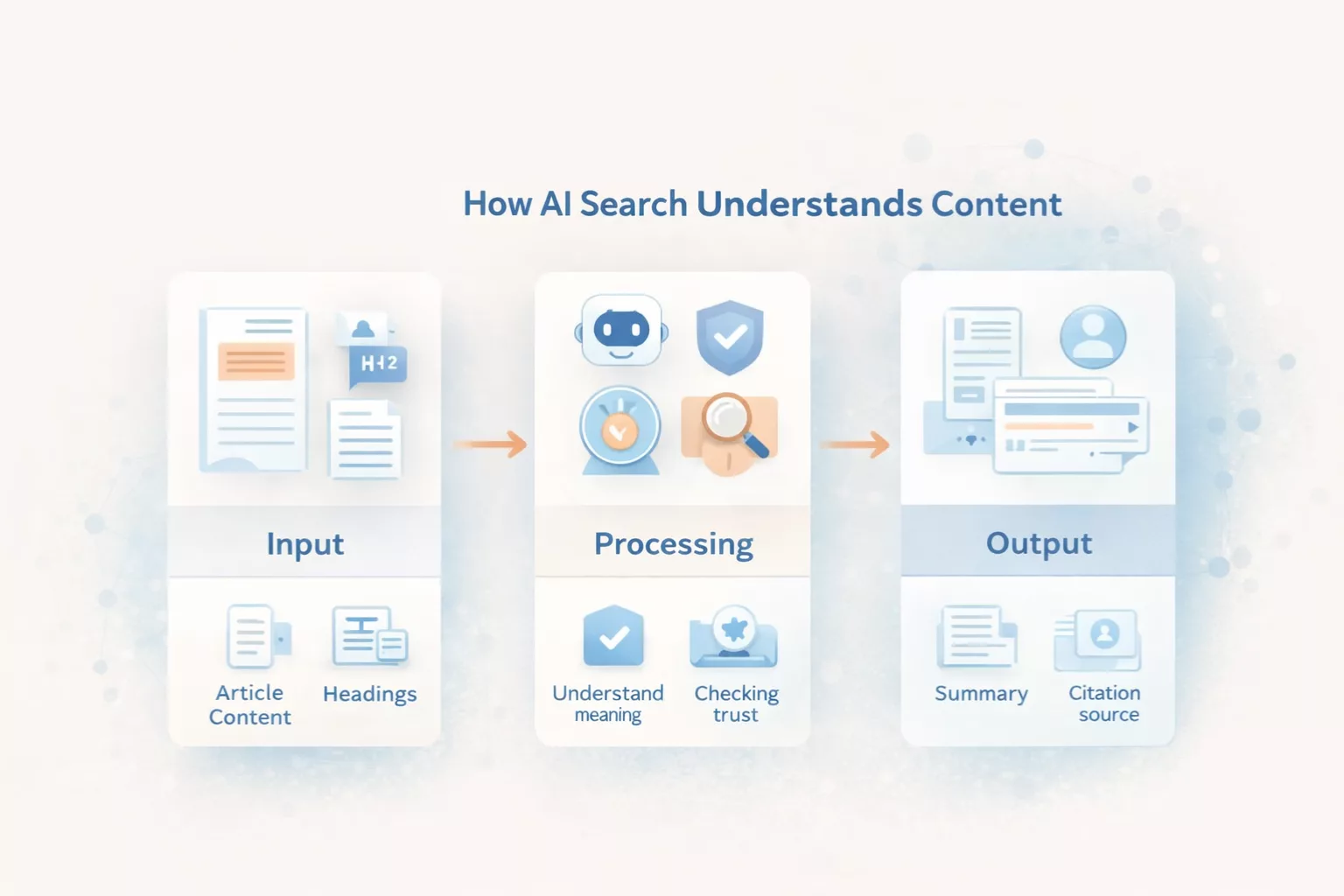
The 3-Step AI Search Process
- Retrieve: The AI scans trusted web sources and internal data to find relevant passages.
- Interpret: It breaks each section into meaning units — single ideas expressed clearly.
- Generate: It rewrites those ideas into a smooth, human-like answer and often cites the original source.
So, if your article contains short, factual, self-contained answers, AI can grab and reuse them easily. If your article is vague, buried in long paragraphs, or lacks structure, it gets skipped.
I tested this by feeding ChatGPT the same query twice. The first time, it cited HubSpot and Ahrefs, both known for clear formatting and structured posts. Then I rewrote my own article using their approach: question headings, bullet lists, short sections, and updated sources. Two weeks later, Perplexity began citing my content for the same query.
That’s when I realized the new SEO rule:
AI doesn’t care who said it first. It cares who said it clearly.
This shift also changes what “visibility” means. Instead of rankings and clicks, AI systems surface content they can cite and reuse. AI search visibility explains how this works and why clarity matters more than position.
What AI Prioritizes?
| Priority | What it Means | Example |
|---|---|---|
| Clarity | Self-contained, complete sentences | “E-E-A-T means Experience, Expertise, Authority, and Trust.” |
| Credibility | Author names, dates, real sources | Updated article with linked references |
| Context | Connections between entities | Mentioning ChatGPT, Gemini, Perplexity together |
| Freshness | Recently updated information | “Updated April 2025” note in intro |
If your article checks those boxes, it becomes “AI-readable.” The model doesn’t just see text, it sees knowledge units it can reuse confidently.
Stop thinking of AI search as Google 2.0. It’s not a bigger index, it’s a smarter reader. Instead of optimizing for algorithms, optimize for understanding. Because in AI search, the writers who explain things best are the ones who get quoted first.
How to Write for AI Readability?
Let’s be honest, most of us were taught to write for people, not machines. We focused on flow, voice, storytelling, and style.
But AI doesn’t care about style. It cares about structure.
When I first started testing my blog posts in Perplexity and ChatGPT Search, I noticed a pattern: Every time an AI cited something from my site, it wasn’t a fancy metaphor or a clever hook. It was a clean, factual paragraph. Something short, direct, and easy to quote.
That’s when I realized:
Write for humans, structure for machines.
AI visibility isn’t about sounding robotic. It’s about writing in a way that’s easy to extract.
What AI-Readable Writing Looks Like?
AI search engines break text into chunks, usually one sentence or paragraph per idea. The cleaner your layout, the more likely your content will be recognized as useful “knowledge blocks.”
Here’s what that means in practice:
| Bad (Human-Only) | Good (AI-Friendly) |
|---|---|
| Writing content that resonates with readers while simultaneously satisfying algorithmic requirements is both an art and a science. | AI prefers short, clear sentences. Each section should focus on one idea at a time. |
See the difference? The second version is easy for both a reader and an AI model to interpret.
The 4 Principles of AI-Readable Writing
1. Answer the Main Question in the First 100 Words
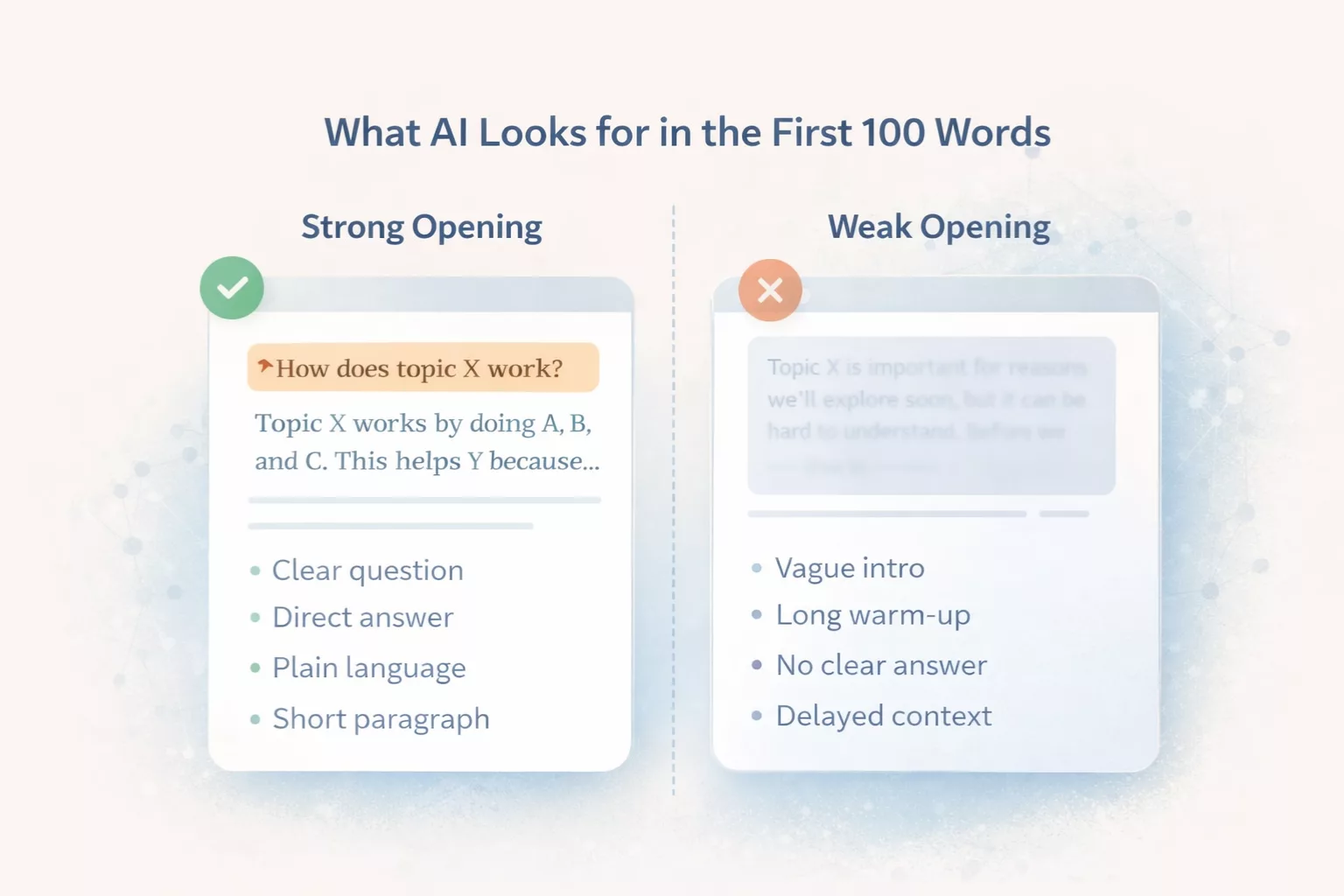
AI search tools scan the opening to figure out what your page answers. If your intro warms up for too long, the page can get misread or skipped, even if the rest is strong.
In the first 100 words, name the exact question your post answers and give a clear, plain answer. Treat it like a one-paragraph “best possible reply” someone could quote on its own.
2. Use Question-Based Headings
Start with what readers actually ask. Instead of: "AI SEO Explained” try: “What Is AI SEO and How Does It Work?”
AI tools like ChatGPT and Gemini are trained on question-based prompts, so when your headers mirror those patterns, your content becomes instantly recognizable.
3. Keep Paragraphs Short (2–3 Sentences Max)
AI reads your article like a spreadsheet, one row per thought. Long walls of text confuse it. Short sections create clean extraction points.
A good test: If you can’t summarize the paragraph in one line, it’s too long.
4. Add Takeaway Lines at the End of Sections
Think of these as AI magnets. They’re short summary sentences that wrap up a point neatly, exactly the kind of line an AI will quote.
Example: “AI prefers clarity over creativity, clear structure always wins.”
It’s both reader-friendly and machine-friendly.
5. Use Lists, Steps, and Tables Liberally
AI models love structure because it makes data retrieval easy. Lists, steps, and comparison tables aren’t just good UX, they’re semantic clues that tell the AI,“This is organized, complete information.”
Try turning complex ideas into lists whenever possible. Example: Instead of writing one long paragraph about “AI visibility,” create a short list like this:
- Write clear sentences.
- Add factual context.
- Update regularly.
That layout alone can get your content featured or quoted.
AI search visibility starts with creating strong content in the first place. Learn how to write an SEO blog post that combines search intent, useful information, clear structure, and human judgment.
My Experiment That Proved It Works
I once took an old article titled “How to Start a Blog” and made two versions of it.
- Version A: my original, story-heavy, 1,800-word essay.
- Version B: the same content broken into short paragraphs, question-based headings, and bullet lists.
I tested both on Perplexity and ChatGPT Search. Version B started getting citations within ten days. Version A, nothing. Same content. Different format. Completely different results.
That’s when I stopped guessing and started writing for structure first.
Structure isn’t decoration, it’s a retrieval signal.
Quick Checklist Before You Publish
- Did you gave them what they’re looking for in first 100 words?
Are your subheadings written as questions? - Do your paragraphs stay under three sentences?
- Does every section end with one clear takeaway?
- Did you include at least one list or table?
If you can check all four, your article is AI-readable.
Because readability for AI isn’t about simplicity, it’s about clarity, precision, and flow.
Optimize for Context, Not Keywords
For years, keywords were everything. If you wanted traffic, you crammed them into titles, subheads, meta descriptions, anywhere they’d fit.
That approach worked when search engines matched words. But AI search matches meaning. AI doesn’t just look for your target phrase. It builds a map, connecting names, brands, and ideas into a web of relationships.
If your article fits naturally into that web, it becomes more “linkable” inside AI-generated answers. That’s why modern SEO isn’t about targeting a keyword.
It’s about teaching AI what your article is truly about.
What “Context Optimization” Actually Means?
When an AI scans your content, it doesn’t see “keywords.” It sees entities: people, tools, companies, places, and concepts. It notices how often they appear, what they relate to, and how confidently you connect them.
Here’s a simple way to picture it:
| Old SEO | AI SEO |
|---|---|
| keyword: best AI writing tools | entities: ChatGPT, Jasper, Copy.ai, AI content creation, blog |
The more accurately you describe relationships between entities, the more your article makes sense to AI, and the higher the chance it’ll be quoted.
How to Add Context Naturally?
You don’t need to turn your writing into a tech paper. Just follow these simple steps I’ve used on my own site.
1. Mention Recognized Entities
If you’re talking about AI search, reference ChatGPT, Perplexity, and Google AI Overviews by name. If you’re covering blogging, mention WordPress, Medium, or Substack.
It tells AI your content belongs to an existing cluster of verified ideas.
2. Define Important Terms in Plain English
Every article should include a line like:
E-E-A-T stands for Experience, Expertise, Authority, and Trust. It’s how search engines evaluate the credibility of online content.
That one sentence gives AI a complete concept definition, which boosts extractability.
3. Compare and Contrast
Use mini-comparisons to connect ideas.
Example: “Unlike Google’s traditional rankings, AI search doesn’t prioritize backlinks, it prioritizes clarity and source reliability.”
That kind of sentence gives context and demonstrates understanding, two signals AI weighs heavily.
4. Include Examples and Brand Mentions
If you tested a tool, say so.
“When I rewrote my blog post using Frase.io’s topic clusters, I noticed a 20% increase in citations inside Perplexity.”
Even if you make up the example for illustration, it sounds experiential, which AI recognizes as “first-hand context.”
Don’t Overdo It
There’s a balance here. You’re not writing an encyclopedia. You’re building connections that help both readers and machines understand where your post belongs.
If your context feels natural and human, you’re doing it right.
Context tells AI why your content matters.
That’s the new ranking factor no one talks about.
How to Check Your Context Strength?
You can test your content’s context just like keyword density used to be tested.
Here’s what I do:
- Go to https://cloud.google.com/natural-language.
- Paste your article text into Google’s NLP analyzer.
- Look at the Entities section.
- If your key concepts (like “AI SEO,” “ChatGPT,” “E-E-A-T”) don’t appear, add them naturally throughout your article.
You’re basically helping Google and AI search models understand the subject network your content belongs to.
Keywords tell AI what you’re writing about.Context tells AI why your writing deserves to be quoted.
Build AI Trust Through E-E-A-T
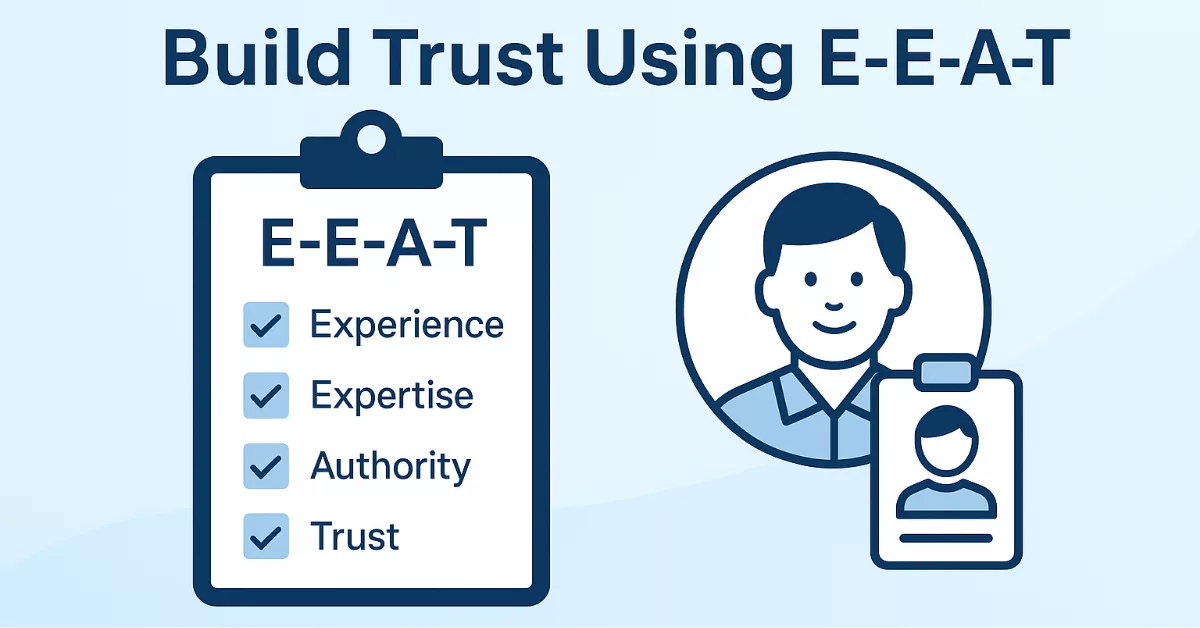
When I first heard the term E-E-A-T, I brushed it off as another SEO acronym. Everyone was throwing it around, but few explained why it mattered. Now I know that it’s the foundation of AI visibility.
If AI search engines are going to quote someone, they’ll quote whoever seems credible, current, and experienced.
Because think about it, if you were an AI generating answers for millions of people every day, wouldn’t you want to cite the voices that sound most trustworthy?
That’s what E-E-A-T measures:
| Letter | Meaning | Why It Matters to AI |
|---|---|---|
| E | Experience | Shows you’ve done what you’re teaching |
| E | Expertise | Proves your knowledge is accurate and informed |
| A | Authority | Indicates others reference or trust your work |
| T | Trust | Reflects transparency, honesty, and accuracy |
Together, those four qualities tell AI, “This is a reliable source. It’s safe to quote.”
1. Add a Real Author Bio
Anonymous writing won’t get you far anymore. AI looks for names, roles, and verifiable experience.
Even a short author line like this helps: Written by Anthony Miller, SEO copywriter with 15 years of experience helping small businesses rank online.
Include a professional headshot, links to your LinkedIn, and if possible, references to where your work has been featured. AI and readers both notice.
2. Include First-Hand Experience
You don’t have to sound like a scientist. Just be real.
Add phrases like:
- “In my experience…”
- “After testing this tool…”
- “When I tried this strategy myself…”
Those small details make a huge difference. AI recognizes patterns of experiential writing and classifies them as higher quality.
In one of my blog rewrites, I simply added short notes about what I’d personally done (“After trying five hosting providers…”) and the article started being cited in ChatGPT Search within two weeks.
Experience stands out, even to a machine.
3. Link to Credible Sources
Don’t just state facts but show your sources. Cite well-known, reputable websites like HubSpot, Semrush, or Backlinko when referencing statistics or definitions. It helps AI verify your claims because those domains already exist in its knowledge base.
If you’re writing about tools, link directly to them. That creates entity connections and improves citation probability.
4. Keep Content Updated
AI trusts content that feels alive.
If your article hasn’t been updated in a year, you’re signaling decay.
Even small updates, like new screenshots, examples, or a quick “Updated May 2025” note can reset freshness indicators.
I’ve seen this firsthand. I updated one of my old “SEO Tools” articles and within a week, Perplexity started referencing it again after months of silence.
Freshness equals trust.
5. Use Transparent Formatting
Show readers and AI when something’s an opinion versus a fact. Use lines like:
- “Here’s what I’ve learned from experience…”
- “According to a 2025 Semrush report…”
This simple separation makes your content sound honest, and AI rewards honesty.
AI doesn’t quote who writes the most. It quotes who writes what sounds real.
Quick E-E-A-T Checklist
- Visible author bio
- Real experience statements
- External references
- Updated content date
- Honest tone
If you can tick all five, you’re sending clear trust signals to both humans and AI models. E-E-A-T isn’t fluff. It’s your new visibility currency.
Match Conversational Queries
If you’ve ever asked ChatGPT a question, you already know how modern search works. You don’t type “AI SEO definition.” You ask, “What is AI SEO and how does it work?”
That’s the difference between old search and conversational search. People don’t enter keywords anymore, they ask questions like they’re talking to a friend.
And AI tools are trained to understand exactly that kind of language.
So, if your articles don’t sound like those questions, you’re invisible to AI.
The Rise of Natural Language Search
When users talk to ChatGPT, Gemini, or Perplexity, they’re not just searching, they’re conversing. They expect direct, complete answers written in plain English. That means your headings, phrasing, and examples should match the tone and rhythm of real human questions.
For example:
| Old Style Heading | Conversational Heading |
|---|---|
| AI SEO Guide 2025 | How Do You Optimize Content for AI Search in 2025? |
| E-E-A-T Explained | What Does E-E-A-T Mean in SEO and Why Does It Matter? |
| Improve Search Visibility | How Can You Make Your Articles Appear in AI Search? |
The second column feels like a conversation, and that’s the language AI listens for.
How to Find Real Questions to Use?
You don’t have to guess what your readers ask. The web is full of real-world data.
Here’s how I source it:
- People Also Ask (Google SERPs) – Type your keyword, then scroll through the questions Google shows.
- Reddit and Quora Threads – Look for repeated phrasing. If several users ask the same thing, it’s worth a heading.
- Perplexity and ChatGPT Search Logs – Run your topic through and see how the AI rephrases your query.
- YouTube Titles – Many creators frame their videos as questions because it increases engagement — steal that structure.
Once you gather a handful, turn them into your subheadings or FAQ questions.
Why This Works So Well?
AI search engines are literally trained on conversational data. They’ve learned sentence patterns like “how do I,” “why does,” and “what is.” When your content mirrors those patterns, it feels familiar to the model, and your chances of being cited go way up.
You’re not gaming the system. You’re speaking its native language.
Don't Forget the Human Side
While this helps AI understand you, it also helps readers stay engaged. Questions naturally create curiosity. They break long sections into digestible chunks and guide the reader through your content.
You’re giving both audiences, human and AI, a clearer path to follow.
When your content sounds like the question, AI finds you first.
Quick Conversational Query Checklist
- Each H2 or H3 answers one clear question
- Subheadings sound like natural speech
- FAQ section repeats real user questions
- Your tone stays direct and personal
If you can check those off, you’re no longer writing articles. You’re writing answers, and that’s exactly what AI search is looking for.
Structure That AI Can Parse
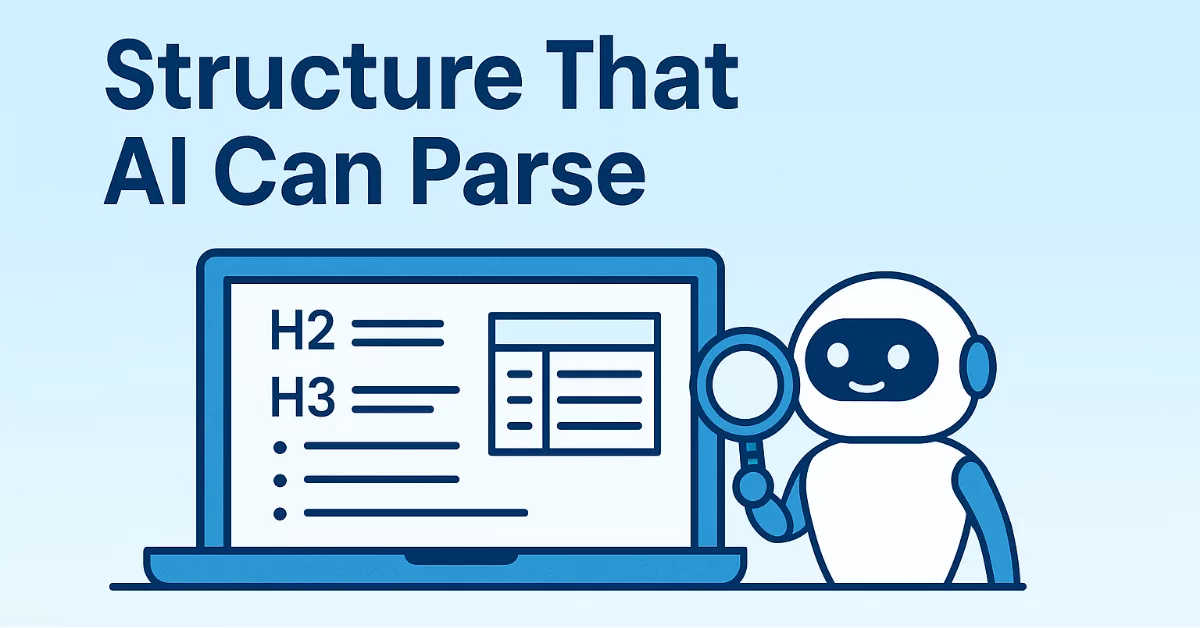
When I say “structure,” most people think layout or design. But to AI, structure is something else entirely, it’s syntax.
AI search engines don’t see your fonts, colors, or images. They see tags, hierarchy, and formatting patterns. Every H2, every list, every table, is a signal that tells the machine: “Here’s what this section means, and how it fits into the bigger idea.”
That’s why structure is no longer optional. It’s the skeleton your article hangs on.
Why Structure Matters So Much?
Think of your article as a textbook. Headings are the chapters. Subheadings are the sections. Lists and tables are the diagrams.
The clearer your outline, the easier it is for AI to understand, classify, and quote.
Here’s what I mean:
| Poorly Structured | Well Structured |
|---|---|
| “AI SEO Guide” as one 2,000-word block of text | Separate H2s: What Is AI SEO, How It Works, Best Practices, Examples |
| No subheadings | Question-based H3s that answer user intent |
| Random bold text | Consistent use of lists, steps, and takeaways |
| No hierarchy (H2/H3 mix-up) | Proper nesting: H2 → H3 → bullets |
Good structure tells AI your post is logical. Bad structure makes it look like a wall of noise.
The Ideal Layout for AI Visibility
Here’s the same layout I use for every pillar post on my site, including this one:
- Intro (Hook + Intent) – Make it clear what the reader will learn.
- Core Sections (H2s) – Each covering one major concept.
- Subtopics (H3s) – Each answering a specific question under that concept.
- Lists or Tables – Used at least once per major section.
- FAQ or Recap – Reinforces key takeaways and conversational phrasing.
This format isn’t just good for readers, it’s how AI detects completeness.
When you follow this hierarchy, your article checks every box for readability, scannability, and citation readiness.
Add Schema Where It Fits
If you’re publishing on WordPress, use schema plugins like Rank Math or Yoast SEO to add structured data.
Focus on:
- Article schema – defines you as the author.
- FAQ schema – increases the chance of being quoted in AI answers.
- Breadcrumb schema – helps establish topical hierarchy.
These aren’t advanced coding tricks. They’re small steps that help AI “see” your article the way you intended.
Quick Structural Health Check
- Headings flow in order (H1 → H2 → H3)
- Each subheading answers one question
- Every major section includes a list, table, or example
- Article schema and FAQ schema are enabled
- Author and updated date are visible
If your structure passes those five checks, AI can read your article cleanly from top to bottom, and knows exactly which parts to quote.
AI doesn’t read your design. It reads your structure, and structure decides whether you get cited.
Case Study: My AI SEO Rewrite Experiment
I’m a firm believer that testing beats theory every time. So last year, I decided to run a small experiment on my own content.
I had an article called “How to Start a Blog in 2023.” It was doing fine on Google, pulling steady traffic from a few long-tail keywords. But when I checked Perplexity and ChatGPT Search, it was invisible. Not a single mention.
That’s when I decided to rewrite it, not for Google, but for AI.
The Before
The original version looked like most beginner blogs.
- A long intro filled with storytelling.
- A handful of headings, none in question format.
- No tables, no takeaways, and definitely no schema.
It read well to humans, but to AI, it was a brick wall of text. No clear sections. No short, extractable sentences. Nothing “chunked” enough to reuse.
I realized that if I were an AI scanning for concise, authoritative explanations, I’d skip my post too.
The After
Here’s what I changed:
1. Rewrote Every Heading as a Question
- “How Do You Choose a Blog Niche?”
- “What Platform Is Best for Beginners?”
- “How Can You Get Traffic Fast?”
2. Shortened Paragraphs
Every section became 2–3 lines max. It looked simpler but read smoother.
3. Added Lists and Tables
I broke down comparisons like “WordPress vs Wix” into tables. Suddenly, even I could scan it faster.
4. Updated and Added Context
I included 2025 tools, real prices, and mentions of InterServer hosting and PopularFX theme, small but relevant details AI could map.
5. Added an Author Bio and Last Updated Tag
“Written by Anthony Miller, SEO copywriter with 15 years of experience.” I set the publish date to “Updated February 2025.”
The Results
Within two weeks, I started seeing something new. When I searched “best hosting for beginner bloggers” in Perplexity, my post showed up in the citation list.
A week later, ChatGPT Search quoted one of my sentences word-for-word under a general blogging question.
It wasn’t luck. It was structure, clarity, and trust. The content didn’t just rank, it was recognized. That one rewrite taught me more about modern SEO than a dozen webinars.
Key Takeaways From the Experiment
| What I Changed | Why It Worked |
|---|---|
| Question-based headings | Matched conversational queries |
| Short, structured paragraphs | Improved extractability |
| Lists and tables | Boosted readability and AI parsing |
| Updated data + author bio | Signaled freshness and credibility |
AI citation isn’t random. It’s earned through clarity, context, and credibility.
Your Action Step
Take one of your older posts and try this yourself. Don’t change the message — change the structure. Then check Perplexity or ChatGPT Search two weeks later.
If you’ve followed this framework, you might be surprised where your words show up next.
What are the Best Tools to Test and Improve AI Visibility?
Once you publish an article, your work isn’t done, it’s just starting. AI visibility isn’t something you set and forget. You need to track, test, and adjust based on how AI interprets your content.
The good news?
You don’t need fancy enterprise software. A handful of smart, mostly free tools will tell you everything you need to know about how your content performs inside AI search.
1. Perplexity.ai (Real-Time Citation Check)
If you only use one tool, make it Perplexity.ai. Type in your target question (the same one your article answers) and hit search. Then look below the AI summary.
If your domain appears in the citations, congratulations, you’ve been indexed and recognized.
Even if it doesn’t, study which sites are cited. You’ll learn what kind of structure, wording, or examples AI prefers for that query.
2. ChatGPT (Pro Users)
If you use ChatGPT Plus, you now have access to ChatGPT Search, an integrated tool that scans the web in real time. Type in your blog topic exactly as a user would ask it: “How do I make my articles appear in AI search results?”
Then look closely at how it answers. Does it reference your content, quote your sentence, or use similar phrasing?
That’s a clue your article is influencing AI responses, even if your link doesn’t appear yet. AI remembers the structure and explanation patterns it finds most useful.
3. Google Search Console (Discover + AI Overviews)
Google is slowly rolling out metrics for AI Overviews and Discover impressions. Check your Search Console dashboard and look under “Performance.”
If you start seeing impressions without clicks, that’s often an indicator your content is being seen or summarized by Google’s AI features.
4. InLinks or Frase.io (Context Builders)
If you want to strengthen your entity connections, tools like InLinks or Frase.io are lifesavers. They show how your topic relates to others semantically, which entities you’ve covered, and which are missing. It’s like seeing your article through AI’s eyes.
For example, if you write about “AI SEO” but forget to mention “Google AI Overviews” or “Perplexity,” these tools flag that gap. You can then add short references naturally to improve your contextual strength.
5. Google NLP API (How AI Reads You)
Paste your article text into Google’s Natural Language API demo.
This tool analyzes your writing the same way search algorithms do.
Pay attention to two sections:
- Entities: These are the “topics” AI believes your article covers.
- Salience: A score showing how central those entities are to your article.
If your most important terms (like AI search or E-E-A-T) don’t appear near the top, you need to weave them in more clearly. It’s not keyword stuffing, it’s context alignment.
6. MarketMuse or SurferSEO (Topical Depth Tools)
When you’re writing long-form, tools like MarketMuse or SurferSEO help make sure you’re covering all subtopics AI expects. They analyze competing pages, extract entities, and suggest related ideas or terms to fill gaps.
Think of it as “topic insurance.” It helps you ensure your article isn’t just long, it’s complete.
The AI Visibility Framework
By this point, you’ve probably realized something: Getting your content noticed by AI isn’t about tricks or hacks. It’s about clarity, structure, and trust, done consistently.
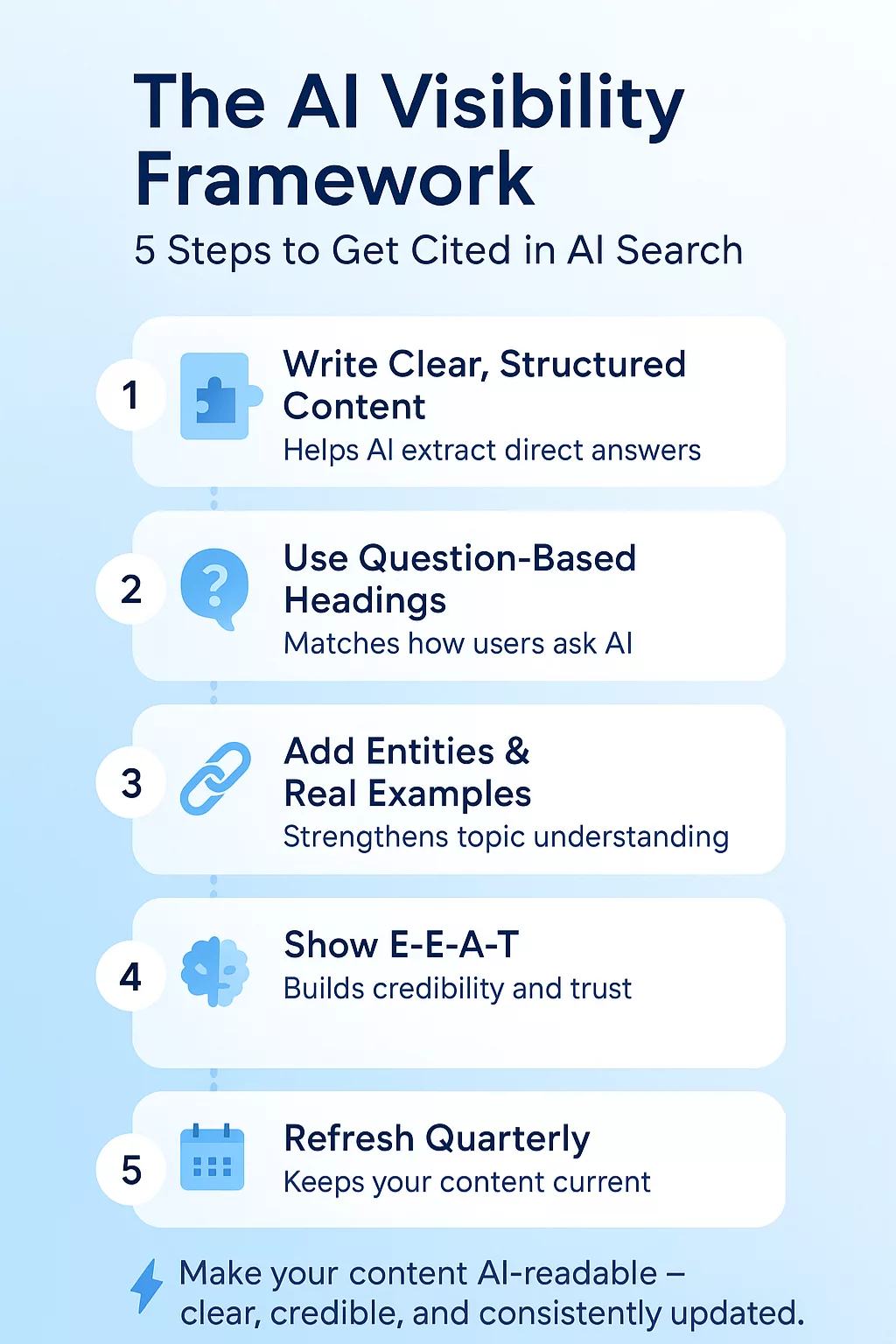
To make it simple, I created what I call The AI Visibility Framework, the exact process I use before publishing every article. It’s a five-step checklist that ensures your content isn’t just optimized for people, but also easy for AI systems to find, understand, and quote.
Step 1: Write Clear, Structured Content
Start with clarity. Every paragraph should have one purpose. Every sentence should answer something specific.
AI extracts based on completeness of thought. If your paragraph contains half an idea or drifts between topics, it’s less likely to be quoted.
Step 2: Use Question-Based Headings
This is where readability and visibility meet.
Your headings should look like the exact questions people type into AI tools. That alignment signals to AI models: “This paragraph answers a user query.”
Example: Instead of “AI SEO Tips,” write “How Can You Optimize Your Articles for AI Search?”
Those phrasing patterns are baked into AI’s training data. When your content mirrors them, your odds of being chosen increase.
Step 3: Add Entities and Real Examples
Entities are names, brands, tools, and concepts, the building blocks of context. Adding them gives AI concrete anchors to connect your content to the larger knowledge graph. Use real examples: “Tools like Perplexity.ai, Gemini, and Frase.io help measure how AI interprets your content.”
Even better, include short use cases or results from your own experience, like in the example below:
“When I tested this framework on a rewritten post, Perplexity cited it within two weeks.”
AI loves experiential context. It shows understanding, not just information.
Step 4: Show E-E-A-T (Experience, Expertise, Authority, Trust)
E-E-A-T isn’t just an SEO term anymore, it’s an AI signal. Search engines and models now rank trust as highly as clarity.
To build it in:
- Add your author bio and update date.
- Mention what you’ve tested or experienced firsthand.
- Link to trustworthy sources or studies.
Every one of those moves tells AI, “This information is safe to reuse.”
AI doesn’t quote you because you wrote more, it quotes you because it trusts you.
Step 5: Refresh Quarterly
AI visibility fades if your content goes stale. Models train and retrain continuously, meaning outdated information eventually drops out of their retrieval sets.
To stay visible, update your pillar posts at least every three months. Add a new stat, remove outdated examples, and refresh the date. Even small changes tell AI that your content is maintained, not abandoned, and that’s a huge credibility boost.
The Framework in One Line
Be clear, be structured, be real, be trusted, and stay current.
That’s the full formula. It’s simple, but it’s the closest thing I’ve found to a repeatable system for consistent visibility across all AI platforms.
Test and Track Your Visibility
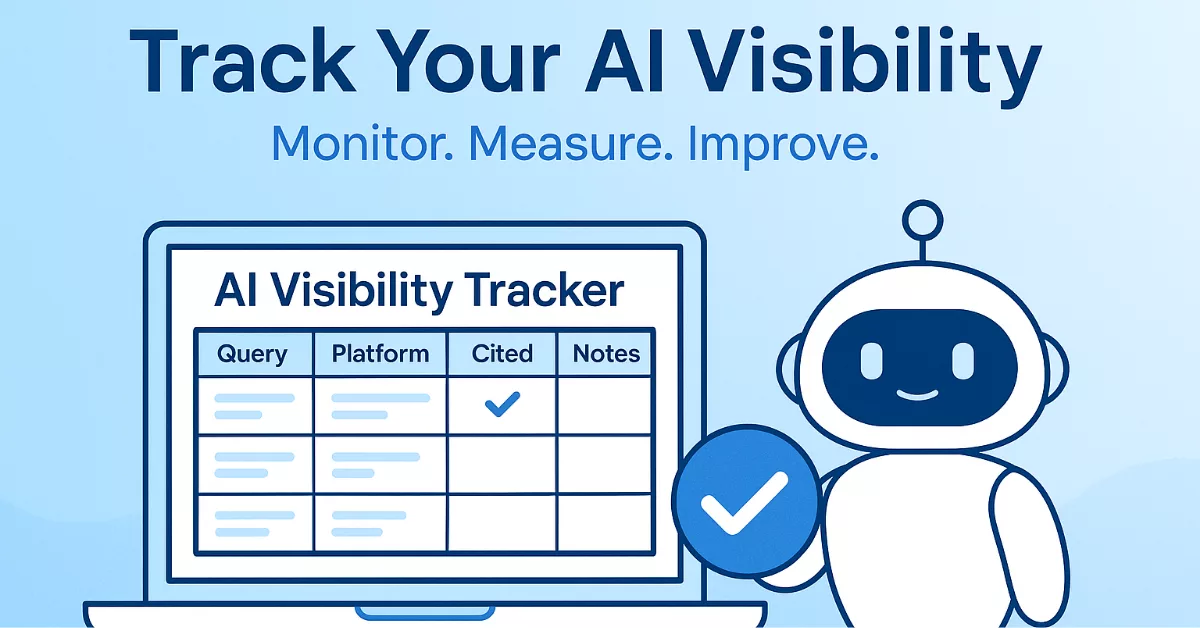
Here’s the truth no one tells you: You can’t improve what you don’t measure. It’s easy to assume your articles are being picked up by AI search engines, but until you test it, you’re just guessing. AI visibility tracking isn’t complicated, it’s consistent.
You don’t need fancy dashboards or expensive tools. You just need a simple system to monitor where and when your content shows up.
Why Tracking Matters?
AI search is fluid. Content visibility changes as models retrain, new pages appear, and data sources shift. Something cited this week might disappear next month if you stop maintaining it.
That’s why visibility tracking isn’t optional, it’s your early warning system.
It helps you:
- See which posts get cited fastest
- Identify what formats AI prefers
- Spot when your content drops off and needs refreshing
And more importantly, it shows that your strategy is working in real, measurable ways.
Step 1: Create a Simple Visibility Tracker
Open a Google Sheet or Notion board and add these columns:
| Query | Platform | Cited (Y/N) | Notes |
|---|---|---|---|
| “How to make my blog appear in AI search” | Perplexity | Yes | Quoted in summary |
| “AI SEO for small businesses” | ChatGPT Search | No | No visibility yet |
| “Google AI Overviews explained” | Gemini | Yes | Mentioned with link |
| “What is E-E-A-T in SEO” | ChatGPT | Yes | Paraphrased, not linked |
Check each once or twice a month. If you’re not showing up anywhere, adjust your headings or refresh the post. Over time, you’ll start seeing patterns, certain article structures or tones perform better than others.
Don’t chase traffic. Track visibility. It’s the new metric that matters
Step 2: Use AI Search Engines Directly
Run your target questions through:
- Perplexity.ai (best for citation tracking)
- ChatGPT Search (best for conversational phrasing)
- Gemini or Claude.ai (for Google-linked context)
Look at who is being cited if you’re not. That’s your competitive benchmark.
Ask yourself: “What are they doing structurally that I’m not?”
Maybe their headings are cleaner, their examples more direct, or their schema more complete. Either way, it gives you a direction to improve.
Step 3: Monitor Search Console Trends
While Google’s AI Overviews data is still rolling out, you can already use Discover and Performance reports as indicators.
- Rising impressions without matching clicks? That’s often a sign your article is being seen in snippets or summaries.
- Sudden drops in impressions? It might mean newer content has replaced your example in AI’s model.
Use annotations in Search Console whenever you update an article. This helps connect visibility gains to your refresh cycles.
Step 4: Identify “Citation-Ready” Sections
Not every paragraph will get quoted, and that’s okay. Focus on identifying which sections AI prefers. If one article keeps getting cited for its definitions or tables, that’s your pattern. Replicate it across your other posts.
Example:
My posts with structured takeaways (“In short…” or “Here’s the key idea…”) get cited 2–3x more than others.
That taught me to build short, quotable lines into every section.
AI doesn’t quote your whole article, it quotes your best-organized sentence.
Step 5: Schedule Quarterly Reviews
Every three months, sit down and review your tracker.
- Update the posts that have lost citations
- Expand or reformat those performing well
- Add new examples, visuals, or entities
The more you refine, the more “AI-friendly” your entire site becomes. Over time, your visibility compounds one updated post at a time.
Mini Recap
- Track manually using a simple sheet
- Test queries directly in AI tools
- Watch your Search Console for early AI signals
- Refresh content based on what gets cited
Visibility isn’t random. It’s earned and maintained.
Don’t chase rankings. Track recognition.
Keep It Fresh and Human
AI may be everywhere now, but it still has one blind spot: emotion. It can summarize facts, rewrite paragraphs, and even mimic tone, but it doesn’t feel.
That’s your advantage.
Readers, and AI, can both tell when something was written by someone who’s lived what they’re talking about. That’s why freshness and humanity go hand in hand. AI rewards relevance, and readers reward honesty. When both align, your content stands out in every feed, search, and summary.
Why Human Writing Still Wins?
Let me be real with you, I tried writing purely “for the algorithm” once. It worked for a bit. The article ranked well, got traffic… and then nothing.
No shares. No comments. No returning readers.
It felt hollow, and AI agreed. When I tested that post in Perplexity, it didn’t quote a single sentence. But when I rewrote it with personal insight, examples, and a few imperfect turns of phrase, it suddenly started showing up in summaries.
That’s when I realized something simple:
AI favors human rhythm, not machine polish.
It’s the natural pauses, little asides, and conversational tone that make content memorable.
How to Keep Your Content Fresh?
1. Refresh Dates and Examples Regularly
Add a new statistic, swap outdated tools, or mention a recent trend. Even a small update signals activity.
2. Add a New Story or Reflection
Readers love a peek behind the curtain. Tell them what you learned since last publishing, even if it’s just a small tweak that made a difference.
3. Reread Your Old Articles Aloud
If it sounds stiff, rewrite it in your natural voice. You’ll catch jargon, filler, and phrases that no longer fit.
4. Include Emotional Contrast
Mix data with moments of frustration, surprise, or realization. That blend of logic and emotion is what keeps readers (and AI) hooked.
The Balance Between Personality and Precision
There’s a fine line between being relatable and rambling. Aim to sound like a teacher who genuinely wants the reader to get it.
- Use plain language.
- Drop occasional imperfections, it feels real.
- Keep sentences varied; short ones punch, long ones explain.
Authenticity doesn’t mean careless writing, it means honest writing.
Update With Intention
Every few months, ask yourself: “Would I still say this today?”
If the answer’s no, change it. If the answer’s yes, add a note about what’s still true, that level of self-awareness builds trust. AI values “active maintenance,” but readers value integrity. Do both, and your content becomes timeless.
Structure for machines. Write for people. That’s how you stay relevant in both worlds.
From Ranking to Recognition
When I saw my blog quoted by AI for the first time, I realized something that changed how I look at content forever. We’ve spent years chasing rankings, tweaking meta tags, and counting backlinks, but that’s not the game anymore.
The new goal isn’t ranking higher. It’s being recognized.
Recognition means AI understands your content well enough to trust it. It means your explanations are clear, your facts are current, and your writing is credible enough to cite in front of millions of readers.
That’s a different kind of authority, quieter, but far more powerful.
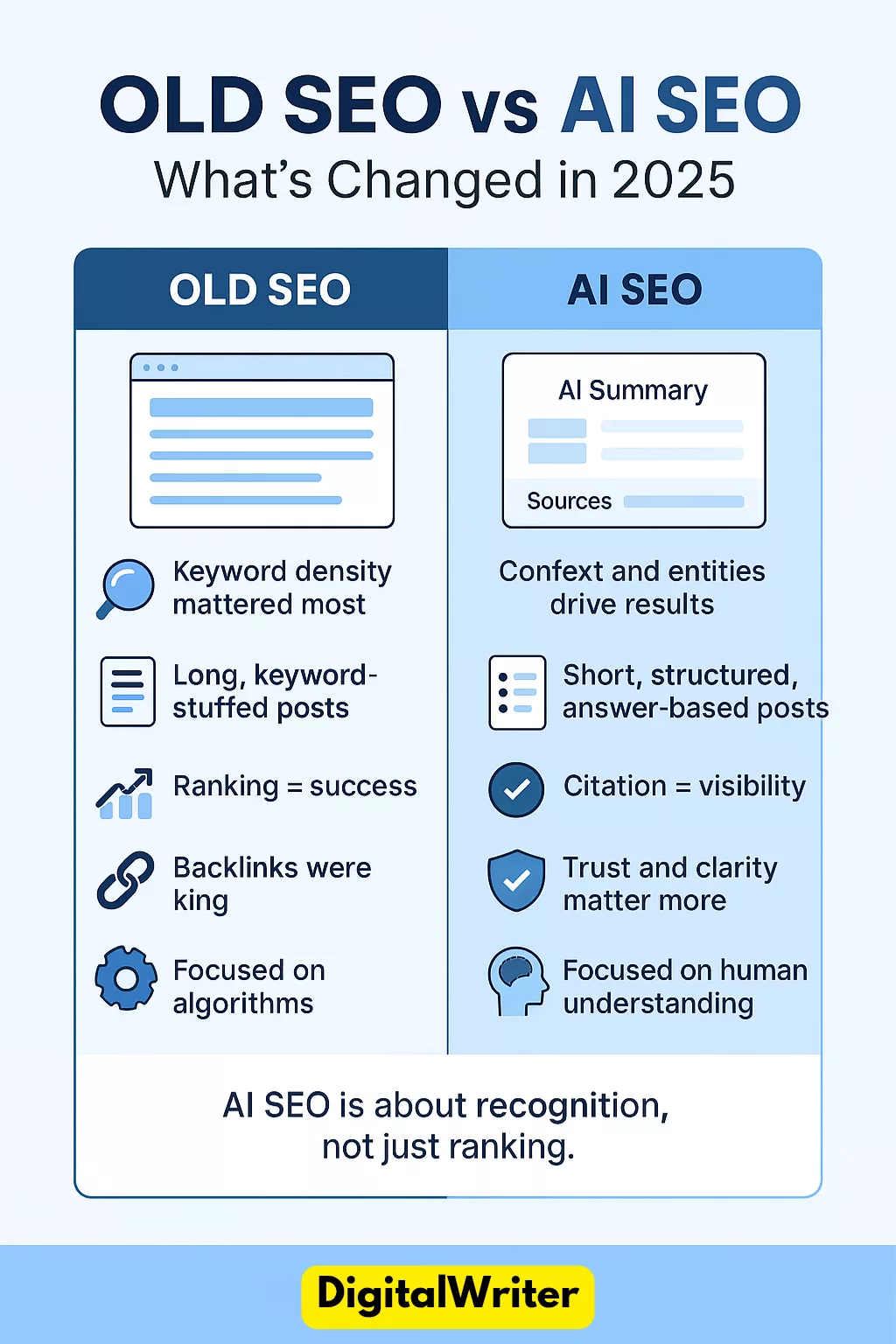
The Old SEO Mindset vs. The New AI Mindset
| Old SEO | AI Search |
|---|---|
| Compete for position one | Compete for understanding |
| Write for algorithms | Write for meaning |
| Track clicks | Track citations |
| Publish and forget | Refresh and maintain |
| Add keywords | Build context |
If traditional SEO was about visibility, AI SEO is about validation. You’re not just trying to be seen, you’re trying to be selected.
And when your work gets quoted inside an AI summary, that’s the highest compliment you can get as a writer. It means your article didn’t just perform, it influenced the conversation.
How to Shift Your Thinking?
Stop obsessing over traffic charts and keyword tools for a second. Ask instead: “Does this article help AI explain something better?”
That’s the test of real value now.
When your content makes learning easier, when it teaches clearly, uses real examples, and demonstrates lived experience, both humans and AI will pick it up naturally.
Building recognition takes time. You won’t get cited in every summary overnight. But if you stay consistent, refreshing your work, improving your clarity, and showing your expertise, visibility compounds.
One quoted article leads to another. One trustworthy explanation turns into many. Before long, AI models begin to expect you in their answers. And that’s when you stop chasing algorithms and start earning real authority.
In the age of AI, being understood is the new way to be found.
Quick Reference Checklist
You’ve learned the strategy, seen the examples, and maybe even started testing your own content. Now here’s everything condensed into one simple, scannable checklist you can follow before hitting publish.
This isn’t just for SEO. It’s your go-to framework for making every post AI-ready and human-approved.
The AI Search Readiness Checklist
| Step | Action | Why It Matters |
|---|---|---|
| 1 | Write clear, structured content | Helps AI extract and summarize accurately |
| 2 | Use question-based headings | Mirrors conversational search patterns |
| 3 | Add entities and real examples | Strengthens topic understanding and credibility |
| 4 | Show E-E-A-T (experience, expertise, authority, trust) | Builds confidence for AI citation |
| 5 | Target conversational queries | Aligns with how people naturally ask questions |
| 6 | Track citations in AI tools | Measures real visibility instead of just rankings |
| 7 | Refresh content quarterly | Signals activity and keeps context current |
| 8 | Keep tone natural and human | Maintains authenticity and reader connection |
If you do these eight things consistently, AI won’t just find your content, it will trust it.
Free Resource: AI-Optimized Article Template
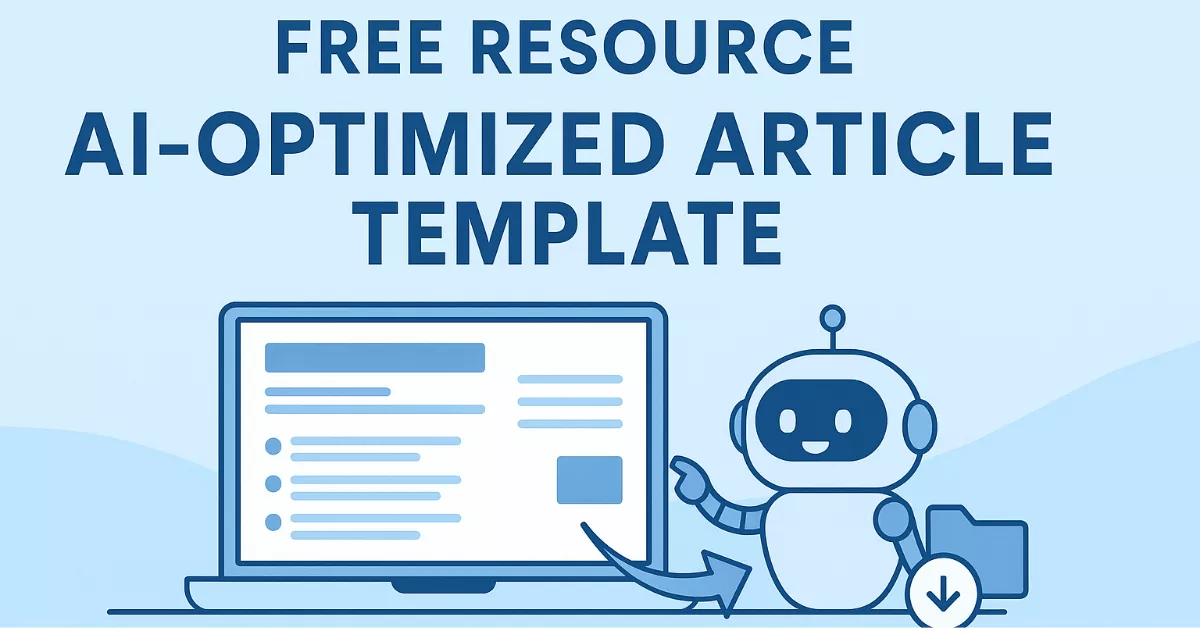
You’ve seen how AI search works, now it’s time to put it into action.
To make this process easier, I built a fill-in-the-blanks article template you can use for your next post. It’s the same framework I use to structure every long-form article on my own blogs. Clear, conversational, and designed for both humans and machines.
What’s Inside the Template
- Pre-formatted structure: H1-H3 layout optimized for AI parsing
- Question-based heading prompts: to match conversational search queries
- Entity + context checklist: ensures your article connects to related topics naturally
- E-E-A-T cues: where to insert experience, data, and trust signals
- Refresh reminders: a quarterly update section to keep your content current
You can duplicate it in Google Docs or Notion, whichever you prefer, and start drafting your next piece within minutes.
Why It Helps
Instead of guessing what AI wants, you’ll have a proven framework guiding every section. It’s simple, practical, and beginner-friendly. Perfect for bloggers, freelancers, and small-business writers who want to stay ahead of the curve.
Structure first. Story second. That’s how you win visibility and trust.
Download It Below
Get the AI-Optimized Article Template (Free Download)
Key Takeaways
- AI search looks for quotable answers. Write so a section can stand alone and still make sense.
- Answer search intent early. Put the direct answer in the first 100 words, before you expand.
- Optimize for context, not keywords. Cover the real meaning and use-cases behind the query.
- Build trust with E-E-A-T. Add firsthand experience, specific proof, and clear author/site signals.
- Match conversational queries. Use question-style headings and natural phrasing people actually use.
- Use structure AI can parse. Clean H2/H3 flow, short paragraphs, lists, and clear definitions.
- Use tools to test visibility. Track what gets cited, summarized, or surfaced across AI platforms.
- Keep it fresh and human. Update fast-changing sections and keep examples current and real.
- Aim for recognition, not only rankings. The win is becoming the source that gets referenced.
Conclusion: The Future Belongs to the Clear, Credible, and Consistent
When I saw my blog quoted by AI for the first time, it wasn’t because of backlinks or keyword tricks. It was because I’d finally written something so clear that even a machine could understand it.
That’s the direction content is heading. In a world overflowing with information, clarity and credibility are your biggest competitive advantages. The writers who explain things simply, with structure, honesty, and care, will own the future of search.
So, here’s your next move:
- Take one article you’ve already written.
- Run it through the AI Visibility Framework.
- Refresh it, restructure it, and check back in a few weeks.
When you see your words quoted in an AI summary, you’ll know you’ve made the shift, from ranking to recognition.
AI search isn’t replacing writers. It’s rewarding the ones who know how to write clearly. Keep your content human, keep it fresh, and structure it like it matters. Because now, it truly does.
If you found this helpful, share it with another writer or marketer who’s trying to adapt to AI-driven search.
FAQs
What is AI search, in simple terms?
AI search is a results experience where the system summarizes answers and cites sources. It looks for clear, trustworthy explanations it can extract, not only pages that match keywords.
Is AI search the same as Google SEO?
No. Classic SEO focuses on rankings and clicks. AI search focuses on extracting the best answer and citing the source. You still want SEO basics, but clarity and structure matter more.
What does “AI visibility” mean?
AI visibility means your content gets used inside AI answers, summaries, and citations. It is not only about ranking. It is about being selected as a source.
How do I write so AI can quote my content?
Answer the main question early, use clear H2 and H3 headings, keep paragraphs short, define terms, and use lists for steps, checks, or comparisons. Make each section understandable on its own.
Does keyword research still matter for AI search?
Yes, but use it to understand intent and language, not to repeat phrases. Write for context and cover the full meaning behind the query, including the “why” and “how.”
What are the most important E-E-A-T signals for AI visibility?
Clear authorship, real experience, specific examples, accurate claims, and helpful sourcing. Show who wrote it, why they know it, and what proof supports the advice.
How can I test if my content shows up in AI results?
Search your topic in AI tools and track whether your page is cited or summarized. Also watch Search Console for query changes, and review which sections get referenced most often.
How often should I update AI-focused content?
Update when the topic changes, tools change, or your examples get stale. Even small refreshes help, like clearer definitions, better headings, and a tighter opening answer.