
Most writing portfolios fail for one simple reason. They show writing ability, but they do not make it easy for a client to see how that ability applies to their problem.
A strong freelance writing portfolio does more than collect your best samples. It shows the kind of work you want to be hired for, the problems your writing can address, and why each sample matters.
That becomes especially important when you are new to freelance writing. You may have good writing samples, but if the samples point in different directions, a client has to figure out where you fit.
The Proof-Aligned Portfolio Method solves that problem.
Instead of building a portfolio around variety, you build it around relevance. Each sample connects one client-recognizable problem to one piece of writing and one clear outcome.
This gives your portfolio a job beyond showing that you can write. It helps a potential client understand what you can do for them.
The method also supports Client Signal Step 2, where your proof should reinforce the problem you claim to solve.
A strong portfolio can help you demonstrate your writing skills to potential clients. The Freelance Writing Hub covers other important steps in building a freelance writing career.
How Do You Create a Freelance Writing Portfolio That Gets Clients?
A strong freelance writing portfolio makes it easy for a client to understand who you help, what type of writing you provide, and why your samples are relevant.
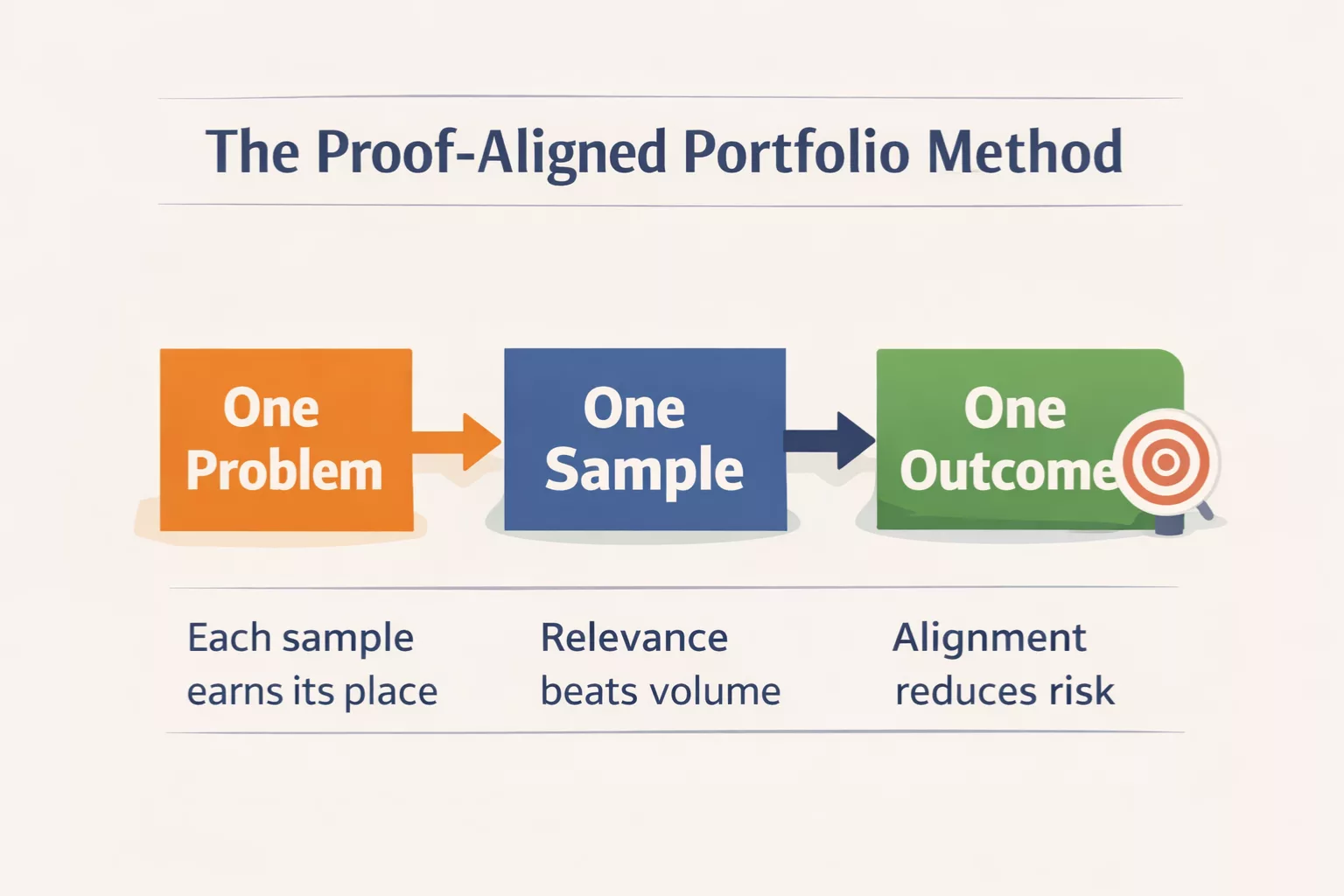
The Proof-Aligned Portfolio Method takes this one step further: one client problem → one relevant sample → one clear outcome. You do not need dozens of samples. You need a focused collection that supports the kind of work you want to be hired for.
If you are starting from scratch, begin with this guide on how to start writing online. It will help you understand the broader path before you build your portfolio.
Your portfolio is one part of that larger process.
If you want to see how the different pieces fit together, visit the Freelance Writing Hub for guides on choosing a direction, finding clients, building proof, and setting your rates.
Table of Content
- How Do You Create a Freelance Writing Portfolio That Gets Clients?
- What Is a Freelance Writing Portfolio?
- What Should a Freelance Writing Portfolio Include?
- Why Most Writing Portfolios Fail to Convert
- What Does “Proof-Aligned” Mean?
- The Proof-Aligned Portfolio Method
- Step 1: Choose a Client-Recognizable Problem
- Step 2: Build a Sample That Mirrors the Real Situation
- Step 3: Anchor Each Sample to a Clear Outcome
- Step 4: Eliminate Portfolio Noise
- How Many Writing Samples Should You Include?
- How to Build a Writing Portfolio With No Experience
- Writing Sample Ideas for Freelance Writers
- A Simple Example of a Proof-Aligned Portfolio
- How to Check If Your Portfolio Is Proof-Aligned
- Common Freelance Writing Portfolio Mistakes
- Freelance Writing Portfolio Checklist
- How to Use Your Portfolio to Get Writing Clients
- Key Takeaways
- Related Guides
- Conclusion: Your Portfolio Should Make the Right Work Easier to See
- FAQs
What Is a Freelance Writing Portfolio?
A freelance writing portfolio is a collection of writing samples that shows potential clients what you can write and what type of work you want to be hired to produce.
That definition sounds simple, but it leaves out an important part.
Your portfolio should not simply answer, “Can this person write?” It should help answer, “Can this person produce the kind of writing my business needs?”
That distinction changes how you choose your samples.
A collection of unrelated blog posts, emails, social media captions, and landing pages may demonstrate range. But if you want to attract SEO writing clients, for example, that range may make your positioning less clear.
A more focused portfolio might show several pieces that demonstrate the type of SEO content you want to produce.
The goal is not to hide your other skills. It is to make the right skill easier to see.
This is why your portfolio should support your positioning rather than exist separately from it.
What Should a Freelance Writing Portfolio Include?
A useful freelance writing portfolio does not need complicated features. It needs enough context to help a potential client understand your work quickly.
- A clear positioning statement: Explain who you write for and what type of problem your writing helps address.
- Relevant writing samples: Choose samples that match the type of work you want to be hired for.
- Context for each sample: Explain the audience, format, purpose, or situation when that information helps the reader understand the piece.
- A clear outcome or purpose: Explain what the sample was designed to accomplish without inventing results.
- Basic information about you: Give clients enough information to understand who they would be working with.
- An easy way to contact you: Do not make a potential client search for the next step.
You do not need to turn every sample into a case study.
A short explanation is often enough. The purpose is to remove unnecessary guessing, not to bury the writing under commentary.
Your portfolio should also be easy to scan. A client should be able to understand your focus without reading every word on the page.
Why Most Writing Portfolios Fail to Convert
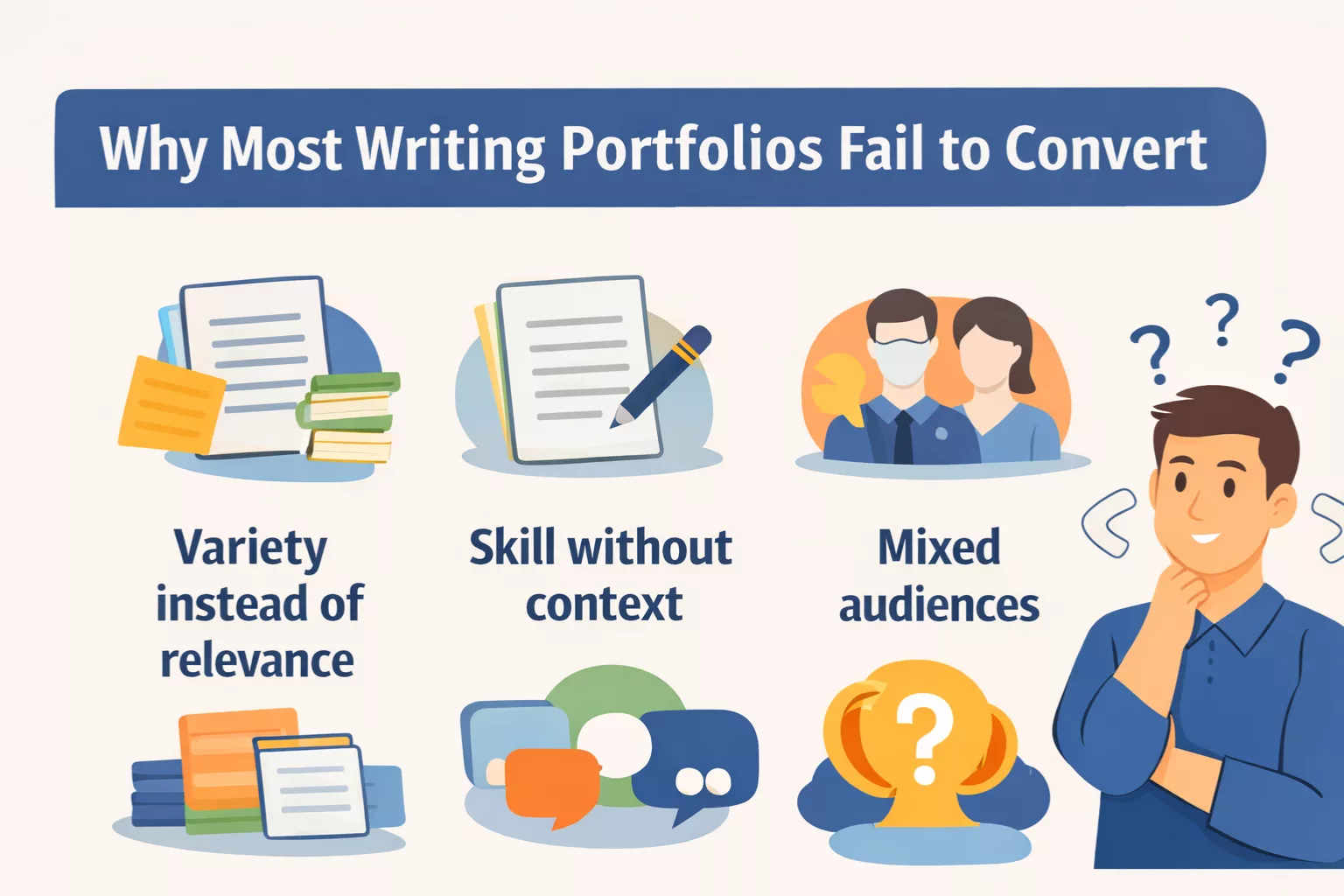
Most weak writing portfolios are not weak because the writing is terrible.
They are weak because the samples do not make their relevance obvious.
Beginners often collect samples that look polished but represent different audiences, formats, industries, and problems. The thinking is understandable: more variety should create more opportunities.
But variety can create a second problem. The client has to decide which part of your portfolio applies to them.
That is work you should do before they arrive.
Clients are looking for evidence that you understand the type of work they need. A relevant sample gives them that evidence faster than a long list of unrelated pieces.
Imagine a company needs someone to write educational SEO articles for a technical audience.
A portfolio containing ten unrelated samples may demonstrate strong writing. A portfolio containing three relevant articles about explaining complex topics gives the client a clearer reason to continue the conversation.
The difference is not necessarily writing quality.
It is relevance.
Your positioning says one thing. Your portfolio should reinforce it.
When the positioning says, “I write SEO content for SaaS companies,” but the portfolio contains travel articles, personal essays, restaurant reviews, social captions, and one SaaS article, the client has to interpret the collection.
When the portfolio contains several pieces that demonstrate the same type of work, the connection is easier to understand.
That is the basic idea behind proof alignment.
What Does “Proof-Aligned” Mean?
Proof-aligned sounds more complicated than it is.
The idea is simple: each sample in your portfolio should support a clear reason for hiring you.
Instead of asking, “What writing samples can I show?” ask, “What problem do I want to be hired to solve?”
The answer gives your portfolio direction.
For example, suppose you want to write content for businesses that struggle to explain complicated products.
A general blog post about your favorite hobby may be excellent writing. But it does not give that potential client much evidence that you can explain a complex product to their audience.
A well-structured educational article that explains a complicated product or concept does.
The second sample is proof-aligned because the client can recognize the connection.
This creates the basic Proof-Aligned Portfolio Method:
- Problem: What client problem do you want to solve?
- Sample: What piece of writing demonstrates that you understand the situation?
- Outcome: What was the piece designed to improve, clarify, support, or achieve?
One problem. One relevant sample. One clear outcome.
That does not mean every portfolio must contain only one sample. It means every sample should have a clear job.
The Proof-Aligned Portfolio Method
The Proof-Aligned Portfolio Method turns your portfolio into a simple decision tool.
Instead of making the client interpret a collection of writing, you create a clear connection between the problem they have and the evidence you provide.
The method follows a simple chain:
- Client problem → what needs to be solved
- Relevant sample → evidence that you can handle the type of work
- Context → why the sample matters
- Outcome → what the writing was designed to accomplish
This structure keeps your portfolio focused.
It also connects naturally to the larger Client Signal system. Step 1 identifies the problem you want to solve. Step 2 gives the client proof that supports that positioning.
The portfolio should therefore reinforce the same message as your positioning.
If your positioning changes, your portfolio may need to change with it.
You do not have to delete every piece of work you have ever produced. You simply need to decide which pieces deserve attention in the context of the work you want next.
That is an important distinction.
A portfolio is not a permanent archive. It is a selected presentation of your capabilities for the clients you want to attract.
Step 1: Choose a Client-Recognizable Problem
Your portfolio becomes easier to build when you know what problem you want to be hired to solve.
A client-recognizable problem is something a potential client already understands from their own business.
They may describe it in different words, but the problem is familiar to them.
For example, a client might say:
- Our prospects do not understand what we offer.
- Our blog gets traffic but does not support the business.
- Our website copy is difficult to understand.
- We need better educational content for our audience.
- Our emails are not communicating the offer clearly.
These problems give you something concrete to build proof around.
Avoid starting with a writing skill.
“I am good at storytelling” or “I write engaging content” describes a capability. It does not tell the client where that capability fits inside their business.
Start with the business situation instead.
A simple test helps:
Could your ideal client recognize this problem without needing you to explain it?
If yes, you have a useful starting point.
If the problem is so broad that it could describe almost every business, narrow it.
Choosing a clear niche can make this process easier. If you need help with that decision, read how to choose a freelance writing niche.
Step 2: Build a Sample That Mirrors the Real Situation
Once you know the problem, choose a sample that demonstrates the type of work needed to address it.
The closer the sample is to the work a client needs, the easier it is to understand its relevance.
If you want SEO writing clients, build SEO-oriented samples. If you want email writing clients, include email samples. If you want B2B thought leadership work, create samples that demonstrate that format and audience.
This does not mean you need paid client work before you can create a portfolio.
You can create realistic portfolio samples specifically to demonstrate the type of work you want to produce. Just label hypothetical or spec work honestly.
The important part is realism.
A hypothetical sample should still have an audience, purpose, format, and business situation.
For example, instead of writing a generic blog post about “The Benefits of Email Marketing,” create an article for a defined audience with a specific purpose.
The sample becomes more useful when the client can recognize the type of assignment behind it.
Context can help too.
You might add a short note explaining who the sample was written for, what problem it addresses, and what the piece was designed to accomplish.
Keep that explanation short.
The writing should remain the main evidence.
If you want a repeatable structure for creating strong online writing samples, you can also use the AI-Optimized Article Template as a supporting resource.
Step 3: Anchor Each Sample to a Clear Outcome
A writing sample becomes more useful when the client understands what it was meant to accomplish.
That does not mean every sample needs a dramatic performance metric.
If you have real results, you can present them accurately. If you do not, describe the intended outcome without pretending that a result occurred.
For example:
- Designed to explain a complex product in simpler language.
- Written to target an informational search query.
- Structured to guide readers toward a relevant service.
- Created to give prospects a clearer understanding of the offer.
- Designed to make a technical subject easier for a nontechnical audience to understand.
These statements tell the client why the sample exists.
That is especially useful when you are building a portfolio without a long list of client results.
You can demonstrate judgment without inventing numbers.
That distinction matters.
Never turn a hypothetical outcome into a claimed result. If a sample was created as practice, say so. If it was designed to achieve something, describe the intended purpose.
Clear context is stronger than impressive but unsupported claims.
Step 4: Eliminate Portfolio Noise
Once you have relevant samples, remove anything that makes the portfolio harder to understand.
Noise can come from unrelated industries, different audiences, unnecessary formats, outdated positioning, or samples that require a long explanation before their relevance becomes clear.
Ask this question about every sample:
Does this sample support the kind of work I want to be hired for now?
If the answer is no, remove it from the main portfolio.
You do not have to destroy or forget the work. Keep it elsewhere if you want. The point is to make the primary portfolio focused.
There is also no need to prove every skill you possess on one page.
If you write blog content, sales emails, landing pages, social media posts, and technical documentation, you may have all of those skills. But a client looking for one specific service does not necessarily need to see all of them.
Your portfolio is a selection, not your complete writing history.
Completeness comes from showing enough relevant evidence, not from showing everything.
How Many Writing Samples Should You Include?
There is no universal number that works for every writer.
A practical starting point for a focused portfolio is three to five strong samples. You can add more when they provide useful evidence rather than simply increasing the number of pieces.
The better question is not “How many samples can I fit?”
Ask:
How many samples does this client need to understand what I can do?
If three highly relevant pieces communicate your positioning clearly, adding seven unrelated samples may make the portfolio weaker.
You can also organize samples by service or audience when you genuinely serve more than one market.
For example, a writer who serves both SaaS companies and professional services firms may use separate portfolio sections. The important thing is that each section remains coherent.
Do not force every potential client to sort through your entire career before finding the sample that matters to them.
How to Build a Writing Portfolio With No Experience
You do not need years of freelance experience before you can create a writing portfolio.
You need relevant evidence.
If you have no paid client samples, create your own.
Choose a type of client you want to work with and create realistic samples for that market.
- Create spec samples: Write a realistic piece for the type of company you want to approach and clearly label it as speculative or self-created work.
- Use your own website: Published articles can demonstrate your ability to research, structure, and explain a topic.
- Rewrite weak examples: Choose a real type of business communication and create your own improved version as a demonstration.
- Create niche-specific samples: If you want to work in healthcare, SaaS, finance, marketing, or another field, create samples that demonstrate familiarity with that audience.
- Use relevant previous work: If you have writing from employment, school, volunteer work, or another legitimate context that can be shared, consider whether it supports the type of work you want now.
The key is honesty.
Do not present a hypothetical project as paid client work. You can still use the sample. You simply need to explain what it is.
A focused portfolio with honest samples is more useful than a portfolio padded with vague claims.
Writing Sample Ideas for Freelance Writers
The best sample depends on the type of writing you want to sell.
Here are some examples of portfolio pieces you can create or collect:
SEO Writers
- Informational blog article
- Comparison article
- Product-led article
- Search-focused guide
- Topic-cluster supporting article
Copywriters
- Landing page
- Product page
- Sales email
- Lead magnet
- Offer page
Email Writers
- Welcome email
- Welcome sequence
- Promotional email
- Newsletter
- Re-engagement email
B2B Writers
- Thought leadership article
- Case study
- Industry guide
- Educational article
- White paper excerpt
You do not need one of everything.
Choose the formats that match the work you want to attract.
A Simple Example of a Proof-Aligned Portfolio
Here is how the method works in practice.
Imagine your positioning says:
I write SEO content for SaaS companies that need to explain complex products in simple language.
Your portfolio could then be organized around problems that fit that positioning.
Problem
Potential customers do not understand a complex product or feature.
Sample
An educational SEO article explaining a complicated product concept in simple language.
Context
The sample is written for nontechnical decision-makers who need to understand the topic before considering a solution.
Outcome
The article is designed to improve understanding, answer an informational question, and create a logical path toward the relevant solution.
Now the client can see the connection.
You are not simply saying that you can write SEO articles.
You are showing the type of problem your writing is designed to address.
How to Check If Your Portfolio Is Proof-Aligned
You can audit your portfolio in about ten minutes.
You are not judging whether the writing is beautiful. You are checking whether the portfolio communicates a clear signal.
Start with your positioning statement.
Can you describe the problem you want to solve in one sentence?
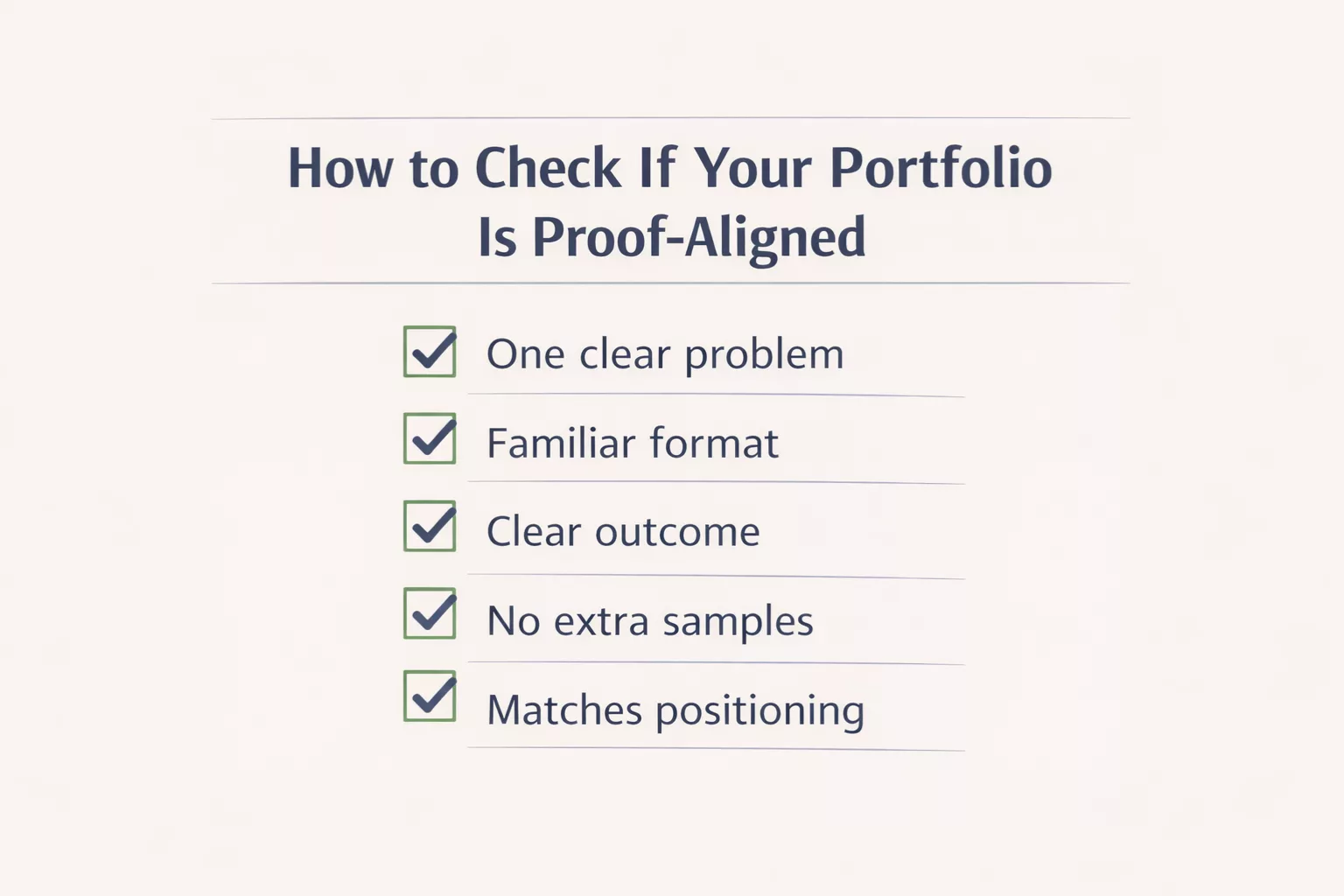
Then look at each sample and ask:
- Who is this sample for?
- What problem does it address?
- What type of work does it demonstrate?
- Why would my target client care about it?
- What was the piece designed to accomplish?
- Does it support my current positioning?
If you cannot answer those questions, the sample may need better context or may not belong in the main portfolio.
Then perform the mismatch test.
Read your positioning statement and immediately look at your samples.
Do they feel like parts of the same story?
If your positioning and portfolio appear to describe different writers, find the source of the mismatch.
That might mean changing the positioning, replacing a sample, adding context, or removing unrelated work.
This check connects directly to Client Signal Step 2. Your proof should confirm the positioning rather than introduce a different message.
Common Freelance Writing Portfolio Mistakes
Many portfolio mistakes come from good intentions.
Including every sample you have
Your portfolio is not a storage system. Select the work that supports the type of writing you want to sell.
Mixing unrelated audiences
A portfolio aimed at several completely different audiences can become difficult to interpret. Use separate sections or pages when you genuinely serve different markets.
Showing samples without context
A client may not know why a sample matters simply by looking at it. A short description of the audience, purpose, or format can make the connection easier to understand.
Inventing results
Do not add impressive numbers to make a sample sound stronger. If you have verified results, present them accurately. If you do not, explain the intended outcome instead.
Using weak or outdated positioning
Your portfolio should reflect the work you want now. If your focus has changed, review your samples and remove pieces that no longer support your direction.
Making the client hunt for contact information
A strong portfolio still needs a clear next step. Make it obvious how a potential client can contact you or learn more about your services.
Freelance Writing Portfolio Checklist
Before you publish or send your portfolio to a potential client, run through this checklist.
- My portfolio clearly identifies the type of work I want to be hired for.
- My positioning identifies the audience or type of client I want to serve.
- My samples match the work I want to attract.
- Each sample has a clear purpose.
- Each sample connects to a recognizable client problem.
- Each sample has enough context to understand why it matters.
- I describe intended outcomes without inventing results.
- Any hypothetical or spec work is labeled honestly.
- I have removed unrelated samples from the main portfolio.
- My portfolio is easy to scan.
- My contact information is easy to find.
- The portfolio works well on mobile devices.
- The portfolio and my positioning communicate the same message.
If several items fail, you do not necessarily need more samples.
You may simply need better alignment.
How to Use Your Portfolio to Get Writing Clients
A portfolio does not find clients by itself.
It becomes useful when you put it in front of people who may need the work you offer.
Use your portfolio when responding to relevant opportunities, contacting potential clients, applying for freelance writing projects, or following up after a conversation.
When possible, do not send the same generic portfolio to everyone.
Choose the sample that most closely matches the client's situation and point them toward it.
That small step turns your portfolio from a passive collection of links into relevant evidence.
For the next part of the process, read how to get writing clients.
Key Takeaways
- A freelance writing portfolio should show more than writing ability. It should make your relevance to a client's problem clear.
- Choose samples based on the type of work you want to attract.
- The Proof-Aligned Portfolio Method connects one client problem to one relevant sample and one clear outcome.
- You can build a strong portfolio without paid client work by creating realistic, clearly labeled samples.
- Three to five focused samples can provide a useful starting point. Add more only when they strengthen the signal.
- Remove samples that introduce unrelated audiences, problems, or services.
- Use your portfolio as evidence when you contact potential clients instead of treating it as a complete archive of your writing.
Once your portfolio is ready, the next step is learning how to get writing clients and using relevant proof when you approach them.
Conclusion: Your Portfolio Should Make the Right Work Easier to See
A freelance writing portfolio is not a complete archive of everything you have ever written.
It is a selected collection of evidence designed to help potential clients understand what you can do for them.
The Proof-Aligned Portfolio Method gives that collection a simple structure: one recognizable client problem, one relevant writing sample, and one clear outcome.
That approach helps you avoid the common mistake of adding more samples when what you really need is more relevance.
If your portfolio feels scattered, start by looking at your positioning. Then look at every sample and ask whether it reinforces that message.
Remove what creates confusion. Add what provides useful evidence. Explain what needs context. Be honest about what is hypothetical and what is verified.
Once your proof and positioning point in the same direction, your portfolio becomes easier for the right client to understand.
A focused portfolio can also give you a stronger foundation when you set your digital writing rates, because your samples help demonstrate the type of work you provide.
And once you have a portfolio that supports your positioning, the next question is whether your writing is creating the results you want. The fastest way to know if your writing is working explores the signals you can use to evaluate your work.
Want to see how portfolio building fits into the larger freelance writing process? Visit the complete Freelance Writing Hub to learn how to choose your direction, build proof, find clients, and grow your writing business.
FAQs
What should I include in a freelance writing portfolio?
Include relevant writing samples, a clear description of the type of work you provide, enough context to understand each sample, information about the intended audience or purpose when useful, and an easy way to contact you.
How many samples should a freelance writing portfolio have?
There is no universal number. Three to five relevant samples are a practical starting point for a focused portfolio. Add more when they provide useful evidence for the type of work you want to attract.
How do I create a writing portfolio with no experience?
Create realistic samples for the type of clients you want to work with. You can write spec pieces, publish useful articles on your own site, or use relevant writing from legitimate previous work. Label self-created or hypothetical work honestly.
What are good writing samples for beginners?
Good beginner samples match the type of work you want to sell. Depending on your direction, that could include an SEO article, landing page, email sequence, product page, educational article, case study, or other relevant format.
Should I include every writing sample I have?
No. Your portfolio should be selective. Remove samples that do not support the type of work you want to be hired for or that introduce an unrelated audience, problem, or service.
Can hypothetical writing samples be used in a portfolio?
Yes. Hypothetical samples can demonstrate your ability when they reflect a realistic audience, purpose, format, and business situation. Make it clear that the work is self-created or speculative rather than presenting it as paid client work.
Do I need results for every writing sample?
No. If you have verified results, you can include them. If you do not, explain the intended purpose or outcome of the sample instead of inventing performance numbers.
What if I want to work with different types of clients?
You can organize your work into separate portfolio sections or pages when the audiences and services are genuinely different. Avoid forcing unrelated work into one collection if doing so makes your positioning harder to understand.
How often should I update my writing portfolio?
Update your portfolio when your target audience, services, positioning, or strongest samples change. You do not need to add new work simply to make the portfolio larger.
How do I know if a writing sample should be removed?
Remove or move a sample when it no longer supports the type of work you want, targets a completely different audience, solves an unrelated problem, or requires too much explanation to justify its relevance.