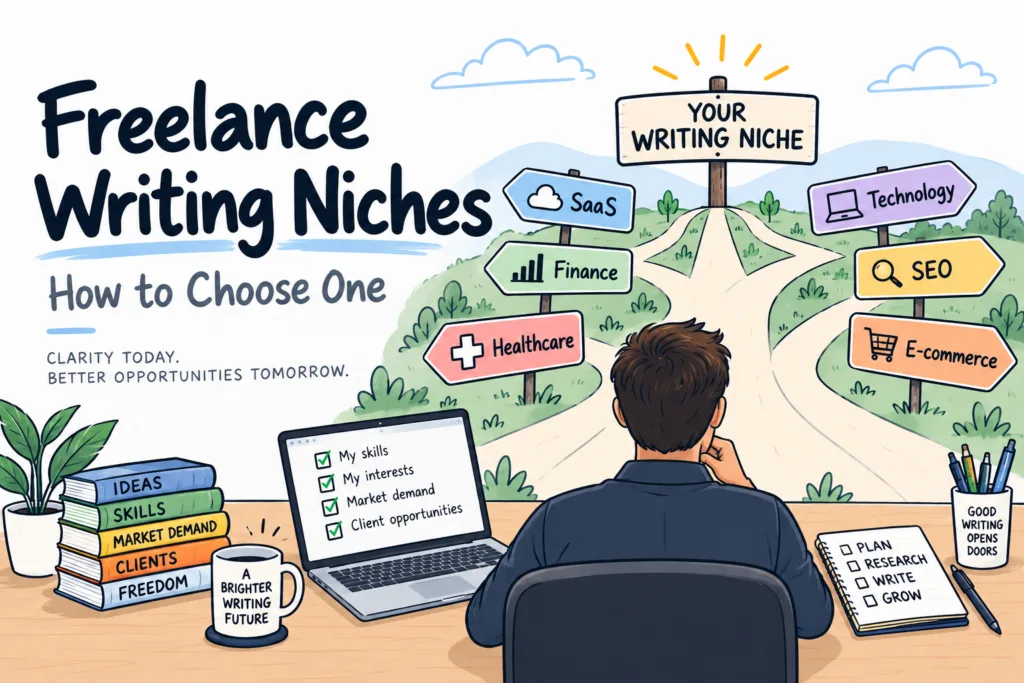

Choosing a freelance writing niche can feel like making a career decision you’re stuck with forever. You see writers earning good money in different niches, and it’s easy to wonder, “What if I choose the wrong one?”
That pressure can lead you to chase the “most profitable” niche instead of finding one that actually fits you.
The truth is, there isn’t one best niche for every writer. A strong niche sits at the intersection of what you know, what you write well, what businesses need, and what clients will pay for.
And choosing a niche doesn’t mean turning down every project outside it. It gives you a clear direction while you build your skills, portfolio, and client base.
In this guide, you’ll learn how to compare freelance writing niches and choose one you can build your freelance career around.
How Do You Choose a Freelance Writing Niche?
Choose a freelance writing niche by finding the overlap between what you know, what you enjoy writing about, what businesses need, and what clients will pay for. Evaluate demand, competition, potential clients, content needs, and your ability to build expertise before choosing a niche.
A strong freelance writing niche should give you enough focus to stand out while leaving enough room to find clients and grow.
-
✓Start with your strengths
Consider your knowledge, experience, interests, and writing skills. -
✓Check market demand
Look for businesses that already invest in content and need writers. -
✓Evaluate the competition
Look for ways to differentiate yourself instead of avoiding competition. -
✓Consider earning potential
Focus on the business value your writing can provide, not hype about a particular niche. -
✓Think long term
Choose a niche where you can develop deeper expertise and authority. -
✓Test before committing
Create samples, contact potential clients, and use real-world results to guide your decision.
Table of Content
- What Is a Freelance Writing Niche?
- Why Should Freelance Writers Choose a Niche?
- The Main Types of Freelance Writing Niches
- Topic vs. Industry vs. Audience vs. Service
- How to Choose a Freelance Writing Niche?
- What Makes a Freelance Writing Niche Commercially Attractive?
- How AI Changes the Value of a Freelance Writing Niche
- The Best Freelance Writing Niches to Consider
- How to Compare Freelance Writing Niches?
- A Simple Freelance Writing Niche Selection Exercise
- Should You Choose a Broad or Narrow Freelance Writing Niche?
- What If You Can't Decide on a Freelance Writing Niche?
- Common Mistakes When Choosing a Writing Niche
- How to Test a Freelance Writing Niche Before Committing?
- How to Position Yourself Once You Choose a Niche?
- Can You Have More Than One Freelance Writing Niche?
- How to Know When It's Time to Change Your Niche?
- Freelance Writing Niche FAQs
- Conclusion: Choose a Niche You Can Build On
What Is a Freelance Writing Niche?
A freelance writing niche is a specific area, industry, audience, or type of writing that you focus on as a freelance writer. Instead of telling potential clients, “I write about anything,” you can position yourself as a writer who understands a particular subject or type of content.
For example, you might specialize in healthcare writing, creating articles and other content for healthcare companies.
You could focus on SaaS writing, finance writing, travel writing, or technical writing. You might also specialize in B2B writing, creating content for businesses that sell products or services to other businesses.
A writing niche is different from a writing service. Your niche describes what you write about or who you write for, while your service describes what you create.
For example, “SaaS” can be your niche, while “SEO blog writing” can be your service.
You can specialize in a few different ways:
- Industry: Healthcare, finance, technology, real estate, or travel.
- Audience: Small businesses, SaaS companies, consumers, startups, or enterprise companies.
- Content type: Blog posts, website copy, case studies, emails, white papers, or technical documentation.
- Subject: Personal finance, cybersecurity, artificial intelligence, fitness, or another specific topic.
- Combination: You can combine these to create a more specific position, such as a SaaS SEO content writer for B2B technology companies.
You don't have to choose only one category. In fact, combining an industry, audience, and writing service can make it easier for potential clients to understand exactly what you offer.
The goal isn't to put yourself in a box. It's to give your freelance writing business a clear direction so you can build relevant expertise, create stronger portfolio samples, and attract clients who need the kind of writing you do best.
Current freelance writing opportunities span areas such as SaaS, technical writing, digital marketing, e-commerce, and AI-assisted content, making market research an important part of choosing a niche. See Upwork's guide to freelance writing niches for additional examples and market considerations.
Why Should Freelance Writers Choose a Niche?
Choosing a freelance writing niche can make your business easier to explain, market, and grow. But that doesn’t mean you need to specialize in one narrow topic and reject every project that falls outside it.
When you have a clear niche, potential clients can understand what you do without trying to connect the dots. “I write SEO content for SaaS companies” tells a client far more than “I’m a freelance writer.”
That clarity can make your positioning stronger and help the right clients recognize that you understand their needs.
A niche also makes building your portfolio easier. Instead of creating random samples on unrelated subjects, you can develop work that shows the type of writing you want to get paid for.
If you want to write for financial companies, for example, your portfolio can demonstrate that you understand finance topics and can explain them clearly.
It can also make finding clients more focused. Rather than searching for every company that might need a writer, you can target businesses in a specific industry or market. Your pitches, website, LinkedIn profile, and content can all speak to the same audience.
Over time, this focus can help you develop deeper subject expertise. The more you write about a particular market, the more familiar you become with its terminology, audience, problems, and content needs.
That expertise can make your work more valuable and may give you more leverage when setting your rates.
A niche can also support your personal brand and content marketing. When you consistently publish useful information about a particular subject, people have a reason to associate you with that area. You can build authority without trying to become known for everything.
If you're building your freelance writing business from the ground up, the Freelance Writing Hub covers the broader skills, strategies, and resources you can use to find clients and grow your writing career.
Will Choosing a Niche Limit Your Opportunities?
This is one of the biggest concerns writers have, and it’s understandable. If you announce that you specialize in one area, you might worry that clients outside that area will stop contacting you.
In practice, specialization and flexibility can coexist.
Your niche is a positioning tool, not a set of rules. You can focus your marketing on a particular type of client while still accepting projects that interest you or pay well.
A writer who specializes in SaaS content, for instance, can still take a technology, business, or marketing project when the opportunity makes sense.
You also don't have to choose your forever niche on day one. Your niche can become more focused as you gain experience and learn which topics, clients, and projects suit you best.
Think of specialization as giving your freelance business a direction rather than putting up a wall. It helps you become easier to find and remember while leaving you room to explore opportunities along the way.
The Main Types of Freelance Writing Niches
“Pick a niche” sounds simple until you realize there’s more than one way to do it. You don’t have to choose a single subject and spend the rest of your career writing about it.
You can specialize by industry, audience, content type, or subject. You can also combine them to create a niche that feels much more specific—and gives potential clients a clearer picture of why you're the right writer for their project.
Let’s look at the main ways you can specialize and what each approach means for your freelance writing business.
Industry-Based Niches
An industry-based niche means you focus your freelance writing on a particular business sector. Instead of learning a little about everything, you develop a deeper understanding of how one industry works, who its customers are, and what kind of content its businesses need.
Common industry-based freelance writing niches include:
- Technology
- Finance
- Healthcare
- Education
- Real estate
- Legal
- Travel
- E-commerce
- Marketing
Industry specialization can make you more valuable because clients aren't only paying for your ability to put words together. They also want a writer who understands their industry, audience, terminology, and challenges.
For example, a technology company may prefer a writer who already understands SaaS, cybersecurity, or artificial intelligence over someone who needs to research every basic concept from scratch.
As you build knowledge in an industry, you can spend less time learning the fundamentals and more time producing useful content that speaks to the right audience.
That expertise can also help you ask better questions, spot weak information, explain complex subjects clearly, and create content that requires less editing.
Over time, those skills can help you stand out from generalist writers and support higher-value client relationships.
Audience-Based Niches
You can also choose a freelance writing niche based on who you write for rather than the industry you cover. This approach focuses on understanding a particular type of client or reader, including their goals, problems, language, and content needs.
Common audience-based niches include:
- Small businesses
- SaaS companies
- Startups
- Consumers
- Enterprise companies
- Marketing agencies
For example, a writer who specializes in content for small businesses needs to understand the challenges those businesses face, while a writer serving enterprise companies may need to understand longer buying cycles, multiple decision-makers, and more complex content requirements.
This type of specialization can make your marketing more focused. You can create portfolio samples, pitches, and website content that speak directly to the clients you want to attract.
It also helps you become familiar with the questions and problems your target audience faces. The better you understand those needs, the easier it becomes to create content that feels relevant rather than generic.
Content-Type Niches
You can also specialize in the type of content you create. Instead of becoming known for one industry, you can build your freelance writing business around a specific service that businesses need.
Common content-type niches include:
- SEO blog writing
- Website copywriting
- Email writing
- Case studies
- White papers
- Technical writing
- Long-form content
This approach can work well if you enjoy a particular type of writing and want to become highly skilled at it.
For example, a writer who specializes in case studies can focus on interviewing customers, finding the strongest results, and turning those details into persuasive stories.
Content-type specialization can also make your offer easier to understand. A business may not need a general freelance writer, but it may be looking for someone who specializes in SEO blog content or technical documentation.
You can also combine a content type with an industry or audience. “SEO blog writer” is a broad position, while “SEO content writer for B2B SaaS companies” tells potential clients exactly what you do and who you serve.
Freelance writers can specialize in many formats, including SEO content, website copy, email campaigns, case studies, e-books, guides, and thought leadership. Explore Upwork's overview of freelance writing jobs and specialties.
Combined Niches
You don't always have to choose between an industry, audience, and content type. Combining two or more can give you a more specific position and make it easier for potential clients to understand exactly what you offer.
For example, “freelance writer” tells a client very little. “SaaS SEO content writer” immediately communicates the industry you understand and the type of writing you provide.
You can take this even further by combining an industry, audience, and service:
- SaaS + SEO content
- Finance + B2B content
- Healthcare + patient education
- E-commerce + product copywriting
- Technology + technical writing
A combined niche can help you stand out because you're not competing on writing ability alone. You're showing that you understand a specific market and can create a specific type of content for it.
The key is to be specific without becoming too narrow. Your niche should make your positioning clearer while leaving you with enough potential clients and projects to build a sustainable freelance writing business.
Topic vs. Industry vs. Audience vs. Service
One reason choosing a freelance writing niche can feel confusing is that writers often use topic, industry, audience, and service as if they mean the same thing. They don't. Understanding the difference makes it easier to define a niche that is specific without becoming too narrow.
| Term | What it means | Example |
|---|---|---|
| Topic | What you write about | AI |
| Industry | The market you understand | SaaS |
| Audience | Who the client serves | B2B buyers |
| Service | What you provide | SEO content |
| Outcome | What the work helps achieve | Qualified organic traffic |
These elements can work together to create a much stronger position than simply calling yourself a freelance writer.
For example:
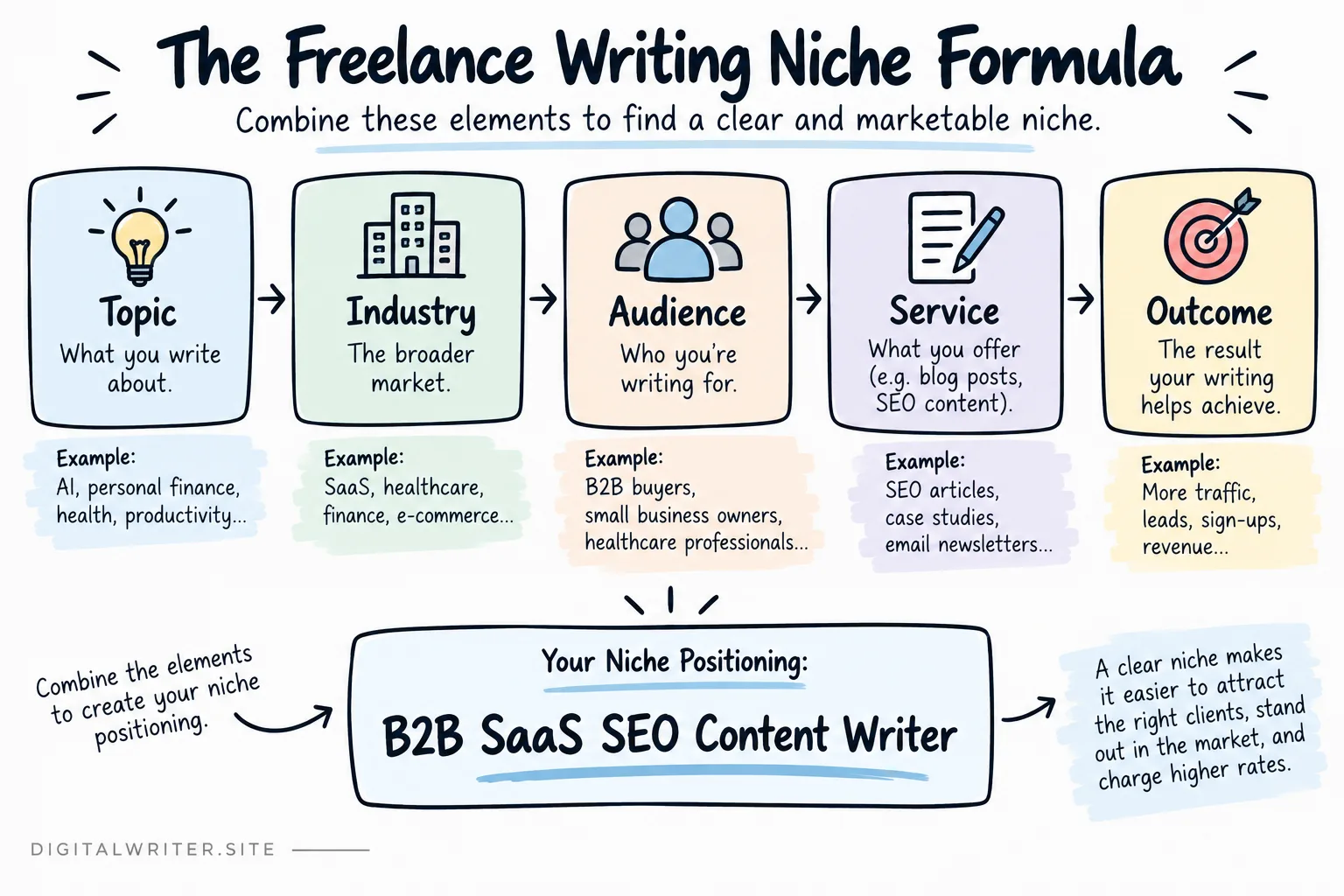
B2B SaaS SEO content writer
This tells a potential client which market you serve, what you write, and the type of content you provide. You can make the positioning even more specific by explaining the business outcome your work supports, such as attracting qualified organic traffic.
You don't need to include every element in your job title or website headline. Use them as a framework for deciding who you want to serve, what you want to offer, and why a client should hire you.
How to Choose a Freelance Writing Niche?
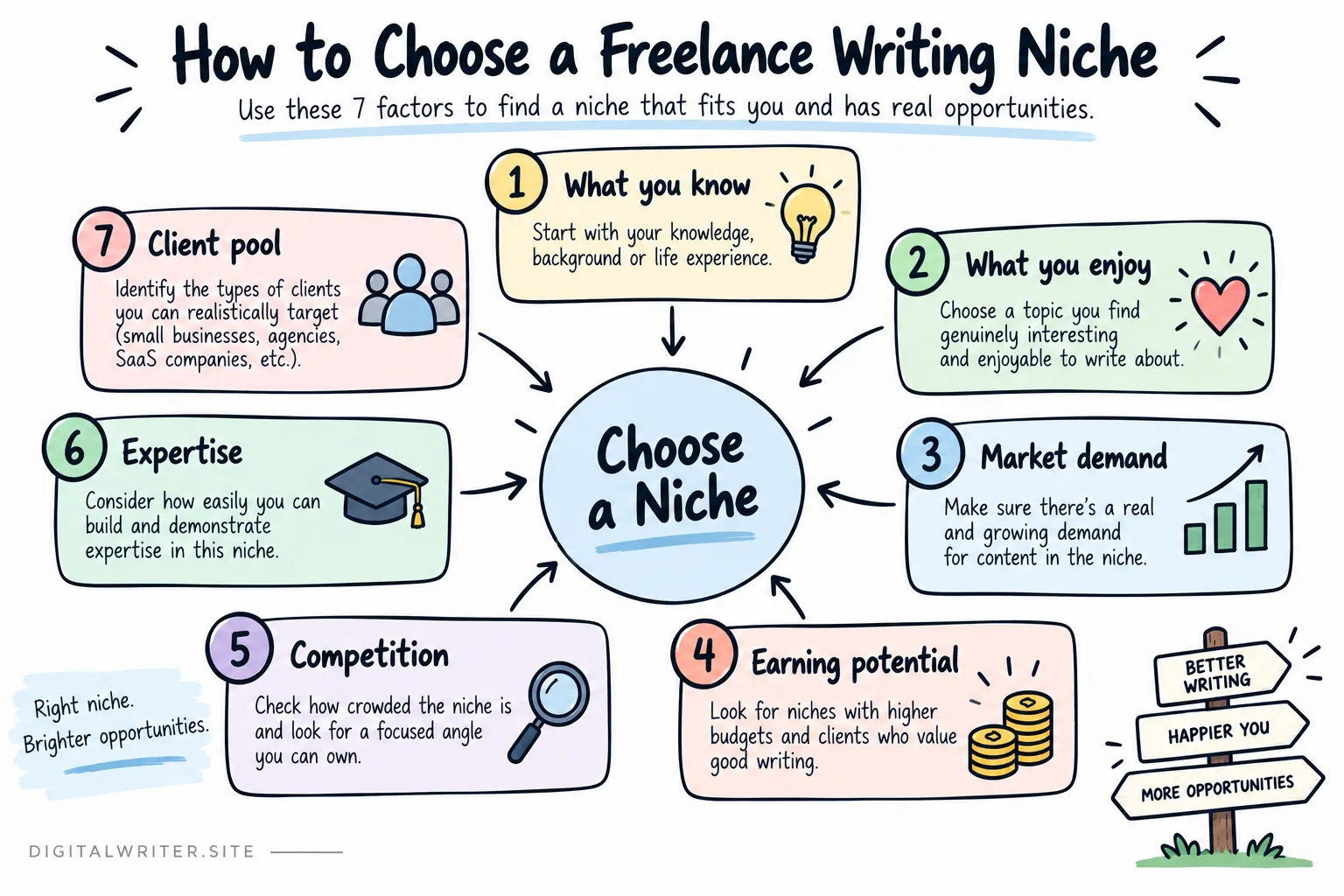
Choosing a freelance writing niche becomes much easier when you stop asking, “Which niche makes the most money?” and start asking, “Which niche makes the most sense for me and the market I want to serve?”
Your best option isn't based on one factor. You need to balance what you know, what you enjoy writing about, what you can write well, what businesses need, and what clients are willing to pay for.
The following framework gives you a practical way to compare your options instead of choosing a niche based on hype or guesswork.
At the end, you'll have a clearer idea of which niche fits your skills, interests, and freelance business goals.
1. Start With What You Already Know
You don't have to start your freelance writing career by becoming an expert in a subject you know nothing about. A good place to look for potential niches is your own experience.
Consider:
- Education: Subjects you studied or qualifications you earned.
- Professional experience: Industries, roles, or business processes you've worked with.
- Industry knowledge: Markets you understand from work or previous projects.
- Hobbies: Activities that have taught you useful knowledge about a particular subject.
- Previous writing experience: Topics or types of content you've written before.
- Personal interests: Subjects you enjoy learning about and could explore in greater depth.
Existing knowledge gives you a head start. When you already understand the basic terminology, audience, problems, and concepts within a field, you don't need to spend as much time learning the fundamentals before you can produce useful content.
That can also make research easier. Instead of trying to understand an entire industry from scratch for every assignment, you can focus your research on the details that matter for the specific piece you're writing.
Don't dismiss experience that doesn't seem related to writing. A former job, long-term hobby, or subject you've studied can give you knowledge that another writer would need years to develop.
Start with making a list of what you already know. You may find several potential freelance writing niches hiding in your experience.
2. Consider What You Actually Enjoy Writing About
Writing about a topic you enjoy can make freelance work much easier to sustain. Think about the subjects you can research for hours without getting bored, the topics you naturally follow, and the problems you enjoy trying to solve.
You might find yourself reading industry news, watching videos, joining discussions, or learning about a subject even when nobody is paying you to do it. That natural curiosity can become an advantage when you turn it into a writing niche.
Consider:
- Topics you can research for hours
- Subjects you naturally follow
- Problems you're interested in solving
- Topics you don't mind learning about
But interest alone isn't enough. You can love a subject and still struggle to build a freelance writing business around it if few businesses need content about it or clients aren't willing to pay for that work.
That's why you should treat personal interest as one part of the decision, not the entire decision. The strongest niche combines something you enjoy with your skills, market demand, and realistic opportunities to find clients.
A simple test is to ask yourself: “Would I still be interested in learning about this topic after I've written about it for the tenth, twentieth, or fiftieth time?” If the answer is yes, you may have found a subject worth exploring further.
3. Look at Market Demand
A writing niche can sound attractive on paper and still be a poor choice if businesses aren't hiring writers in that market. Don't judge demand by popularity alone. Look for evidence that companies actually buy the writing service you want to offer.
Start by looking for businesses that publish content, invest in SEO, send newsletters, maintain active blogs, or work with content marketing agencies. These are useful signs that content plays a role in the market.
However, go one step further and look for actual buying signals.
Search for:
- Freelance writer job postings
- Content writer job postings
- Agency subcontracting opportunities
- Companies hiring content marketers
- Companies publishing content on a consistent schedule
- Businesses expanding into new markets
- Companies launching new products or services
- Businesses with weak or outdated content
- Companies publishing content that could be improved
These signals tell you more than simply seeing that companies in a niche have blogs. A market may produce a lot of content but rely on internal teams, automated tools, or other resources rather than freelance writers.
The better question isn't: “Does this market use content?”
Ask: “Is this market currently buying the writing service I want to sell?”
That shift can help you find niches with real client opportunities rather than chasing markets that only look attractive from the outside.
You can also use keyword research for writers to see how to identify the topics businesses and audiences are actively searching for.
Businesses invest in content because useful, relevant content can help attract and retain an audience and support profitable customer action. The Content Marketing Institute explains how content marketing supports business goals.
4. Evaluate Earning Potential
A niche may have strong demand, but you also need to consider whether the work can support the freelance business you want to build. That means looking beyond the topic itself and considering the value of the work you're providing.
Several factors can affect freelance writing rates:
- Client type: A small business, startup, agency, and enterprise company may have different budgets and content needs.
- Content complexity: Specialized or technical content can require more knowledge and skill than a basic article.
- Writer expertise: As you develop deeper knowledge and a stronger track record, you can offer more value to clients.
- Business value: Content that helps a company attract qualified leads, educate prospects, or support sales can be more valuable than content with little business impact.
- Research requirements: Projects that require interviews, industry research, original research, or extensive fact-checking can require more time and expertise.
- Content format: Blog posts, website copy, case studies, white papers, and other formats have different demands.
- Industry: Some industries require more specialized knowledge, compliance awareness, or technical understanding.
- Scope of work: Research, interviews, SEO, revisions, strategy, and other responsibilities can all affect the price of a project.
The important point is that the niche itself does not determine your rate. The value you provide does.
A writer in a seemingly ordinary niche can earn more than a writer in a popular niche if they offer stronger expertise, solve more valuable problems, understand the client's business, and produce content that supports meaningful business goals.
So don't choose a niche simply because someone calls it a “high-paying niche.” Look at the type of work clients need, the value that work creates, and the skills you can develop to become more valuable within that market.
Your niche is only one factor that affects what you can charge. Learn more about the factors that influence freelance writing rates in this guide to digital writing rates.
The business value of content can extend beyond traffic to areas such as sales, customer loyalty, and revenue. The Content Marketing Institute discusses how businesses can connect content with measurable business value.
5. Look at the Competition
Seeing other freelance writers in your potential niche shouldn't make you walk away. Competition can be a sign that businesses are already paying for writing services.
The goal isn't to find a niche with no competition. It's to find a market where you can offer something valuable and stand out.
Start by researching the writers already serving the niche. Ask:
- How many writers serve this market?
- Are they generalists or specialists?
- What services do they offer?
- What types of clients do they target?
- How do they position themselves?
- Can you offer something different?
Look at their websites, portfolios, LinkedIn profiles, and service pages. Pay attention to the problems they focus on and the types of content they create.
Then look for gaps.
Perhaps most writers serve large companies while you could focus on small businesses. Maybe they offer blog writing but don't specialize in case studies or email content.
You might also bring industry experience, a different content format, or a stronger understanding of a specific audience.
Don't assume that low competition means a better opportunity.
A niche with little competition may have little demand. A competitive niche with strong demand can give you more potential clients, if you can find a clear way to differentiate yourself.
The question isn't “How can I avoid competition?” It's “What can I offer that makes the right clients choose me?”
6. Consider Whether You Can Build Expertise
Choosing a niche isn't only about what you know today. Think about whether you can become genuinely knowledgeable about the subject over time.
Ask yourself:
- Can you learn this subject deeply?
- Can you understand the audience?
- Can you explain complex concepts clearly?
- Can you produce credible content?
- Can you stay interested in the industry?
You don't need to know everything before choosing a niche. What matters is whether you're willing and able to keep learning. As you write more, research more, and work with clients in the industry, your knowledge can become a valuable part of what you offer.
Deep expertise can also make your writing stronger. You'll understand the terminology, recognize important issues, ask better questions, and know which details matter to the audience.
This is where niche selection connects to long-term authority. Instead of treating your niche as a label for your website or portfolio, you can use it as a foundation for building knowledge and becoming the writer clients turn to when they need content in that market.
Building expertise in a niche also gives you an opportunity to develop authority through related content. Learn how to approach this with the guide to topical authority.
7. Check Whether the Niche Has Enough Clients
A niche can look promising on paper and still be too small to support your freelance writing business. Before committing to one, make sure there are enough potential clients to give you room to find work, replace clients, and grow.
Look for different types of businesses and organizations that might need your services:
- Companies
- Agencies
- Publications
- Startups
- Consultants
- E-commerce brands
- SaaS businesses
- Professional service firms
Don't limit your research to companies that advertise for freelance writers.
Many businesses need content but don't post public job listings. Look for organizations that publish blogs, create resources, send newsletters, produce case studies, or invest in other forms of content.
Pay attention to the size of the potential market, too.
A niche with only a handful of suitable clients may leave you with few options when a project ends. A larger market gives you more opportunities to prospect, build relationships, and find clients that fit your preferred type of work.
The goal isn't to choose the largest possible niche. It's to find a niche that is specific enough to make your positioning clear while broad enough to provide a healthy pool of potential clients.
Once you've identified the type of businesses you want to work with, the next challenge is finding and approaching them. This guide to how to get writing clients can help you turn your niche into a practical client-acquisition strategy.
What Makes a Freelance Writing Niche Commercially Attractive?
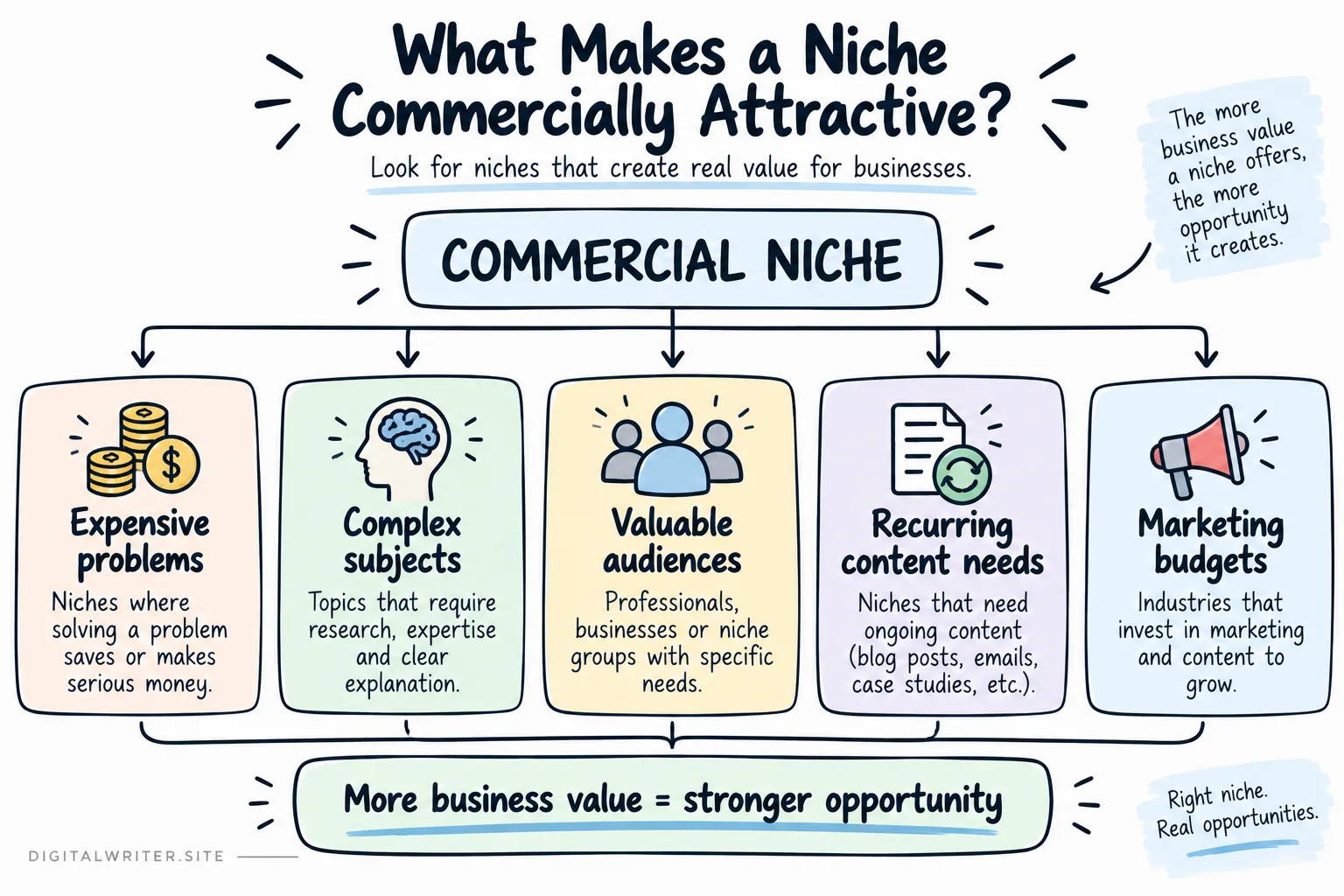
Not every niche with content demand is a strong freelance writing opportunity. A commercially attractive niche gives businesses a clear reason to invest in your work and gives you enough opportunities to build a sustainable writing business.
Look for these five factors when evaluating a niche:
1. Expensive Problems
Content becomes more valuable when poor communication can cost a business leads, sales, customer trust, or compliance.
For example, a company selling complex financial software may care more about accurate, persuasive content than a business where content has little effect on revenue. When the problem you're solving has a high business cost, clients have a stronger reason to invest in skilled writing.
2. Complex Subjects
Some subjects require knowledge, research, and judgment that aren't easy to replicate with generic content.
Technical, financial, healthcare, legal, and cybersecurity topics can create opportunities for writers who are willing to develop real subject knowledge. You don't need to be an industry veteran from day one, but you should be capable of learning the subject well enough to produce credible content.
3. Valuable Audiences
Consider the value of the people your client's content is trying to reach.
A business may be willing to invest more in content when attracting the right reader can lead to a high-value sale, long-term customer relationship, or business contract. The size of the audience matters less than its value to the business.
4. Recurring Content Needs
A niche becomes more attractive when businesses need content on an ongoing basis.
Look for markets where companies regularly need:
- Blog posts
- SEO content
- Website copy
- Case studies
- Email content
- Thought leadership
- Guides and resources
- Product content
Recurring needs can give you the chance to develop long-term client relationships instead of constantly searching for one-off projects.
5. Businesses With Marketing Budgets
A market can have plenty of businesses and still offer limited opportunities for freelance writers if those businesses don't invest in content.
Look for companies that already spend money on marketing, SEO, content, advertising, or customer education. Existing investment is a useful signal that businesses understand the value of reaching and educating their audience.
So, What Makes a Niche Worth Pursuing?
You don't need all five factors to be present. But the more of them a niche has, the more promising it may be.
This is why niches such as B2B SaaS, technical writing, finance, healthcare, legal, and cybersecurity can be attractive to freelance writers. They often involve complex subjects, valuable audiences, significant business problems, and ongoing content needs.
That doesn't mean these niches automatically pay the most. The niche creates the opportunity, but your expertise, positioning, service, and the value you provide determine what you can earn.
How AI Changes the Value of a Freelance Writing Niche
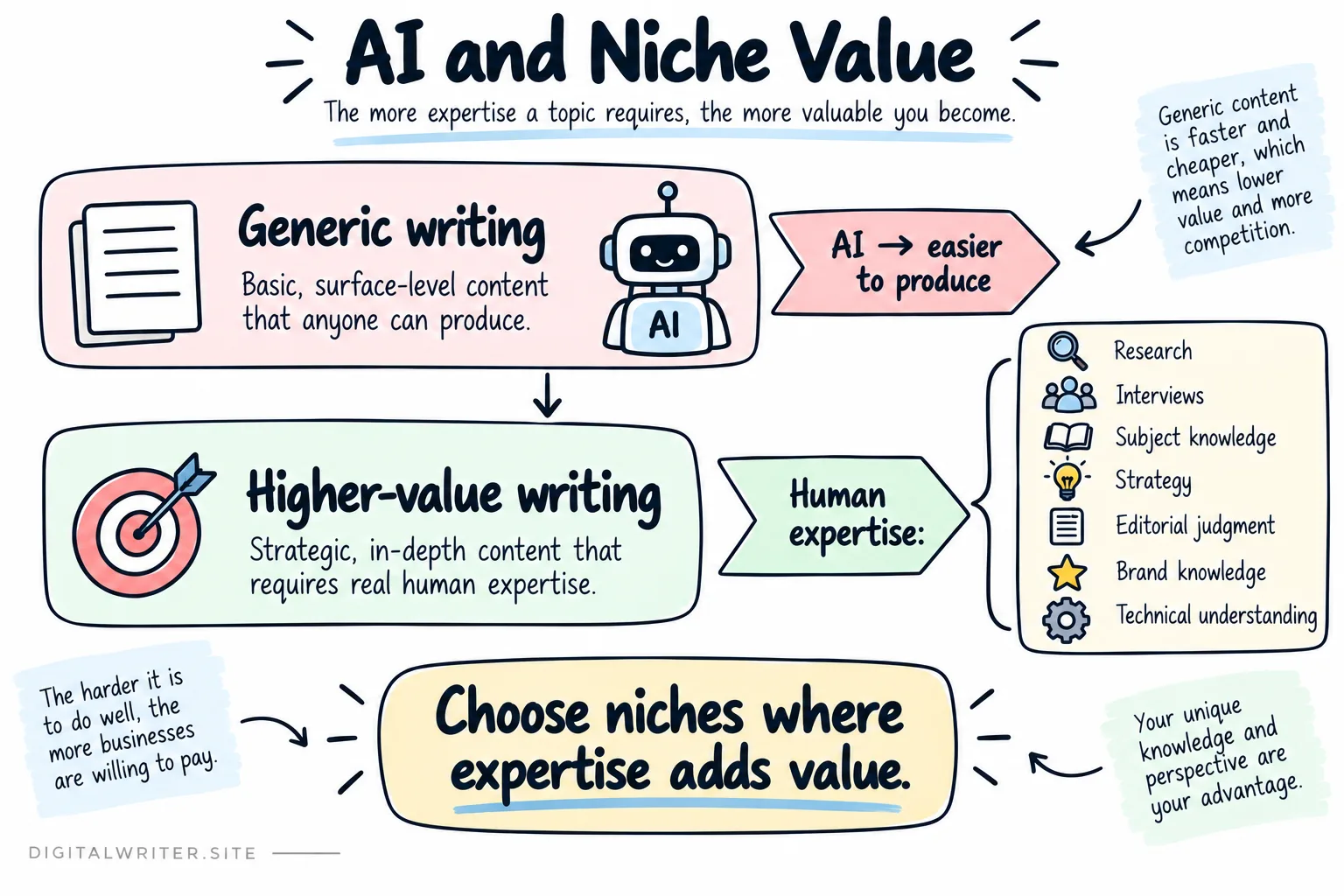
AI has made generic information easier to produce. That doesn't mean businesses no longer need writers. Instead, it changes where a writer can provide the most value.
When a client can generate a basic article with an AI tool, simply producing words becomes less distinctive. Writers can stand out by bringing knowledge, judgment, research, and business understanding that generic AI-generated content can't provide on its own.
Some niches are more defensible because the work requires:
- Subject expertise — You understand the industry and its terminology.
- Original research — You can find, evaluate, and interpret information beyond generic sources.
- Interviews — You can draw insights from customers, executives, specialists, and other sources.
- Expert insight — You can add knowledge and perspectives that aren't available in basic AI output.
- Technical understanding — You can explain complex products, systems, or processes accurately.
- Strategic thinking — You understand why the content exists and how it supports a business goal.
- Editorial judgment — You can decide what information belongs in the piece, what needs verification, and what readers actually need.
- Regulatory awareness — You understand when accuracy, compliance, and careful wording matter.
- Brand knowledge — You can adapt content to a company's voice, positioning, customers, and standards.
- Conversion knowledge — You understand how content can guide readers toward an action.
This doesn't mean every freelance writer needs to work in a highly technical or regulated niche. The key is to identify where your human expertise adds value beyond producing generic text.
For example, “AI writer” is a broad position. “B2B SaaS SEO content writer who understands complex software and creates content designed to attract qualified organic traffic” gives a potential client a much clearer reason to hire you.
The goal isn't to compete with AI at producing more words. It's to develop a niche where your knowledge, judgment, and understanding of the client make the writing more valuable.
The Best Freelance Writing Niches to Consider
There is no single best freelance writing niche. The right choice depends on your skills, interests, experience, the type of clients you want to work with, and the opportunities available in the market.
Instead of ranking niches from “best” to “worst,” it makes more sense to look at the different opportunities each one can offer. A niche may be a strong choice because it has many potential clients, ongoing content needs, opportunities to develop expertise, or room for specialization.
The examples below can help you compare your options. For each niche, consider who hires writers, what they need, how much subject knowledge you may need, where the opportunities are, and what challenges you could face.
B2B Writing
Who hires: B2B companies, professional service firms, technology companies, agencies, and consultants.
Common content needs: Blog posts, case studies, white papers, website content, reports, email campaigns, and thought leadership.
Knowledge required: A good understanding of business audiences, industries, products, and the problems businesses solve.
Potential advantages: B2B companies often need content that educates prospects and supports longer buying decisions. This creates opportunities for writers who can understand complex subjects and communicate them clearly.
Potential challenges: B2B audiences can be knowledgeable and demanding. You may need to understand technical subjects, industry terminology, and different decision-makers.
SaaS Writing
Who hires: SaaS companies, software startups, technology companies, and agencies serving software businesses.
Common content needs: SEO articles, product pages, comparison content, tutorials, case studies, email content, and knowledge-base articles.
Knowledge required: An understanding of software products, customer problems, SaaS business models, and the target audience.
Potential advantages: SaaS companies often have ongoing content needs and many topics to cover as their products and markets grow.
Potential challenges: Software products can be complex. You need to understand the product rather than rely on surface-level research.
Technology Writing
Who hires: Technology companies, software companies, publications, startups, and technology agencies.
Common content needs: Blog posts, guides, product content, news analysis, tutorials, and thought leadership.
Knowledge required: Depending on the subject, you may need to understand software, hardware, AI, cybersecurity, or other technical concepts.
Potential advantages: Technology gives writers many possible areas of specialization.
Potential challenges: Technology changes fast, so writers need to keep learning and verify information before publishing.
Finance Writing
Who hires: Financial companies, fintech businesses, banks, investment firms, publications, and financial services providers.
Common content needs: Educational articles, website content, newsletters, reports, guides, and financial explainers.
Knowledge required: A strong understanding of financial concepts and the ability to explain them without confusing readers.
Potential advantages: Finance offers many specialized subjects and audiences.
Potential challenges: Accuracy matters. Depending on the assignment, financial content can also require careful research and attention to regulatory considerations.
Healthcare Writing
Who hires: Healthcare organizations, health companies, medical businesses, publications, and agencies.
Common content needs: Patient education, blog articles, website content, guides, newsletters, and health-related educational materials.
Knowledge required: Strong research skills and an ability to understand and explain medical or health information.
Potential advantages: Healthcare covers a large range of subjects and audiences, giving writers room to specialize.
Potential challenges: Accuracy and responsible communication are critical. Writers may need to work with subject-matter experts and reliable sources.
Legal Writing
Who hires: Law firms, legal technology companies, publications, consultants, and agencies.
Common content needs: Practice-area articles, website content, legal guides, newsletters, and educational resources.
Knowledge required: Familiarity with legal terminology and the ability to communicate complex information clearly.
Potential advantages: Writers can specialize in areas such as employment law, real estate law, business law, or intellectual property.
Potential challenges: Legal content requires careful research and accuracy. Writers must also avoid presenting general information as personalized legal advice.
Real Estate Writing
Who hires: Real estate agencies, brokers, property companies, developers, and real estate technology businesses.
Common content needs: Property content, market articles, neighborhood guides, blog posts, website copy, and email content.
Knowledge required: An understanding of the real estate market and the audience you're writing for.
Potential advantages: There are many possible sub-niches, from residential real estate to commercial property and real estate investing.
Potential challenges: Local knowledge can matter, and market information can become outdated.
E-commerce Writing
Who hires: Online retailers, e-commerce brands, agencies, and product companies.
Common content needs: Product descriptions, category pages, buying guides, blog posts, emails, and landing pages.
Knowledge required: Understanding of products, customers, search intent, and conversion-focused writing.
Potential advantages: E-commerce businesses need content across many stages of the buying journey.
Potential challenges: Some projects involve large volumes of content, and writers need to maintain quality and consistency across many products.
Digital Marketing Writing
Who hires: Marketing agencies, software companies, consultants, and businesses with in-house marketing teams.
Common content needs: Blog posts, landing pages, email campaigns, lead magnets, case studies, and marketing guides.
Knowledge required: Familiarity with content marketing, SEO, email marketing, conversion, and digital channels.
Potential advantages: Writers can combine writing skills with marketing knowledge to offer more strategic value.
Potential challenges: Digital marketing changes fast, so writers need to keep their knowledge current.
SEO Writing
Who hires: Businesses, agencies, publishers, e-commerce companies, and companies investing in organic search.
Common content needs: SEO blog posts, guides, comparison pages, landing pages, and supporting content.
Knowledge required: Search intent, keyword research, content structure, on-page SEO, and reader-focused writing.
Potential advantages: SEO writing can apply across many industries, giving writers flexibility while allowing them to specialize in the service itself.
Potential challenges: Good SEO writing requires more than inserting keywords. Writers need to understand search intent, the audience, and the business purpose of the content.
If you decide to specialize in SEO writing, the SEO Writing Guide provides a deeper look at the skills and strategies involved in creating content that serves both readers and search engines.
Technical Writing
Who hires: Software companies, technology businesses, manufacturers, engineering companies, and other organizations with complex products or processes.
Common content needs: Documentation, user guides, tutorials, product documentation, technical articles, and knowledge bases.
Knowledge required: Strong research skills, technical understanding, and the ability to turn complex information into clear instructions.
Potential advantages: Technical knowledge can create a strong barrier to entry and make specialized writers valuable.
Potential challenges: The subject matter can have a steep learning curve, and accuracy is essential.
Travel Writing
Who hires: Travel companies, tourism organizations, publications, hotels, agencies, and travel websites.
Common content needs: Destination guides, travel articles, itineraries, hotel content, and travel blogs.
Knowledge required: Research skills, destination knowledge, and an understanding of travel audiences.
Potential advantages: Travel offers a wide range of subjects and opportunities to develop regional or travel-style specializations.
Potential challenges: Competition can be high, and some travel writing markets have limited budgets.
Education Writing
Who hires: Schools, educational companies, online learning platforms, publishers, and education technology businesses.
Common content needs: Educational articles, course content, guides, lesson materials, website content, and learning resources.
Knowledge required: Strong research and communication skills, plus an understanding of the learner or educator you're writing for.
Potential advantages: Writers can specialize in subjects, age groups, learning formats, or education technology.
Potential challenges: Content often needs to be clear, accurate, accessible, and appropriate for a specific learning level.
Personal Finance Writing
Who hires: Financial websites, fintech companies, banks, publishers, and personal finance brands.
Common content needs: Money guides, budgeting articles, investing education, product comparisons, newsletters, and financial explainers.
Knowledge required: Strong financial literacy and research skills.
Potential advantages: Personal finance has many potential subtopics and audiences, allowing writers to develop a focused specialty.
Potential challenges: Financial information must be accurate and current, and some topics require careful handling because readers may make important financial decisions based on the content.
Business Writing
Who hires: Companies, consultants, professional service firms, publications, and business-focused websites.
Common content needs: Business articles, reports, thought leadership, website content, case studies, newsletters, and company communications.
Knowledge required: A broad understanding of business concepts and the ability to adapt writing to different professional audiences.
Potential advantages: Business writing can provide flexibility across industries while still giving you opportunities to specialize in specific business topics.
Potential challenges: “Business writer” can be too broad as a market position. You may need to narrow your audience, subject, or service to stand out.
How to Use This List?
Don't choose a niche because it appears near the top of a list or because someone calls it a high-paying freelance writing niche. Use these examples as starting points for research.
Look for the combination that makes the most sense for you:
Your knowledge + your interests + market demand + client opportunities + the value you can provide
You may discover that your strongest niche isn't a single category. It could be a combination such as B2B SaaS SEO writing, technical content for cybersecurity companies, or personal finance content for fintech brands.
That level of specificity can give you a clearer position without forcing you to turn down every project outside your niche.
How to Compare Freelance Writing Niches?
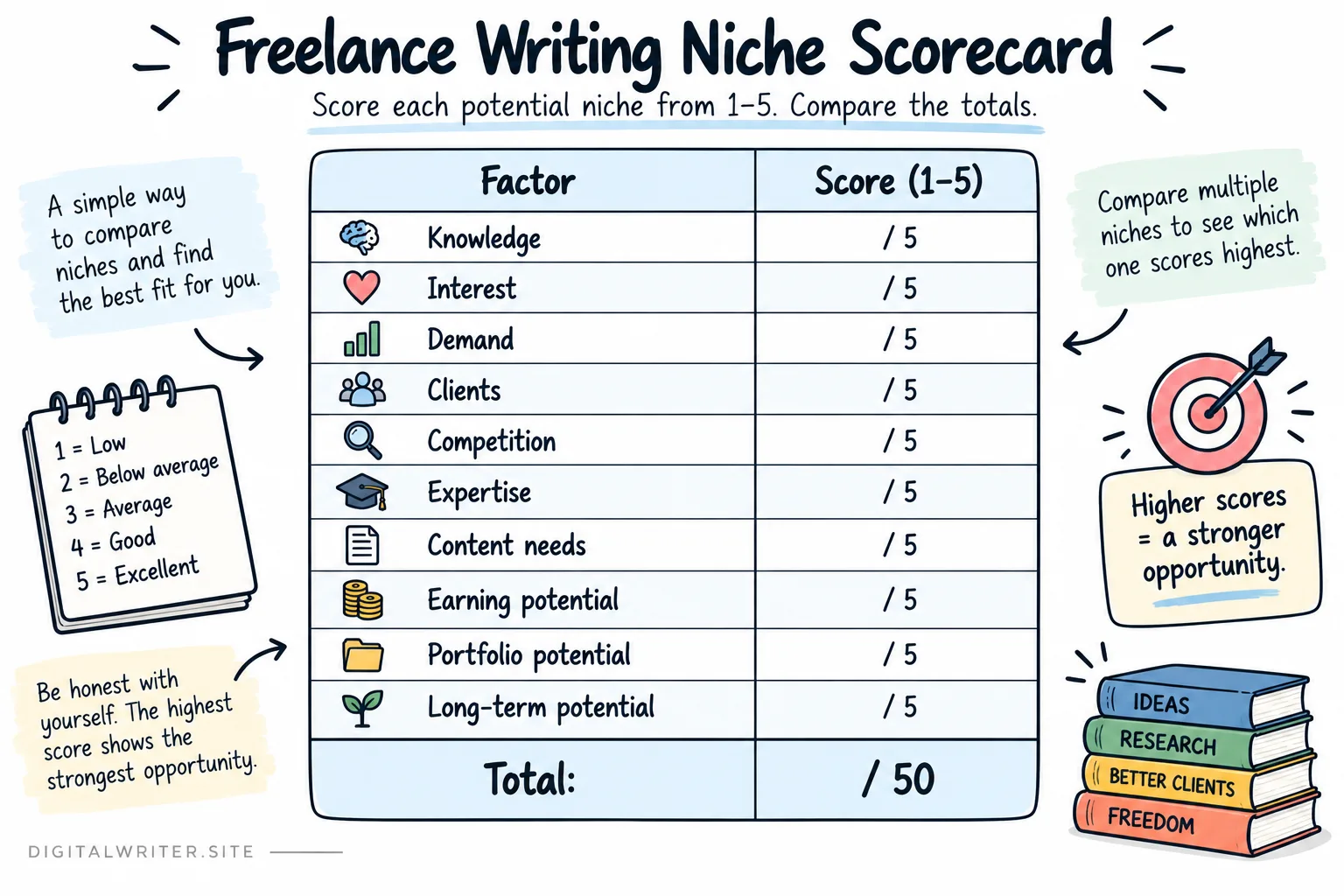
Choosing between several promising niches can be harder than finding them in the first place. Instead of relying on gut instinct or choosing the niche that sounds the most profitable, use a simple scoring system to compare your options side by side.
For each potential niche, ask the questions below. Be honest with your answers. A niche that looks attractive at first may lose its appeal once you consider the competition, client pool, or long-term potential.
| Factor | Questions to Ask |
|---|---|
| Knowledge | Do I understand the subject? |
| Interest | Can I stay interested in it? |
| Demand | Do businesses need content? |
| Clients | Are there enough potential clients? |
| Competition | Can I differentiate myself? |
| Expertise | Can I become highly knowledgeable? |
| Content needs | Do clients need ongoing content? |
| Earning potential | Does the work create business value? |
| Portfolio | Can I create relevant samples? |
| Long-term potential | Can I build a career around it? |
Score Each Niche
Choose three to five niches you're considering and give each factor a score from 1 to 5.
- 1: Very weak
- 2: Weak
- 3: Average
- 4: Strong
- 5: Excellent
Add up the scores for each niche and compare the results. The highest score doesn't automatically make that niche your winner, but it gives you a more objective starting point.
Pay close attention to the areas where a niche scores poorly. A niche might have strong earning potential but few potential clients. Another might match your interests but have little demand for freelance writing.
The goal isn't to find a perfect score. It's to identify the niche with the best overall fit between your strengths, the market, and the freelance business you want to build.
A Simple Freelance Writing Niche Selection Exercise
If you’re still unsure which niche to choose, turn the decision into a simple exercise. Instead of trying to predict the perfect niche, work through these eight steps and let the evidence narrow your options.
Step 1: Write Down 5–10 Topics You Know
List subjects you understand from your education, work experience, hobbies, previous writing, or personal interests. Don't worry about whether they seem profitable yet. The goal is to see what you already bring to the table.
Step 2: List Industries You Understand or Want to Learn
Think beyond individual topics. Consider industries where you already have knowledge or would enjoy developing expertise.
Step 3: Identify Businesses That Hire Writers
Find companies, agencies, publications, startups, consultants, e-commerce brands, SaaS businesses, and professional service firms that operate in those industries.
Look for evidence that they use content as part of their business or marketing.
Step 4: Look at Their Content Needs
Review what these businesses publish. Do they need blog posts, website copy, case studies, emails, guides, technical content, or other forms of writing?
This helps you see whether your potential niche has real opportunities.
Step 5: Choose 3 Potential Niches
Narrow your list to three options that seem to offer the strongest combination of your skills, interests, and market opportunities.
Step 6: Score Each Niche
Use the comparison framework from the previous section. Score each niche for knowledge, interest, demand, clients, competition, expertise, content needs, earning potential, portfolio opportunities, and long-term potential.
Step 7: Choose the Strongest Candidate
Look at the scores and your reasoning. Choose the niche that offers the strongest overall fit rather than simply picking the one with the highest earning potential.
Step 8: Test It Before Committing Fully
Don't treat your decision as permanent. Create relevant samples, identify potential clients, and start pitching or networking within the niche.
Pay attention to the response you get and your own experience doing the work. If the niche shows promise, build on it. If it doesn't, use what you've learned to test another option.
The goal isn't to choose your perfect niche in one sitting. It's to make an informed choice, test it in the real market, and refine your direction as you gain experience.
Should You Choose a Broad or Narrow Freelance Writing Niche?
Once you understand your options, you still have another decision to make: How specific should your niche be?
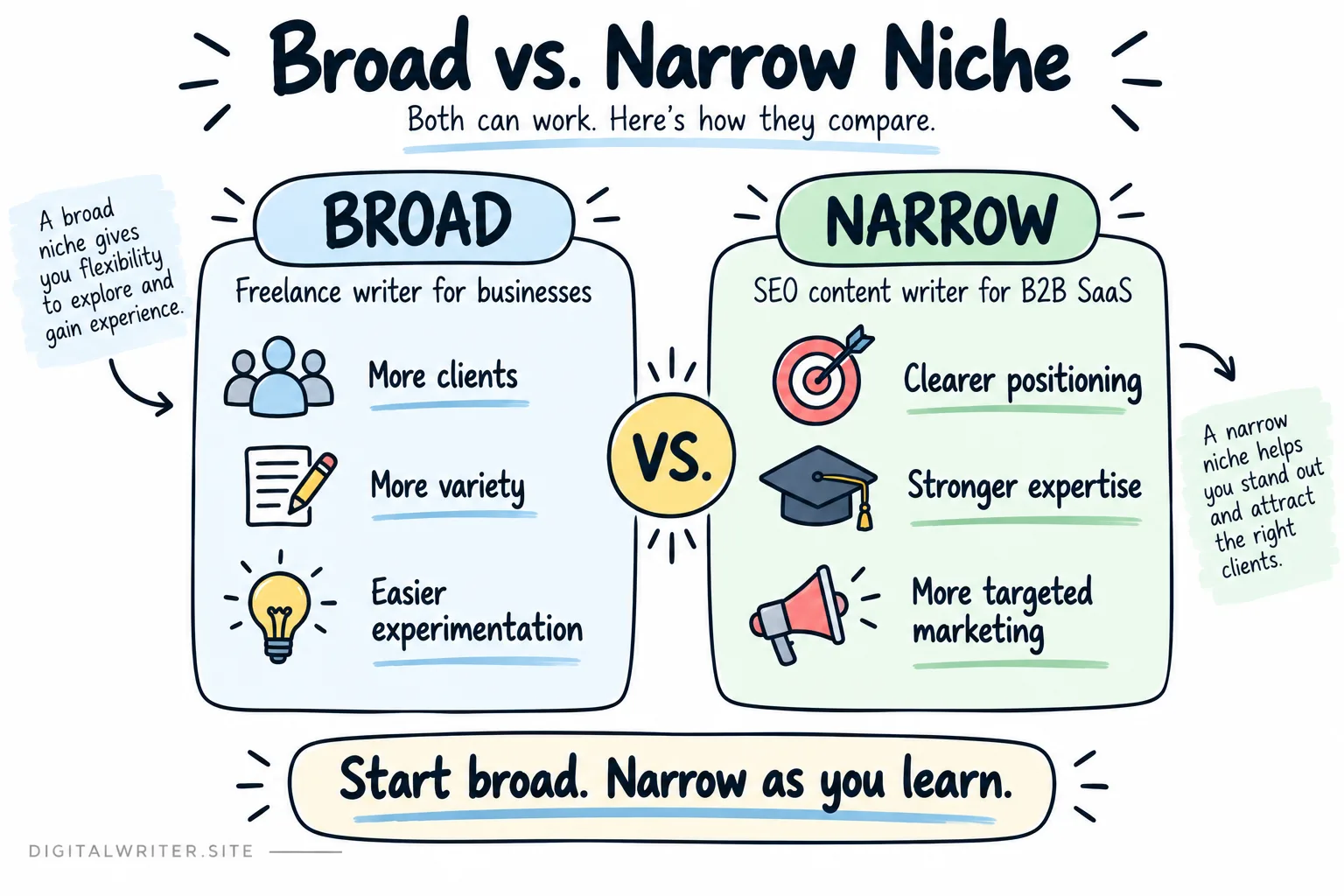
Compare these two positions:
Broad: Freelance writer for businesses
Narrow: SEO content writer for SaaS companies
The first gives you access to a wider range of projects. The second makes it much clearer what you do, who you serve, and where your expertise lies. Neither approach is automatically better. The right choice depends on where you are in your freelance career and what you're trying to build.
Broad Niche
A broad position gives you more room to explore.
Pros:
- More potential clients
- More variety in your work
- Easier to experiment with different industries and services
Cons:
- Harder to differentiate yourself
- Less focused marketing
- Harder to establish specialized expertise
A broad approach can make sense when you're new to freelance writing and still figuring out which types of work you enjoy and where you can find opportunities.
Narrow Niche
A narrow position gives your freelance business a clearer identity.
Pros:
- Clear positioning
- Stronger expertise
- Easier portfolio development
- More targeted prospecting
Cons:
- Smaller potential market
- May feel restrictive
- Requires deeper subject knowledge
When you specialize, you can create samples and marketing messages that speak directly to your ideal clients. The trade-off is that you may have fewer potential clients and need to invest more time in understanding your chosen market.
You Don't Have to Choose Forever
You don't need to start with the narrowest possible niche. In fact, starting relatively broad can help you discover what works before you specialize.
You might begin as a freelance writer for businesses, then notice that your strongest projects involve SEO content.
Later, you may discover that you enjoy working with SaaS companies and understand their products well. Your positioning can then evolve into SEO content writer for SaaS companies.
The key takeaway: Start with enough focus to give your freelance business direction, but leave yourself room to learn. As you discover where your skills, interests, and market opportunities overlap, you can narrow your niche and strengthen your positioning.
What If You Can't Decide on a Freelance Writing Niche?
Sometimes the problem isn't finding potential niches. It's choosing between several that all seem like good options. If you're stuck, you don't have to make the decision based on guesswork.
Choose two or three possibilities and test them. Create a few relevant sample pieces for each niche, then start pitching potential clients in those areas. Track which pitches lead to conversations, which questions prospects ask, and where you see the strongest interest.
At the same time, pay attention to your own experience. Which type of work do you enjoy? Which subjects do you find easier to research? Where do you feel your knowledge growing? Which niche seems to produce better opportunities?
This gives you something more useful than a theoretical answer: real-world evidence.
You don't need to choose your forever niche on day one. Your first niche can be a starting point. As you gain experience, talk to clients, and see what works, you can refine your focus, or change direction entirely.
Common Mistakes When Choosing a Writing Niche
Choosing a niche can give your freelance writing business direction, but the wrong approach can leave you with a market you don't enjoy, few clients to target, or a position that's too vague to stand out. Watch for these common mistakes before you commit.
Choosing a Niche Only Because It Pays Well
A niche may have a reputation for high rates, but that doesn't mean it's the right fit for you.
If you have little interest in the subject or struggle to understand the audience, producing strong work can become difficult. You may also spend more time researching each assignment than a writer with relevant expertise.
Look at earning potential, but consider it alongside your skills, interest, demand, and ability to develop expertise.
Choosing Something You Know Nothing About
You don't need to be an expert before entering a niche, but starting with zero knowledge creates a steeper learning curve.
You'll need more time to understand basic concepts, terminology, competitors, and the audience. That can affect both your productivity and the quality of your work.
Choose a niche where you have some relevant knowledge or a genuine willingness to learn and develop expertise.
Picking a Niche That's Too Broad
A niche that's too broad can make your positioning difficult to understand.
For example:
“I write about business.”
What type of business? For which audience? What kind of content do you provide?
A more focused position gives potential clients a clearer reason to consider you. You don't need to become extremely narrow, but you should provide enough detail to distinguish your services from those of a generalist writer.
Picking a Niche That's Too Narrow
Going too far in the other direction can create another problem: there may not be enough potential clients.
If your niche applies to only a handful of businesses, you may struggle to find consistent work or replace clients when projects end.
Before narrowing your position, make sure there is a large enough market to support your goals. Specificity is useful only when there are enough opportunities behind it.
Copying Another Writer's Niche
You may see another writer succeeding in a particular niche and assume you should do the same.
But their niche works because it fits their skills, experience, interests, positioning, and market. Those factors may not apply to you.
Use successful writers as sources of ideas, not templates to copy. Look for opportunities where your own strengths give you an advantage.
Changing Niches Every Week
Experimenting is useful when you're trying to find your direction. Constantly changing your niche, however, can make it difficult to build recognition and expertise.
If your website says one thing this week, your portfolio focuses on another topic next week, and your outreach targets a different market the week after, potential clients may struggle to understand what you actually specialize in.
Give a promising niche enough time to produce meaningful evidence before abandoning it.
Confusing a Topic With a Market
A topic and a market aren't the same thing.
AI is a topic. SaaS companies using AI tools can represent a target market.
The distinction matters because businesses, not topics, hire writers.
Instead of asking only, “What do I want to write about?”, also ask:
“Which businesses need this content, and who am I helping them reach?”
That shift can turn a general subject into a clear freelance writing niche with a defined audience and client base.
How to Test a Freelance Writing Niche Before Committing?
You don't have to bet your freelance writing career on a niche you haven't tested. A 30-day niche test can give you useful evidence before you commit to building your portfolio, marketing, and positioning around it.
The goal is simple: spend a month researching the market, creating relevant work, and talking to potential clients. Then use what you learn to decide whether the niche deserves more of your time.
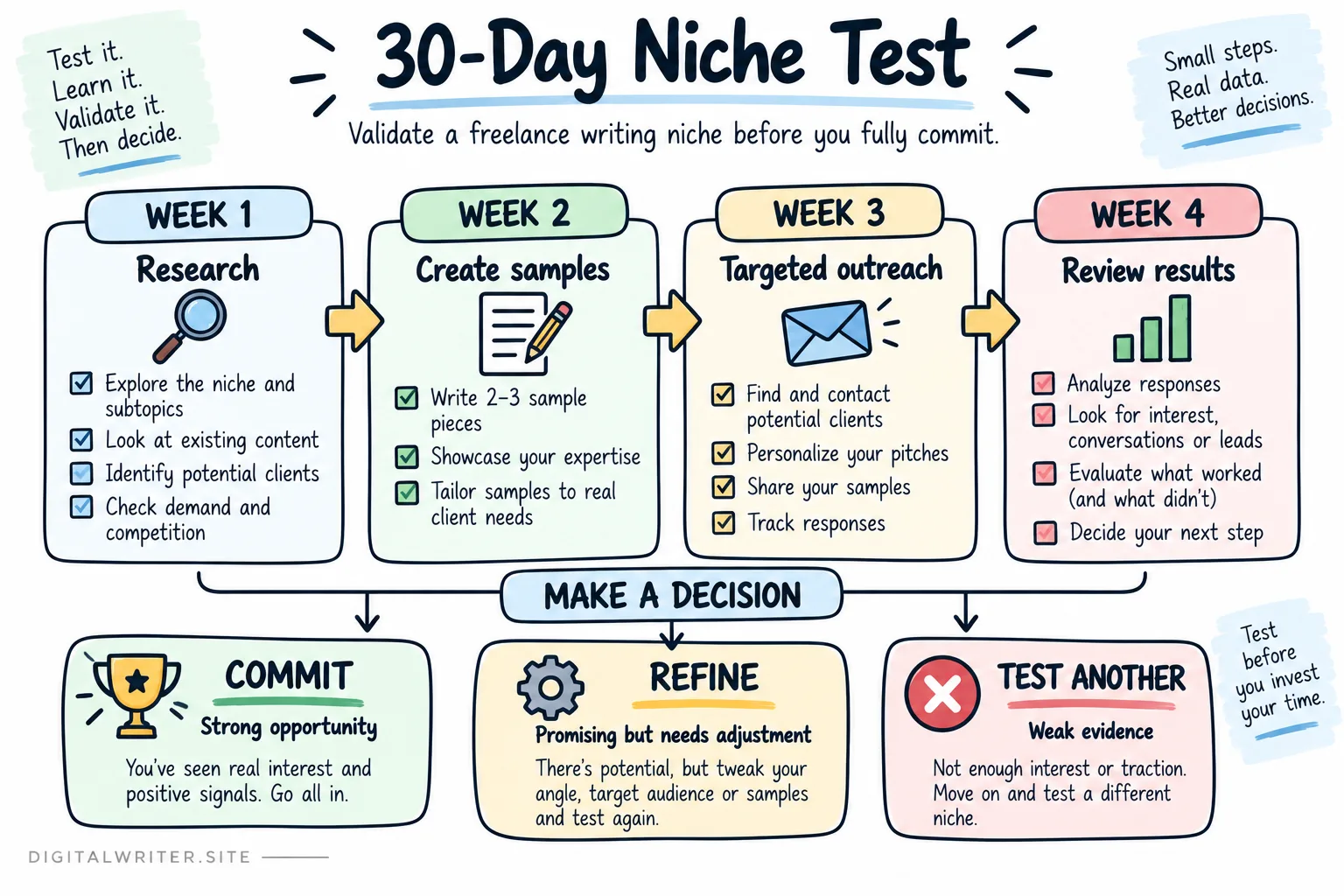
Week 1: Research the Niche
Start by learning about the market and identifying potential clients.
Look for:
- Companies that operate in the niche
- Agencies that serve those companies
- Businesses that publish content
- Potential decision-makers to contact
- Common content needs
- Problems your writing could help solve
You want to confirm that there is a real market behind your idea.
Week 2: Create Portfolio Samples
Create two or three relevant writing samples that demonstrate what you could offer clients in the niche.
Choose topics and formats that potential clients actually need. For example, if you're testing an SEO writing niche, create samples that demonstrate your ability to research a topic, satisfy search intent, and produce useful content.
Your samples don't need to come from paying clients. They need to show that you can do the work.
Once you choose a niche, your portfolio should support the position you want to sell. The Proof-Aligned Portfolio Method can help you select and present samples that support your positioning.
Week 3: Start Targeted Outreach
Now take your niche into the real market.
Contact potential clients with a focused pitch that explains:
- Who you help
- What type of content you provide
- Why you understand their audience or industry
- How your writing can support their goals
Don't focus only on getting hired. Pay attention to how people respond to your offer.
Week 4: Review What You Learned
After three weeks of research, samples, and outreach, look at the evidence.
Consider:
- Responses: Are potential clients responding to your outreach?
- Client interest: Do prospects show interest in your services?
- Questions prospects ask: What problems or content needs keep coming up?
- Your enjoyment: Did you enjoy researching and writing about the niche?
- Quality of your work: Can you produce strong content without constantly struggling with the subject?
- Potential for repeat work: Do clients appear to have ongoing content needs?
You don't need dozens of clients to reach a conclusion. You're looking for enough evidence to decide whether the niche is worth pursuing.
Decide: Commit, Refine, or Test Another Niche
At the end of the 30 days, choose one of three paths:
Commit: The market shows promise, you enjoy the work, and you see opportunities to build a business around the niche.
Refine: The niche has potential, but your positioning is too broad or needs adjustment. Narrow your audience, service, industry, or content type and test again.
Test another niche: The evidence isn't strong enough to justify investing more time. Take what you learned and apply it to your next option.
This approach takes the pressure out of niche selection. You don't need to predict the perfect niche, you can test your way toward one.
How to Position Yourself Once You Choose a Niche?
Choosing a niche is only the first step. Once you know who you want to serve and what you want to write, your marketing should make that position clear.
Start by reviewing the places where potential clients encounter you:
- Rewrite your freelance writer bio to highlight your niche, expertise, and the type of clients you serve.
- Update your LinkedIn profile so your headline, About section, and experience reflect your new positioning.
- Build a niche-specific portfolio that puts your most relevant work first.
- Create relevant samples if you don't have enough client work in your chosen niche.
- Identify target clients that match your industry, audience, and service.
- Adjust your pitch so you speak directly to the problems and content needs of those clients.
- Publish niche-related content to demonstrate your knowledge and attract the audience you want to reach.
- Build authority around the topic by consistently producing useful content and developing deeper expertise.
The goal is consistency. Your website, portfolio, LinkedIn profile, pitches, and published content should tell the same basic story about what you do and who you help.
Make Your Positioning Specific
Compare these two statements:
Weak:
“I'm a freelance writer who writes about many topics.”
Stronger:
“I write SEO content for B2B SaaS companies that want to attract qualified organic traffic.”
The second statement gives a potential client much more information. It identifies the service (SEO content), the market (B2B SaaS companies), and the business goal (attracting qualified organic traffic).
You don't need to use the exact same wording everywhere, but your positioning should remain clear and consistent. When the right client visits your website or profile, they should quickly understand what you do, who you serve, and why your expertise matters.
Can You Have More Than One Freelance Writing Niche?
Yes. You can have more than one freelance writing niche. In fact, combining closely related niches can give you flexibility without making your positioning vague.
A good approach is to choose one primary niche that gives your freelance business a clear focus. You can then add a secondary niche that expands your opportunities without taking your positioning in a completely different direction.
For example, these combinations make sense:
- SaaS + technology
- SEO + digital marketing
- Finance + fintech
- Healthcare + wellness
- Real estate + home improvement
Related niches can also reinforce each other. A writer who understands SaaS may find it natural to write about broader technology topics. An SEO writer can expand into digital marketing because the subjects and clients often overlap.
The key is to avoid presenting yourself as an expert in everything. If your website lists ten unrelated niches, potential clients may struggle to understand what you actually specialize in.
Think of your niches as a focused group of related skills and markets, not a list of every topic you can write about. One strong primary niche can establish your identity, while a related secondary niche gives you room to grow.
How to Know When It's Time to Change Your Niche?
Choosing a niche doesn't mean you have to stay with it forever. Your skills, interests, goals, and the market can all change as your freelance writing career develops. Sometimes the best move is to adjust your direction.
Here are some signs that it may be time to reconsider your niche:
- Consistent lack of client demand: You've tested the market and continue to struggle to find suitable clients or projects.
- You've lost interest in the subject: You no longer enjoy researching or writing about the topic.
- Better opportunities appear elsewhere: Another market offers stronger demand, better clients, or work that fits your skills more closely.
- The niche doesn't fit your expertise: You discover that developing the level of knowledge the market requires isn't a good match for you.
- You struggle to produce strong work: The subject remains difficult even after you've invested time in learning it.
- Your positioning no longer reflects your goals: Your niche may have made sense when you started, but your career has moved in a different direction.
Changing niches isn't a sign that you failed. It can be a normal part of developing a freelance writing career.
Your first niche can teach you what type of clients you enjoy, what work you're good at, and where the strongest opportunities exist. That experience can help you make a better decision the next time.
The goal isn't to stay loyal to a niche. The goal is to build a freelance writing business that continues to fit your skills, interests, and opportunities.
Freelance Writing Niche FAQs
What is the best niche for freelance writers?
There is no single best freelance writing niche. The best niche is one that matches your knowledge, interests, writing skills, market demand, client opportunities, and earning potential.
How do I find my freelance writing niche?
Start with topics you know and enjoy, then research market demand, potential clients, competition, content needs, and earning potential. Compare several options before choosing one to test.
Which freelance writing niches pay the most?
Rates vary by client, project complexity, writer expertise, content format, industry, and business value. Instead of choosing a niche based only on its reputation for high rates, focus on where you can provide valuable expertise.
Is SEO writing a good freelance niche?
Yes. SEO writing can be a strong niche because businesses, agencies, publishers, and e-commerce companies need content that attracts search traffic. You can also combine SEO with an industry or audience to create a more focused position.
Can a beginner freelance writer specialize in a niche?
Yes. A beginner doesn't need to be an expert before choosing a niche. Start with an area you understand or are willing to learn, create relevant samples, and build expertise through research and client work.
Should freelance writers have one niche or several?
One primary niche can provide focus, while a related secondary niche can expand your opportunities. Closely related niches often make more sense than presenting yourself as an expert in many unrelated subjects.
Can I change my freelance writing niche later?
Yes. Your niche isn't permanent. You can change it when your interests, expertise, goals, or market opportunities change. Testing a new niche before making a full transition can reduce the risk.
How narrow should my writing niche be?
Your niche should be specific enough to make your positioning clear but broad enough to provide enough potential clients. You can start broader and narrow your focus as you learn where your strongest opportunities lie.
Conclusion: Choose a Niche You Can Build On
Choosing a freelance writing niche isn't about finding the trendiest topic or the niche someone else says pays the most. It's about finding a market where your skills and interests meet real business demand.
Start with what you already know and enjoy. Look at whether businesses need writers, whether there are enough potential clients, and how you can differentiate yourself from other writers. Then consider whether the niche gives you room to develop deeper expertise and build authority over time.
Most important, test your niche before making a major commitment. Create relevant samples, contact potential clients, and pay attention to the response. Real-world experience can tell you more than any list of “best freelance writing niches.”
Your niche can also evolve as your career develops. You can start broad, narrow your focus as you learn, or move into a related market when better opportunities appear.
The best niche isn't necessarily the one with the most hype. It's the one you can build on.
If you're ready to strengthen your SEO writing skills and build a more focused writing business, explore the SEO Writing Hub.