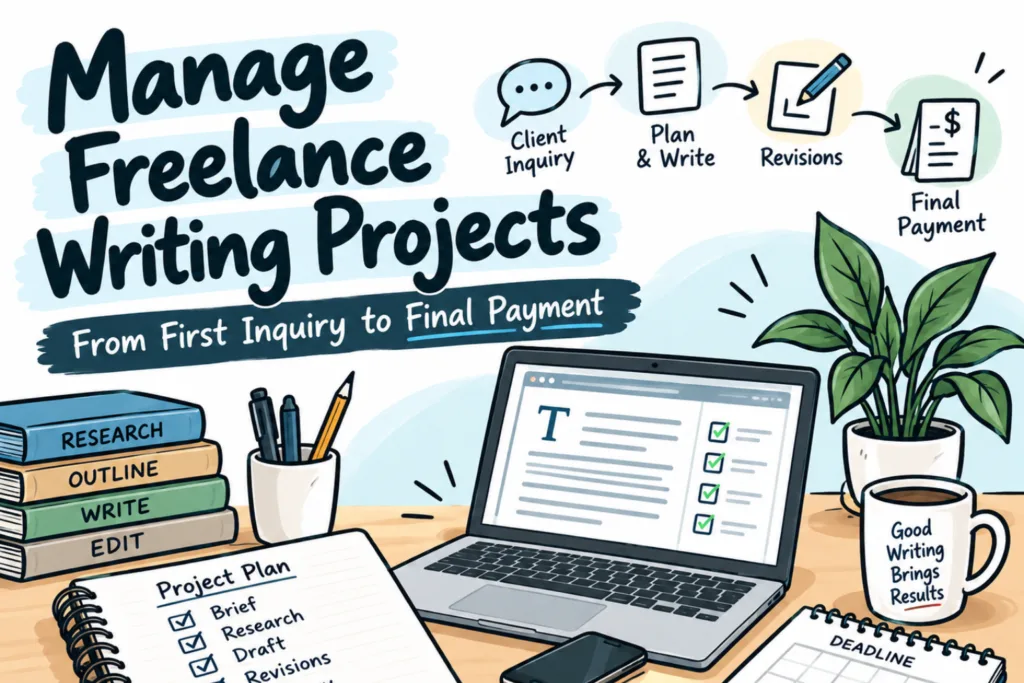

Managing a freelance writing project involves more than writing an article and sending it to a client. You need to understand what the client wants, agree on the price and deadline, plan the work, handle feedback, and make sure you get paid.
Without a clear process, small jobs can become frustrating. A client might ask for extra sections halfway through the project, send feedback a day before publication, or assume that your original fee includes unlimited revisions.
You can avoid many of these problems by agreeing on the details before you start.
This guide walks you through the entire process, from the first client inquiry to final delivery and payment. You will also follow one example project throughout the article to see how each step works in practice.
If you're building a freelance writing career, explore our Freelance Writing hub for practical guides on finding clients, pricing your services, managing projects, and building a sustainable writing business.
How do you manage a freelance writing project from start to finish?
Follow these nine steps to keep your writing projects organized, meet deadlines, and avoid misunderstandings with clients:
- Understand the client's needs and clarify the brief.
- Estimate the work and prepare your quote.
- Agree on the scope, payment terms, and deadline.
- Collect the materials and plan your schedule.
- Research, write, and proofread the draft.
- Submit the draft and collect feedback.
- Complete the agreed revisions.
- Deliver the final files and collect payment.
- Close the project, update your records, and request feedback.
Table of Content
- The Freelance Writing Project Workflow
- Step 1: Understand what the client needs
- Step 2: Estimate the work and prepare your quote
- Step 3: Agree on the scope before starting
- Step 4: Collect the brief and plan the schedule
- Step 5: Research, write, and check the draft
- Step 6: Submit the draft and collect feedback
- Step 7: Complete the agreed revisions
- Step 8: Deliver the final files and collect payment
- Step 9: Close the project properly
- A complete project example: From inquiry to payment
- Common freelance project management mistakes
- Freelance writing project checklist
- Related Guides
- Final Thoughts
- Frequently Asked Questions
The Freelance Writing Project Workflow
Most writing projects follow these nine steps:
- Understand the client's request.
- Estimate the work and prepare a quote.
- Agree on the scope, payment terms, and deadline.
- Collect the brief and plan the schedule.
- Research, write, and check the draft.
- Submit the draft and collect feedback.
- Complete the agreed revisions.
- Deliver the final files and collect payment.
- Close the project and record what you learned.
Each step prepares you for the next. Spending a little time on the details at the beginning can save hours of confusion later.
Step 1: Understand what the client needs
When a potential client contacts you, resist the urge to give a price immediately. First, find out what they need and whether you can deliver it.
A request such as “Can you write a blog post about email marketing?” leaves too many questions unanswered.
You need to know what the article should accomplish, who will read it, how long it should be, and what research it requires.
Ask questions such as:
- What is the topic and purpose of the content?
- Who is the intended audience?
- What format do you need: a blog post, landing page, email sequence, or something else?
- Do you have a target word count?
- Are there specific keywords, sources, or competitors I should review?
- Do you have a style guide or examples of content you like?
- Who will review and approve the work?
- When do you need the first draft and the final version?
You do not need to send the client a long questionnaire every time. Ask for the information that is missing.
Example: A client requests a blog post
Imagine a client asks you to write an article about email marketing for a small business website.
After asking a few questions, you learn that the client wants a 1,500-word blog post for small business owners. It should explain how to build an email list and encourage readers to download a free checklist. The client will provide the checklist and brand guidelines.
You now have a much clearer picture of the work.
You also discover that the client expects you to research competing articles and suggest a search-friendly structure. That work needs to be included in your estimate.
Your deliverable for this step: A clear understanding of the requested content, its purpose, and the work involved.
If the client cannot explain what they need, help them clarify it before quoting the project. If the requirements change substantially later, you can discuss a revised quote.
Step 2: Estimate the work and prepare your quote
A word count alone does not tell you how much work a project requires.
A 1,500-word article based on a detailed client brief may take much less time than a 1,500-word article that requires extensive research, interviews, keyword analysis, and several rounds of editing.
Before quoting, list the tasks you will need to complete.
For a typical SEO blog post, these might include:
- Reviewing the brief and client materials
- Researching the topic and checking sources
- Reviewing search intent and competing content
- Creating an outline
- Writing the first draft
- Editing and proofreading
- Formatting the article
- Making the agreed revisions
Estimate the time for each task rather than guessing at the total.
Example: Estimating a 1,500-word blog post
The following is an illustrative estimate, not a standard rate or a promise that every article will take this long.
| Task | Estimated time |
|---|---|
| Review brief and client materials | 20 minutes |
| Research and source checking | 90 minutes |
| Outline | 30 minutes |
| Writing | 120 minutes |
| Editing and proofreading | 40 minutes |
| Formatting and final checks | 20 minutes |
| Total | 320 minutes (5 hours 20 minutes) |
Suppose you charge a fixed fee of €250 for this project. That works out to approximately €46.88 per estimated working hour before expenses, taxes, and other unpaid business time.
The figure is useful because it lets you evaluate whether the fee makes sense for the amount of work involved. It does not mean you should automatically charge €250 for every 1,500-word article.
Your actual quote should reflect the research, complexity, experience required, client expectations, and commercial value of the work.
Decide what your price includes
Before sending the quote, define the service you are selling.
For example, your fee might include:
- One 1,500-word blog post
- Topic research
- An SEO-focused outline
- One first draft
- One round of reasonable revisions
- A final proofread
- Delivery in Google Docs or Word
It might not include interviews, original photography, uploading the article to WordPress, extensive SEO competitor analysis, or additional articles.
List any extra services separately so the client knows what they are paying for.
Send a clear quote
Your quote does not need to be complicated. It should tell the client what you will deliver, how much it will cost, when you expect to deliver it, and what happens next.
A simple example:
- Project: SEO blog post about email marketing
- Length: Approximately 1,500 words
- Included: Research, outline, first draft, proofreading, and one round of revisions
- Fee: €250
- First draft: Within five business days of receiving the complete brief and agreed payment
- Payment: 50% upfront and 50% upon final delivery
- Additional work: Quoted separately and approved before it begins
Adapt the payment schedule to your business, the client's requirements, and the size of the project. For a small one-off job, you might request full payment upfront. For a larger project, you might divide the fee into milestones.
Your deliverable for this step: A written quote that covers the work, price, schedule, and payment arrangement.
Step 3: Agree on the scope before starting
A client accepting your price is not the same as both of you agreeing on every detail.
Before starting work, confirm the project scope and terms in writing. Depending on the size and nature of the project, this might be a signed agreement, a proposal accepted by email, or another written arrangement suitable for the job.
Make sure the agreement covers:
- The content you will deliver
- The fee and payment dates
- The information the client must provide
- The expected delivery date
- The number of revision rounds included
- What counts as a revision and what counts as new work
- How delays or changes will affect the schedule
- How the project can be cancelled
- When the client can use the completed work and any applicable rights or licensing terms
For substantial projects, consider getting appropriate professional advice about your contract and legal obligations.
Define revisions clearly
“Revisions included” can mean different things to different people.
A useful agreement might include one round of revisions to correct inaccuracies, clarify sections, or bring the draft closer to the approved brief.
It would not automatically include changing the topic, doubling the word count, or rewriting the article for a different audience after the client has approved the original direction.
Explain this distinction before work begins.
What if the client changes the project?
Suppose the client approves a 1,500-word article and then asks you to turn it into a 3,000-word guide with an additional case study.
That is not a small revision. It changes the amount of work.
Respond politely, explain the difference, and provide a revised fee and deadline. Wait for written approval before doing the extra work.
This protects both sides. The client knows what the change will cost, and you avoid working additional hours for free.
Your deliverable for this step: Written approval of the scope, fee, payment terms, and schedule.
Step 4: Collect the brief and plan the schedule
Once the project is approved, collect everything you need to begin.
Depending on the assignment, that might include:
- The content brief
- Brand guidelines and examples of existing content
- Information about the target audience
- Product or service details
- Target keywords and search intent
- Internal links the client wants included
- Reliable sources or research documents
- The preferred document format
- Instructions for submitting the draft
For SEO assignments, clarify whether the client expects keyword research and competitor analysis or will provide those materials. Do not assume they are included in every writing fee.
If you need help evaluating search intent, see the guide to search intent for writers. For projects that include finding and evaluating target phrases, use the keyword research guide for writers.
Turn the deadline into a schedule
A final deadline tells you when the project must be finished. A work schedule tells you what needs to happen before then.
For the example article, you might use this schedule:
| Day | Task | Result |
|---|---|---|
| Day 1 | Review the brief and research the topic | Research notes |
| Day 2 | Organize the research and create the outline | Outline for the article |
| Day 3 | Write the first draft | Complete draft |
| Day 4 | Edit, fact-check, and proofread | Draft ready for submission |
| Day 5 | Submit the draft to the client | Client receives the draft |
This schedule assumes the client has supplied the necessary materials and does not need to approve the outline separately. If you are waiting for client input, build that into the schedule.
Set your own internal deadline a little earlier than the final deadline when possible. This gives you room to deal with an unexpected research problem or a technical issue.
Keep the project organized
You do not need expensive project management software to manage a few writing jobs.
A spreadsheet, task list, or simple project board can track:
- Client and project name
- Agreed fee
- Start and delivery dates
- Current stage
- Outstanding client materials
- Next action
- Invoice and payment status
Create one folder for each project. Store the brief, research, drafts, feedback, and final files there. Use clear file names, such as Email-Marketing-Article-Draft-1 and Email-Marketing-Article-Final.
Your deliverable for this step: A complete brief, an agreed schedule, and an organized project folder.
Step 5: Research, write, and check the draft
Now you can do the writing.
Follow the brief and approved outline instead of repeatedly changing direction as new ideas occur to you. If your research reveals that the original angle will not work, discuss it with the client before making a major change.
For an SEO article, that may mean reviewing the search results, checking the intent behind the target keyword, and identifying the questions the content needs to answer. Your research should help you make useful decisions, not encourage you to copy the structure or wording of competing pages.
Write the first draft before trying to perfect every sentence. Then edit it with the reader and the brief in mind.
Use a final-check routine
Before submitting the draft, check the following:
- Does the article answer the question or solve the problem identified in the brief?
- Is the structure easy to follow?
- Are important claims supported by reliable sources?
- Are names, figures, quotations, and links accurate?
- Have you removed repeated points and unnecessary paragraphs?
- Does the tone suit the audience and the client's brand?
- Are the introduction and conclusion doing useful work?
- Is the word count within the agreed range?
- Have you followed the formatting and SEO requirements?
- Have you corrected spelling, grammar, and punctuation errors?
For a more detailed approach to improving a draft, see the SEO writing guide and the guide to on-page SEO for writers.
Do not send the article the moment you finish the last paragraph. Leave time to review it with fresh eyes, even if that means taking a short break before editing.
Your deliverable for this step: A complete draft that meets the agreed brief and is ready for client review.
Step 6: Submit the draft and collect feedback
When the draft is ready, send it in the agreed format. Include a short message that tells the client what you are delivering and when you need feedback.
For example:
Hi Sarah,
I've completed the first draft of the email marketing article and added it to the shared document.
Please review it against the brief and add your feedback as comments. If possible, send all requested changes together by Thursday so I can complete the revision round and keep the agreed delivery date.
The agreed fee includes one round of revisions. If you would like to change the scope or add new sections, I'll confirm any extra cost and timing before proceeding.
Best,
[Your Name]
This message gives the client a clear next step without sounding demanding.
Make feedback easier to manage
Ask the client to collect feedback in one place, such as comments in the shared document. Feedback scattered across email, chat, and separate files is harder to track.
When the comments arrive, read them all before making changes. Group related requests together and identify anything that needs clarification.
For example, “Make the introduction stronger” is open to interpretation. Ask whether the client wants a shorter introduction, a more direct opening, or a different angle.
Do not guess when the answer could change the direction of the article.
What if the client does not respond?
A delayed response can affect your schedule, especially when the client needs to approve an outline or supply information.
Send a polite follow-up that identifies what you need and how the delay affects the next deadline.
Hi Sarah,
I'm following up on the draft I sent on Tuesday. I need your feedback before I can complete the revisions. If you can send it by Friday, I can aim to deliver the final version early next week. If that timing no longer works, please let me know so we can agree on a new schedule.
Do not keep promising the original delivery date if the client has delayed a necessary approval. Refer to the schedule you agreed on and confirm any changes in writing.
Your deliverable for this step: One collected set of client feedback and a clear understanding of the changes requested.
Step 7: Complete the agreed revisions
Before editing, compare the feedback with the original brief and your agreement.
Most revision requests fall into one of three groups:
| Type of request | Example | How to handle it |
|---|---|---|
| Correction | A product detail is inaccurate | Correct it |
| Clarification | A section needs a clearer explanation | Improve the section |
| Scope change | The client wants a new audience, topic, or major section | Agree on extra cost and timing before proceeding |
The distinction matters because a revision should improve the agreed deliverable, not quietly turn it into a different project.
Work through the comments systematically. Resolve each one, and ask for clarification if two instructions conflict.
For example, a client might ask you to make an article shorter while also requesting several new sections. Explain that both goals may not be possible within the original word count. Suggest a solution and get approval before changing the direction.
When the revisions are complete, read the entire article again. Changes to one section can create repetition or awkward transitions elsewhere.
Then send the revised version with a brief note explaining that the requested changes have been addressed.
If the client requests further changes beyond the agreed revision round, refer to your original terms. You can quote for the additional work or agree to a small adjustment at your discretion. The important point is to make the decision deliberately rather than letting the project expand without discussion.
Your deliverable for this step: A revised article that addresses the agreed feedback and is ready for final approval.
Step 8: Deliver the final files and collect payment
Before sending the final version, check that you are delivering the correct file and format. Remove unresolved comments, accept or reject tracked changes as appropriate, and make sure the document is named clearly.
Your final delivery message should state what is attached or linked, confirm that the agreed work is complete, and explain any remaining payment steps.
For example:
Hi Sarah,
The final version of the email marketing article is ready. I've completed the agreed revisions and checked the document for consistency and formatting.
You can access the final file here: [Document link]
The remaining balance is €125, as agreed. I've attached the invoice with the payment details.
Thank you for the opportunity to work on this project.
Best,
[Your Name]
This example assumes a €250 project with a 50% deposit already paid. The remaining balance is therefore €125.
Follow the payment terms you agreed on. If payment is due before the final files are released, make that clear in your delivery process. If payment is due after delivery, send the invoice and track its due date.
What if the invoice is overdue?
Start with a straightforward reminder. Include the invoice number, amount, due date, and payment instructions.
If the client still does not pay, follow up in writing and refer to the agreed terms. Keep records of the invoice, messages, and completed work. If the dispute continues, consider the options available under your agreement and applicable law rather than making threats or repeatedly sending angry messages.
For future projects, review your payment terms and consider whether a deposit or milestone payments would reduce your risk.
Your deliverable for this step: The final files have been delivered according to the agreement, and payment has been received or is being tracked.
Step 9: Close the project properly
Once the client has approved the work and payment is settled, take a few minutes to close the project.
This step is easy to skip when you are eager to move on to the next assignment, but it helps you run your writing business more efficiently.
Complete your project records
Save the final version, brief, approved quote, feedback, invoice, and relevant correspondence in the project folder.
Record the actual time you spent on the job. Compare it with your original estimate.
For example, you estimated 5 hours and 20 minutes for the email marketing article but spent 7 hours because the research took longer than expected. That information helps you make better estimates next time.
It may also show that your process needs adjustment. Perhaps you need to define the research stage more carefully, charge separately for extensive keyword research, or allow more time for client feedback.
Ask for feedback
If the client is satisfied, ask whether they would be willing to provide a short testimonial or feedback you can use to improve your service. Get permission before publishing their name, company, or comments.
You can also ask whether they have upcoming content needs. Keep the question relevant to the work you just completed rather than turning the closing message into a sales pitch.
Archive the project
Move the completed project out of your active task list and update your records. Keep files for as long as needed for your business and contractual obligations, while respecting confidentiality and any agreed data-handling requirements.
Your deliverable for this step: An organized project archive, updated time and payment records, and useful feedback for future work.
A complete project example: From inquiry to payment
Here is how the nine steps fit together in one project.
A small business hires a freelance writer to create a 1,500-word email marketing article.
| Stage | What happens | Result |
|---|---|---|
| Inquiry | The writer asks about the audience, purpose, format, and deadline | The requirements are clear |
| Quote | The writer estimates the research, writing, and editing time | A €250 quote is sent |
| Approval | The client accepts the scope, one revision round, and payment terms | The project is approved in writing |
| Planning | The client supplies the brief and brand guidelines | The writer prepares a schedule |
| Production | The writer researches, outlines, writes, and edits | A complete first draft is ready |
| Review | The client provides feedback in the shared document | The requested changes are clear |
| Revision | The writer completes the agreed changes | The final article is approved |
| Delivery | The writer sends the final document and invoice for the remaining €125 | Delivery is complete |
| Closure | The writer records the time spent, confirms payment, and archives the files | The project is closed |
The example assumes the client pays a €125 deposit before work begins and the remaining €125 after final delivery. It also assumes the client provides the brief on time and requests only the included revision round.
Real projects may take a different path. The purpose of the process is not to make every job identical. It is to make sure that you know what has been agreed, what needs to happen next, and what to do when something changes.
Common freelance project management mistakes
Even a good process can break down if you overlook a few basic details.
| Mistake | Why it causes problems | Better approach |
|---|---|---|
| Quoting before understanding the job | You may underestimate the work | Ask questions and estimate each task first |
| Starting without written approval | You may disagree about the fee or deliverable later | Confirm the scope and terms before starting |
| Giving vague deadlines | The client may expect a different schedule | Set dates for the draft, feedback, and final delivery |
| Including unlimited revisions | The project can expand beyond the fee | Define the included revision round |
| Accepting extra work without discussing the price | You may work unpaid hours | Quote for changes before doing them |
| Sending drafts without checking them | Errors damage trust and create avoidable rework | Use a consistent pre-submission checklist |
| Failing to follow up on client feedback | The project can stall | Send a polite reminder and agree on a new schedule if needed |
| Forgetting to track time and payments | You cannot judge whether the project was profitable | Update your records when the project closes |
You do not need a complicated system to avoid these mistakes. You need clear agreements, a reliable way to track tasks, and the habit of confirming changes before acting on them.
Freelance writing project checklist
Use this checklist before, during, and after each assignment.
Before starting
- Understand the client's goal and audience.
- Confirm the format, length, and required deliverables.
- Identify the research and additional work involved.
- Estimate the time and prepare the quote.
- Agree on the fee, payment schedule, and deadline.
- Define the revision policy and how extra work will be charged.
- Get written approval.
- Collect the brief and required materials.
During the project
- Create a schedule and project folder.
- Track tasks and outstanding client information.
- Research and write according to the brief.
- Check facts, links, structure, and language.
- Submit the draft in the agreed format.
- Collect feedback in one place.
- Clarify conflicting or unclear requests.
- Confirm extra fees and deadlines before accepting scope changes.
At completion
- Complete the agreed revisions.
- Check and name the final files.
- Deliver the work according to the agreement.
- Send or update the invoice.
- Confirm payment.
- Archive the project records.
- Record the actual time spent.
- Request feedback or a testimonial when appropriate.
Key Takeaways
- Start with a clear brief. Understand the client's goals, audience, content requirements, and expectations before quoting.
- Price the entire project. Account for research, planning, writing, editing, communication, and revisions when estimating your fee.
- Agree on the terms in writing. Confirm the scope, payment schedule, deadlines, deliverables, and revision limits before starting.
- Break the work into stages. Use a schedule to manage research, drafting, client feedback, and final delivery.
- Keep communication organized. Collect feedback in one place and clarify requests that could change the original scope.
- Protect your time. Quote additional work separately instead of accepting unlimited changes within the original fee.
- Close every project properly. Confirm payment, archive files, track your actual working hours, and ask for client feedback.
Final Thoughts
Managing a freelance writing project becomes easier when you stop treating it as one large task and start treating it as a series of clear steps.
Understand the request, estimate the work, agree on the terms, plan the schedule, write and check the draft, manage feedback, deliver the final files, and close the project properly.
The most important work often happens before you write the first sentence. A clear brief, a realistic quote, and written agreement on revisions can prevent many of the problems that make freelance projects stressful.
Build a process you can repeat, then improve it as you learn how long your work takes and what your clients need. That will help you deliver better work, manage your time, and make more informed decisions about which projects are worth accepting.