
You can write a genuinely good blog post and still get little or no search traffic.
I’ve seen this happen many times in SEO writing. The problem often isn’t the quality of the writing. It’s that the article doesn’t match what people are searching for or what they expect to find.
After years of writing SEO content, I’ve learned that successful SEO writing starts long before the first sentence.
You need to choose the right topic and keyword, understand search intent, research the subject, build the right structure, and then write and optimize the article for both readers and search engines.
In this guide, I’ll show you that process step by step.
Follow it each time you write an SEO blog post, and you’ll have a repeatable system for creating content designed to be found, read, and useful.
Quick Answer: How to Write an SEO Blog Post?
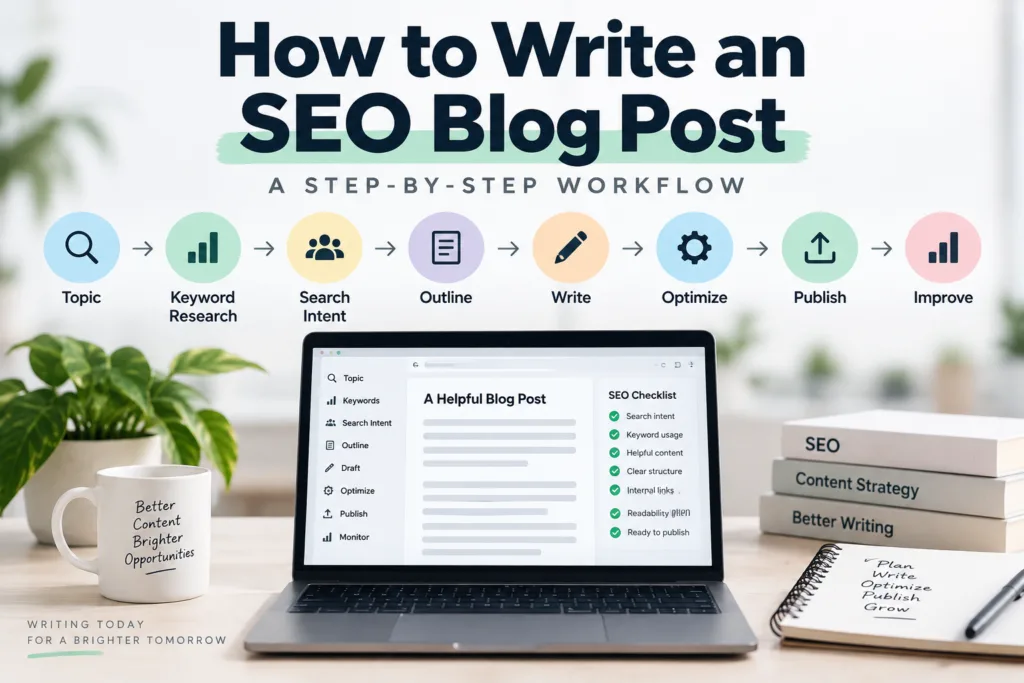
To write an SEO blog post, choose a relevant topic and primary keyword, understand search intent, analyze the search results, build an outline, research the topic, and write useful content for your readers. Then optimize the article, add relevant links and supporting elements, edit it, publish it, and monitor its performance.
The basic process: Topic → Keyword → Search Intent → SERP Research → Outline → Research → Draft → Optimize → Edit → Publish → Improve
Table of Content
- What Is an SEO Blog Post?
- SEO Blog Post vs. Regular Blog Post
- 1. Choose a Topic With Search Potential
- 2. Find and Choose the Primary Keyword
- 3. Understand Search Intent Before Writing
- 4. Analyze the Search Results
- 5. Build an SEO-Friendly Content Outline
- 6. Research the Topic and Gather Reliable Information
- 7. Add First-Hand Experience and Original Insights
- 8. Write an Introduction That Matches Search Intent
- 9. Write for People First
- 10. Optimize the Article for Your Primary Keyword
- 11. Add Semantic Keywords and Related Topics
- 12. Add Internal and External Links
- 13. Optimize the Title, Meta Description, and URL
- 14. Add Elements That Improve the User Experience
- 15. Edit and Optimize the Draft Before Publishing
- 16. Add a Clear CTA
- 17. Publish, Monitor, and Improve the Article
- How to Use AI When Writing an SEO Blog Post
- The Complete SEO Blog Post Workflow
- SEO Blog Post Checklist
- Common SEO Blog Writing Mistakes to Avoid
- Conclusion: How to Write an SEO Blog Post That Helps Readers
- Related SEO Writing Guides
- Ready to Put This Process Into Practice?
- Frequently Asked Questions
What Is an SEO Blog Post?
An SEO blog post is a piece of content created to answer a specific search query while making the topic clear and useful for both readers and search engines.
It combines search intent, keyword targeting, helpful information, clear structure, and on-page optimization.
Unlike an ordinary blog post, an SEO blog post:
- Targets a specific search need rather than a broad topic.
- Matches search intent so the content satisfies what the searcher wants.
- Has a clear topic and structure that makes the information easy to understand.
- Uses keywords naturally to help communicate the page's subject.
- Covers related questions and concepts that help provide a complete answer.
- Provides a useful next step that helps the reader continue their journey.
The difference isn't that an SEO blog post is written for search engines instead of people. It's written for people with search behavior in mind.
That distinction sets up the workflow that follows: find what people need, understand what they expect, and create content that gives them a better answer.
If you want to explore the broader topic, visit the SEO Writing Hub for practical guides on creating, optimizing, and improving content for search.
SEO Blog Post vs. Regular Blog Post
The two can look similar on the surface, but the planning behind them is different.
The key difference: An SEO blog post isn't written for search engines instead of people. The writing process starts with understanding what the reader is searching for.
Let's move on to actual steps needed to write an SEO blog post.
1. Choose a Topic With Search Potential
Before you worry about keywords, headings, or word count, make sure you’re writing about something people actually care about.
Start with your audience. What problems are they trying to solve? What questions do they ask? Those questions can lead you to topics with real value.
Your topic should also fit your website. Publishing random articles because a keyword has search volume can bring traffic, but it won’t necessarily build topical authority or attract the right audience.
Before choosing a topic, check:
- Audience needs: Does the topic solve a real problem or answer a useful question?
- Search demand: Are people searching for information about it?
- Topical relevance: Does it fit your website’s main subject?
- Existing content: Have you already covered the topic or a closely related one?
- Topical authority: Will the article strengthen your coverage of an important subject?
For example, if your website focuses on SEO writing, an article about how to write an SEO blog post makes sense. It addresses a clear reader need while strengthening your coverage of SEO content creation.
The key is to find the overlap between what your audience needs, what people search for, and what you know well enough to teach.
The best SEO blog topics sit at the intersection of reader needs, search demand, and your website’s expertise.
Your topic should also fit into your site's broader subject coverage, which is why understanding topical authority can help you choose articles that strengthen your site's expertise instead of treating every keyword as a separate opportunity.
If you're new to SEO, Google's SEO Starter Guide provides a useful overview of the fundamentals of making content easier for search engines to discover and understand.
2. Find and Choose the Primary Keyword
Once you have a topic, choose the primary keyword that best represents what the page is about. This is the main search term you want the article to be relevant for.
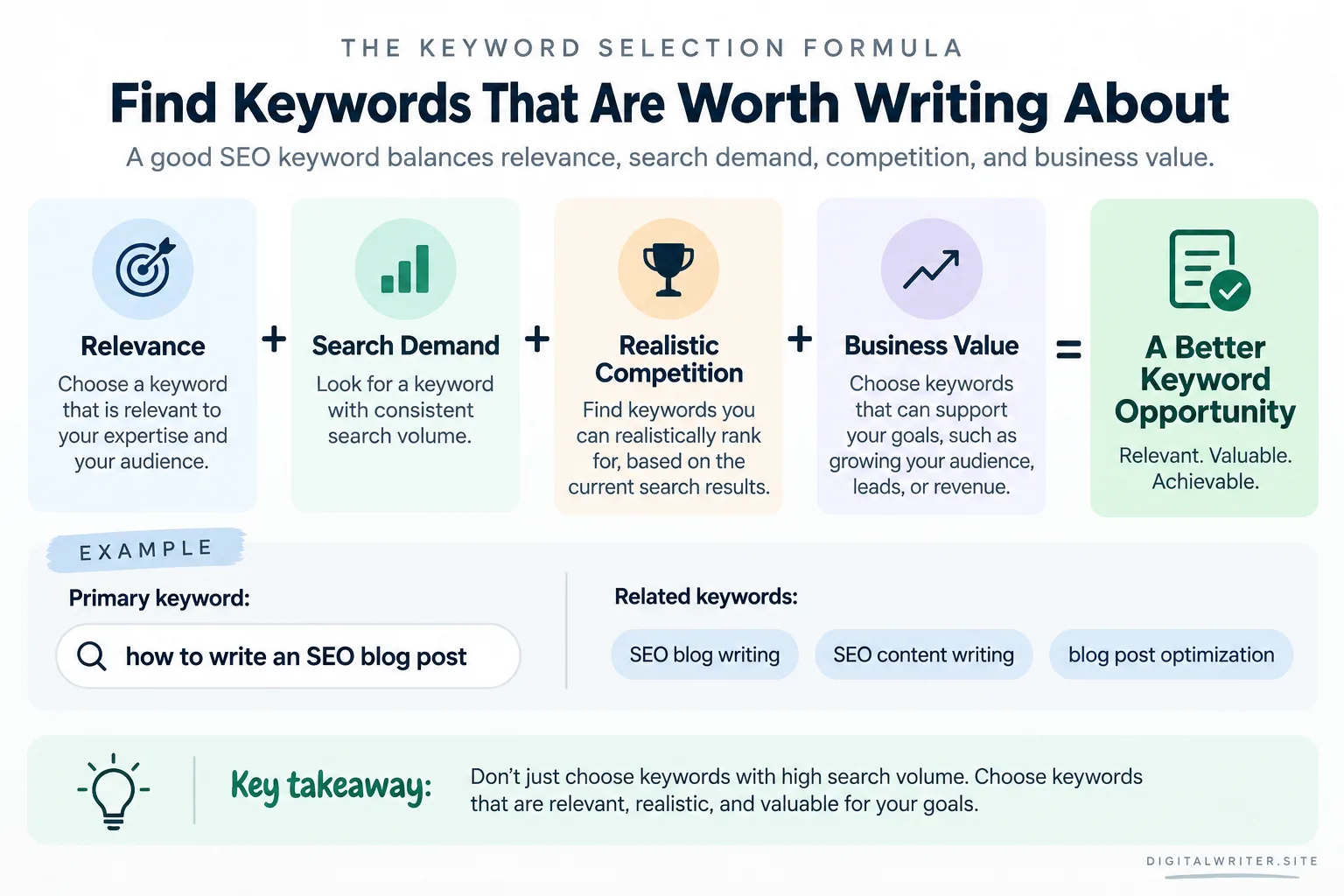
Don't choose a keyword based on search volume alone. You want a term that your audience actually uses, that fits your topic, and that gives you a realistic opportunity to compete.
How to Find Keyword Ideas
Start with your topic and look for the different ways people search for information about it.
Use several sources:
- Google Autocomplete: Start typing your topic into Google and note the suggestions that appear.
- People Also Ask: Look at the questions Google shows for related searches. These can reveal specific problems and questions your article could address.
- Related searches: Check the searches Google suggests at the bottom of the results page for additional variations.
- Competitor pages: Examine the keywords, topics, and questions covered by pages already ranking for your topic.
- Keyword research tools: Use them to discover keyword variations and evaluate potential opportunities.
- Search volume and competition: Look at how much demand exists and how difficult the keyword may be to rank for.
- Long-tail variations: Consider more specific phrases that reveal a clearer search need and may be easier to target.
Don't treat any single source as the answer. Combine what you discover to build a better picture of how people search for the topic.
Search Volume Isn't Enough
A keyword with thousands of monthly searches isn't automatically a good keyword for your article. If it has little connection to your audience or business, ranking for it may bring visitors who have no reason to stay.
A lower-volume keyword can be more valuable when it closely matches your audience's needs and your site's expertise.
Think of keyword selection this way:
Good keyword = Relevance + Search demand + Realistic competition + Business value
Your primary keyword should describe the article's central topic. Once you've chosen it, identify secondary and related terms that help you cover the subject naturally.
For example:
Primary keyword:
- how to write an SEO blog post
Related terms:
- SEO blog writing
- SEO blog post
- writing SEO content
- SEO content writing
- blog post optimization
The goal isn't to find the keyword with the biggest numbers.
Choose the keyword that gives you the best opportunity to reach the right reader with the right content.
Choosing the right keyword is a key part of SEO writing, and my guide to keyword research for writers shows you how to find search terms that match your audience, topic, and content goals.
3. Understand Search Intent Before Writing
Choosing the right keyword is only half the job. You also need to understand why someone is searching for it.
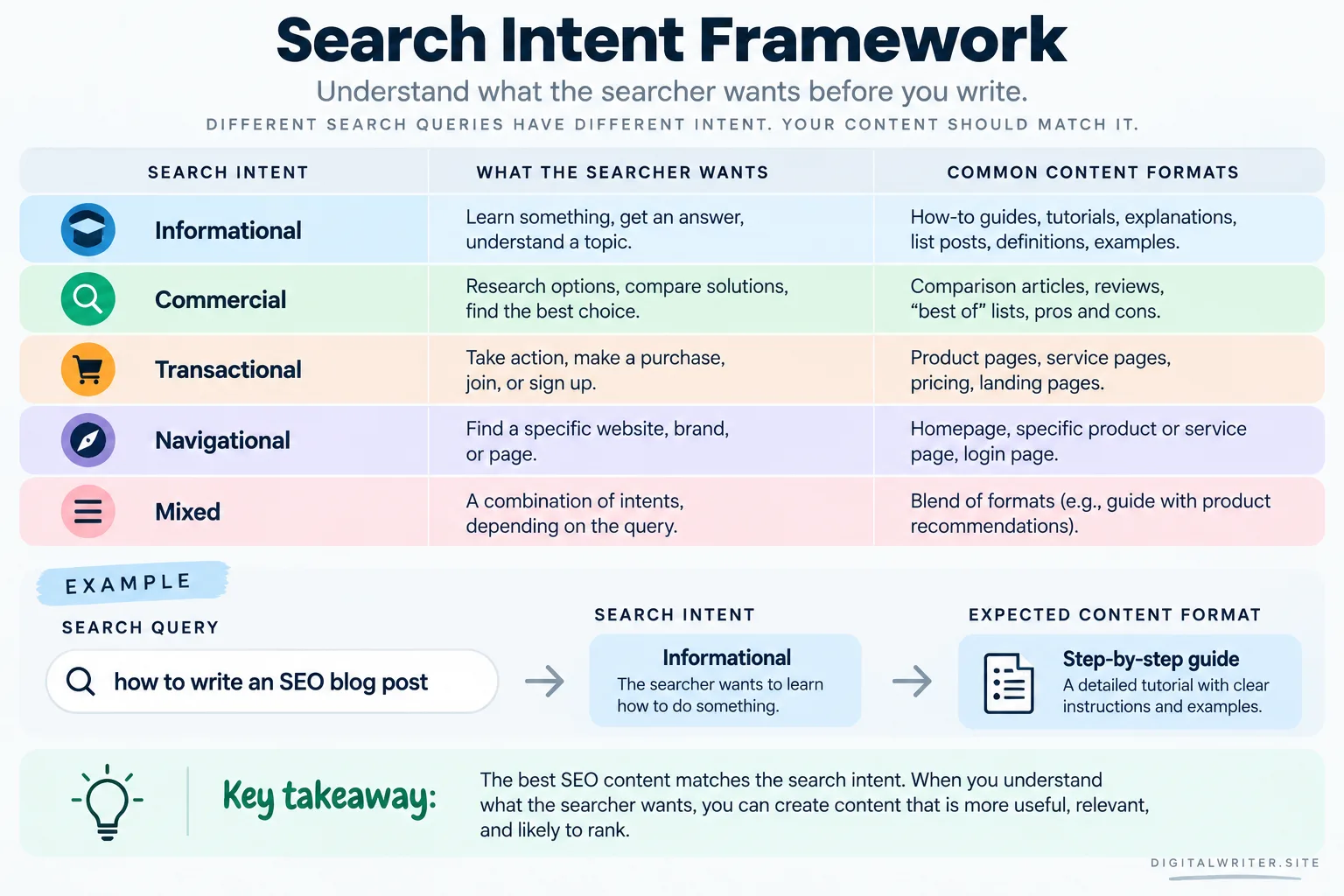
Search intent is the goal behind a search query. Someone searching “how to write an SEO blog post” wants to learn a process, while someone searching “best SEO writing tools” is likely comparing options. The content that satisfies those searches should look very different.
Most searches fall into four main categories:
- Informational: The searcher wants to learn something or solve a problem.
- Commercial: The searcher is researching options before making a decision.
- Transactional: The searcher is ready to take an action, such as buying or signing up.
- Navigational: The searcher is trying to find a specific website, page, or resource.
Some queries have mixed intent, where searchers may want more than one type of information.
The easiest way to understand intent is to search your target keyword yourself. Look at the pages appearing in the results and ask what they have in common. Are they guides, product pages, comparisons, reviews, lists, or something else?
Google is giving you a clue about what searchers expect.
If most results are step-by-step guides, a product roundup probably won’t satisfy the query. If comparison pages dominate the results, a general educational article may miss the mark.
Before writing, ask yourself:
What does someone searching this phrase actually want to accomplish?
Once you know the answer, match your article's format and depth to that goal. This approach helps you create content that satisfies the searcher instead of simply inserting a keyword into a page.
Search intent should guide the article, not be something you check after the article is written.
Before you start writing, take time to understand search intent for writers so you can create the type of content that matches what people expect to find.
4. Analyze the Search Results
Before you start writing, take a close look at the pages already ranking for your target keyword. The search results give you a useful picture of what Google believes satisfies the query.
Open several of the top-ranking pages and look for patterns. What topics do they cover? What format do they use? Which questions do they answer? How much depth do they provide?
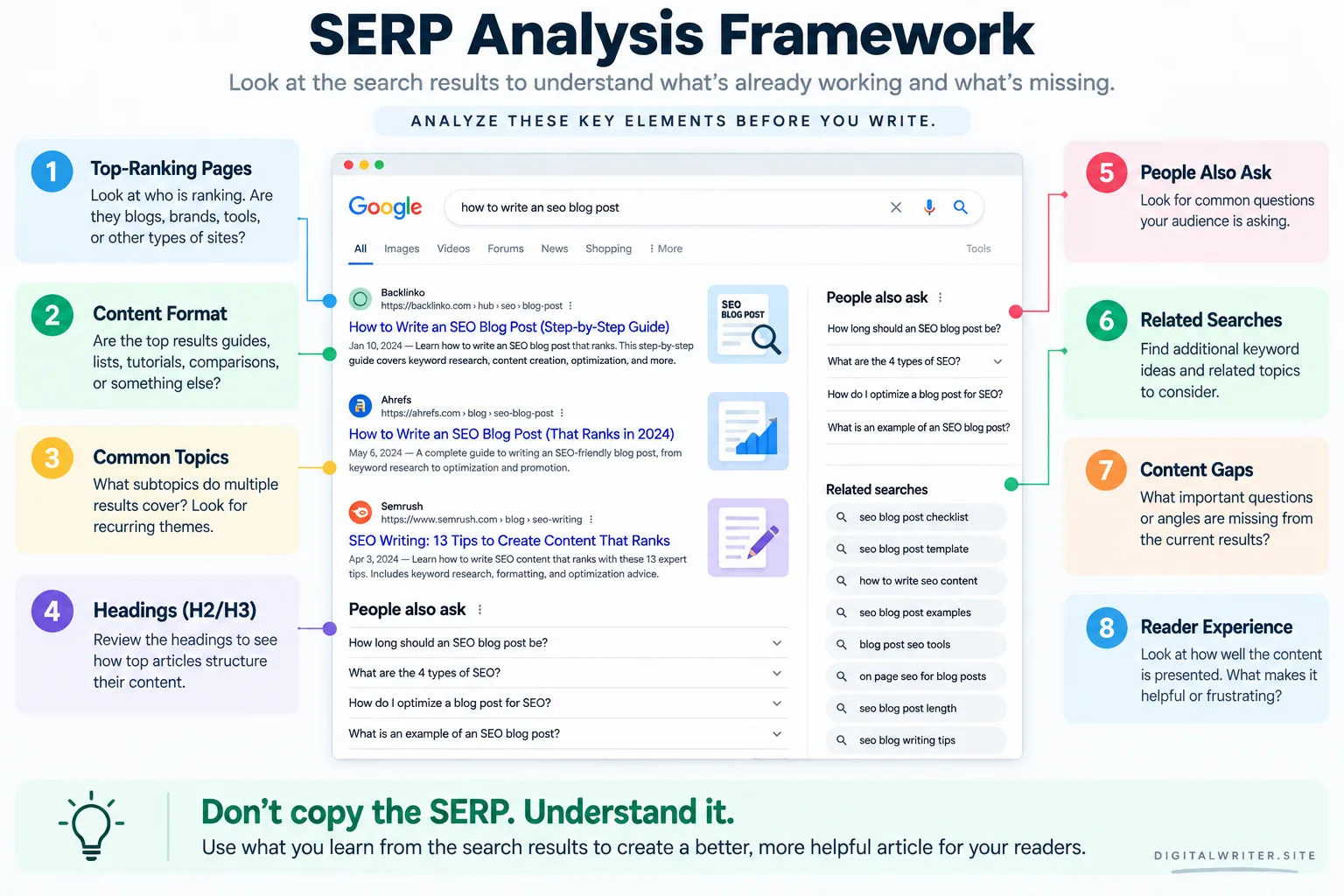
Pay attention to:
- Common topics: Look for subjects covered across several competing pages.
- Content format: Determine whether the results are guides, tutorials, comparisons, reviews, lists, or another format.
- Questions: Note the questions competitors answer and look for important questions they miss.
- Headings: Examine their H2s and H3s to understand how they organize the topic.
- Content depth: See how thoroughly they explain the subject, but don't assume longer content is better.
- Content gaps: Identify useful information, examples, or explanations that are missing.
- Reader experience: Look for ways to make your article clearer, easier to scan, or more practical.
Use People Also Ask and Related Searches
Google can give you more clues beyond the main search results. Check the People Also Ask questions and the Related searches section at the bottom of the results page.
Use them to:
- Find questions your article should answer.
- Discover long-tail keyword variations.
- Identify subtopics you hadn't considered.
- Improve your H2 and H3 structure.
- Find potential questions for an FAQ section.
Don't automatically add every question you find. Some may have a different intent or may not belong in your article.
Include questions and subtopics that genuinely support the searcher's intent.
Look for Content Gaps
Now compare what the ranking pages cover with what the searcher actually needs.
You may find that competitors:
- Skip an important question.
- Explain a concept without an example.
- Provide outdated information.
- Make a topic harder to understand than it needs to be.
- Cover the basics but offer little practical guidance.
These gaps give you opportunities to make your article more useful.
This process isn't about finding a competitor to copy. In fact, copying the structure of a top-ranking article can leave you with the same weaknesses as everyone else.
Use the search results to understand what searchers expect, then look for ways to create something more useful.
Your goal is not to reproduce what already ranks.
Your goal is to understand the standard, identify the gaps, and create a better resource.
5. Build an SEO-Friendly Content Outline
Once you know what your audience wants and what the search results expect, build your outline before you start writing. A good outline gives the article a clear direction, helps you cover the important parts of the topic, and reduces the chance of having to reorganize the draft later.
Start with the H1 and define the article's main promise. Then organize the major ideas into H2 sections and use H3s for important subtopics that need more explanation.
Put those sections in an order that makes sense to the reader. Answer the most important questions first, then move into supporting information. Think about what the reader needs to know at each point rather than simply arranging headings around keywords.
Your outline should also identify:
- Questions readers need answered: Include the questions that matter most to the search intent.
- Examples: Use them when they make a concept easier to understand.
- Tables: Add them when readers need to compare information.
- Lists: Use them when several related points are easier to scan.
- Checklists: Include them when readers need a practical way to apply what they've learned.
- Internal links: Decide which relevant pages you should link to before you begin writing.
A simple structure looks like this:
H1 → Introduction → H2s → H3s → Conclusion → CTA
Your SEO title also needs to work for the person deciding whether to click, which is why learning how to write engaging headlines can strengthen your approach to titles.
You don't need to fill every article with H3s, tables, or lists. Use each element when it improves the reader's experience.
The goal of an outline isn't to create more headings. It's to give the article a logical path from the reader's question to a useful answer.
6. Research the Topic and Gather Reliable Information
A strong outline gives you the structure, but research gives the article substance. Before you start drafting, gather the information you need to explain the topic accurately and give readers something useful.
Start with reliable, authoritative sources when you make factual claims. Check statistics, dates, studies, technical details, and other information that could affect the accuracy of your article.
Research should also help you find original examples and practical insights that make the content more useful. Don't simply repeat what the top-ranking pages already say. Look for ways to explain the subject more clearly or apply the information to real situations.
As you research, separate facts from opinions. A statement supported by evidence should not be presented in the same way as your personal recommendation or interpretation.
At the same time, don't research just to make the article longer. Every piece of information should help the reader understand the topic, make a decision, or take the next step.
What to Research Before Writing?
Depending on the topic, research:
- Definitions: Make sure important terms are accurate and easy to understand.
- Current best practices: Check whether recommendations have changed.
- Statistics: Verify numbers and their original sources.
- Examples: Find practical examples that clarify the subject.
- Expert sources: Look for credible people, organizations, studies, or publications.
- Common questions: Identify what readers still want to know.
- Common mistakes: Find problems that could prevent readers from getting the desired result.
- Competing approaches: Understand the different methods or opinions surrounding the topic.
Good research isn't about collecting as much information as possible.
It's about finding the right information to help you write something accurate, useful, and worth reading.
7. Add First-Hand Experience and Original Insights
Research tells you what is known about a topic. Your experience can show readers how to apply that knowledge.
When you have relevant experience, use it. Explain what you've learned from actual writing work, share examples you've created yourself, and explain why you recommend one approach over another.
For example, instead of simply saying that outlines improve SEO content, explain how a structured outline helps you identify missing topics, avoid repetition, and keep the article focused on the searcher's needs.
Like this:
Writer's Insight
After 17 years of writing long-form SEO content, I've learned that the strongest articles don't start with keywords. They start with understanding the reader.
Keyword research tells you what people search for, but it doesn't tell you everything they need. Your experience as a writer helps you recognize gaps, explain difficult ideas in simpler terms, choose useful examples, and decide what deserves more attention.
That's why I don't treat competitor content as a template to reproduce. I use it to understand the search landscape, then bring my own knowledge, judgment, and examples to the subject.
Look for opportunities to add:
- Lessons from your writing experience: Share practical observations that come from doing the work.
- Original examples: Create examples that demonstrate your recommendations instead of repeating examples from other websites.
- Your reasoning: Explain why you recommend a particular approach.
- Real project lessons: When appropriate, describe what worked, what didn't, and what you learned.
- Practical judgment: Explain where a technique makes sense and where it doesn't.
Don't simply summarize information you've found elsewhere. Research should provide the foundation, but your experience, analysis, and examples can make the article more useful and distinctive.
At the same time, make a clear distinction between experience and established facts. If you're sharing a personal observation, present it as your experience. If you're making a factual claim, support it with reliable evidence.
For example:
Experience: “In my SEO writing work, I've found that outlining before drafting helps me spot content gaps early.”
Fact: “Search intent describes the underlying goal behind a search query.” Support this type of statement with an appropriate authoritative source when needed.
This distinction helps you build credibility without presenting personal experience as universal evidence.
8. Write an Introduction That Matches Search Intent
Your introduction should confirm within the first few sentences that the reader has found the right page. Don't make them work through a long background section before getting to the answer.
Start by addressing the problem behind the search. Acknowledge the reader's situation, then tell them what they will learn and what they can expect from the article.
For an SEO blog post, the introduction should:
- Address the problem quickly: Show that you understand why the reader searched for the topic.
- Validate the reader: Acknowledge a common frustration or challenge.
- State the promise: Tell readers what the article will help them accomplish.
- Introduce the main idea: Give them the key point early.
- Use the target keyword naturally: Include it where it fits without forcing it.
- Create a reason to continue: Make the benefit of reading clear.
A simple formula works well:
Problem → Validation → Promise → Roadmap
For example, you might open by naming the problem, reassure the reader that it's common, explain what they'll learn, and briefly show them what the article will cover.
Keep the introduction focused. The reader came for an answer, so start helping them as soon as possible.
9. Write for People First
This is where good SEO writing separates itself from keyword-focused writing.
Search engines need to understand your topic, but people need to understand your content. If you fill an article with keywords but make it difficult to read, optimization won't fix the underlying problem.
Write in clear, familiar language. Explain a concept before introducing technical terms, and use those terms only when they help the reader. Keep paragraphs short, vary your sentence length, and use active voice to make your writing easier to follow.
Each paragraph should focus on one main idea. When a reader asks a question, answer it directly instead of making them search through several paragraphs for the answer.
Examples can help, too. If you're explaining an abstract concept, show readers what it looks like in practice. A simple example can often replace a paragraph of explanation.
And watch for filler. If a sentence doesn't teach, clarify, demonstrate, or move the reader forward, ask whether you need it.
Make the Article Easy to Scan
Most readers don't read a blog post from beginning to end. They scan the page first to decide whether it contains what they need.
Make that process easy with:
- Short paragraphs that don't create large blocks of text.
- Descriptive headings that tell readers what each section covers.
- Bullet points when presenting several related items.
- Numbered steps when explaining a process.
- Tables when readers need to compare information.
- Bold emphasis for important points that deserve attention.
- Plenty of white space to give the page room to breathe.
Good formatting isn't decoration. It helps readers find, understand, and remember the information you're providing.
That's the real meaning of writing for people first: make the content useful and easy to consume, then let SEO support that experience.
Google recommends creating helpful, reliable, people-first content that is created to benefit readers rather than manipulate search rankings.
These principles are also part of the broader digital writing skills that help writers communicate clearly across online formats.
10. Optimize the Article for Your Primary Keyword
Once the draft is written, optimize it around your primary keyword. The goal isn't to repeat the phrase as many times as possible. It's to make the page's topic clear while keeping the writing natural.
Place the primary keyword where it makes sense, including:
- H1: Make the main topic clear in the page's primary heading.
- Introduction: Mention the keyword naturally when introducing the topic.
- Relevant H2s and H3s: Use it or a close variation when it accurately describes the section.
- Body copy: Include the keyword naturally where it fits the discussion.
- Meta description: Use the keyword when it can be included without making the description awkward.
- URL: Create a short, descriptive URL that can include the primary keyword.
- Image alt text: Describe the image accurately and include the keyword only when it's relevant to the image.
- Internal link anchor text: Use descriptive anchor text when linking to the article from relevant pages.
You don't need to use the exact keyword in every location. Variations and related terms can help you cover the topic without making the writing repetitive.
For example, if your primary keyword is how to write an SEO blog post, you might naturally use phrases such as SEO blog writing, SEO content, and blog post optimization throughout the article.
Don't Force the Keyword
Keyword stuffing can make an article harder to read and can distract from the information you're trying to provide.
If a keyword sounds awkward in a sentence, don't force it in. Rewrite the sentence or use a natural variation.
Topic coverage and relevance matter more than repeating the same phrase.
Your primary keyword should help define the article, not control every sentence you write.
Once the draft is complete, use these on-page SEO techniques for writers to improve elements such as headings, keywords, links, and other page-level signals without making the content feel forced.
11. Add Semantic Keywords and Related Topics
Your primary keyword tells search engines what the page is about, but it doesn't tell the whole story. Semantic keywords are related words and concepts that help provide context around the main topic.
Think about the terms a reader would expect to see in a complete article. If you're writing about SEO blog posts, for example, it makes sense to discuss search intent, keyword research, content optimization, and on-page SEO.
Use these related terms naturally as you explain the topic. They can help you cover important concepts without relying on the same keyword in every paragraph.
For an SEO blog post, related terms might include:
- SEO blog writing
- search intent
- keyword research
- content optimization
- organic traffic
- SERP
- on-page SEO
- internal links
- meta description
- title tag
- content structure
- topical relevance
- featured snippets
Questions and keyword variations can also help you expand your coverage. If readers commonly ask how long an SEO blog post should be, for example, answering that question gives you a chance to address an important aspect of the topic in a natural way.
The key is to write about the concepts, not to write lists of keywords.
Don't add related terms simply because you want to include them. Use them when they help explain the subject, answer a question, or provide information the reader needs.
Semantic optimization is about covering the topic thoroughly and naturally, not finding excuses to mention more keywords.
12. Add Internal and External Links
Links help readers move through your content and give search engines more context about how your pages relate to each other. The key is to add links where they provide a clear benefit.
Internal Links
Internal links connect one page on your website to another. Use them to:
- Link to relevant supporting articles.
- Connect supporting articles to your pillar or hub content.
- Help readers find the next logical resource.
- Provide additional information without repeating it in the current article.
- Use descriptive anchor text that tells readers what they'll find when they click.
But internal linking shouldn't be a one-way process. Think about it before and after publishing.
Before publishing: Identify relevant pages on your site that your new article should link to.
After publishing: Find relevant existing articles that should link back to your new article.
For example, if you publish a new article about how to write an SEO blog post, look through your existing SEO writing content for natural opportunities to introduce the new article. An older article about keyword research, search intent, or content optimization may be a good place to add a link.
This creates a connected content structure rather than leaving your new article isolated.
External Links
External links take readers to useful resources on other websites. Use them when they add credibility or help readers explore a subject in more depth.
You can use external links to:
- Support factual claims.
- Reference research or statistics.
- Point readers toward authoritative sources.
- Provide deeper information that doesn't belong in your article.
You don't need to add an external link every time you mention a fact. Use one when the source adds meaningful value or helps the reader verify or explore the information.
Think of Internal Linking as a Two-Way Process
A simple workflow is:
Before publishing:
New article → links to relevant existing content
After publishing:
Existing relevant content → links back to the new article
This second step is easy to overlook, but it can help your new content become part of your site's existing content network.
The same principle applies to both types of links:
Link because the reader needs the resource, not because you need another link.
A useful link should feel like part of the article, not something added to satisfy an SEO checklist.
When adding links, focus on usefulness rather than manipulating rankings; Google's spam policies explain how practices such as low-quality or manipulative links can violate its guidelines.
13. Optimize the Title, Meta Description, and URL
Your title, meta description, and URL are small parts of an SEO blog post, but each has an important job. Together, they tell search engines and readers what the page is about and what they can expect from it.
Write an SEO-Friendly Title
Your title should make the topic and benefit clear at a glance.
A strong SEO title should:
- Include the primary keyword when it fits naturally.
- Make the benefit clear so readers know what they'll get.
- Match search intent rather than promising something the article doesn't provide.
- Avoid clickbait that creates expectations the content can't meet.
For example, if the primary keyword is how to write an SEO blog post, a title such as How to Write an SEO Blog Post Step by Step clearly tells the reader what the article covers.
Write the Meta Description
The meta description gives searchers a short preview of your page.
Make it:
- A concise summary of the article.
- Naturally written around the primary keyword.
- Focused on the value readers will get from clicking.
- Short enough to communicate the main point without unnecessary detail.
Don't treat the meta description as a place to cram in keywords. Give searchers a clear reason to choose your result.
Create a Clean URL
Your URL should be simple and descriptive.
Follow these guidelines:
- Keep it short.
- Describe the topic clearly.
- Remove unnecessary words and numbers.
- Include the primary keyword when it fits naturally.
For this article, for example:
/how-to-write-an-seo-blog-post/
A clean URL is easier for readers to understand and gives them another clear signal about what the page covers.
Your title attracts the click, your meta description supports the decision, and your URL helps identify the page. Make all three clear and relevant.
Your title and description help communicate what a page is about in search results, so it's worth following Google's guidance on title links and search-result snippets.
14. Add Elements That Improve the User Experience
Well-written text isn't always enough. The right visual or interactive elements can make a complex topic easier to understand, help readers find information, and give them practical ways to apply what they've learned.
Consider adding:
- Screenshots to show readers exactly what to click or where to find something.
- Diagrams to explain processes, relationships, or complex ideas.
- Examples to show how a concept works in practice.
- Checklists to turn advice into an actionable process.
- Tables when readers need to compare options or information.
- Templates that give readers something they can use.
- Videos when seeing a process is more useful than reading about it.
- Downloadable resources such as guides, worksheets, or checklists that extend the value of the article.
Don't add these elements just because you think an SEO article needs more visuals. Every element should have a purpose.
A screenshot should clarify a process. A table should make comparison easier. A checklist should help the reader take action.
Use visuals and interactive elements to make the content clearer and more useful, not simply to decorate the page.
15. Edit and Optimize the Draft Before Publishing
Don't try to write and edit at the same time. Once the first draft is complete, work through it in separate passes. This makes it easier to catch problems that are hard to spot while you're focused on getting your ideas onto the page.
First Editing Pass: Accuracy
Make sure the information is reliable and supported.
- Check facts.
- Verify claims.
- Remove unsupported statements.
- Check statistics, dates, and other details that need confirmation.
Second Editing Pass: Structure
Make sure the article flows in a logical order.
- Check the heading hierarchy.
- Remove repetition.
- Improve transitions between sections.
- Move sections when a different order makes more sense.
- Make sure each section contributes to the article's main purpose.
Third Editing Pass: Readability
Now edit for the person reading the article.
- Shorten complex sentences.
- Remove filler.
- Replace unnecessary jargon with familiar language.
- Break up dense paragraphs.
- Look for places where an explanation could be clearer.
Fourth Editing Pass: SEO
Finish with an SEO check.
- Review primary keyword usage.
- Check the title and meta description.
- Review internal links and anchor text.
- Check headings for relevance and clarity.
- Review images and alt text.
- Make sure the article covers the topic naturally without keyword stuffing.
Don't use SEO as an excuse to weaken the writing. The final pass should confirm that your optimization supports the article rather than getting in the reader's way.
A useful rule is simple: write first, then edit for accuracy, structure, readability, and SEO.
16. Add a Clear CTA
A good SEO blog post should give readers a logical next step. But that step should match why they came to the page in the first place.
If someone is looking for information, don't immediately push them toward a purchase. Give them something that builds on what they've just learned.
For Informational Articles
Useful CTAs include:
- Read the next guide.
- Download a checklist.
- Get a template.
- Join your newsletter.
- Explore a related resource.
For Commercial Articles
When readers are researching a purchase, you can guide them toward:
- Comparing products.
- Viewing your recommendations.
- Reading a detailed review.
- Exploring available options.
For Service-Focused Content
A reader who has a problem your service can solve may be ready to:
- Request a consultation.
- Contact your business.
- Learn more about the service.
- View relevant case studies.
The important thing is timing. Let the article deliver value before asking the reader to take a commercial action.
Your CTA should feel like the natural next step, not an interruption.
Match the CTA to the reader's intent, give them value first, and make the next step clear.
17. Publish, Monitor, and Improve the Article
SEO writing doesn't end when you click Publish. Once the article is live, its performance gives you information you can use to make it better.
Monitor how the article performs and look for signs that it needs attention.
Pay attention to:
- Organic traffic: Is the article attracting visitors from search?
- Impressions and clicks: Is Google showing the page, and are people choosing it?
- Ranking changes: Is the page gaining or losing visibility?
- Search queries: What terms is the article beginning to appear for?
- Content gaps: Are there sections that need more explanation based on what people are searching for?
- Outdated information: Do statistics, recommendations, examples, or other details need updating?
- Internal links: Have you published new related content that should link to the article?
- Search intent: Has what searchers expect from the query changed?
Don't assume that a page needs a complete rewrite when its performance drops. Sometimes a few targeted improvements can make a meaningful difference.
You might expand a section, answer a newly important question, update outdated information, improve internal links, or adjust the content to better match current search intent.
Publish the article, learn from its performance, and keep improving it. SEO content should evolve with your readers and the search results.
How to Use AI When Writing an SEO Blog Post
AI can make the SEO writing process faster, but it shouldn't take over the work. AI can assist with the workflow. The writer remains responsible for the strategy, accuracy, expertise, and final judgment.
Used well, AI can help you:
- Brainstorm topics and keywords: Generate ideas and variations that you can evaluate against your audience and SEO strategy.
- Analyze search intent: Explore what a searcher may want to accomplish and what type of content could satisfy that need.
- Develop an outline: Organize H2s, H3s, questions, examples, and supporting topics before drafting.
- Assist with research: Find areas that need investigation and help organize information. Verify factual claims against reliable sources.
- Create a first draft: Turn your outline and research into a starting point that you can develop and improve.
- Edit the article: Check structure, readability, repetition, clarity, and other quality issues.
- Find content gaps: Compare your coverage against the questions and topics readers may expect.
- Suggest internal links: Identify places where related content could help the reader.
This approach fits a broader principle: AI should support the writer's thinking, not replace it. Your AI Content Strategist, for example, is designed around planning, search intent, content gaps, semantic coverage, featured snippets, internal linking, and quality review before the writing stage.
If you want to take this further, learn how to optimize content for AI search tools while keeping the focus on useful, well-structured information.
What to Avoid When Using AI for SEO Writing?
AI becomes a problem when convenience replaces judgment.
Avoid:
- One-click article generation: Don't generate an entire article and publish it without reviewing and developing it.
- Publishing unedited AI output: AI-generated text still needs fact-checking, editing, and human judgment.
- Invented facts: Never assume that an AI-generated statistic, study, quotation, or claim is accurate.
- Generic examples: Replace vague examples with specific, useful examples that actually help the reader.
- Keyword stuffing: Don't ask AI to force your target keyword into every section. Natural topic coverage matters more.
- Losing your expertise and voice: Your knowledge, judgment, experience, and perspective are what make the article different from thousands of other pages.
The goal isn't to hide the use of AI. The goal is to use it as a capable assistant while keeping the writer in control.
As search continues to evolve, understanding AI Search Visibility can also help you think beyond traditional rankings and create content that remains useful across modern search experiences.
Let AI handle parts of the process where it can save time. Keep the decisions that require expertise, judgment, and responsibility in human hands.
The same principle applies to professional AI-assisted writing: how professional writers use AI matters as much as the tools they use.

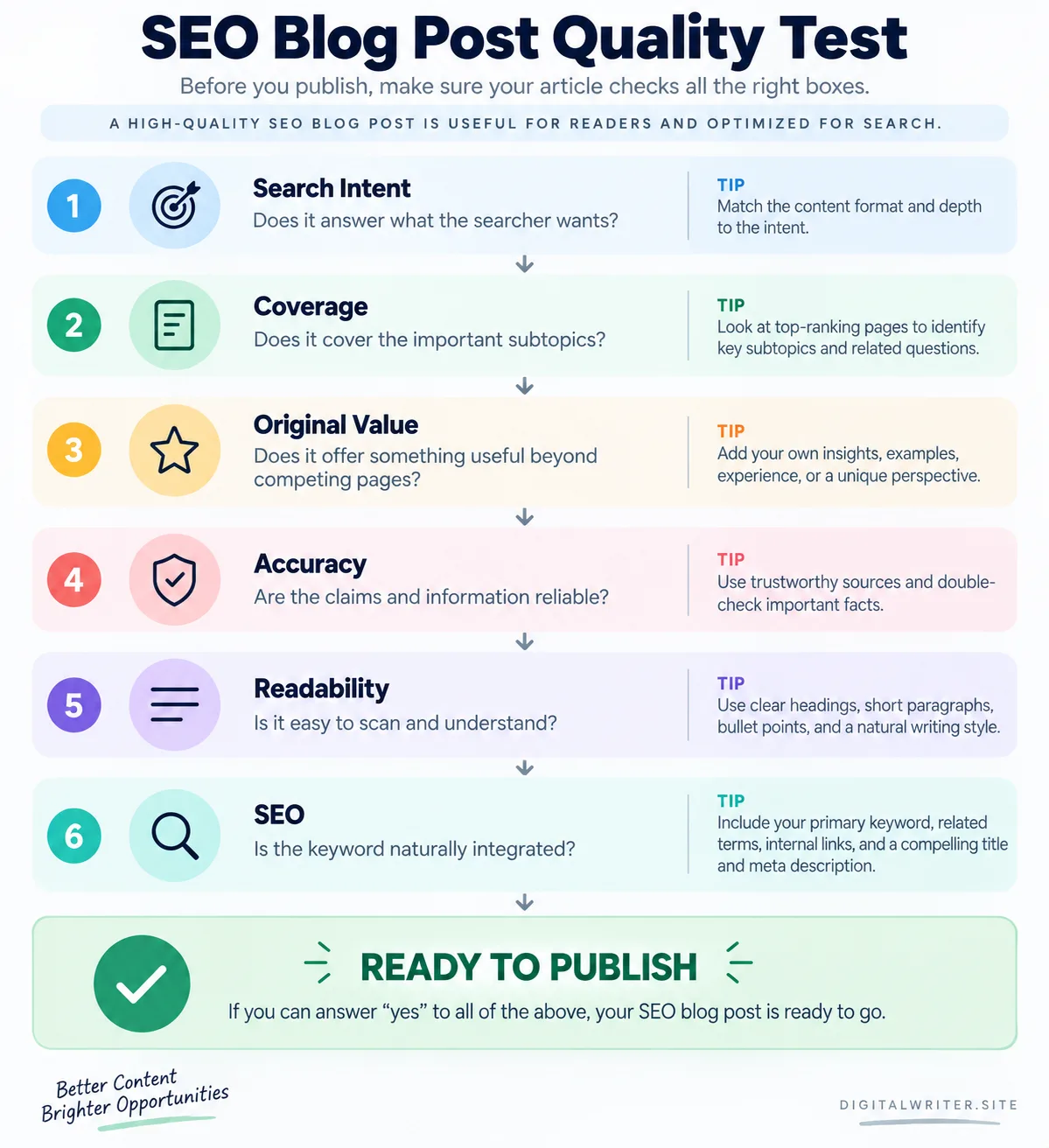
How to Know Your Article Is Good Enough to Publish?
Before you click Publish, step back from the SEO details and ask whether the article actually does its job for the reader.
Your SEO blog post is ready when:
- It clearly answers the searcher's question.
- The format matches search intent.
- It covers the important subtopics.
- The information is accurate.
- The article offers something useful beyond competing pages.
- The primary keyword is naturally integrated.
- The structure is easy to scan.
- Internal and external links add value.
- The title accurately represents the content.
- You've edited the article for readers, not just search engines.
The final test: If you removed the keywords and SEO elements, would the article still be genuinely useful to the person who searched for it?
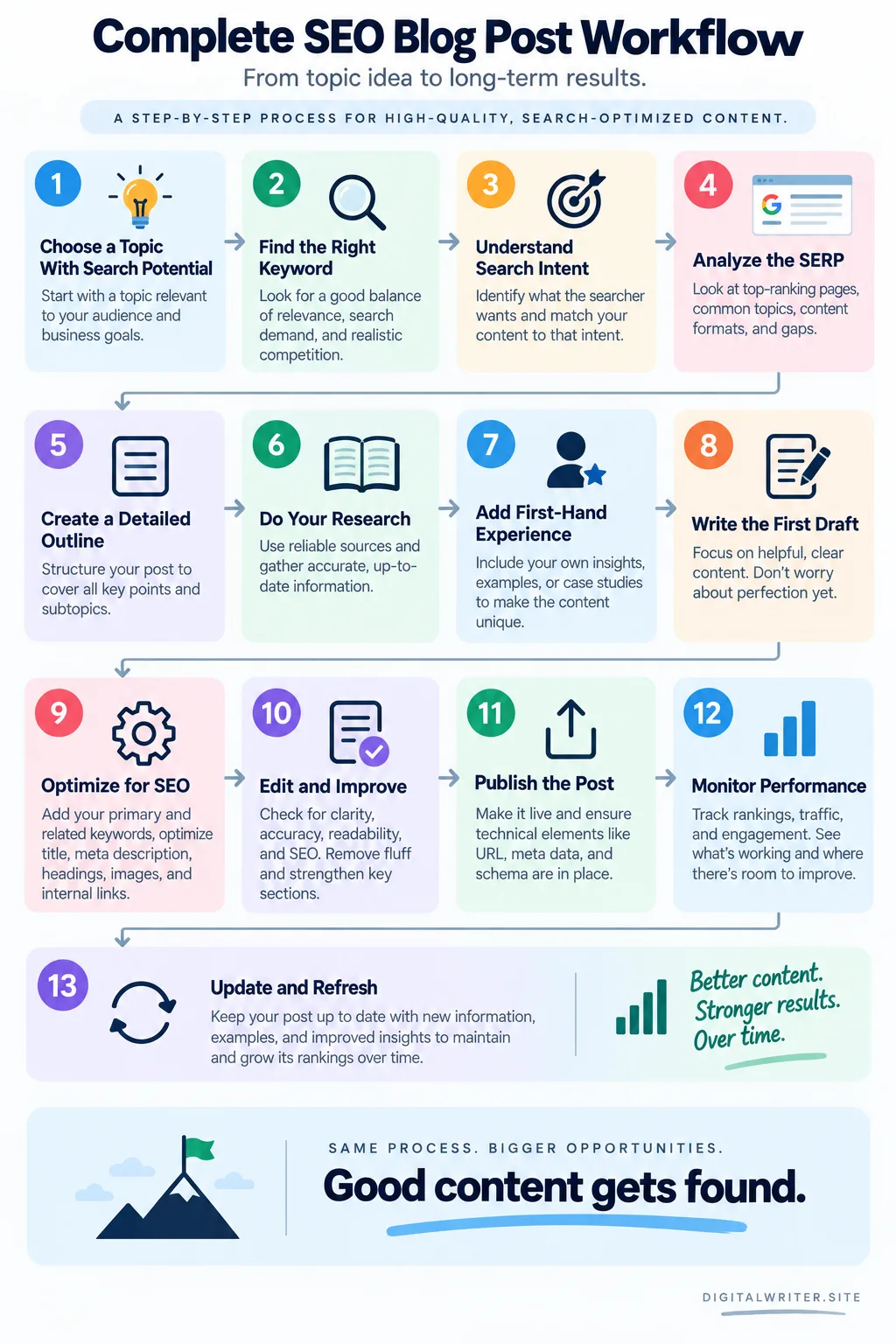
The Complete SEO Blog Post Workflow
Follow this process from the first topic idea through ongoing content improvement.
Remember: Publishing is not the end of the process. Use performance data to find opportunities, improve the article, and keep it useful.
SEO Blog Post Checklist
Before you publish, use this checklist to make sure your article is useful to readers and properly optimized for search.
Research & Strategy
Content
SEO
Editing & Conversion
Final check: If you can check every box, your article is ready to publish. But SEO doesn't stop there. Once the article has enough performance data, use what you learn to improve it.
Common SEO Blog Writing Mistakes to Avoid
Even a well-researched article can underperform when the writing process focuses too much on SEO and not enough on the reader. Avoid these common mistakes when creating SEO blog posts.
1. Writing for Keywords Instead of People
Keywords help define your topic, but they shouldn't dictate every sentence. Write for the person behind the search and use keywords where they fit naturally.
2. Ignoring Search Intent
If your article doesn't answer the question the searcher actually has, even strong optimization won't make it useful. Understand the intent before you write.
3. Choosing Irrelevant Keywords
A keyword may have high search demand, but that doesn't make it a good choice for your website. Choose terms that match your audience, expertise, and business goals.
4. Copying Competitors
Ranking pages can show you what searchers expect, but copying their structure or content won't give readers a reason to choose your article. Use competitor research to find gaps and opportunities.
5. Stuffing Keywords
Repeating the same keyword can make your writing awkward and distract readers. Cover the topic naturally instead.
6. Writing Long Introductions
Readers shouldn't have to work through several paragraphs before getting an answer. Address their problem and show them what they'll learn early.
7. Creating Huge Paragraphs
Large blocks of text make an article harder to scan. Break complex ideas into shorter paragraphs and use formatting where it helps.
8. Publishing Without Editing
Your first draft is not your finished article. Check accuracy, structure, readability, and SEO before publishing.
9. Adding Links Without Context
Don't add links simply because an SEO checklist says you need them. Every internal or external link should give the reader a useful next step.
10. Ignoring Internal Linking
A new article shouldn't exist in isolation. Connect it to relevant pages so readers and search engines can discover related content.
11. Focusing on Word Count Instead of Usefulness
Longer doesn't automatically mean better. Focus on answering the reader's questions and covering the topic well. Add depth where it provides value, not to hit an arbitrary word count.
12. Never Updating Old Content
Search intent, facts, tools, and best practices can change. Review your existing articles and update them when the information or reader expectations change.
The common thread behind these mistakes is simple: don't let SEO become the purpose of the article. SEO should support useful content, not replace it.
If you want to build a stronger foundation in SEO writing, explore the SEO Writing Hub for more practical guides on keyword research, search intent, on-page SEO, content optimization, and related topics.
Conclusion: How to Write an SEO Blog Post That Helps Readers
Writing an SEO blog post is a process, not a keyword exercise.
Start with a topic your audience cares about. Choose a relevant keyword, understand the search intent, and study the search results. Then build your outline, research the topic, and write the draft. After that, optimize the article, edit it for readers, publish it, and use performance data to improve it over time.
The complete process looks like this:
Topic → Keyword → Search Intent → SERP Research → Outline → Research → Draft → Optimize → Edit → Publish → Improve
You don't need to chase every SEO tactic or repeat your keyword until the article sounds unnatural. Focus on understanding what the searcher needs and creating the best resource you can.
SEO should help the right reader find useful content, not turn useful content into a collection of keywords.
Related SEO Writing Guides
Keep building your SEO writing skills with these practical guides.
Ready to Put This Process Into Practice?
You now have the complete workflow for writing an SEO blog post. The next step is to use it on your own content.
Use my SEO Writer Checklist to work through the key SEO and writing tasks before you publish your next article.
Get the SEO Writer ChecklistKeep it beside you while you write, edit, and optimize. It gives you a simple way to make sure you don't miss the important steps.
Frequently Asked Questions
Here are answers to common questions about writing SEO blog posts.
How do I write an SEO blog post?
Start by choosing a relevant topic and primary keyword. Then understand search intent, analyze the search results, build an outline, research the topic, and write useful content for your readers. Optimize the article, edit it, publish it, and monitor its performance so you can improve it over time.
What is the ideal length for an SEO blog post?
There is no ideal word count that guarantees rankings. Write enough to satisfy the search intent, answer important questions, explain the subject clearly, and provide useful examples or evidence. Focus on usefulness rather than reaching an arbitrary word count.
How many keywords should an SEO blog post have?
Focus on one primary keyword and use relevant secondary and semantic keywords naturally. There is no useful keyword-count target. Your priority should be covering the topic thoroughly and answering the searcher's questions without forcing keywords into the content.
Should I use AI to write an SEO blog post?
AI can assist with topic brainstorming, search-intent analysis, outlining, research support, drafting, editing, content-gap analysis, and internal-link suggestions. However, the writer should remain responsible for strategy, accuracy, expertise, judgment, and the final content.
How long does it take for an SEO blog post to rank?
There is no fixed timeframe for an article to rank. Results can depend on factors such as competition, search intent, content quality, site authority, and how established the website is. Monitor the article after publishing and use the data to identify opportunities for improvement.
How often should I update an SEO blog post?
Update an article when the information becomes outdated, search intent changes, new questions emerge, or the article's performance shows an opportunity for improvement. Don't update content simply because a certain amount of time has passed.
What makes an SEO blog post rank?
A strong SEO blog post starts by understanding what the searcher wants and creating content that satisfies that need. Relevant topic selection, search intent, useful information, clear structure, natural keyword use, strong internal linking, accurate information, and ongoing improvement all contribute to a stronger SEO content strategy.