
Every blog post, landing page, email, and social media post starts with one thing: writing. But writing for the internet is different from writing for school, print, or business reports.
Online readers skim before they read. They expect clear answers, useful information, and content that’s easy to follow.
That’s why digital writing skills matter. They help you communicate ideas clearly, keep readers engaged, and create content that people and search engines can understand.
Whether you want to grow a blog, build a personal brand, attract clients, or support a business, these skills can make a real difference.
The good news is that you don’t need to be a professional writer to develop them. Like any skill, digital writing improves with practice and the right approach.
The most successful online writers aren’t always the most talented. They’re the ones who understand their audience, organize their ideas, and consistently publish content that solves real problems.
In this guide, you’ll learn what digital writing skills are, why they matter more than ever, and the essential skills every online writer should develop.
You’ll also discover practical ways to improve your writing so you can create content that is easier to read, more useful to your audience, and more likely to perform well online.
Quick Summary
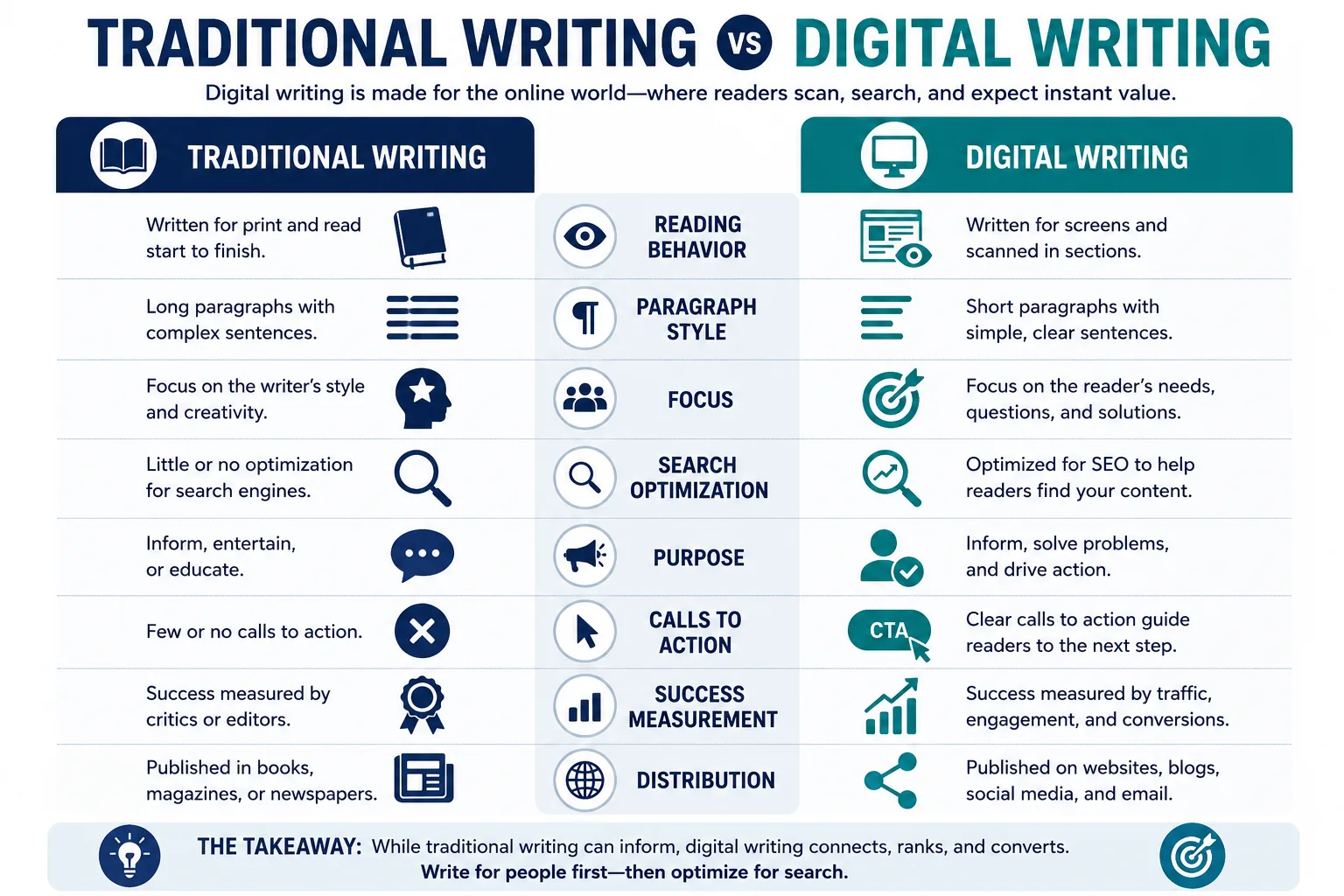
Digital writing combines clear communication, SEO, copywriting, formatting, content strategy, analytics, and AI collaboration to create content that attracts readers and delivers value. Whether you're writing blog posts, emails, or website copy, these skills help you communicate more effectively and achieve better results.
- Write with clarity and keep your reader's needs in mind.
- Learn the basics of SEO, keyword research, and search intent.
- Structure content with headings, short paragraphs, and visuals.
- Use AI as a writing assistant, not a replacement for human judgment.
- Create a content strategy instead of publishing without a plan.
- Measure performance and improve your content over time.
- Build consistency through regular writing and continuous learning.
Table of Content
- Quick Summary
- What Are Digital Writing Skills?
- Why Digital Writing Skills Matter More Than Ever?
- 1. Clear Writing
- 2. Knowing Your Audience
- 3. Research Skills
- 4. SEO Writing Skills
- 5. Copywriting Skills
- 6. Storytelling
- 7. Editing Skills
- 8. Formatting for Online Reading
- 9. AI Collaboration Skills
- 10. Content Strategy
- 11. Consistency
- 12. Analytics
- How to Improve Your Digital Writing Skills
- Common Mistakes Beginners Make
- Frequently Asked Questions
- Not Sure What to Do Next as a Writer?
- Conclusion
- Continue Your Learning
What Are Digital Writing Skills?
Digital writing skills are the abilities you need to create clear, engaging, and effective content for online platforms such as blogs, websites, emails, newsletters, and social media.
These skills go beyond grammar and spelling. They include understanding your audience, organizing information, writing for search engines, and making content easy to read on a screen.
Unlike traditional writing, digital writing is designed for people who are often in a hurry. Someone reading a printed book is more likely to read each page from beginning to end. Online readers behave differently.
They skim headings, scan bullet points, and look for quick answers before deciding whether to keep reading. If they can’t find what they need within a few seconds, they’ll usually move on to another page.
That’s why digital writers focus on clarity before creativity. They use descriptive headings, short paragraphs, simple language, and logical structure to help readers find information quickly.
Every sentence should have a purpose, and every section should move the reader one step closer to their goal.
Digital writing also serves many different purposes. A blog post might educate readers, a landing page might encourage someone to sign up for a newsletter, an email might build trust with subscribers, and a social media post might start a conversation.
Although each format is different, they all rely on the same core writing skills: understanding your audience, communicating clearly, and providing value.
As more businesses, creators, and professionals build their presence online, strong digital writing skills have become more valuable than ever. They help you create content that attracts readers, keeps them engaged, and encourages them to take action, whether that’s reading another article, joining your email list, or becoming a customer.
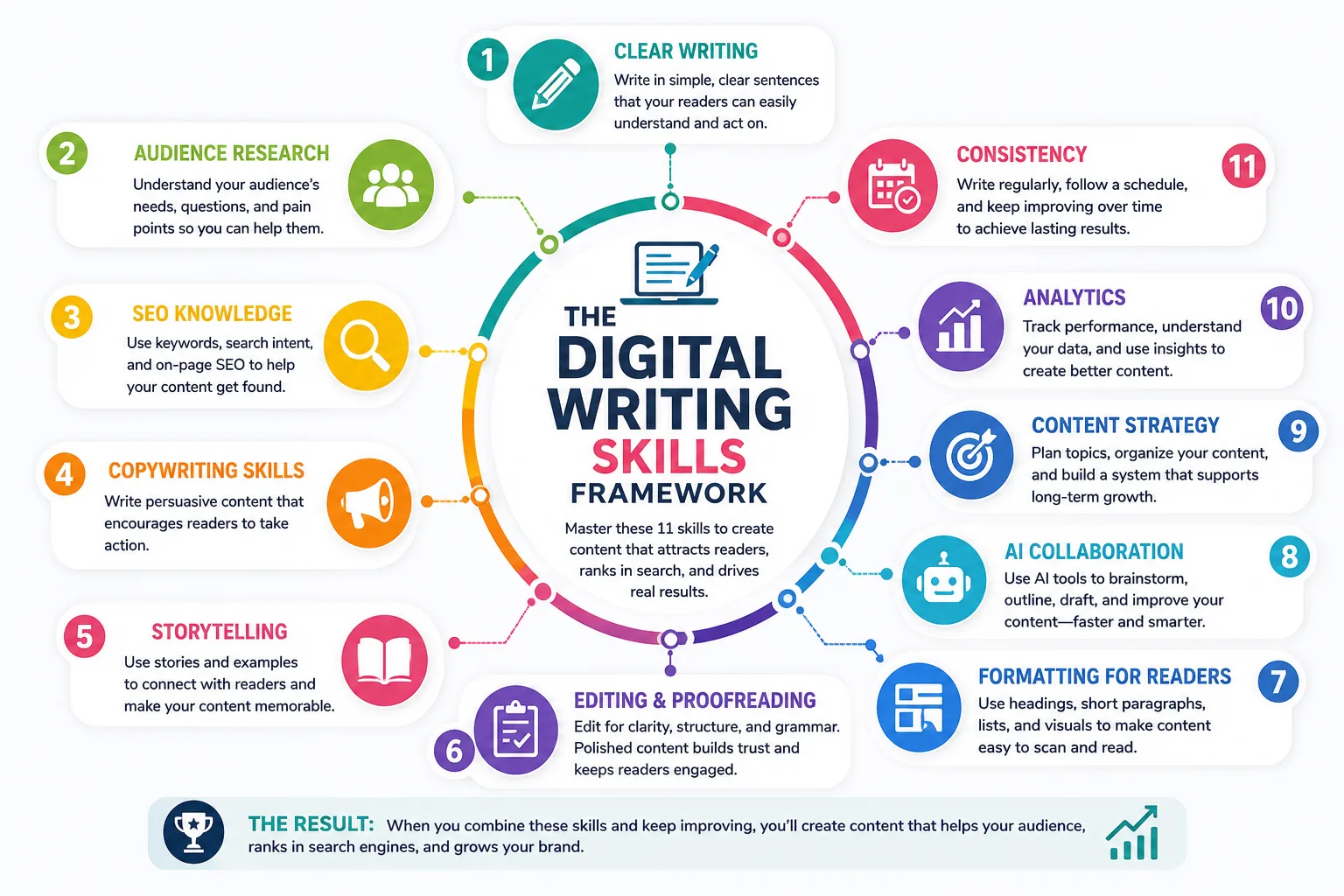
Digital Writing vs. Traditional Writing
| Digital Writing | Traditional Writing |
| Written for screens | Written mainly for print |
| Easy to scan with headings and short paragraphs | Usually read from start to finish |
| Focuses on user experience and search intent | Focuses on narrative or formal structure |
| Often includes links, images, and calls to action | Rarely includes interactive elements |
| Updated regularly as information changes | Usually remains unchanged after publication |
The goal of digital writing isn’t simply to write well. It’s to help readers find, understand, and use the information they need as quickly and easily as possible.
Why Digital Writing Skills Matter More Than Ever?
If you’ve ever thought, “AI can write now, so why should I improve my writing?” you’re not alone. It’s a fair question. The truth is that digital writing skills are becoming more valuable, not less.
While AI can help you create drafts, organize ideas, and speed up your workflow, it still needs human guidance to produce content that is accurate, helpful, and worth reading.
Businesses understand this. Nearly every company needs online content to attract customers, answer questions, and build trust. They publish blog posts, update websites, send email newsletters, create social media content, and produce landing pages.
Behind every piece of content is someone who knows how to communicate clearly and solve a reader’s problem. That’s why skilled writers continue to play an important role in digital marketing.
Search engines have also raised the bar. Google doesn’t reward content simply because it contains the right keywords. It rewards content that satisfies search intent, answers questions clearly, and gives readers a better experience.
Articles that are well organized, easy to understand, and genuinely helpful are more likely to earn visibility in search results than content written only to rank.
At the same time, the demand for freelance writers continues to grow. Businesses often hire writers instead of building an in-house content team because it’s more flexible and cost-effective. Freelance writers can specialize in blogging, SEO content, email marketing, copywriting, technical writing, or industry-specific topics.
As long as companies need content to reach customers, there will be opportunities for writers who can produce high-quality work.
Another reason these skills matter is the continued growth of content marketing. Instead of relying only on paid advertising, businesses use helpful articles, videos, newsletters, and guides to attract potential customers.
This approach builds trust before asking for a sale. Every successful content marketing strategy depends on clear, useful writing that helps readers solve real problems.
Learning digital writing skills isn’t just about becoming a better writer. It’s about becoming a better communicator in a digital world. Whether you’re building a blog, growing a business, creating content for clients, or looking for freelance work, these skills can help you stand out.
The tools may continue to change, but the ability to explain ideas clearly, earn trust, and help readers will always be valuable.
1. Clear Writing
Clear writing is the foundation of every successful piece of online content. It doesn’t matter how much you know about a topic if readers can’t understand your message. When your writing is simple and easy to follow, people are more likely to stay on the page, trust your advice, and take the next step.
One of the easiest ways to improve clarity is to use simple language. Choose familiar words instead of complex ones whenever possible. Your goal isn’t to impress readers with a large vocabulary. It’s to explain ideas in a way that anyone can understand.
For example, compare these two sentences:
- Less clear: "Utilize concise terminology to facilitate enhanced reader comprehension.”
- Clear: "Use simple words so readers understand your message.”
Both sentences mean the same thing, but the second is easier to read.
Another important habit is writing in the active voice. Active voice makes your writing stronger and more direct because it clearly shows who is doing the action.
- Passive voice: “The article was written by the marketing team.”
- Active voice: “The marketing team wrote the article.”
The active version is shorter, clearer, and more engaging.
Paragraph length also matters. Large blocks of text can overwhelm readers, especially on mobile devices. Instead of writing five or six sentences in one paragraph, keep most paragraphs to one, two, or three sentences. This creates more white space and makes your content easier to scan.
Finally, avoid unnecessary jargon. Industry terms can confuse beginners and make your content feel less welcoming. If you need to use a technical term, explain it in plain English before moving on. Never assume your readers already know what a word means.
For example, instead of writing:
“Optimize your content for semantic search using entity-based SEO.”
You could write:
“Help search engines understand your content by naturally covering related topics and important terms.”
The second example is much easier for a beginner to understand.
Tips for Writing More Clearly
- Use everyday words whenever possible.
- Write in the active voice.
- Keep paragraphs short.
- Explain technical terms before using them.
- Remove words that don’t add value.
- Read your content out loud to spot awkward sentences.
Clear writing isn’t about making your content shorter. It’s about making every sentence easier to understand. When readers don’t have to work to figure out what you’re saying, they’re more likely to keep reading and come back for more.
2. Knowing Your Audience
One of the biggest mistakes new writers make is writing for themselves instead of their readers. They focus on what they want to say rather than what their audience wants to learn. Great digital writing does the opposite. It starts with the reader and builds every sentence around their needs.
Before you write, ask yourself a simple question: Who am I writing for? The answer shapes everything that follows, from your headline to your call to action. A beginner needs simple explanations and step-by-step guidance, while an experienced professional may prefer advanced strategies and detailed examples.
This is known as reader-first writing. Instead of trying to show how much you know, you focus on helping one person solve one problem. When readers feel that your content speaks directly to them, they’re more likely to keep reading and trust your advice.
Understanding your reader also means knowing their level of awareness. Some people are discovering a topic for the first time, while others are comparing solutions or looking for expert advice. Your content should match where they are in their journey.
For example, someone searching “what are digital writing skills” wants a clear explanation. They aren’t looking for advanced writing techniques or complicated marketing strategies. On the other hand, someone searching “how to improve digital writing skills” already understands the basics and wants practical tips they can use right away.
Another important concept is search intent. Search intent is the reason behind a search query. It helps you understand what readers expect to find when they visit your page. If your content doesn’t meet those expectations, they’ll leave and continue searching elsewhere.
There are four common types of search intent:
- Informational: The reader wants to learn something.
- Navigational: The reader is looking for a specific website or page.
- Commercial: The reader is comparing products or services before making a decision.
- Transactional: The reader is ready to take action, such as buying a product or signing up for a service.
Most educational blog posts, including this one, target informational search intent. Readers want clear answers, practical advice, and examples they can apply.
Above all, remember that people search online because they have a problem to solve. They may want to improve their writing, attract more readers, or start a freelance career. Your job is to remove confusion and provide a solution. Every section of your article should move the reader closer to achieving their goal.
Tips for Writing With Your Reader in Mind
- Identify who you’re writing for before you begin.
- Match your content to the reader’s knowledge level.
- Understand the search intent behind your target keyword.
- Answer the questions readers are most likely to ask.
- Focus on solving one clear problem instead of covering everything.
When you understand your audience, writing becomes much easier. Instead of wondering what to say next, you simply answer the questions your readers already have. That’s what makes content feel helpful, relevant, and worth sharing.
3. Research Skills
Strong writing starts with strong research. Even the best writing won’t help your readers if the information is outdated, inaccurate, or misleading. That’s why research is one of the most important digital writing skills you can develop.
The first step is finding reliable sources. Not everything you read online is accurate, even if it appears on the first page of search results. Look for information from trusted organizations, government agencies, universities, industry experts, and well-known publications. When possible, go to the original source instead of relying on articles that simply repeat someone else’s work.
Fact checking is just as important. Before you publish an article, verify important facts, statistics, dates, and quotes. If you find the same information in several trustworthy sources, you can feel more confident that it’s accurate.
If you can’t confirm a claim, don’t include it. It’s better to leave out uncertain information than risk sharing something that’s wrong.
Good research also means organizing your information before you start writing. Instead of collecting dozens of random notes, group related ideas together. You might organize your research into sections such as definitions, key points, examples, statistics, and frequently asked questions.
A clear structure makes writing faster and helps your article flow naturally from one topic to the next.
For example, if you’re writing about digital writing skills, you could collect information under headings like:
- What digital writing is
- Essential writing skills
- SEO best practices
- Common mistakes
- Helpful tools
- Frequently asked questions
When your research is organized, you spend less time searching for information and more time writing.
Another important responsibility is avoiding misinformation. False or outdated information spreads quickly online, especially when writers copy content without checking the original source.
As a digital writer, your reputation depends on accuracy. Readers trust you to provide information they can rely on, and that trust is difficult to rebuild once it’s lost.
When discussing topics that change often, such as artificial intelligence, SEO, or digital marketing, check that your information is current before publishing. Review older articles regularly and update them when new information becomes available. Fresh, accurate content is more valuable to readers and more useful over time.
Tips for Better Research
- Start with trustworthy and authoritative sources.
- Verify important facts before publishing.
- Compare information from multiple reliable sources.
- Organize your research before you begin writing.
- Update articles when facts, tools, or best practices change.
- Never copy information without checking the original source.
Great writers don’t know everything. They know how to find reliable information, verify it, and explain it clearly. That’s what turns good content into content that readers trust and recommend.
4. SEO Writing Skills
Great writing is only valuable if people can find it. That's why SEO writing is an essential digital writing skill. SEO, or search engine optimization, helps your content appear in search results when people are looking for information.
The goal isn't to write for Google. It's to create helpful content that answers readers' questions while making it easy for search engines to understand your page.
Everything starts with keywords. A keyword is the phrase someone types into a search engine. Before writing, identify the primary keyword your audience is searching for and naturally include it in your title, introduction, headings, and throughout your article.
Instead of repeating the same keyword over and over, use related terms that help cover the topic more completely.
If you're new to keyword research, our Keyword Research for Writers guide will show you how to find topics your audience is actively searching for.
Choosing the right keyword is only half the job. You also need to understand search intent. Search intent is the reason behind a search.
Someone searching for digital writing skills wants to learn what those skills are and how to improve them. They aren't looking for a sales page or a product review. When your content matches the reader's intent, they're more likely to stay on your page and find it useful.
Want to learn more? Read Search Intent for Writers to understand how search intent influences both rankings and reader satisfaction.
Your article should also have a clear structure. Use one H1 heading for the page title, H2 headings for major topics, and H3 headings for supporting ideas. A logical heading structure helps readers scan your content and makes it easier for search engines to understand what each section covers.
Good SEO also depends on how your pages connect to one another. Internal links guide readers to related content, help search engines discover your pages, and strengthen your site's topical authority. Whenever you mention a topic you've already covered, link to the relevant article instead of making readers search for it themselves.
For example, this article naturally connects to:
- What Is Digital Writing?
- On-Page SEO for Writers
- SEO Optimization Strategies
- Beginner's Guide to Topical Authority
Another useful SEO technique is optimizing for featured snippets. These are the answer boxes that sometimes appear above the regular search results. You can improve your chances of earning one by writing clear definitions, answering common questions directly, using numbered steps, and creating simple tables or bullet lists where they make sense.
As AI becomes part of every writer's workflow, understanding how to optimize AI-assisted content is becoming another valuable skill. My guide How to Optimize Content for AI Search Tools explains how to combine AI with human expertise to create content that readers trust.
Finally, focus on EEAT, which stands for Experience, Expertise, Authoritativeness, and Trustworthiness. Google wants to recommend content that demonstrates real knowledge and provides genuine value.
You don't build trust by using complicated language or stuffing keywords into every paragraph. You build it by answering questions clearly, keeping your information accurate, supporting important claims with reliable sources, and creating content that genuinely helps your audience.
Tips for Better SEO Writing
- Research keywords before you start writing.
- Match your content to the reader's search intent.
- Use clear headings to organize your ideas.
- Add internal links to related articles.
- Answer common questions directly.
- Create content that demonstrates expertise and builds trust.
- Write for people first and search engines second.
SEO writing isn't about chasing algorithms. It's about creating content that is easy to find, easy to understand, and genuinely useful. When you focus on helping your readers, better search visibility often follows naturally.
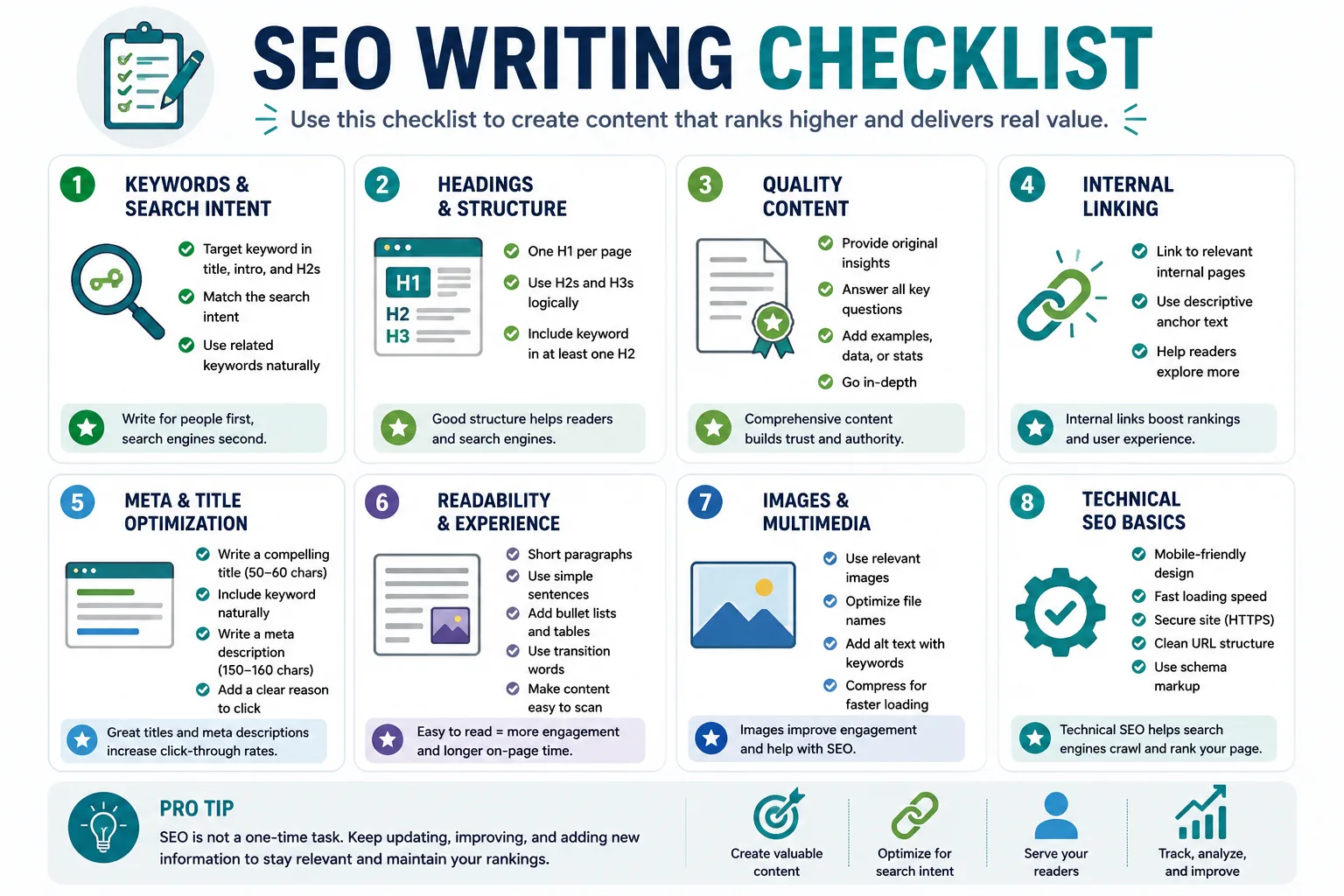
Google recommends creating content for people first rather than trying to manipulate search rankings. If you want to understand what Google looks for in high-quality content, read the Creating Helpful, Reliable, People-First Content guidance from Google Search Central.
5. Copywriting Skills
Writing online isn't just about sharing information. Sometimes you want readers to take action after they finish reading. That action might be subscribing to your newsletter, downloading a guide, sharing your article, or buying a product. That's where copywriting skills become valuable.
Copywriting is the art of using words to persuade people to take a specific action. Good copywriting doesn't rely on hype or pressure. Instead, it helps readers understand why something matters and how it can solve their problem.
One of the most important copywriting skills is writing headlines. Your headline is often the first thing people see in search results, social media, or an email inbox. If it doesn't grab attention, many people won't click through to read the rest of your content.
A strong headline should:
- Promise a clear benefit.
- Match the reader's search intent.
- Spark curiosity without being misleading.
- Include your primary keyword when appropriate.
For example:
- Weak headline: Writing Tips
- Strong Headline: Digital Writing Skills Every Online Writer Should Master
After your headline comes the hook. The opening paragraph should convince readers to keep reading. You can do this by asking a question, describing a common problem, sharing an interesting fact, or making a promise about what they'll learn.
For example:
Most people don't struggle because they can't write. They struggle because they write for themselves instead of their readers.
That opening makes readers curious and encourages them to continue.
Another essential copywriting skill is writing effective calls to action (CTAs). A CTA tells readers what to do next. Without one, many people will simply leave your website, even if they found your content helpful.
Good CTAs are simple, specific, and relevant to the article.
For example:
- Download the free Writing Jumpstart guide.
- Read our Copywriting Basics for Beginners guide.
- Explore What Is Copywriting? to learn more.
- Subscribe to receive weekly writing tips.
Another key concept is understanding the difference between features and benefits.
A feature describes what something is or what it includes.
A benefit explains why it matters to the reader.
For example:
- Feature: This course includes 25 writing lessons.
- Benefit: You'll learn the skills you need to write faster and attract more clients.
Readers care far more about the outcome than the feature itself.
Finally, good copywriting uses persuasion, but never manipulation. The goal is to help readers make informed decisions by showing them the value of an idea, product, or service. The best copywriters build trust through clear explanations, useful examples, and honest recommendations instead of exaggerated claims.
If you'd like to improve your persuasive writing, these articles are a great next step:
- What Is Copywriting?
- Copywriting Basics for Beginners
- How Copywriting Works
- AIDA Copywriting Explained
- Copywriting FAQs
- Website Copywriting Guide
Tips for Better Copywriting
- Write headlines that promise a clear benefit.
- Hook readers in the first few sentences.
- Focus on benefits instead of features.
- Use one clear call to action.
- Build trust with honest, helpful writing.
- Persuade by solving problems, not by creating pressure.
Copywriting is one of the most valuable digital writing skills because every piece of online content has a purpose. Whether you're writing a blog post, an email, or a landing page, strong copy helps readers understand the value of your message and gives them a clear next step.
6. Storytelling
Facts teach, but stories make people care. That's why storytelling is one of the most valuable digital writing skills you can develop. A well-told story captures attention, explains complex ideas, and helps readers remember what they've learned long after they leave your website.
Storytelling doesn't mean turning every article into a personal memoir. It means using relatable examples, real-life situations, and simple narratives to make your content more engaging and easier to understand.
One of the biggest benefits of storytelling is that it keeps readers engaged. Instead of presenting a list of facts, you show readers how those facts apply in the real world. This creates curiosity and encourages them to keep reading.
For example, instead of saying:
- Short paragraphs improve readability.
You could write:
- Imagine opening a blog post and seeing one giant block of text that fills your phone screen. Most people won't read it. They'll leave and look for an article that's easier to scan.
Both examples teach the same lesson, but the second helps readers picture the situation.
Another effective technique is using personal examples. You don't have to share private details or dramatic life stories. Even a simple observation, lesson learned, or challenge you've experienced can make your writing feel more authentic and relatable.
For example:
When I first started writing online, I focused on sounding smart instead of being clear. Once I began writing for one reader instead of everyone, my content became easier to read and more helpful.
A short example like this adds personality without taking attention away from the reader.
Every good story also follows a simple structure. You don't need complicated storytelling techniques. In most cases, this simple framework works well:
- Introduce a problem.
- Explain what happened.
- Share the solution.
- End with the lesson.
This structure works just as well in blog posts as it does in emails, case studies, and social media posts.
Finally, storytelling creates an emotional connection. People may forget statistics or technical details, but they often remember how a story made them feel. When readers recognize their own struggles in your examples, they begin to trust your advice because they feel understood.
The goal isn't to entertain for the sake of entertainment. Every story should support your main point and help readers understand the lesson more clearly.
If you'd like to improve your writing voice and create stronger connections with readers, these articles can help:
- Digital Writing Techniques
- How to Pick One Reader
- Clear Writing vs. Clever Writing
- Beginner-Friendly Writing Guide
Tips for Better Storytelling
- Start with a situation your readers recognize.
- Use examples to explain complex ideas.
- Keep stories short and relevant.
- Focus on one lesson or takeaway.
- End every story by connecting it back to the reader.
Stories make information easier to understand and remember. When you combine clear explanations with meaningful examples, your content becomes more engaging, more memorable, and more valuable to your readers.
7. Editing Skills
Great writing rarely happens in the first draft. Even experienced writers spend time reviewing and improving their work before publishing it. That's because writing and editing are two different skills. Writing helps you get your ideas onto the page, while editing helps you communicate those ideas clearly.
One of the most valuable habits you can develop is self-editing. Instead of publishing your first draft immediately, take a break before reviewing it. Even a short break helps you spot awkward sentences, missing information, and small mistakes that are easy to miss while you're writing.
As you edit, look for opportunities to remove fluff. Fluff includes words, phrases, or entire paragraphs that don't add value. Every sentence should teach something, answer a question, or move the reader closer to the main point. If a sentence doesn't serve a purpose, delete it.
For example:
- Wordy: It is important to note that using short paragraphs can often help improve readability for many different types of readers.
- Better: Short paragraphs make your content easier to read.
The second sentence says the same thing using fewer words.
Good editing also includes checking grammar, spelling, and punctuation. Small mistakes can distract readers and make your content appear less professional. While writing tools can catch many errors, don't rely on them completely. Read your article carefully and make sure every sentence sounds natural.
Another important step is improving readability. Most people don't read online word for word. They scan headings, bullet points, and short paragraphs before deciding whether to continue. Your job is to make important information easy to find.
Ask yourself:
- Are my paragraphs short?
- Are my headings descriptive?
- Would someone understand this without rereading it?
- Does the article flow naturally from one section to the next?
If the answer is no, keep editing.
Finally, focus on clarity. Readers shouldn't have to guess what you mean. Replace vague words with specific ones, explain unfamiliar terms, and keep your sentences simple. Clear writing builds trust because readers can understand your message without extra effort.
One useful editing technique is reading your article out loud. If a sentence sounds awkward when you say it, it will probably feel awkward to your readers as well. Reading aloud also helps you catch repeated words, long sentences, and transitions that don't flow smoothly.
Self-Editing Checklist
Before publishing, ask yourself:
- Does every sentence add value?
- Have I removed unnecessary words?
- Is the grammar and spelling correct?
- Are my paragraphs easy to scan?
- Is every idea explained clearly?
- Have I answered the reader's main question?
Editing isn't about making your writing sound smarter. It's about making it easier to understand. The clearer your writing becomes, the easier it is for readers to learn, trust your advice, and take action.
8. Formatting for Online Reading
Even the best-written article can fail if it's difficult to read. Most people don't read web pages from beginning to end. They scan the page, looking for headings, keywords, images, and anything that helps them find the information they need quickly. Good formatting makes that process easier.
One of the most important formatting tools is headings. Clear headings break your article into logical sections and tell readers what each part is about. They also help search engines understand your content. Use one H1 for the page title, H2 headings for major sections, and H3 headings for supporting topics.
For example, someone reading this article can quickly jump to sections about SEO, copywriting, or editing without reading every paragraph first. That's exactly how many people consume online content.
Another simple way to improve readability is by using bullet lists. Lists make important information easier to scan and remember. Instead of hiding key points inside long paragraphs, use bullets whenever you're explaining steps, tips, benefits, or checklists.
For example, a checklist is much easier to read like this:
- Use descriptive headings.
- Keep paragraphs short.
- Add internal links where they help readers.
- Include images to support your explanation.
- End with a clear call to action.
Tables are another useful formatting tool. They help readers compare information without reading several paragraphs. Whenever you're comparing features, tools, methods, or concepts, a table is often the clearest choice.
For example:
| Poor Formatting | Better Formatting |
|---|---|
| Long paragraphs | Short paragraphs |
| Few headings | Clear H2 and H3 headings |
| Large text blocks | Bullet lists and tables |
| No images | Helpful visuals and diagrams |
Don't underestimate the value of white space. Empty space between paragraphs, headings, and images makes your content feel less overwhelming. Large blocks of text can discourage readers, especially on mobile devices. Keeping paragraphs to one, two, or three sentences creates a cleaner layout and encourages people to keep reading.
Finally, use images to support your content, not decorate it. Screenshots, diagrams, charts, infographics, and illustrations can explain ideas much faster than text alone. Every image should have a purpose. Ask yourself whether it helps readers understand the topic better. If it doesn't, leave it out.
Remember to optimize your images by:
- Using descriptive file names.
- Adding helpful alt text.
- Compressing images to improve page speed.
- Placing images near the relevant text.
Formatting Checklist
Before publishing, make sure your article includes:
- Clear H2 and H3 headings.
- Short, easy-to-read paragraphs.
- Bullet lists where they improve clarity.
- Tables for comparisons.
- Plenty of white space.
- Relevant images that support the content.
Formatting isn't just about making your article look better. It improves the reader's experience, helps visitors find answers faster, and keeps them engaged from the introduction to the conclusion. When your content is easy to scan, it's also easier to understand and more likely to achieve its purpose.
Making your content easy to read also means making it accessible to a wider audience. The Web Content Accessibility Guidelines (WCAG) provide internationally recognized recommendations for creating content that's easier for everyone to use.
9. AI Collaboration Skills
Artificial intelligence has changed the way people create content, but it hasn't replaced good writers. Instead, it's become another tool in the writing process. The most successful digital writers know how to work with AI, not rely on it.
Think of AI as a writing assistant. It can help you generate ideas, create outlines, summarize information, and overcome writer's block. However, it's your knowledge, judgment, and creativity that turn those drafts into content people trust.
The first skill to learn is prompt writing. AI produces better results when you give it clear instructions. Instead of asking for "an article about SEO," explain your audience, goal, tone, and the information you want to include.
For example:
- Weak prompt Write an article about SEO.
- Better prompt Write a beginner-friendly article explaining SEO writing skills for bloggers. Use simple language, include practical examples, and organize the content with H2 headings.
The more context you provide, the more useful the output becomes.
Another essential skill is editing AI-generated content. AI can write quickly, but it often repeats ideas, uses vague language, or includes generic advice. Rather than publishing the first draft, rewrite sections to match your voice, improve clarity, and remove unnecessary information.
You should also fact-check everything AI produces. AI can misunderstand questions, reference outdated information, or present incorrect facts with confidence. Before publishing, verify statistics, dates, quotes, and important claims using reliable sources. Accuracy is your responsibility, not the AI's.
One of the best ways to improve AI-generated content is by adding your own experience and insights. Explain concepts in your own words, include practical examples, share observations, or add details that AI is unlikely to know. These human touches make your content more useful and help readers connect with your writing.
Finally, never skip the human review. Read the article from beginning to end and ask yourself:
- Does this answer the reader's question?
- Is every section accurate?
- Does the article sound like me?
- Have I removed repetition and filler?
- Is the content genuinely helpful?
If the answer to any of these questions is no, keep editing.
Best Practices for Working With AI
- Use AI to brainstorm ideas and create first drafts.
- Write detailed prompts with clear instructions.
- Edit every AI-generated draft before publishing.
- Verify facts, statistics, and sources.
- Add your own knowledge, examples, and insights.
- Always perform a final human review.
AI is changing how we write, but it isn't replacing skilled writers. The writers who thrive will be the ones who combine AI's speed with human creativity, critical thinking, and expertise. When you use AI as a partner instead of a replacement, you can create content that's both efficient and genuinely valuable.
Strong digital writing still depends on skills that go beyond generating text. See how professional writers use AI to support their skills while keeping their expertise at the center of the process.
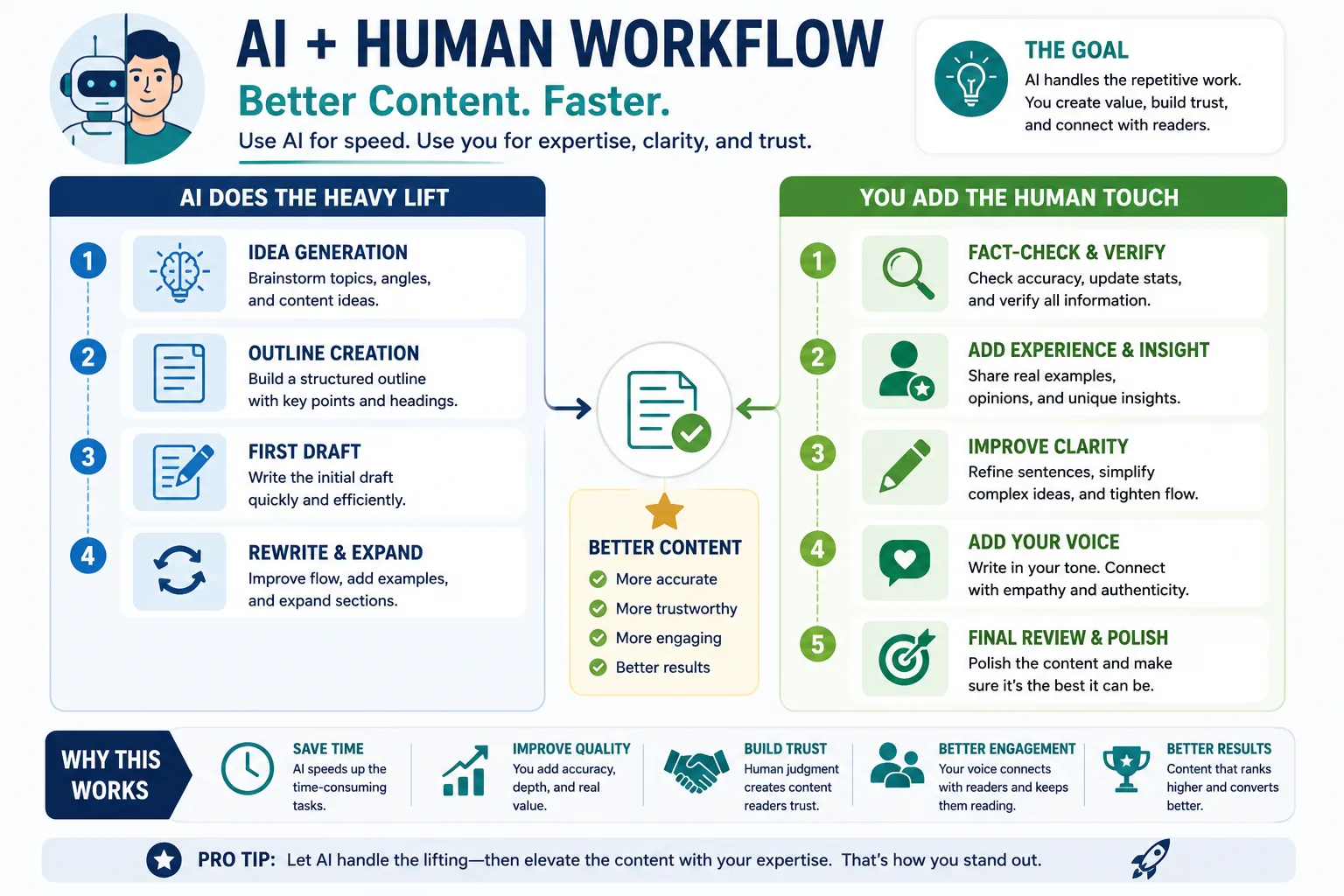
If you'd like to improve your prompting skills, the OpenAI Prompt Engineering Guide provides practical techniques for writing clearer instructions and getting more useful AI-generated content.
10. Content Strategy
Writing one great article is an achievement. Building a collection of articles that work together is a strategy. That's why content strategy is one of the most valuable digital writing skills you can develop. It helps you publish with purpose instead of writing random articles whenever inspiration strikes.
Everything begins with planning. Before writing, decide who your audience is, what problems they need to solve, and how your content will help them. A simple content plan saves time, keeps you focused, and makes it easier to create articles that support your long-term goals.
One of the best ways to organize your content is by using topic clusters. A topic cluster is a group of related articles built around one main subject, often called a pillar page. The pillar page provides a broad overview, while supporting articles explore individual topics in greater detail.
For example, this article about Digital Writing Skills can serve as a pillar page. It naturally connects to supporting articles such as:
- What Is Digital Writing?
- Keyword Research for Writers
- Search Intent for Writers
- On-Page SEO for Writers
- Copywriting FAQs
- Beginner's Guide to Topical Authority
- How to Optimize Content for AI Search Tools
Together, these articles create a content cluster that helps readers learn more while showing search engines that your website covers the topic in depth.
Another important part of content strategy is maintaining a content calendar. A content calendar helps you decide what to publish, when to publish it, and how each article supports your overall strategy. Instead of wondering what to write next, you'll always have a list of planned topics ready to go.
A simple content calendar should include:
- Article title
- Target keyword
- Search intent
- Publish date
- Internal links
- Call to action
Planning ahead also helps you publish consistently, which builds trust with both readers and search engines.
As your website grows, internal linking becomes even more important. Every new article should connect to related content on your site. Internal links guide readers to the next logical resource, increase the time they spend on your website, and help search engines understand the relationship between your pages.
For example, someone reading this guide might want to learn more about SEO or copywriting. Linking to those articles creates a better experience because readers don't have to search for the information themselves.
Finally, focus on creating evergreen content. Evergreen articles remain useful for months or even years because they answer questions that people search for regularly. While some updates may be needed as industries change, the core information stays relevant over time.
Examples of evergreen topics include:
- How to write better online
- What is digital writing?
- SEO writing basics
- Copywriting fundamentals
- Content marketing strategies
These articles continue attracting readers long after they're published, making them some of the most valuable assets on your website.
Tips for Building a Better Content Strategy
- Plan your content before you start writing.
- Build topic clusters around your main subjects.
- Use a content calendar to stay consistent.
- Connect related articles with internal links.
- Focus on evergreen topics that provide long-term value.
- Update your best-performing content regularly.
A successful website isn't built one article at a time. It's built by creating a connected library of helpful content that answers your audience's questions and guides them from one resource to the next. That's what turns individual articles into a lasting content strategy.
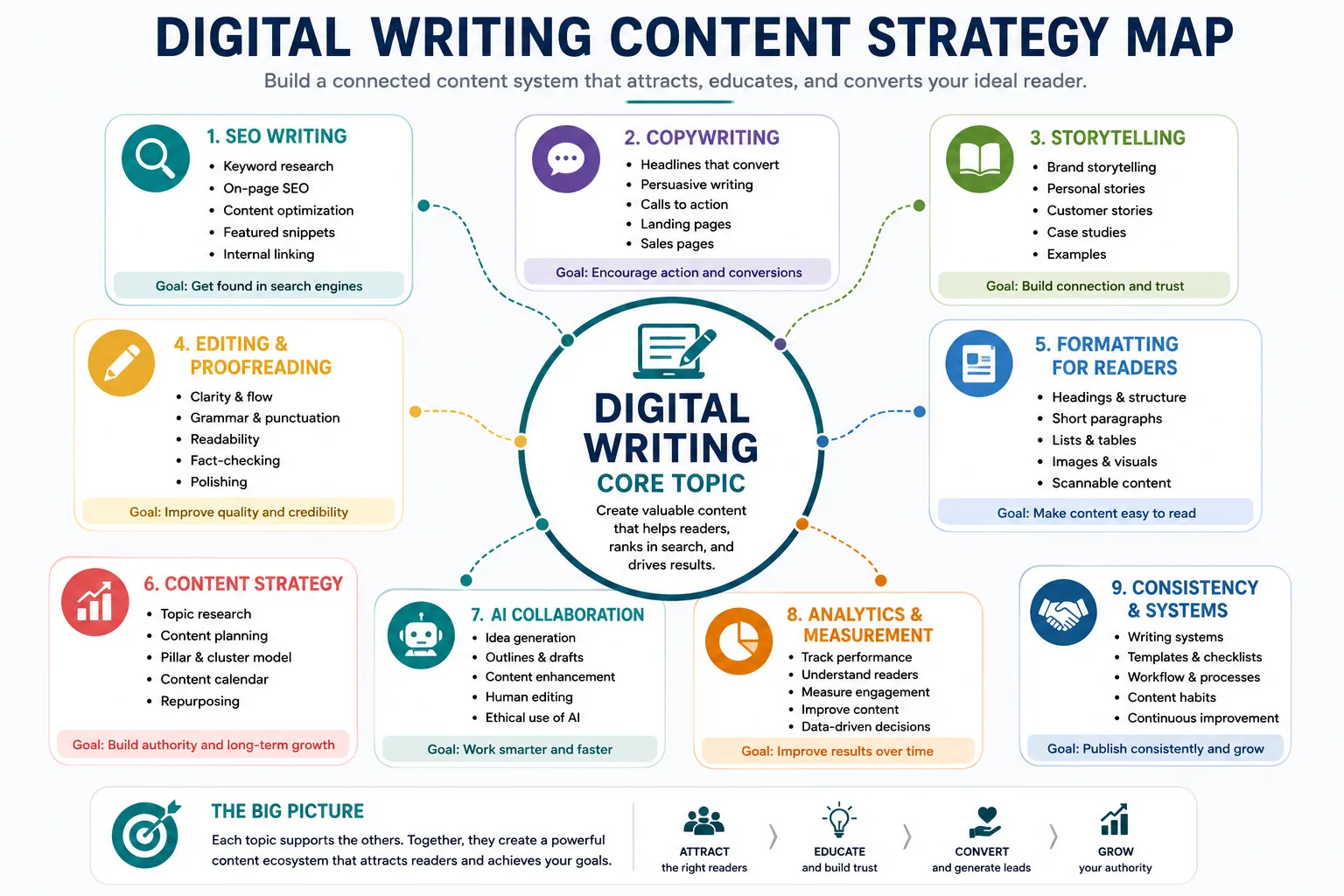
11. Consistency
Writing one great article won't transform your website overnight. Real growth comes from showing up regularly, improving your skills, and publishing helpful content over time. That's why consistency is one of the most important habits every digital writer can develop.
Many beginners believe they need to publish every day to succeed. In reality, a realistic schedule that you can maintain is far more effective than an ambitious plan you'll abandon after a few weeks. Whether you publish once a week or twice a month, consistency builds momentum and helps readers know when to expect new content.
The foundation of consistency is creating writing habits. Instead of waiting for inspiration, set aside dedicated time to write. Some writers prefer writing first thing in the morning, while others work better in the evening. The best routine is the one you can stick to over the long term.
You can also make writing easier by breaking it into smaller tasks. For example:
- Monday: Research the topic.
- Tuesday: Create an outline.
- Wednesday: Write the first draft.
- Thursday: Edit and improve the article.
- Friday: Publish and promote your content.
This approach feels much less overwhelming than trying to do everything in one sitting.
Another important habit is following a publishing schedule. A content calendar helps you plan upcoming articles, stay organized, and ensure you're creating content that supports your overall strategy. It also reduces the stress of deciding what to write next because your topics are already planned.
Remember that consistency isn't just about publishing. It's also about improving over time. Every article teaches you something new. You learn which headlines attract clicks, which topics resonate with readers, and which writing techniques keep people engaged.
As your skills grow, revisit your older content. Update outdated information, improve readability, add internal links, and expand sections that need more detail. Refreshing existing articles is often just as valuable as publishing new ones.
Don't compare your progress to writers who've been publishing for years. Every experienced writer started with a first article. What separates successful writers from everyone else isn't talent. It's the willingness to keep learning, keep writing, and keep improving.
Tips for Staying Consistent
- Create a writing routine that fits your schedule.
- Set realistic publishing goals.
- Plan your content in advance.
- Focus on steady progress instead of perfection.
- Review and improve older articles regularly.
- Celebrate small wins to stay motivated.
Consistency isn't about writing more than everyone else. It's about making writing a regular habit. Over time, those small, consistent efforts turn into a valuable library of content that attracts readers, builds authority, and creates new opportunities.
12. Analytics
Writing and publishing an article isn't the final step. The best digital writers measure how their content performs and use that information to make it better. Analytics helps you understand what your audience is searching for, which articles attract the most visitors, and where you can improve.
One of the most valuable free tools is Google Search Console. It shows how your website performs in Google Search, including which keywords bring visitors to your pages, how often your articles appear in search results, and how many people click on them.
For example, you might discover that an article ranks on the first page for several keywords you never intended to target. That insight can help you expand the article, improve its headings, or create new supporting content.
Another important metric is your click-through rate (CTR). CTR measures how many people click on your page after seeing it in search results. If your article appears 1,000 times and receives 50 clicks, your CTR is 5%.
A low CTR often means your title or meta description isn't encouraging enough. Improving your headline, making your value proposition clearer, or better matching search intent can increase clicks without changing your rankings.
It's also helpful to understand bounce rate and other engagement metrics. Bounce rate measures the percentage of visitors who leave your website without viewing another page. While a high bounce rate isn't always bad, it can sometimes indicate that readers didn't find what they expected or weren't encouraged to continue exploring your content.
One way to reduce bounce rate is by:
- Answering the reader's question quickly.
- Adding internal links to related articles.
- Improving readability with headings and short paragraphs.
- Including a clear next step at the end of the article.
You should also monitor your search rankings. Rankings change over time as competitors publish new content and search engines update their algorithms. Instead of checking rankings every day, review your most important articles regularly to see whether they're improving, staying the same, or losing visibility.
Finally, make it a habit to update your content. Publishing an article doesn't mean your work is finished. Refresh your best-performing content by adding new information, improving examples, updating screenshots, fixing broken links, and expanding sections that no longer answer readers' questions completely.
A simple content update can often improve rankings faster than writing a brand-new article.
Analytics Checklist
Review your content regularly and ask yourself:
- Which articles receive the most search traffic?
- Which keywords are driving visitors?
- Do my titles earn enough clicks?
- Which pages have dropped in rankings?
- What information needs updating?
- Where can I add internal links to improve the reader's journey?
Analytics isn't about collecting numbers for the sake of it. It's about understanding how people interact with your content so you can make every article more helpful. The more you learn from your data, the better your writing and content strategy will become.
If you're new to the platform, the Google Search Console Help Center explains how to measure search performance, identify opportunities, and troubleshoot common issues.
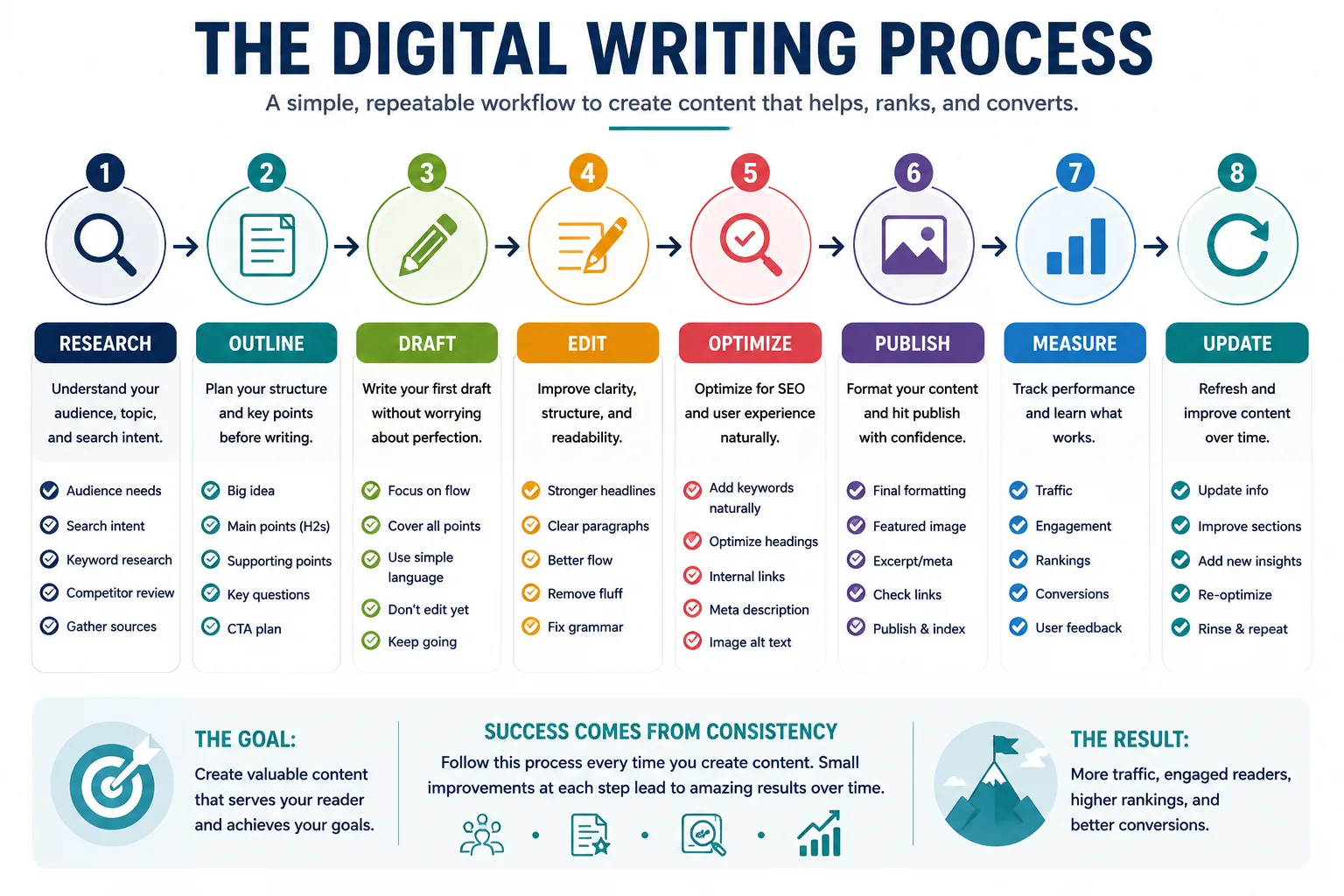
How to Improve Your Digital Writing Skills
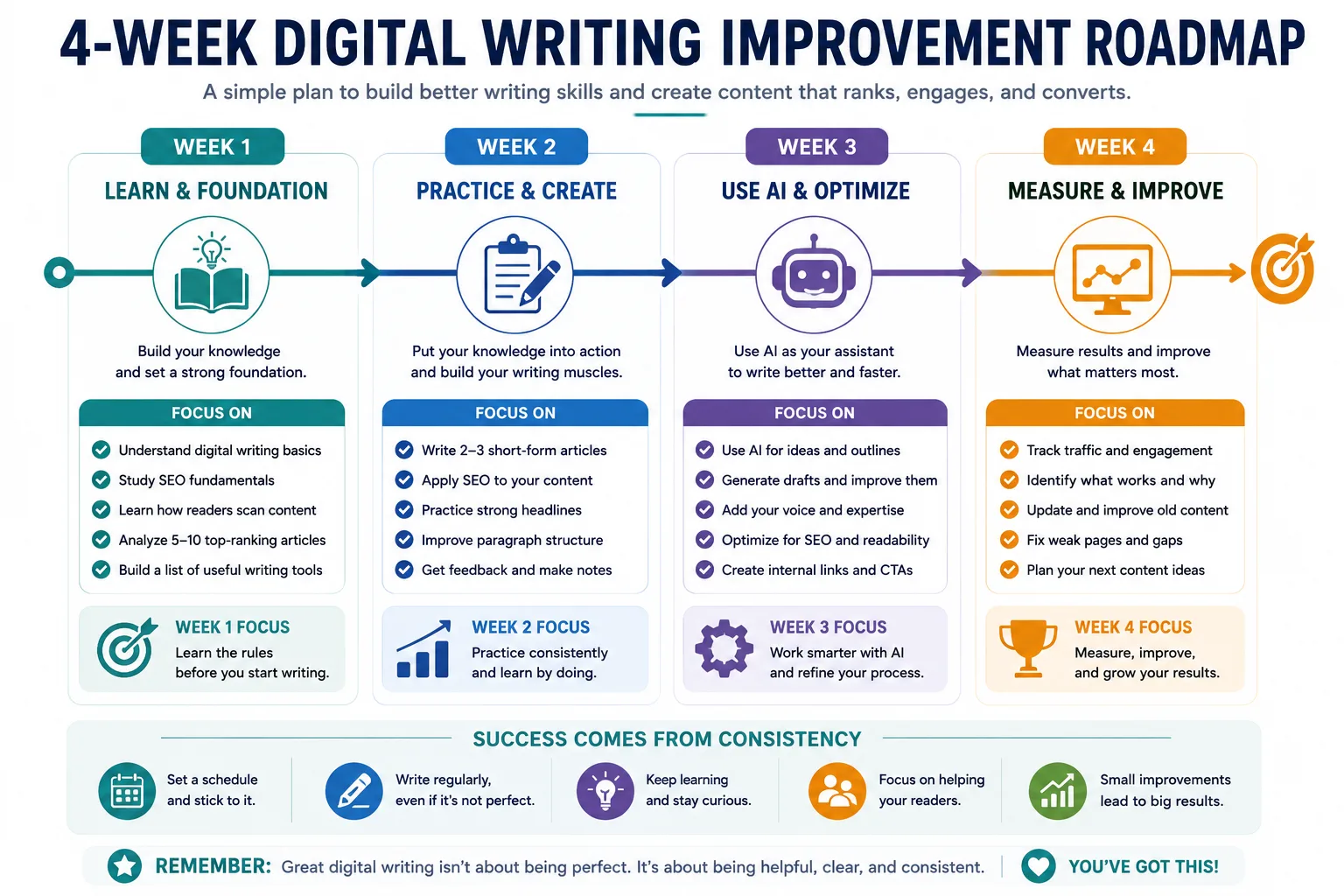
Learning digital writing isn't about mastering every skill at once. The best approach is to focus on one area at a time and practice consistently. Small improvements each week will have a much bigger impact than trying to learn everything in a single weekend.
The following four-week plan will help you build a solid foundation and develop habits you can continue long after the month is over.
Week 1: Build the Basics
Your goal this week is to understand what makes online writing different from traditional writing.
Focus on:
- Reading high-quality blogs in your niche.
- Practicing clear, simple writing.
- Learning how to use headings and short paragraphs.
- Writing one 800 to 1,000-word article.
Before publishing, read your article aloud and remove any sentences that sound confusing or unnecessary.
Week 2: Learn SEO and Reader Intent
This week, shift your attention from writing to helping people find your content.
Focus on:
- Researching keywords before writing.
- Identifying the search intent behind each topic.
- Writing better titles and meta descriptions.
- Adding internal links to related articles.
- Publishing one SEO-optimized article.
Remember that your goal isn't to use more keywords. It's to answer the reader's question better than competing pages.
Week 3: Use AI to Work Smarter
Now that you have a writing process, learn how AI can support it without replacing your own thinking.
Practice using AI to:
- Brainstorm article ideas.
- Create outlines.
- Rewrite difficult paragraphs.
- Generate headline variations.
- Check your writing for clarity.
Then review everything carefully. Rewrite sections that sound generic, verify important facts, and add your own examples and insights.
Week 4: Measure and Improve
Great writers don't stop after publishing. They look at what worked and make their content even better.
This week:
- Review your articles in Google Search Console.
- Identify pages that receive the most impressions.
- Improve titles with low click-through rates.
- Update older articles with new information.
- Add internal links between related content.
- Create a plan for your next month of writing.
By the end of the fourth week, you'll have a repeatable writing system instead of relying on motivation alone.
Keep Improving Every Month
Digital writing is a skill that develops through practice. Every article teaches you something about your audience, your writing style, and the topics that matter most to your readers.
As you continue publishing, make these habits part of your routine:
- Write consistently.
- Read quality content every week.
- Learn one new skill each month.
- Review your analytics regularly.
- Update your best-performing articles.
- Experiment with new formats and ideas.
You don't need to become an expert overnight. If you keep writing, learning, and improving one article at a time, your skills will grow naturally, and so will your confidence.
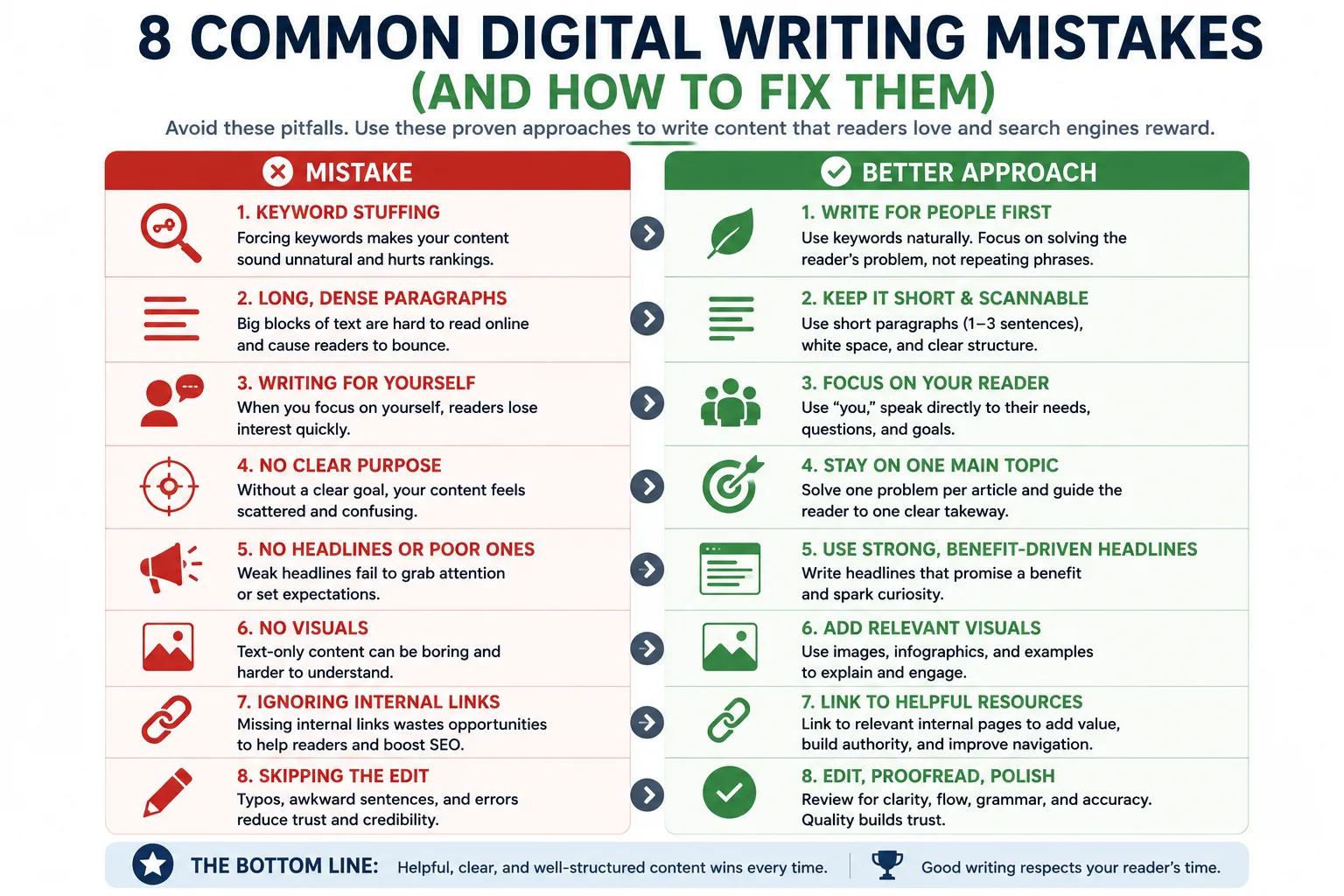
Common Mistakes Beginners Make
Every digital writer makes mistakes in the beginning. The good news is that most of them are easy to fix once you know what to look for. Avoiding these common problems will help you create content that's more useful, easier to read, and more likely to perform well in search results.
Writing for Yourself Instead of Your Reader
Many beginners write about what they find interesting instead of what their audience needs.
Before you start writing, ask yourself:
What question is my reader trying to answer?
When your content solves a real problem, it's much more likely to keep readers engaged and earn their trust.
Ignoring Search Intent
Choosing the right keyword isn't enough. You also need to understand why someone searched for it.
For example, a person searching for "digital writing skills" wants to learn what those skills are and how to improve them. If your article only promotes your services, readers will leave because it doesn't meet their expectations.
Always match your content to the reader's intent.
Keyword Stuffing
Some writers believe repeating a keyword dozens of times will improve rankings. In reality, it makes content awkward to read and can hurt the user experience.
Instead of forcing keywords into every paragraph:
- Use your primary keyword naturally.
- Include related words and phrases.
- Focus on answering the topic thoroughly.
Write for people first and search engines second.
Skipping the Editing Process
Your first draft is rarely your best draft.
Before publishing, review your article carefully:
- Remove unnecessary words.
- Fix grammar and spelling mistakes.
- Rewrite confusing sentences.
- Check that every section supports your main topic.
A few extra minutes of editing can dramatically improve the quality of your content.
Publishing Without a Clear Structure
Readers shouldn't have to work to understand your article.
A well-structured article typically includes:
- A clear introduction.
- Descriptive headings.
- Short sections.
- Lists and tables where appropriate.
- A conclusion that summarizes the main points.
Good structure helps both readers and search engines navigate your content.
Writing Huge Paragraphs
Large blocks of text can overwhelm readers, especially on mobile devices.
Instead:
- Keep paragraphs to one, two, or three sentences.
- Break up complex ideas into smaller sections.
- Use headings and bullet lists to improve readability.
Shorter paragraphs make your content feel easier to read, even when covering complex topics.
Forgetting the Call to Action
Many beginners finish an article without telling readers what to do next.
Every piece of content should guide readers toward another helpful step. Depending on your goals, your call to action might encourage them to:
- Read a related article.
- Download a free resource.
- Join your email newsletter.
- Try a recommended tool.
- Contact you for help.
A clear call to action keeps readers engaged and helps turn visitors into subscribers, customers, or returning readers.
Quick Checklist Before You Publish
Before clicking Publish, ask yourself:
- Am I writing for my reader instead of myself?
- Does the article match search intent?
- Have I used keywords naturally?
- Did I edit and proofread the content?
- Is the article well organized?
- Are my paragraphs easy to scan?
- Does the article include a clear next step for the reader?
Making mistakes is part of learning. The important thing is to recognize them, improve with every article, and keep writing. Over time, these best practices will become second nature, helping you create content that's both helpful and effective.
Frequently Asked Questions
What are digital writing skills?
Digital writing skills are the abilities you need to create effective content for online audiences. They include clear writing, understanding your audience, SEO, copywriting, editing, formatting, content strategy, and using analytics to improve your work.
Can anyone learn digital writing?
Yes. Digital writing is a practical skill that anyone can develop through practice. If you write consistently, study what works, and improve over time, you can become a skilled digital writer.
How long does it take to improve your digital writing skills?
Most beginners notice improvement within a few weeks of consistent practice. Building strong digital writing skills takes ongoing learning and regular writing.
Are digital writing and copywriting the same?
No. Digital writing includes many forms of online content, while copywriting focuses on persuading readers to take a specific action, such as making a purchase or joining an email list.
Do I need SEO to become a digital writer?
You don't need to become an SEO expert, but learning keyword research, search intent, on-page SEO, and internal linking will help your content reach more readers.
Can AI replace digital writers?
No. AI can speed up research and drafting, but it cannot replace human judgment, creativity, editing, and experience. The best writers use AI to enhance their workflow.
What is the most important digital writing skill?
Clear communication is the foundation of every other digital writing skill. When readers quickly understand your message, every other skill becomes more effective.
Not Sure What to Do Next as a Writer?
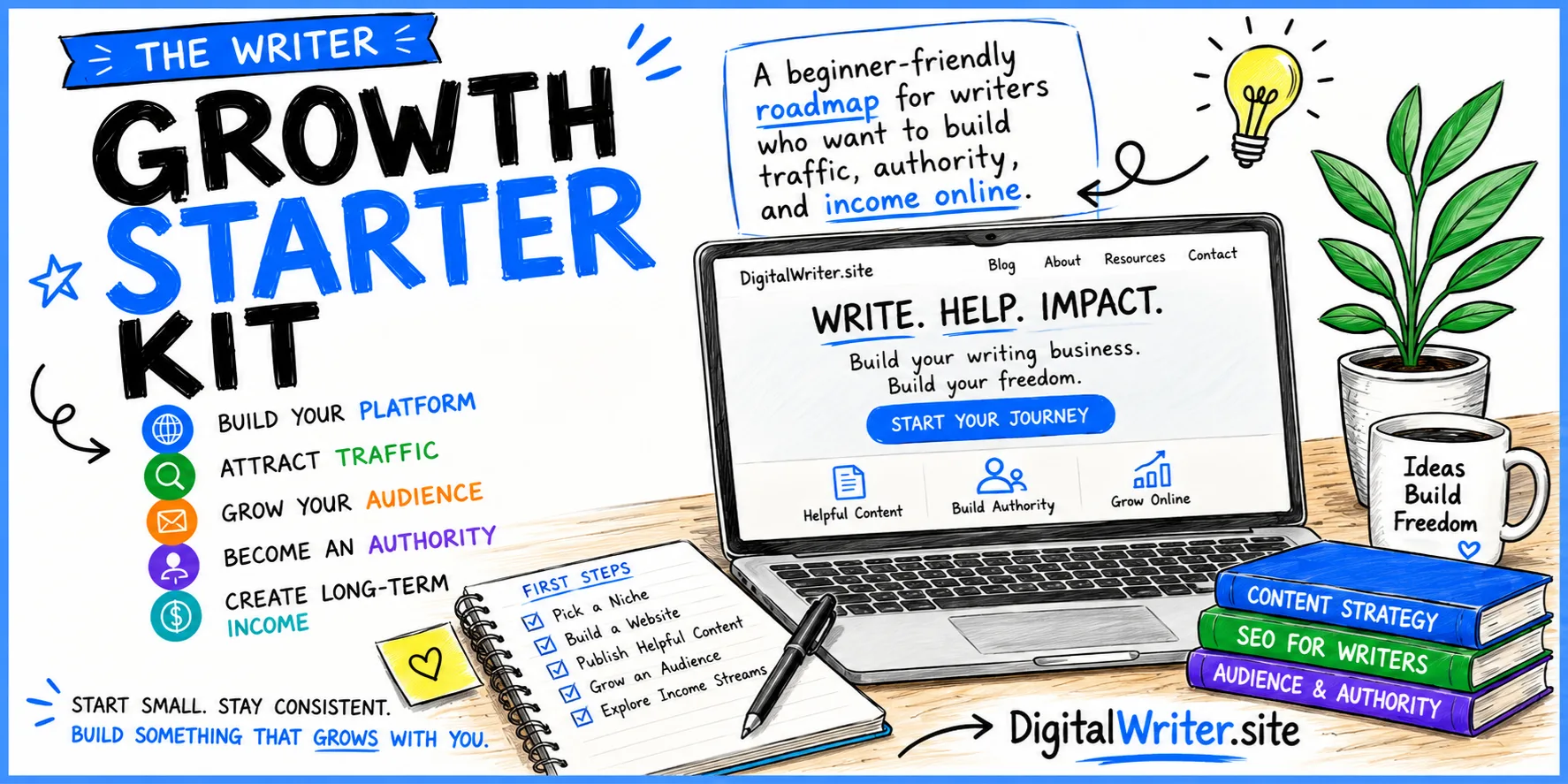
The Writer Growth Starter Kit gives you a beginner-friendly roadmap for choosing a direction and building traffic, authority, and income online.
Get the Free Starter Kit →Conclusion
Every digital writer starts somewhere.
No one publishes their first article with perfect writing, flawless SEO, or a complete content strategy. Those skills are developed through practice. Every article you write teaches you something new about your audience, your process, and how to communicate more effectively.
The key is to focus on helping one reader at a time. Write clearly, answer real questions, and keep improving with every piece you publish. Over time, those small improvements add up, turning individual articles into a valuable body of work that attracts readers, builds authority, and creates opportunities.
Remember, digital writing isn't about writing the most words or using the latest tools. It's about creating content that helps people solve problems and achieve their goals. If you stay consistent, learn from your results, and continue refining your skills, you'll become a better writer with every article you publish.
Digital writing is a skill, not a talent you're born with. Start where you are, write consistently, and focus on helping your readers. Progress happens one article at a time.
Ready to take the next step?
Download the Writing Jumpstart Guide to learn a simple, repeatable process for planning, writing, and publishing your first high-quality digital articles with confidence.
Continue Your Learning
Ready to keep improving your digital writing skills? Explore these related guides to learn SEO, write more effectively, and build a stronger foundation as a digital writer.