
You’ve seen words that make you click, buy, or sign up. That’s not luck. That’s copywriting.
Most beginners think copywriting is just writing. I thought the same at first. Then I realized it’s more about understanding people than writing pretty sentences.
If you want to make money writing, build a freelance career, or grow a business, copywriting sits at the center of it all.
This guide breaks down what is copywriting in simple terms so you can understand what it is, how it works, and how to start.
What Is Copywriting? (Quick Summary)
Copywriting is the process of writing words that persuade people to take action, such as clicking a link, signing up, or buying a product. It focuses on clear messaging, audience understanding, and guiding decisions.
- Copywriting aims to drive action, not just inform
- It appears in ads, emails, websites, and sales pages
- Good copy focuses on benefits and clear outcomes
- Simple language performs better than complex writing
- Understanding your audience is key to effective copy
- Strong headlines and calls to action improve results
- It is a high-demand skill used in every industry
Table of Content
- What Is Copywriting? (Quick Summary)
- What Is Copywriting? (Simple Definition)
- What Does a Copywriter Actually Do?
- Copywriting vs Content Writing (Key Differences)
- Types of Copywriting (With Examples)
- Why Copywriting Matters? (Real Impact)
- Basic Copywriting Principles Every Beginner Should Know
- Real Copywriting Examples (Breakdown)
- How to Start Copywriting? (Step-by-Step)
- How Copywriters Make Money?
- Common Copywriting Mistakes Beginners Make
- Tools and Resources for Beginner Copywriters
- Is Copywriting Hard to Learn? (Honest Answer)
- Key Takeaways
- Conclusion
- Frequently Asked Questions
What Is Copywriting? (Simple Definition)
I remember when I first heard the word “copywriting,” I thought it had something to do with copyright laws. It didn’t. And that confusion is pretty common. In simple terms, copywriting means writing words that make someone take action.
That action can be small. Click a button. Sign up for a newsletter. Or it can be bigger, like buying a product.
Either way, the goal stays the same. You write with a purpose, not just to inform, but to move someone to do something.
Regular writing and copywriting may look similar at first. Both use words. Both try to communicate an idea. But they feel different once you pay attention.
Regular writing often shares information. Copywriting pushes toward a decision.
For example, a blog post might explain how email marketing works. That’s content writing. But the line at the end that says “Start your free trial today” is copywriting. It asks for action. It guides the reader to the next step.
I learned this the hard way. Early on, I wrote what I thought was great copy. It sounded smart. It had long sentences. It explained everything in detail.
But nothing happened.
No clicks. No replies.
That’s when it hit me. Good copy is not about sounding impressive. It’s about being clear and direct.
You’ll see copywriting everywhere once you notice it. It’s on websites, landing pages, ads, emails, even social media captions.
That “Buy Now” button you clicked last week? That’s copy.
The subject line that made you open an email? Also copy.
A simple way to spot copywriting is to ask one question. Is this trying to make me do something? If the answer is yes, you’re looking at copy.
Here’s a quick example to make it clear.
Content writing:
“Running shoes are designed to support your feet during long runs and reduce injury.”
Copywriting:
“Run longer without pain. Try these lightweight running shoes today.”
Same topic. Different goal. One informs. The other moves you to act.
That shift is what makes copywriting powerful. And once you understand it, you start to see why businesses care so much about it.
Words stop being just words. They become tools that drive results.
Now that you understand the definition, here’s a simple breakdown of how copywriting actually works step by step.
What Does a Copywriter Actually Do?
When I started looking into copywriting, I assumed the job was simple. You sit down, write some text, send it off, and get paid.
That idea didn’t last long. Once I actually tried it, I realized most of the work happens before you even write a single sentence.
A copywriter’s main job is to write words that drive action. That includes sales pages, emails, ads, and landing pages. But writing is only one part of the process. The real work starts with understanding people.
Before I write anything now, I spend time digging into the audience.
- What do they want?
- What are they struggling with?
- What are they tired of trying?
This part can feel slow, and honestly, I used to skip it. Big mistake. My early copy sounded fine, but it didn’t connect. Once I started focusing on real problems and real desires, everything improved.
After research, the next step is structuring the message.
Good copy is not random. It follows a flow that makes sense to the reader. You grab attention, build interest, create desire, and then guide them toward action.
If the structure is off, even good writing falls flat. I’ve written pieces that looked great but had zero results, just because the flow didn’t lead anywhere.
Then comes the writing itself.
This is where most beginners focus, but it’s only one piece of the puzzle. You’re not trying to impress anyone. You’re trying to make the message easy to follow and easy to act on. Clear beats clever every time.
Editing is another big part of the job.
First drafts are rarely good. I often go back and cut half of what I wrote. Remove extra words. Simplify sentences. Make the message sharper.
Sometimes one small change, like tweaking a headline or a call to action, can make a huge difference in results.
And then there’s performance.
Copywriting is tied to outcomes.
- Did people click?
- Did they sign up?
- Did they buy?
A copywriter looks at what works and what doesn’t, then improves it. Over time, you start to see patterns.
Finally, many copywriters work with clients or brands. That means understanding their product, their voice, and their audience. It’s not just about writing what you like. It’s about writing what works for them.
So when you ask what a copywriter actually does, the answer is simple, but not easy. They research, plan, write, edit, and improve messages that move people to act.
Writing is just the visible part. The thinking behind it is what makes it work.
Copywriting is a core part of marketing and persuasion. If you want a deeper breakdown, this guide from American Writers & Artists Institute explains how copywriting works in real-world business.
One of the simplest ways to understand how persuasion works is through the AIDA copywriting formula, which breaks writing into clear steps that lead to action.
Copywriting vs Content Writing (Key Differences)
This confused me for a long time. I thought copywriting and content writing were the same thing. You write words, publish them, and hope they work. But once I started getting real feedback, I saw the gap fast.
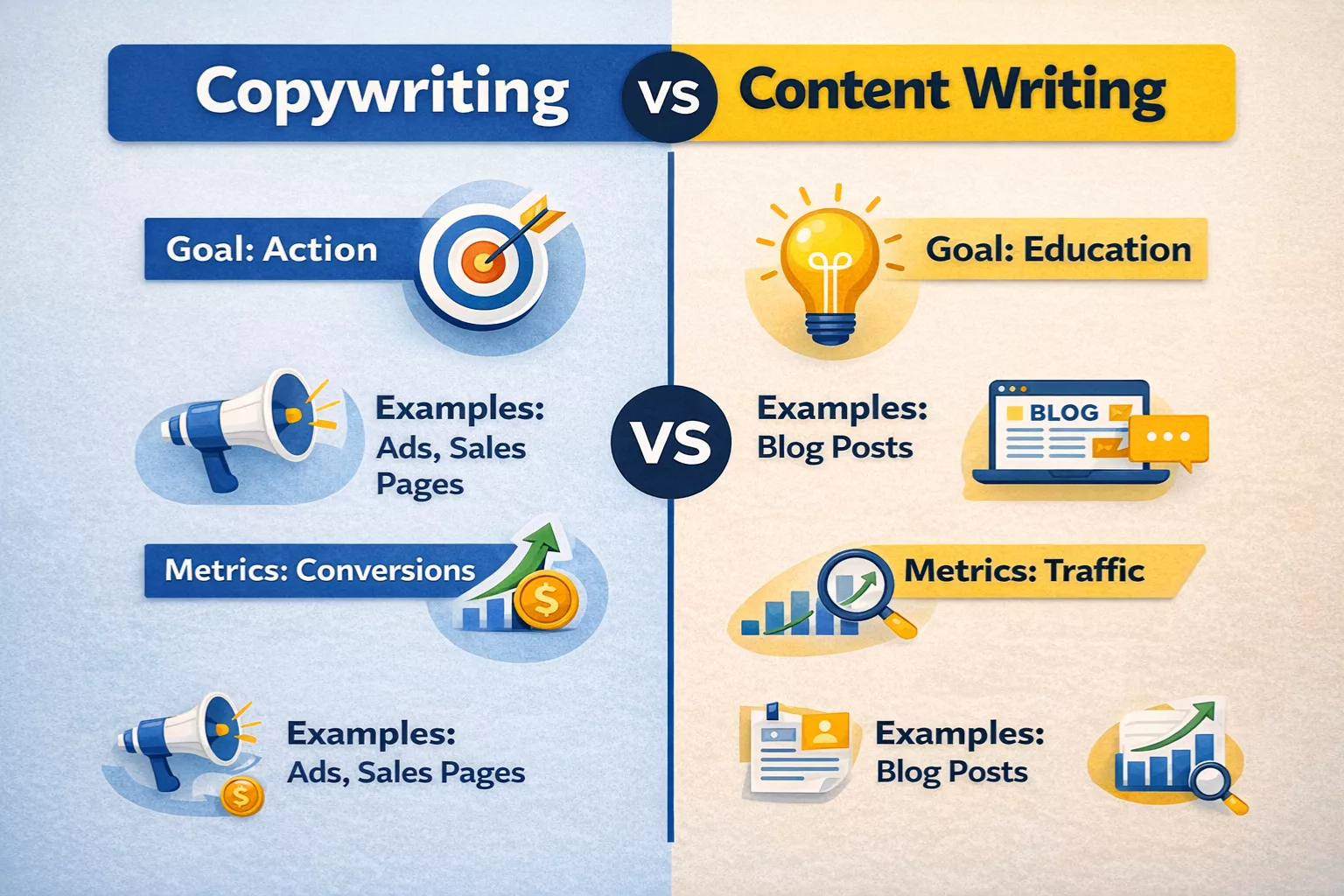
Copywriting is about persuasion. Content writing is about education. That’s the simplest way to understand it.
When you write copy, your goal is action. You want someone to click a button, join a list, or buy something. Every word pushes toward that outcome. There’s no extra space. Everything has a job.
Content writing works differently. Its goal is to bring people in and help them understand something. Blog posts, guides, and articles fall into this category.
You’re not pushing hard. You’re building trust, answering questions, and giving value.
I made the mistake of mixing the two early on. I wrote blog posts that sounded like sales pages. Too pushy. Then I wrote sales pages that sounded like blog posts. Too soft. Neither worked well.
The difference also shows up in how success is measured.
With copywriting, you look at results like:
- Click-through rate
- Conversion rate
- Sales or sign-ups
It’s direct. You see what works and what doesn’t.
With content writing, the focus shifts:
- Traffic from search engines
- Time spent on page
- Shares and engagement
It’s more about attracting and keeping attention over time.
Here’s a simple example that helped me understand it.
Content writing:
- “How to choose the right laptop for remote work”
This brings people in. It helps them learn.
Copywriting:
- “Get more done with this lightweight laptop. Order today.”
This pushes for action.
Same topic. Different intent.
Beginners often confuse these two because they both live online and use similar formats. A blog post can include copy. A sales page can include helpful content. The lines blur if you’re not paying attention.
What helped me was asking one clear question before writing anything. What is the goal of this piece?
If the goal is to teach or attract, I’m writing content.
If the goal is to convert, I’m writing copy.
Once you separate those two in your mind, writing becomes much easier. You stop guessing. You start writing with direction.
If you're just starting, this guide covers the copywriting basics for beginners so you can build a strong foundation.
Types of Copywriting (With Examples)
When I first got into copywriting, I thought it was just one thing. You write “copy” and that’s it.
But once I started working on different projects, I realized copywriting shows up in many forms. Each type has a different job, even though the goal stays the same, to get someone to act.
Understanding these types helped me stop guessing. I could match the writing style to the situation instead of using the same approach everywhere.
Let’s break them down.
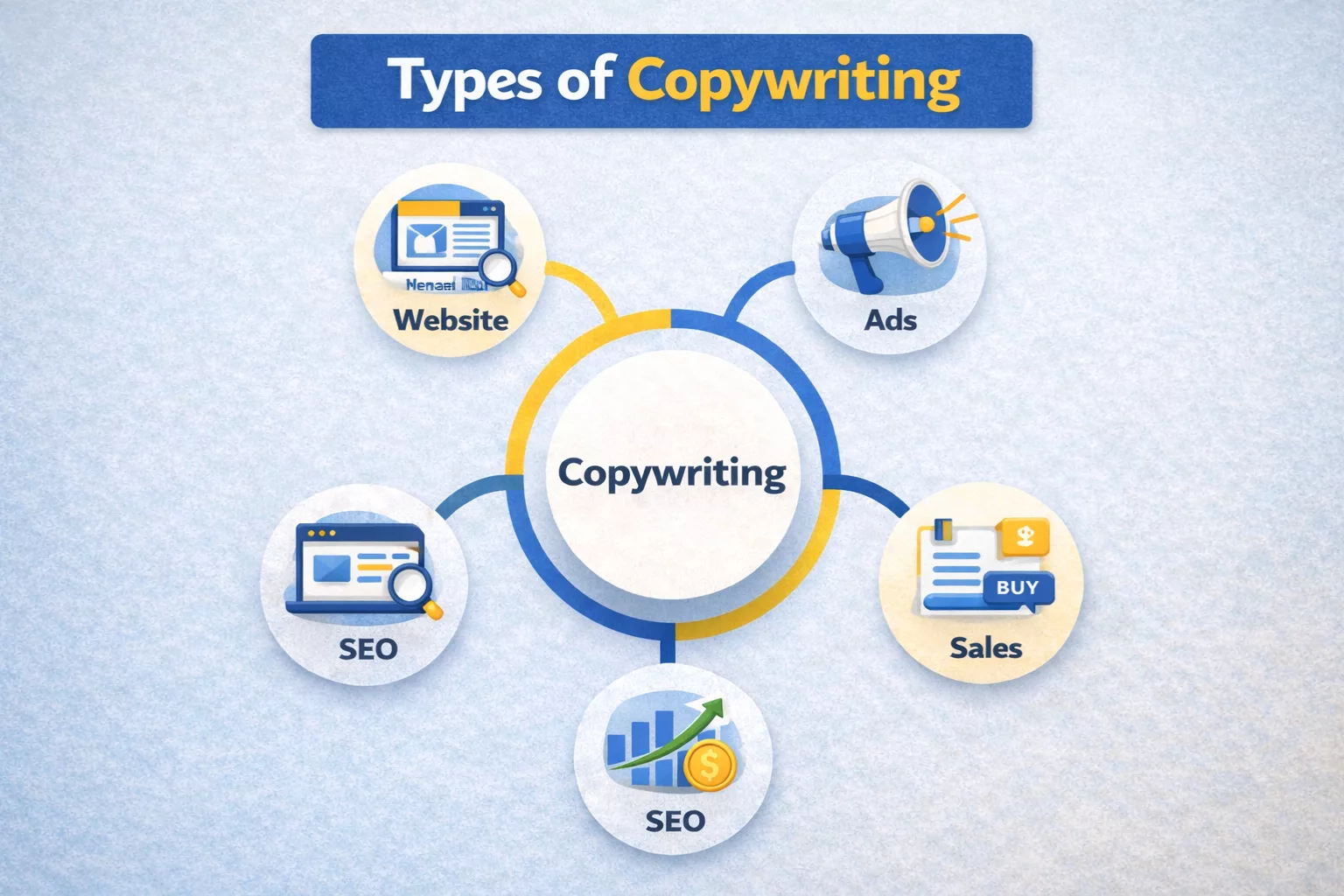
Website copy is usually the first thing people see. This includes homepages and landing pages.
The goal here is simple. Explain what you do, who it’s for, and why it matters. Then guide the visitor to the next step.
I used to overcomplicate this. Long paragraphs, too much detail. It didn’t work. The best website copy feels clear and direct. It answers questions fast and removes doubt.
Email copywriting works differently.
You’re showing up in someone’s inbox, which is a crowded place. You need to grab attention fast, usually with the subject line. Then keep the message focused.
Emails can educate, build trust, or sell, depending on the goal. I’ve seen simple emails outperform fancy ones. Plain text, one idea, one call to action. That’s often enough.
Ad copy is even tighter. You have very little space to make an impact. Whether it’s Facebook, Google, or YouTube, the goal is to stop the scroll and spark interest.
This is where I struggled at first. I tried to say too much. Good ads say less, but say it clearly. One strong idea beats five weak ones.
Sales copy is where everything comes together. This includes sales pages and product pages.
You guide someone from interest to decision. You address doubts, highlight benefits, and show why this is the right choice.
Structure matters a lot here. If the flow feels off, people drop off.
I’ve rewritten sales pages where small changes doubled conversions. Not magic, just better alignment with what the reader cares about.
Then there’s SEO copywriting. This sits between content and copy. You write in a way that helps your content rank on search engines, but you still guide the reader toward action.
I like this type because it builds traffic and conversions at the same time. But it’s easy to get wrong. If you focus only on keywords, it feels robotic. If you ignore them, no one finds your content.
| Type of Copywriting | Where It Appears | Main Goal | Example |
|---|---|---|---|
| Website Copy | Homepages, landing pages | Explain offer and guide action | “Start your free trial today” |
| Email Copywriting | Newsletters, email sequences | Build trust and drive clicks | “Open this before midnight” |
| Ad Copy | Facebook, Google, YouTube ads | Grab attention and get clicks | “Lose weight without dieting” |
| Sales Copy | Sales pages, product pages | Convert readers into buyers | “Get instant access now” |
| SEO Copywriting | Blog posts, optimized pages | Rank on Google and drive action | “Best tools for beginner writers” |
Each type of copywriting has its place. You don’t need to master all of them at once. Start with one. Practice it. Then expand.
That’s what worked for me. Once I focused on one type at a time, things started to click.
Why Copywriting Matters? (Real Impact)
I didn’t fully understand the value of copywriting until I saw it affect real results. Before that, it just felt like “writing better words.” But once I worked on projects where small changes led to more clicks, more leads, and actual sales, it started to make sense.
Copywriting drives revenue. That’s the core of it.
A single headline can change how many people stay on a page. A better call to action can double sign-ups. I’ve seen pages with decent traffic do nothing, then after a few changes in the copy, they start converting.
Same offer. Same design. Just better words.
That’s when it clicked for me. Copy is not decoration. It’s the engine behind decisions.
It also builds trust, which most beginners overlook. People don’t buy right away. They read, scan, hesitate. Good copy meets them where they are. It answers doubts, explains things in a simple way, and makes the next step feel safe.
I used to write like I was trying to convince people fast. It felt pushy. Once I slowed down and focused on helping instead, results improved.
Copywriting also helps businesses grow faster. Without it, even good products struggle. You can have the best offer in the world, but if the message is unclear, people move on. There’s too much noise online. Clear messaging cuts through that.
And this applies to every niche. Fitness, tech, finance, local services, it doesn’t matter. If there’s a product or service, there’s a need for copy. I’ve seen simple businesses outperform bigger competitors just because their message was easier to understand.
For freelancers, this is where things get interesting. Copywriting is a skill that connects directly to money. Businesses are willing to pay for results. Not just words, but outcomes. That’s why demand stays high.
When I started, I thought I needed to be a great writer first. That slowed me down. What actually matters is understanding what makes people act. Writing is just the tool you use to deliver that.
Once you see copywriting this way, everything shifts. You stop focusing on sounding good. You start focusing on what works. And that’s where real progress happens.
Basic Copywriting Principles Every Beginner Should Know
When I started learning copywriting, I kept looking for tricks. Formulas. Shortcuts. I thought there was some hidden technique that would make everything work fast.
There isn’t.
What actually moved the needle for me were a few simple principles. Nothing fancy. But once I applied them, my writing started to get results. Not perfect, but better.
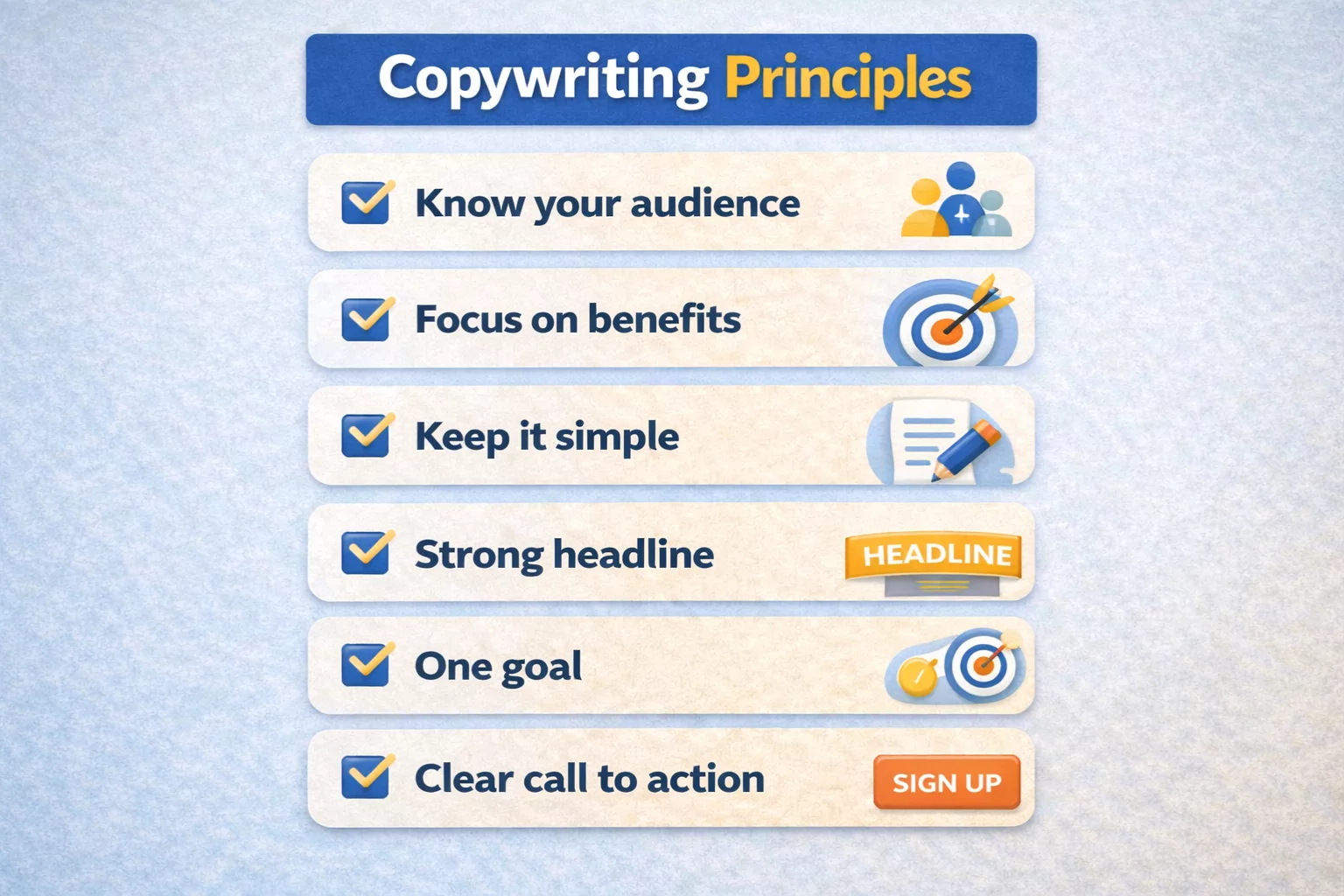
The first one is knowing your audience. This sounds obvious, but most beginners skip it. I did. I wrote based on what I thought sounded good, not what people actually cared about. Big difference.
Once I started reading comments, reviews, and forums, I saw the real language people use. Their problems became clearer. Writing got easier after that.
Next is focusing on benefits, not features. This one took me time to understand.
Features describe what something is. Benefits explain what it does for the person.
People don’t buy features. They buy outcomes. I used to list details like it mattered. It didn’t. What mattered was how those details improved someone’s situation.
Simple language is another big one. Early on, I tried to sound smart. Longer words, complex sentences. It felt right at the time. But it made things harder to read.
Now I aim for the opposite. Short sentences. Clear ideas. If someone has to stop and think about what you wrote, you lose them.
Headlines matter more than most people think. If the headline doesn’t grab attention, the rest doesn’t get read.
I’ve spent more time rewriting headlines than anything else. Sometimes one small change can lift results more than rewriting the whole page.
Then there’s focus. One message, one goal. I used to pack too much into one piece. Multiple ideas, multiple directions. It confused the reader. Now I stick to one clear point. One desired action. Everything supports that.
And finally, the call to action. This is where you tell the reader what to do next. Sounds simple, but I used to forget it or make it vague. “Learn more” or “check it out” doesn’t always work.
Clear beats vague. Tell people exactly what step to take.
These principles don’t look impressive on paper. But they work.
Once I stopped chasing complicated strategies and focused on these basics, my copy started to improve. Not overnight, but steady. And that’s what you want.
Clear writing matters more than complex wording. Tools like Hemingway Editor can help you simplify your sentences and make your copy easier to read.
Real Copywriting Examples (Breakdown)
I used to read about copywriting and think, “Okay… but what does this actually look like?” Theory is helpful, but things only started to click when I saw real examples.
So let’s break a few down in a simple way.
First, headlines.
A weak headline I wrote early on looked like this:
- “Learn More About Freelance Writing”
Nothing wrong with it. But nothing pulls you in either. It’s vague. It doesn’t say why it matters.
Here’s a stronger version:
- “Get Your First Freelance Writing Client in 7 Days”
Now there’s a clear outcome. A time frame. It speaks to a specific goal. That’s what makes people stop and read.
Next, a simple sales message.
Here’s how I used to write:
- “Our course includes 10 modules, worksheets, and video lessons designed to help you understand copywriting.”
It’s full of features. But it doesn’t answer the real question in the reader’s mind.
Here’s the improved version:
- “Write your first high-paying copy project, even if you’re starting from scratch.”
This focuses on the result. It connects with what someone actually wants. The details can come later.
Now let’s look at a before and after example.
Before:
- “This productivity app has many useful features that can help you manage your tasks more efficiently.”
After:
- “Stop feeling overwhelmed. Organize your day in minutes with this simple app.”
Same product. Different impact. The second version speaks to a problem people feel. It offers a clear benefit. It’s easier to connect with.
I remember rewriting a landing page like this once. The original version listed features and tried to explain everything. It barely converted. After simplifying the message and focusing on outcomes, conversions improved. Not perfect, but noticeably better.
So why do these examples work?
They focus on the reader, not the product.
They highlight outcomes, not details.
They use clear language instead of trying to sound impressive.
And they guide the reader toward a specific action.
That’s really the pattern behind good copy.
Once you start spotting it, you’ll see it everywhere. And more importantly, you’ll start using it in your own writing without overthinking every word.
How to Start Copywriting? (Step-by-Step)
When I first tried to get into copywriting, I felt stuck before I even started. Too many options. Too many opinions. Courses, books, frameworks. It felt like I needed to learn everything before doing anything.
That slowed me down.
What actually helped was taking simple steps and learning by doing. Not perfectly. Just consistently.
The first step is learning the basics. You don’t need a paid course right away. There’s enough free material to understand how copy works. Focus on the core ideas. What copywriting is, how it drives action, and what makes it effective. Don’t get lost in theory. Learn just enough to start.
Then move into practice as soon as possible.
One thing that helped me a lot was rewriting existing ads. I would take a Facebook ad, an email, or a landing page and try to improve it. Change the headline. Simplify the message. Focus more on benefits. At first, it felt awkward. But over time, I started to see patterns.
After that, create a few sample pieces. You don’t need clients yet. Just pick a product or service and write:
- One landing page
- One email
- One ad
These become your starting portfolio. They don’t need to be perfect. They just need to show that you understand the basics.
Next, choose a direction. Not forever, just to focus. You might lean toward email copy, landing pages, or ads. I tried doing everything at once. That made progress slower. Once I focused on one area, things became easier to manage.
Then comes the part most people avoid. Start applying for small jobs.
You won’t feel ready. That’s normal. I wasn’t either. But you learn faster by doing real work than by preparing forever. Look for simple projects. Lower stakes. Even small wins build confidence.
And finally, improve through feedback.
This is where real growth happens. Some of your work won’t perform well. Some clients won’t respond. That’s part of the process. Instead of guessing what went wrong, look at results. Ask for feedback when you can. Adjust and try again.
I used to think progress would be fast. It wasn’t. But it was steady once I followed this approach.
Start small. Keep going. That’s how you build skill in copywriting.
How Copywriters Make Money?
When I first looked into copywriting, the money part felt unclear. I saw people talking about high-paying clients and big projects, but no one explained how it actually works step by step.
So I’ll break it down in a simple way.
The most common path is freelancing. You work with clients on specific projects. That can be writing emails, landing pages, ads, or full sales pages.
This is how most beginners start. You find clients, agree on a project, deliver the work, and get paid.
At the beginning, the pay is usually lower. That’s normal. You’re building experience and proof. Over time, as you improve and get results, you can charge more.
I started with small projects that didn’t pay much, but they gave me something more valuable, real examples and feedback.
Another option is agency work. Instead of finding your own clients, you work with a marketing agency. They bring in the clients, and you handle the writing.
This can feel more stable because you don’t have to chase work all the time. The trade-off is less control and sometimes lower pay compared to freelance.
Then there are in-house roles. This means working for one company as their copywriter. You focus on their emails, website, ads, and campaigns.
It’s more like a traditional job. Fixed salary, steady work. Some people prefer this because it removes the pressure of finding clients.
You can also make money through your own projects. This is where things get interesting.
For example, affiliate marketing. You write content or copy that promotes products and earn a commission when someone buys through your link. Or you create your own product, like a guide or course, and use copywriting to sell it.
This takes more time, but it gives you more control over income.
Now let’s talk about how copywriters charge.
There are a few common pricing models:
Per project is the most beginner-friendly. You agree on a fixed price for a landing page, email sequence, or ad set. Clear scope, clear payment.
Hourly pricing is simple but less common at higher levels. You charge based on time spent. The problem is, better copywriters often work faster, so this can limit income.
Retainers are more stable. A client pays you a set amount each month for ongoing work. This could be weekly emails, regular ads, or updates. It creates predictable income.
I made the mistake early on of underpricing everything. I focused too much on getting work and not enough on value. Over time, I learned that businesses don’t pay for words. They pay for results.
Once you understand that, pricing becomes easier to manage.
There’s no single path here. You can mix these options. Freelance work, agency projects, personal income streams. What matters is starting somewhere and building from there.
Pricing can feel confusing at the start. If you’re not sure what to charge, use this digital writing rates calculator to estimate fair rates based on your skill level and project type.
Common Copywriting Mistakes Beginners Make
I made most of these mistakes without realizing it. At the time, everything I wrote felt fine. It sounded “good.” But the results told a different story. No clicks. No replies. No action.
That’s when I started paying attention to what was going wrong.
The first big mistake is writing too complex. I used long sentences, big words, and tried to explain everything in detail. It felt professional, but it made the message harder to follow.
People don’t want to work to understand your writing. They scan. If it’s not easy to read, they move on.
Another common mistake is ignoring audience research. I skipped this step early on because I thought I already knew what people wanted. I didn’t. When you don’t understand the reader’s problem, your copy feels off.
It might sound okay, but it won’t connect. Once I started reading real comments, reviews, and questions people asked, my writing improved fast.
Then there’s the missing call to action. I used to write full pieces and forget to tell the reader what to do next. Or I’d add something vague like “check it out.”
That’s not enough. People need direction. Clear, simple, direct. If you don’t guide them, they leave.
Trying to sound smart is another trap. I fell into this one hard. I thought better writing meant more advanced language.
It doesn’t. It means clearer communication.
When you try to sound impressive, you often lose the reader. Simple writing wins almost every time.
And then there’s not testing or improving your copy. This is something many beginners don’t even think about. You write something once and move on.
But copywriting is tied to results. If something doesn’t work, you adjust it. Change the headline. Rewrite the opening. Test a different angle. Small changes can lead to better outcomes.
I used to take it personally when something didn’t work. Now I see it differently. It’s just feedback.
These mistakes are normal. Everyone makes them in the beginning. The key is noticing them early and adjusting. Once you do that, your writing starts to improve in a way that actually matters.
Tools and Resources for Beginner Copywriters
When I started copywriting, I thought I needed a long list of tools. Paid apps, premium software, all of it. I kept saving links, thinking I’d use them later.
I didn’t.
Most of my early work was done with simple tools. And honestly, that’s still true. You don’t need much to get started. What matters is how you use what you have.
For writing, keep it basic. I used Google Docs for almost everything. It’s clean, easy to use, and works anywhere. No distractions.
That’s important when you’re trying to focus on your message. Tools like Grammarly can help catch small errors, but they won’t fix weak copy. I learned that fast. Good copy comes from thinking, not tools.
Research tools matter more than writing tools.
This is where I spend most of my time now. Forums, product reviews, comment sections. Places where people talk freely.
I’ve gone through pages of Reddit threads just to understand how people describe their problems. The exact words they use are gold. You don’t need to guess what to write when you have that.
At first, I ignored this part. I thought I could come up with ideas on my own. But the copy felt flat. Once I started using real language from real people, everything improved. It felt more natural, and it connected better.
Swipe files are another useful resource. This is just a collection of good copy examples. Emails, ads, landing pages, anything that works.
I started saving pieces that caught my attention. Not to copy them, but to understand why they worked. Over time, you build a sense of patterns.
I remember rewriting the same email from a swipe file a few times just to understand its structure. It felt repetitive, but it helped.
Courses and books can help, but they’re optional. You don’t need them to start. I’d recommend waiting until you’ve practiced a bit. That way, the information makes more sense. Otherwise, it’s easy to get stuck in learning mode without doing anything.
I made that mistake early on. I kept learning, but not applying. Progress only started when I flipped that.
So keep it simple. One writing tool. A few places for research. A growing swipe file.
That’s enough to get started.
Is Copywriting Hard to Learn? (Honest Answer)
I’ll be honest. Copywriting felt harder than I expected when I started. Not because the ideas were complex, but because the results didn’t show up right away.
You read something, it makes sense. You try to apply it, and… nothing happens.
That gap is what makes copywriting feel difficult at first.
The learning curve is not about writing. Most people can write. The challenge is understanding how people think and what makes them act.
That takes time. You start noticing patterns, but only after you’ve written enough and seen what works and what doesn’t.
What made it easier for me was keeping things simple and practicing often. Instead of trying to master everything, I focused on small pieces. Headlines. Short emails. Simple offers.
That removed a lot of pressure. I didn’t need to be perfect. I just needed to improve one step at a time.
Another thing that helped was studying real examples. Not theory. Actual ads, emails, and landing pages.
I would ask myself, why did this make me stop? Why did I keep reading? That kind of thinking speeds up learning more than just reading guides.
Now, what slows beginners down?
Trying to learn too much before doing anything. I did this for weeks. Watching videos, reading articles, saving notes. It felt productive, but nothing changed. Progress only started when I began writing and testing.
Overthinking is another one. You write a sentence, then rewrite it ten times. You try to make it perfect. That kills momentum. Most of the time, simple and clear is enough.
And comparing yourself to experienced copywriters doesn’t help either. Their work looks easy because they’ve done it for years. You don’t see the messy drafts behind it.
So how long does it take to see results?
It depends on how you approach it. If you practice consistently and work on real examples, you can start seeing small improvements in a few weeks. Getting your first paid project might take a bit longer, maybe a few weeks to a couple of months.
I didn’t see results right away. But once things started to click, progress became faster.
Copywriting is not hard in the way people think. It’s not about talent or perfect writing. It’s about understanding people and improving over time.
If you stay consistent, it becomes easier than it looks at the start.
Key Takeaways
- Copywriting is writing that drives action like clicks, sign-ups, and sales
- It focuses on persuasion, while content writing focuses on education
- Good copy is clear, simple, and focused on benefits, not features
- Understanding your audience is the foundation of effective copywriting
- Strong headlines and clear calls to action improve results
- Copywriting skills can be used in freelancing, jobs, or personal projects
- You can start with basic tools, simple practice, and real examples
- Progress comes from writing, testing, and improving over time
Conclusion
Copywriting is not about writing more. It’s about writing with purpose.
Once you understand how words influence decisions, everything changes. You stop guessing and start seeing patterns that work.
If you want to build a writing income, this is one of the most useful skills you can learn. Start small, practice daily, and focus on helping real people solve real problems.
Frequently Asked Questions
What is copywriting in simple terms?
Copywriting is writing that encourages people to take action, such as buying a product, signing up, or clicking a link. It focuses on clear and persuasive messaging.
Is copywriting hard for beginners?
Copywriting is not hard to start, but it takes practice to improve. The main challenge is understanding what makes people take action, not just writing well.
What does a copywriter do?
A copywriter creates content like ads, emails, landing pages, and sales pages designed to persuade people to take a specific action.
Can you learn copywriting without experience?
Yes, you can start copywriting without experience by learning the basics, practicing with sample projects, and applying for small jobs to build skills.
How do copywriters make money?
Copywriters earn money through freelance work, agency roles, in-house jobs, or by using copywriting skills in their own business or affiliate projects.