
Most beginners think copywriting is about being a good writer. It’s not.
It’s about understanding people. What they want. What they fear. And how to move them to act with simple words.
If you’ve ever stared at a blank page wondering what to write or why your content doesn’t convert, you’re not alone. That frustration is common. The good news is this: once you understand a few core copywriting basics, everything starts to click.
In this guide about copywriting basics, you’ll learn how copywriting works, what makes words persuasive, and how to start writing copy that actually gets results.
Copywriting Basics for Beginners (Quick Summary)
Copywriting basics focus on writing clear, persuasive words that guide the reader to take action. Instead of just sharing information, copywriting helps turn attention into clicks, leads, and sales.
- Know your audience: Understand their problems, desires, and doubts before writing
- Focus on clarity: Use simple language that is easy to read and understand
- Use emotion: Connect to real frustrations and desired outcomes
- Follow structure: Use proven formulas like AIDA or PAS to guide your writing
- Write strong headlines: Grab attention with clear benefits or specific problems
- Highlight benefits: Show what the reader gains, not just what something is
- Include a call to action: Always tell the reader what to do next
- Practice consistently: Rewrite copy, study examples, and write daily
When you apply these copywriting basics, your writing becomes more focused, easier to follow, and more effective at turning readers into action-takers.
Table of Content
- Copywriting Basics for Beginners (Quick Summary)
- What Is Copywriting?
- Why Copywriting Basics Matter for Beginners?
- The Core Principle of Copywriting: Know Your Audience
- The 3 Essential Elements of Great Copy
- Basic Copywriting Formulas Every Beginner Should Know
- How to Write Headlines That Grab Attention?
- How to Write Persuasive Copy Step by Step
- Common Copywriting Mistakes Beginners Make
- Copywriting Practice Tips for Beginners
- Where to Use Copywriting Skills? (Real Opportunities)
- Key Takeaways
- Download Your Copywriting Practice Pack
- Conclusion
- Frequently Asked Questions
What Is Copywriting?
I used to think copywriting was just “writing online.” That’s what most beginners believe at first. You write blog posts, maybe a few emails, and hope people read them.
But then I noticed something strange. Some pages made me click, sign up, even buy… while others did nothing. Same topic. Same audience. Different results.
That’s when it hit me. Copywriting isn’t about writing more. It’s about writing in a way that moves people.
Copywriting means using words to get someone to take action. That action can be small, like clicking a link, or bigger, like buying a product or joining a list.
You’re not just sharing information. You’re guiding someone toward a decision. And that shift changes everything.
Now here’s where most beginners get confused. They mix up copywriting and content writing. I did the same.
Content writing informs. Think blog posts, guides, tutorials. The goal is to teach or help. Copywriting, on the other hand, persuades. It leads somewhere.
Even when it teaches something, it still nudges the reader toward a next step. That’s the key difference.
For example, a blog post might explain how email marketing works. That’s content writing. But the page that convinces you to sign up for an email tool? That’s copywriting. Same topic, different goal.
You’ll see copywriting everywhere once you start paying attention.
Ads that make you stop scrolling. Emails that pull you in with a subject line. Landing pages that walk you through a problem and then present a solution. Sales pages that answer every doubt you didn’t even know you had.
I remember reading a simple sales page once. No fancy words. No long paragraphs. Just clear sentences, one after another. It spoke directly to a problem I had been dealing with for weeks.
And before I even realized it, I was clicking the buy button. That wasn’t luck. That was good copy doing its job.
And that’s exactly why businesses pay well for it.
Good copy makes money. It turns visitors into leads. Leads into customers. Customers into repeat buyers. A small change in wording can increase conversions in a big way.
I’ve seen headlines double clicks just by making them more specific. Nothing else changed.
That’s why companies don’t see copywriting as “just writing.” They see it as a revenue skill.
If you understand this early, you skip a lot of frustration. You stop trying to sound impressive. You start focusing on being clear, direct, and helpful. And slowly, your writing starts working.
If you’re new to this, start with a simple breakdown of what is copywriting to understand how it works before going deeper.
If you’re still unsure how everything fits together, this guide shows you how copywriting works in practice .
Why Copywriting Basics Matter for Beginners?
I ignored the basics when I started. I thought better words would fix everything. So I wrote longer sentences, tried to sound smart, and packed pages with information.
It felt productive. But nothing converted. No clicks, no replies, no sales.
Then I made a small change. I simplified one page. Short sentences. Clear promise. One problem, one solution. That page got more results than everything I wrote before. That’s when I understood why copywriting basics matter.
Strong copy directly affects sales and conversions. There’s no way around it. You can have a great product, a clean design, even traffic coming in. But if your words don’t connect, people leave.
On the other hand, even average offers can perform well with clear, focused copy. It guides the reader step by step until the decision feels natural.
This is where copywriting connects to online income. If you run a blog, promote affiliate offers, or sell services, your words do the selling. Not your logo. Not your layout. Your words.
That means improving your copywriting skills often leads to more clicks, more sign-ups, and more income over time. It’s a direct link, not a vague one.
Most beginners miss this because they write for themselves. I did the same. I wrote what I liked. What sounded good to me. But the reader doesn’t care about that. They care about their problem. Their situation. Their outcome.
When you shift your focus from “what do I want to say” to “what does the reader need to hear,” everything changes. Your writing becomes easier to follow. It feels relevant. It makes sense to the person reading it.
Another mistake beginners make is trying to sound advanced. Long sentences, complex words, clever phrases. It feels like better writing, but it usually hurts performance. Simple copy works better because it’s easier to read. And if something is easy to read, it’s easier to trust.
I’ve tested this more than once. A shorter, simpler version of the same message often wins. Not because it’s more creative, but because it removes friction. The reader doesn’t have to think as much. They just understand and move forward.
That’s why learning copywriting basics early gives you an advantage. You build the right habits from the start. You learn how to write with purpose. You understand structure, flow, and how people make decisions.
And here’s the part most people overlook. This skill compounds.
Once you know how to write copy, you can use it anywhere. Blog posts, emails, landing pages, social content, offers. It all connects. Each piece improves the next.
So instead of guessing what works, you start seeing patterns. You know why something works. And that’s what turns writing into a real, reliable skill.
The Core Principle of Copywriting: Know Your Audience
This is the part I skipped at the start. And it cost me time.
I thought good copy meant strong words, clever lines, maybe a catchy headline. But none of that worked until I understood one thing. If you don’t know who you’re writing for, your copy won’t land. It might sound fine to you, but it won’t connect.
Everything in copywriting starts with the reader.
When you understand your audience, your writing becomes easier. You don’t guess what to say. You know what matters to them. You know what they struggle with, what they want, and what’s holding them back. That gives your words direction.
The easiest way to think about this is simple. People take action when they feel understood.
So your job is to show them that you get it.
That means identifying three things. Their pain points, their desires, and their objections.
Pain points are the problems they’re dealing with right now. The thing that frustrates them. Maybe they can’t get clients. Maybe their writing doesn’t convert. Maybe they feel stuck and don’t know what to fix.
Desires are what they want instead. More income. Better results. Less confusion. A clear path forward.
Objections are the doubts that stop them from acting. “Will this work for me?” “Do I have enough experience?” “Is this worth it?”
If your copy speaks to all three, it starts to feel personal.
Another shift that helped me was writing to one person, not everyone.
At first, I tried to make my writing “for beginners.” That’s too broad. It creates vague copy. But when I pictured one person sitting across from me, everything changed.
The tone became natural. The message became clear. It felt like a conversation, not a broadcast.
You can do this even if you don’t have an audience yet.
Just pick a specific type of reader. Someone who is struggling with one clear problem. Then write as if you’re helping them directly.
Now, you don’t need fancy tools to understand your audience. Some of the best insights come from simple places.
- Read comments on blog posts or YouTube videos
- Check reviews on products in your niche
- Browse forums and communities where your audience hangs out
- Look at the exact words people use to describe their problems
This part is important. Use their language, not yours.
I once rewrote a section of copy using phrases I found in reviews. Same idea, different wording. It performed better right away. Not because it was smarter, but because it felt familiar to the reader.
Here’s a quick example to make this clear.
Weak copy sounds like this:
“This program helps you improve your writing skills and achieve better results.”
It’s vague. It could apply to anyone. It doesn’t say much.
Audience-focused copy sounds like this:
“If your blog posts aren’t getting clicks or clients, this will show you exactly what to fix and how to write words that actually convert.”
Now it speaks to a specific problem. It feels relevant. It makes sense to the reader who needs it.
That’s the difference.
Once you understand your audience, copywriting stops feeling random. You’re no longer guessing. You’re responding. And that’s when your writing starts to work.
The 3 Essential Elements of Great Copy
I used to think good copy needed tricks. Fancy words. Clever lines. Something that makes people stop and think, “wow, that’s smart.”
But the truth is simpler. The best-performing copy I’ve written followed three basic elements. Nothing complicated. Just clarity, emotion, and action. When those three are in place, things start working.
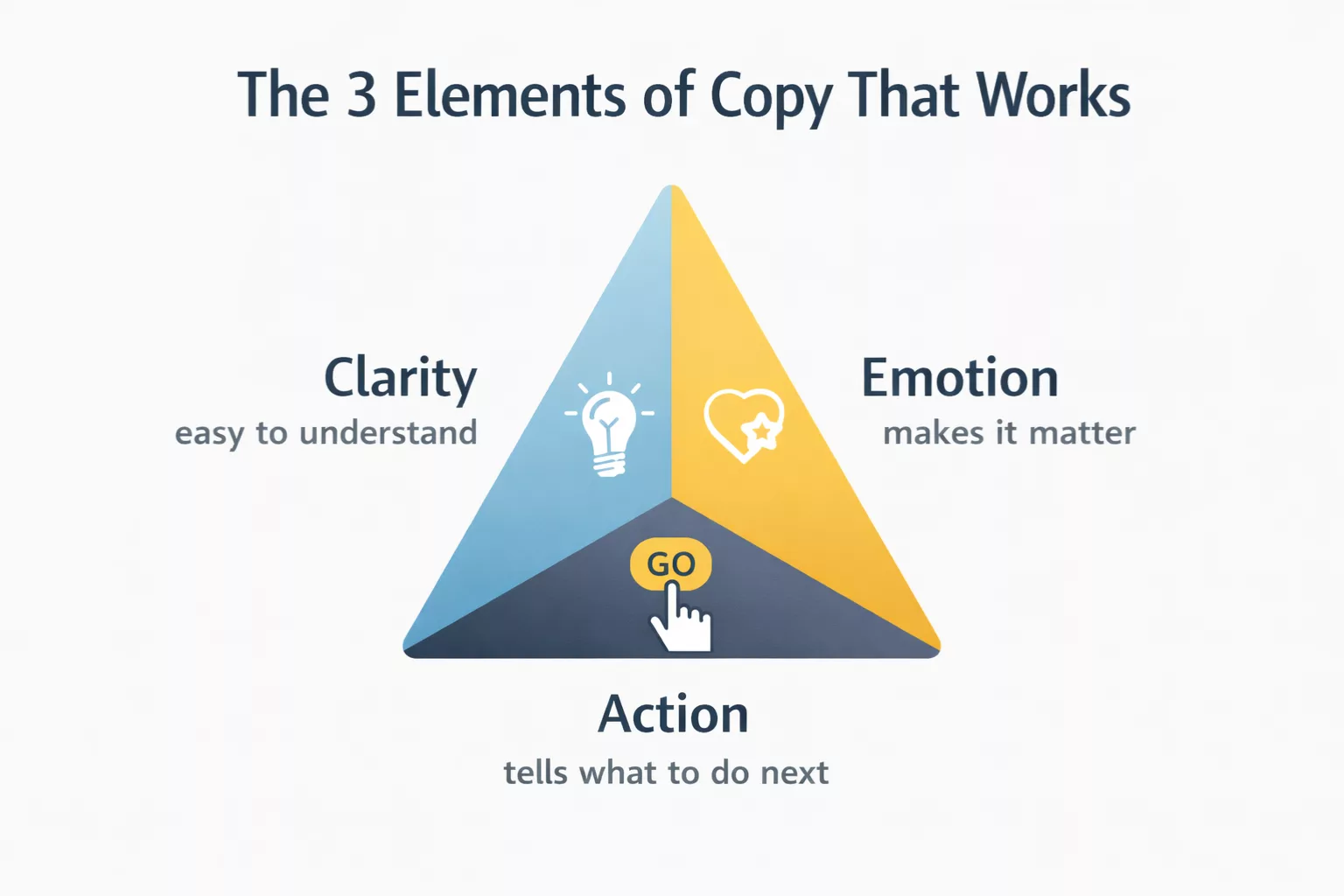
1. Clarity
This is where most beginners struggle. I did too.
You try to sound professional, so your sentences get longer. You use words you wouldn’t normally say out loud. It feels like better writing, but it actually makes things harder to read.
Clear copy wins because it’s easy to understand.
A good rule is this. Write so a 12-year-old can follow it without effort. If someone has to stop and reread your sentence, you’ve already lost momentum.
I remember rewriting a landing page once. The original version sounded polished, but it was dense. I shortened the sentences, removed extra words, and replaced complex phrases with simple ones. Same message, just easier to read. Conversions went up.
Clarity isn’t about dumbing things down. It’s about removing friction.
Avoid jargon unless your audience uses it daily. Keep sentences direct. Say what you mean without dressing it up. When your copy is clear, people trust it more because it feels honest.
2. Emotion
People like to believe they make logical decisions. But most decisions start with emotion.
Think about it. Nobody buys a product because of features alone. They buy because of what those features mean for them. Less stress. More time. Better results. A feeling of progress.
Early on, I focused too much on explaining things. I listed benefits, features, steps. It made sense, but it didn’t connect. The missing piece was emotion.
Once I started writing about real problems and real outcomes, things changed.
Instead of saying, “This course teaches copywriting,” I’d say, “If you’re tired of writing posts that no one reads, this will help you turn that around.”
Now it speaks to frustration. It feels real.
You don’t need dramatic language. Just describe situations your reader recognizes. Show them where they are now, and where they could be. That gap creates movement.
This works because people make decisions based on psychological triggers, which are explained in the principles of persuasion.
3. Action
This part gets overlooked more than anything else.
You can write clear, emotional copy, but if it doesn’t lead somewhere, it doesn’t work. Every piece of copy needs a next step.
At one point, I wrote a long article that got good engagement. People read it, spent time on the page, even shared it. But nothing happened after that. No clicks, no sign-ups. I realized I never told them what to do next.
That was the problem.
People need direction. Not in a pushy way, just a clear step.
Click here. Sign up. Download this. Start now.
When the next step is obvious, more people take it. When it’s missing or vague, they leave.
Now I always check this before publishing. What should the reader do after this? If the answer isn’t clear, I fix it.
These three elements work together. Clarity makes your message easy to follow. Emotion makes it matter. Action moves the reader forward.
You don’t need more than that to start writing copy that works.
Even small changes in wording can improve results, which is a core idea behind conversion rate optimization.
Basic Copywriting Formulas Every Beginner Should Know
When I first heard about copywriting formulas, I thought they would make my writing feel robotic. Like I’d be following a script instead of actually thinking.
But the opposite happened.
Formulas gave me structure. They removed that “what do I write next” feeling. And once I understood them, my writing became easier and more focused.
You don’t need dozens of frameworks. Just a few core ones that show you how to guide a reader from attention to action.
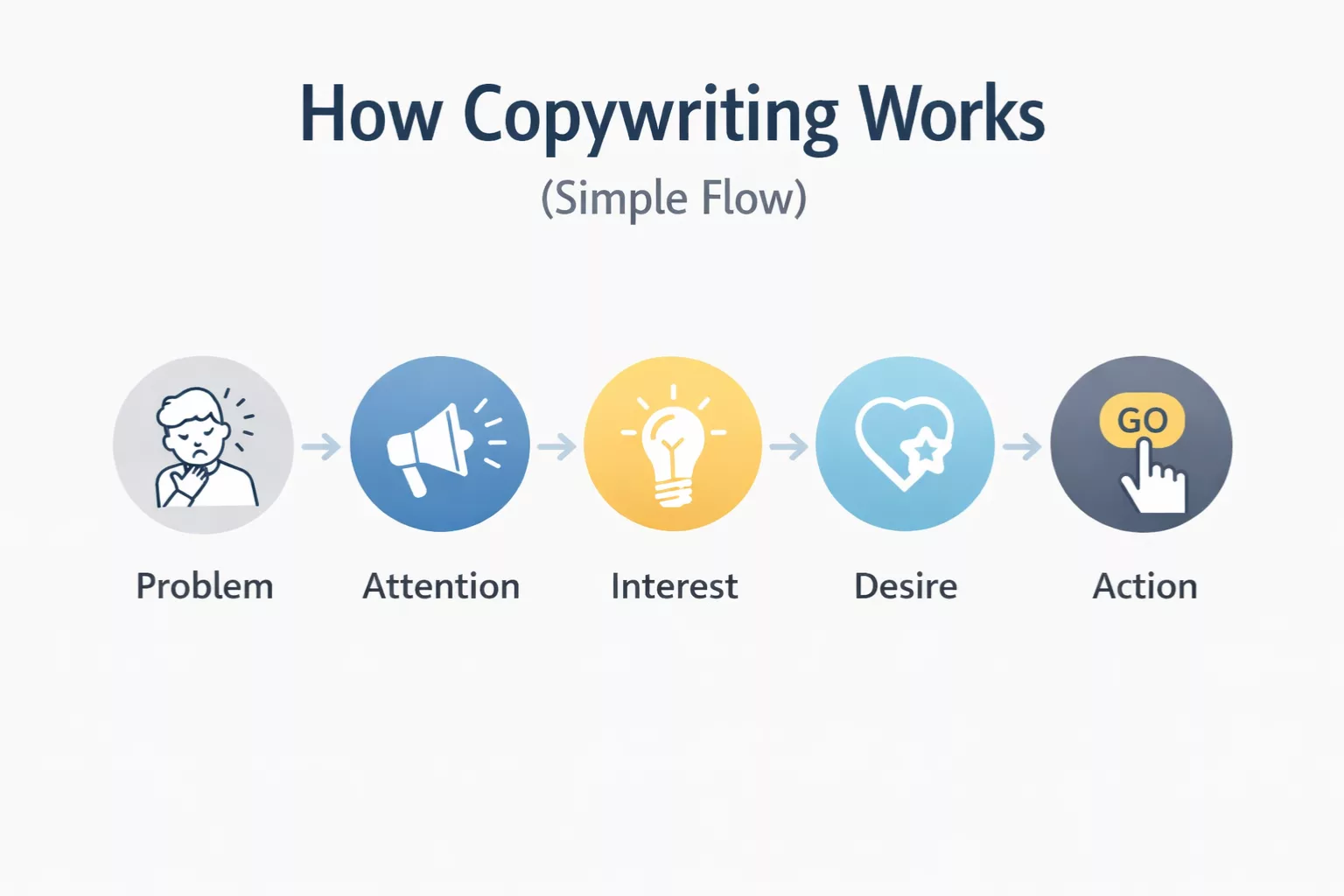
AIDA (Attention, Interest, Desire, Action)
This is one of the most common copywriting formulas. And for good reason. It follows how people naturally move through a decision.
First, you grab attention. That could be a headline, a bold statement, or a relatable problem.
Then you build interest. You explain the situation and make the reader want to keep going.
Next comes desire. You show the benefit. What changes for them if they take action.
Finally, you guide them to act.
I used AIDA on a simple landing page once. Before that, the page just listed features. After restructuring it with AIDA, it flowed better. People stayed longer. More of them clicked the button.
A quick example:
“Struggling to get clients?” (Attention)
"Most beginners write content that gets ignored.” (Interest)
"Here’s how you can turn your writing into a client magnet.” (Desire)
"Start here.” (Action)
Simple. But it works.
PAS (Problem, Agitate, Solution)
This one hits harder emotionally.
You start with the problem. Something the reader already feels.
Then you agitate it. You go a bit deeper. You show what happens if it doesn’t change. Not in a dramatic way, just real consequences.
Then you present the solution.
I avoided this formula at first because I thought it sounded negative. But it works because it reflects reality. People are already dealing with problems. You’re just putting it into words.
Example:
“You’re writing content but getting no results.” (Problem)
"You spend hours writing, and still no clicks or clients.” (Agitate)
"This guide shows you how to fix that.” (Solution)
It feels direct. That’s why it connects.
Before–After–Bridge
This one is easy to use, especially for beginners.
- You show the “before” state. Where the reader is now.
- Then the “after” state. Where they want to be.
- Then you build the bridge. How to get from one to the other.
I like this formula for blog posts and emails because it feels natural. It doesn’t push. It shows a path.
Example:
"Right now, your writing feels scattered and hard to follow.” (Before)
Imagine writing clear copy that gets results.” (After)Here’s a simple way to start.” (Bridge)
It’s simple, but it paints a clear picture.
| Formula | Best For | Simple Use |
|---|---|---|
| AIDA | Landing pages, sales pages | Full flow from attention to action |
| PAS | Ads, emails | Highlight problem and present solution |
| Before–After–Bridge | Blog posts, softer copy | Show transformation and path |
When to Use Each Formula?
This part confused me at first. I thought I had to pick the “right” formula every time.
You don’t.
AIDA works well for structured pages like landing pages and sales pages. It gives you a full flow from start to finish.
PAS is great when the problem is strong and obvious. It works well in ads, emails, and short-form copy.
Before–After–Bridge fits educational content, blog posts, and softer selling. It helps guide the reader without pressure.
Over time, you’ll start mixing them without thinking.
Why These Formulas Actually Help?
Here’s what I realized after using them for a while. They’re not rules. They’re shortcuts.
They help you stay focused. They keep your copy from drifting. And they make sure you don’t forget key parts like emotion or action.
In the beginning, they feel structured. Later, they feel natural.
If you’re stuck staring at a blank page, pick one formula and follow it step by step. It removes guesswork. And that alone can make your writing better.
How to Write Headlines That Grab Attention?
I used to treat headlines like a quick step. Write something decent, move on to the rest. That was a mistake.
The headline does most of the work.
If it doesn’t grab attention, nothing else matters. People won’t read your copy. They won’t see your offer. They won’t even give you a chance. I’ve had articles where changing just the headline doubled clicks. Same content, different result.
That’s when I started taking headlines seriously.
A good headline makes one promise. It tells the reader, “this is for you, and it’s worth your time.” Not vague. Not clever for the sake of it. Just clear and relevant.
There are three simple angles that work almost every time. Curiosity, benefit, and pain.
Curiosity makes someone want to know more. It creates a gap. Something feels unfinished, so they click to complete it.
Benefit shows a clear outcome. What the reader gets if they keep reading.
Pain speaks directly to a problem they’re already dealing with.
You don’t need all three at once. One strong angle is enough.
I used to overcomplicate headlines. Trying to be creative, different, unique. But simple and direct wins more often.
If someone reads your headline and instantly understands what they’ll get, you’re on the right track. If they have to think about it, it’s too complex.
Numbers also help. They make things feel specific and structured. “5 ways,” “3 steps,” “7 mistakes.” It tells the reader what to expect. It feels easier to commit to.
Same with clear outcomes. Instead of saying “improve your writing,” say “write copy that gets clicks.” One is general. The other is concrete.
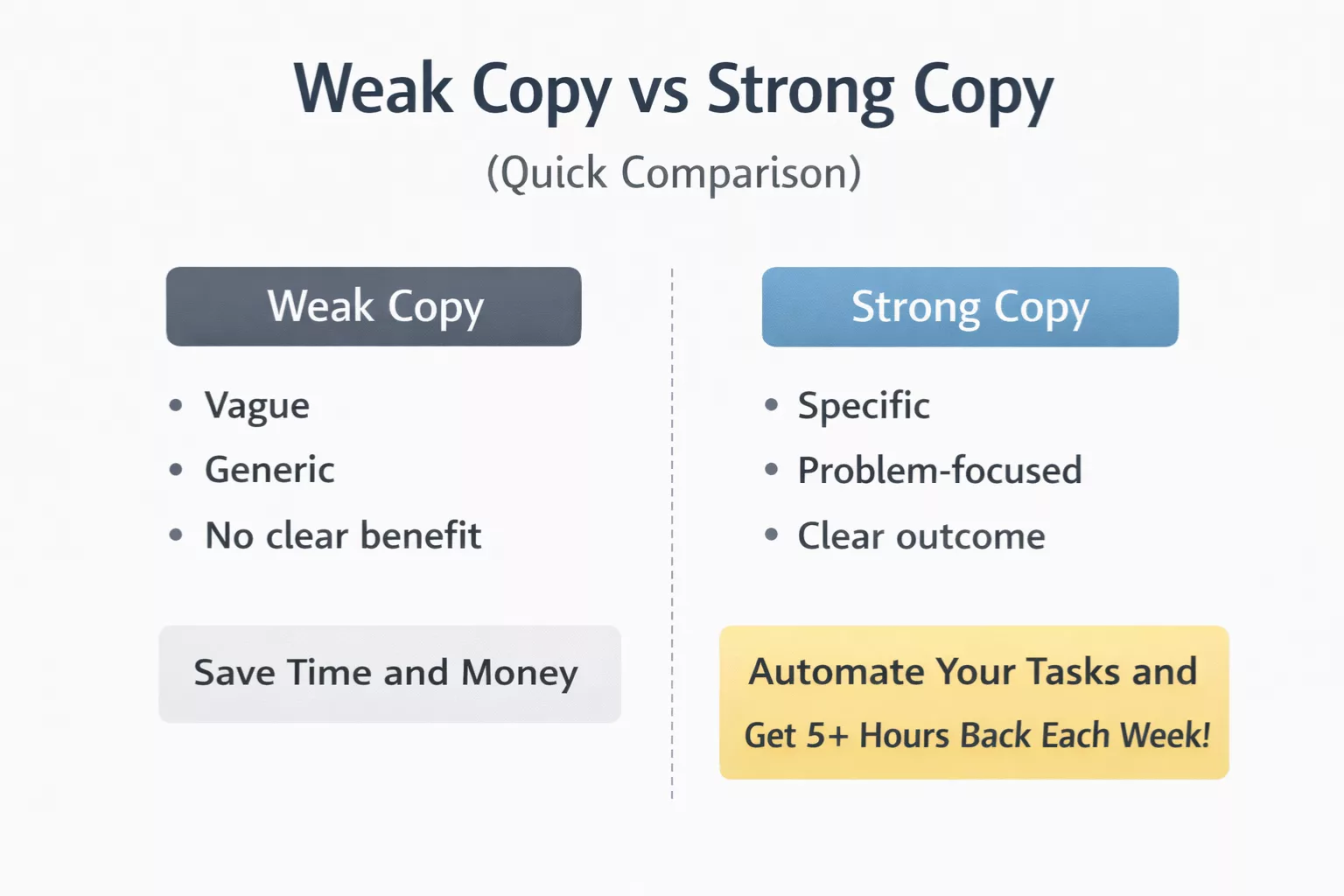
Here’s a quick comparison that helped me improve.
Weak headline:
- “Tips to Improve Your Writing”
It’s broad. It could mean anything. There’s no reason to click.
Stronger headline:
- “5 Copywriting Basics That Turn Words Into Sales”
Now it’s specific. It promises a result. It speaks to someone who wants better outcomes, not just better writing.
Another one.
Weak:
- “Learn Copywriting Today”
Stronger:
- “Struggling to Get Results? Start With These Copywriting Basics”
The second one connects to a real problem. It feels more personal.
When I write headlines now, I slow down. I test a few versions. Sometimes five or ten. Not because I need perfection, but because small changes matter here more than anywhere else.
If the headline works, the rest of your copy finally gets seen.
| Weak Copy | Strong Copy |
|---|---|
| Vague message | Specific message |
| Generic statements | Problem-focused language |
| No clear benefit | Clear outcome |
How to Write Persuasive Copy Step by Step
For a long time, I wrote in the wrong order.
I would start with what I wanted to say. My idea, my point, my message. Then I’d try to shape it into something useful. It felt forced. And honestly, it didn’t convert.
Persuasive copy works better when you flip that approach.
You don’t start with yourself. You start with the reader.
Start with the reader’s problem
This is where everything begins.
If you open with a general statement, people skim. But when you describe a problem they recognize, they stop. It feels relevant.
I like to think of it as entering the conversation already happening in their head.
Something like:
“You’re writing content, but it’s not bringing any results.”
That line works because it reflects a real situation. No guesswork. No fluff.
The key is to be specific. Not “you want to improve your writing,” but “your posts aren’t getting clicks or clients.” That level of detail makes the difference.
Build interest with relatable situations
Once you have their attention, you need to keep it.
This is where you expand the problem. You describe what it feels like, what’s happening, and why it’s frustrating. Not in a dramatic way. Just real, everyday experience.
I used to skip this part and jump straight to solutions. Big mistake.
People don’t move forward until they feel understood. When you slow down and describe their situation, they stay with you longer.
For example:
“You spend hours writing, editing, trying to make it better… and still nothing changes.”
Now the reader is thinking, “yeah, that’s exactly it.”
That’s interest.
Introduce your solution naturally
Here’s where most copy goes wrong. It jumps too fast.
If you introduce your solution too early, it feels pushy. Like you’re trying to sell before understanding the problem.
Instead, transition into it.
Something like:
“The issue isn’t your effort. It’s how the message is structured.”
Now you’re not selling yet. You’re reframing the problem.
Then you can introduce the solution as the next logical step:
“Once you understand a few copywriting basics, your writing starts working differently.”
It feels natural because it follows the flow.
Add proof or examples
At this point, the reader is interested. But they still need reassurance.
Why should they believe you?
This is where proof comes in. It doesn’t have to be complicated. Simple examples, small results, or clear comparisons work well.
I often use before-and-after situations. Or mention how a small change improved results.
For example:
“I rewrote one page using this structure, and it started getting clicks the same day.”
It’s simple, but it shows that the idea works.
End with a clear call to action
This is the step I used to forget.
You guide the reader all the way through, and then… nothing. No direction. So they leave.
Every piece of persuasive copy needs a next step.
Tell them what to do.
Read the guide. Try the method. Sign up. Start now.
Keep it simple. One clear action.
Now, before I publish anything, I check this. If someone reads this, what should they do next? If the answer isn’t obvious, I fix it.
When you follow this structure, writing becomes easier.
You’re not guessing anymore. You’re guiding.
Problem. Interest. Solution. Proof. Action.
That flow works because it matches how people think.
Common Copywriting Mistakes Beginners Make
I made most of these mistakes without realizing it.
At the time, my writing felt fine. It looked clean, sounded decent, and covered the topic. But it didn’t do anything. No clicks, no replies, no action. That gap between “looks good” and “works” usually comes down to a few common issues.
The first one is writing without a clear goal.
I used to sit down and just write. No specific outcome in mind. Just trying to create something useful. The problem is, if you don’t know what the reader should do next, your copy won’t guide them anywhere. It becomes passive.
Now I start with a simple question. What is the one action I want from this piece? Click a link, join a list, read another page. Once that’s clear, the writing becomes focused. Every part supports that goal.
Another big mistake is focusing on features instead of benefits.
This one is easy to miss. You describe what something is, what it includes, how it works. But the reader is thinking something else. “What does this do for me?”
I remember writing a section listing everything a product offered. It was detailed, but flat. Then I rewrote it by translating each feature into a result.
Instead of “includes 10 lessons,” it became “gives you a step-by-step path so you don’t feel stuck.”
Same product. Different impact.
People care about outcomes, not details.
Then there’s the habit of trying to sound smart.
I fell into this early. Longer words, more complex sentences, trying to sound professional. It felt like progress, but it made the copy harder to read.
Simple writing works better because it’s easier to follow. When something is easy to read, it feels more honest. The reader doesn’t have to work to understand your message.
If you catch yourself rereading your own sentence, that’s usually a sign it needs to be simplified.
Another mistake is ignoring structure and flow.
Without structure, copy feels scattered. Ideas jump around. The reader has to piece things together. Most won’t bother.
Once I started using simple structures, everything improved. Problem first, then explanation, then solution. Each part leading to the next. It doesn’t need to be complicated. It just needs to make sense.
If you’re unsure how to structure your writing, start with the AIDA copywriting framework, which gives you a clear path from headline to call to action.
Good flow keeps the reader moving without effort.
And finally, no call to action.
This is the one that quietly kills results.
You write something helpful. The reader finishes it. And then… nothing. No direction. So they leave.
I’ve done this more times than I’d like to admit.
Now I always include a clear next step. Not pushy, just obvious. What should they do now?
When you fix these mistakes, your writing doesn’t just look better. It starts working.
That’s the shift most beginners are trying to reach.
Copywriting Practice Tips for Beginners
This is where most people get stuck.
They read about copywriting. They understand the basics. But when it’s time to write, they freeze. I’ve been there. You feel like you need more knowledge before you start, so you keep learning instead of practicing.
That slows everything down.
The only way to improve at copywriting is to write. Not once in a while. Regularly.
One of the best things I did early on was rewriting ads and sales pages.
Not copying, but rewriting in my own words. I’d take a simple ad, break it down, and try to recreate it. Same message, different wording. At first, it felt awkward. But over time, I started noticing patterns. How they opened. How they built interest. How they closed.
It trains your eye faster than just reading.
Studying successful copy also helps, but there’s a difference between reading and studying.
When you study, you ask questions. Why does this headline work? Why is this sentence here? What makes this part convincing? I used to skim through pages without thinking. Once I slowed down and analyzed them, I learned much more.
Another simple exercise that helped a lot was writing headlines only.
No full articles. Just headlines.
I’d write ten versions for the same idea. Most of them were bad. That’s normal. But a few stood out. And that practice made a big difference over time. Headlines are a skill on their own, and improving them improves everything else.
Getting feedback is another step many beginners avoid.
I avoided it too. It’s uncomfortable. You don’t want someone pointing out what’s wrong. But that’s where the growth happens.
Even one piece of feedback can show you something you didn’t notice. Maybe your message isn’t clear. Maybe you’re focusing on the wrong thing. Fixing that early saves time later.
And you don’t need to start with big projects.
Start small.
Write short emails. Social posts. Simple landing pages. These are easier to manage and give you faster feedback. You can test ideas without spending days on one piece.
I used to think I needed to write long, perfect pages to improve. Turns out, shorter pieces helped more. You write more often. You learn faster. You see what works.
The key is consistency.
Not perfect writing. Not long sessions. Just regular practice.
If you keep showing up and applying what you learn, your copy will improve. It doesn’t happen overnight, but it happens faster than you expect once you stay consistent.
If you want a simple way to practice daily, grab the copywriting practice pack and follow the exercises step by step.
Where to Use Copywriting Skills? (Real Opportunities)
This is the part that made everything click for me.
At first, copywriting felt like a skill without a clear path. I was learning it, practicing it, but I didn’t fully see how it turned into real results. Then I started applying it in different places. That’s when I realized something important.
Copywriting isn’t one thing. It’s a skill you can use almost anywhere online.
And once you see that, it stops feeling abstract. It becomes practical.
One of the most direct paths is freelance writing.
Businesses need copy. Emails, landing pages, ads, product descriptions. They don’t have time to write it all, so they hire someone who can. Even basic copywriting skills can help you land small projects. I’ve seen simple email sequences and landing page rewrites turn into paid work.
You don’t need to be perfect. You just need to understand how to write with a goal.
Blogging and affiliate marketing is another strong option.
This is where copy meets content. You write helpful articles, but you also guide the reader toward a product or next step. Without copywriting, blog posts get traffic but don’t convert. With it, the same content can generate clicks and income.
I’ve had posts that got views but no results. Then I adjusted the copy. Clearer message, stronger transitions, better calls to action. Same traffic, different outcome.
Email marketing is where copywriting really stands out.
Emails are direct. No distractions. Just your message and the reader. That makes every word matter more. A simple subject line can decide whether your email gets opened or ignored.
I remember testing two subject lines for the same email. One was general. The other spoke to a specific problem. The second one got noticeably more opens. That’s the impact of small changes in copy.
Social media content also relies on copywriting.
Even short posts follow the same principles. Hook, interest, message, action. You’re competing for attention, so your words need to be clear and immediate. If the first line doesn’t connect, people scroll.
This is a good place to practice because the feedback is fast. You see what gets attention and what doesn’t.
And then there are sales pages and landing pages.
This is where everything comes together.
Structure, emotion, clarity, flow. A good page guides the reader from problem to solution step by step. Every section has a purpose. Every sentence moves things forward.
I used to think these pages had to be long and complex. But the best ones I’ve seen are simple and focused. They answer questions, remove doubts, and make the next step obvious.
What ties all of this together is one idea.
Copywriting is not limited to one format.
Once you understand the basics, you can apply them anywhere. That’s what makes it valuable. You’re not learning a narrow skill. You’re learning how to communicate in a way that leads to action.
And that opens more opportunities than most beginners expect.
Key Takeaways
- Copywriting basics focus on persuasion, not just writing
- The goal is always to move the reader to take action
- Knowing your audience is the most important skill to develop
- Strong copy uses clarity, emotion, and direction
- Simple writing performs better than complex or “smart” writing
- Proven formulas like AIDA and PAS help structure your message
- Headlines decide whether your content gets read or ignored
- Good copy follows a clear flow: problem → interest → solution → action
- Most beginner mistakes come from lack of focus and structure
- Copywriting improves with consistent practice, not theory
- You can use copywriting in freelancing, blogging, emails, and sales pages
- This is a skill that directly connects to income and results
Want a simple way to practice and improve your copywriting faster?
Download Your Copywriting Practice Pack
Follow step-by-step exercises that help you write better copy without guessing what to do next.
Get the Practice PackStart small. Improve daily. See real progress.
Conclusion
Copywriting basics are simple, but they’re not easy at first.
You’ll write bad copy. Everyone does. The difference is, once you understand how persuasion works, you improve fast.
Start with one principle. Practice daily. Focus on the reader, not yourself.
That’s how you go from writing words… to writing words that sell.
Frequently Asked Questions
What are copywriting basics?
Copywriting basics are the core principles of writing persuasive content that encourages readers to take action. This includes understanding your audience, writing clearly, using emotion, and guiding the reader with a clear call to action.
Is copywriting hard for beginners?
Copywriting is not hard to start, but it takes practice to improve. Beginners often struggle at first, but focusing on simple structure, clear writing, and consistent practice makes the process easier over time.
What is the difference between copywriting and content writing?
Copywriting focuses on persuading the reader to take action, such as buying or signing up. Content writing focuses on informing or educating the reader, often through blog posts or guides.
How do I start learning copywriting?
You can start by learning basic copywriting formulas, studying successful examples, and practicing daily. Rewriting ads, writing headlines, and creating short pieces of copy are effective ways to build your skills.
Do I need experience to become a copywriter?
No, you don’t need prior experience to start copywriting. Many beginners begin by practicing on their own projects, building samples, and improving through feedback and repetition.
Where can I use copywriting skills?
You can use copywriting in many areas, including freelance writing, blogging, affiliate marketing, email marketing, social media, and sales pages. It is a versatile skill that applies across most online platforms.