
Most beginners think copywriting is just writing words that sound good.
It’s not.
Copywriting is about understanding people, guiding attention, and leading someone to take action. If your writing doesn’t move the reader, it doesn’t work.
In this guide, I’ll break down how copywriting actually works step by step. You’ll see what happens behind every ad, landing page, and email that converts.
If you’re new, start with these copywriting basics for beginners before diving deeper into how it all works.
How Copywriting Works (Quick Summary)
Copywriting works by guiding a reader from attention to action using a simple, structured process.
It starts by understanding the audience and their problem, then presents a clear solution, builds trust, and leads the reader to take action.
At its core, copywriting uses psychology. It connects with emotion first, supports with logic, and keeps the message simple so the reader can act without confusion.
- Identify a specific problem
- Present a clear solution
- Show proof or results
- Tell the reader what to do next
Table of Content
- How Copywriting Works (Quick Summary)
- What Is Copywriting? (Quick Definition)
- The Core Idea Behind How Copywriting Works
- The Copywriting Process (Step-by-Step Breakdown)
- The Key Elements of High-Converting Copy
- How Copywriting Uses Psychology to Work?
- Common Copywriting Mistakes Beginners Make
- Simple Example of How Copywriting Works (Real Breakdown)
- Key Takeaways
- Conclusion
- Frequently Asked Questions
What Is Copywriting? (Quick Definition)
If you strip it down to the basics, copywriting is writing that gets someone to take action.
That action can be anything. Click a link. Join a list. Buy a product. Book a call. Good copy moves the reader from thinking to doing.
When I first started, I thought copywriting meant writing in a clever or creative way. I tried to sound smart. Long sentences, fancy words, all that. None of it worked. People didn’t click. They didn’t read. They just left.
That’s when it clicked for me.
Copywriting is not about sounding good. It’s about being understood fast and making the next step feel easy.
This process becomes much easier when you follow a proven structure like AIDA copywriting, which guides the reader step by step toward a decision.
Copywriting vs Content Writing
This is where most beginners get confused.
Content writing is meant to inform, educate, or entertain. Think blog posts, guides, or articles like the one you’re reading now. The goal is to give value and build trust over time.
Copywriting is different.
It has a clear goal. It pushes toward action.
Here’s a simple way to look at it:
- Content writing builds attention
- Copywriting converts that attention into action
For example, a blog post might explain how to start freelancing. That’s content.
A landing page that asks you to sign up for a freelance course is copy.
Both matter. But they serve different roles.
Where You See Copywriting Every Day?
Once you understand copywriting, you start to notice it everywhere.
- Ads you see on social media
- Landing pages that ask for your email
- Sales pages that explain a product
- Emails that try to get you to click a link
Even simple things like a button that says “Start Free Trial” are copywriting.
Every word has a job. Nothing is there by accident.
The Core Goal of Copywriting
At its core, copywriting does one thing.
It moves the reader to act.
Not later. Not someday. Now.
That means your writing needs to be clear, direct, and focused on the reader. You’re not writing to impress. You’re writing to guide someone to the next step.
And here’s the part most people miss.
Good copy doesn’t feel like pressure. It feels like help.
It shows the reader that you understand their problem and gives them a simple way forward.
If you want a deeper definition, read this guide on what is copywriting .
The Core Idea Behind How Copywriting Works
At its core, copywriting is not about writing.
It’s about persuasion.
Once I understood that, everything changed. Before that, I was focused on words. After that, I started focusing on people. What they want. What they fear. What makes them act.
That’s the real game.
Copywriting Is Persuasion, Not Just Writing
You’re not writing to express yourself.
You’re writing to move someone from point A to point B.
That means every sentence has a job. It either keeps attention, builds interest, or pushes toward action. If it doesn’t do one of those, it’s just noise.
This is why some simple ads outperform “beautiful” writing. They are direct. They speak to a real need. They make the next step feel obvious.
It Follows Psychology, Not Creativity Alone
A lot of beginners think copywriting is about being creative.
It’s not.
It follows patterns based on how people think and decide. Things like:
- People avoid pain faster than they seek gain
- People trust what feels familiar
- People need to feel understood before they act
When you write with these in mind, your copy starts to connect.
When you ignore them, even great writing falls flat.
Every Piece of Copy Answers One Question
Every reader is thinking the same thing:
“Why should I care?”
If your copy doesn’t answer that fast, they’re gone.
This is where most writing fails. It talks about features, ideas, or opinions. But the reader only cares about one thing.
What does this do for me?
Strong copy makes that clear right away. No guessing. No effort.
Emotion First, Logic Second
People like to think they make logical decisions.
They don’t.
They feel first, then justify later.
That means your copy needs to connect emotionally before it explains anything. You highlight the problem. You show the frustration. You paint the outcome they want.
Then, and only then, you support it with logic. Proof. Reasons. Details.
If you start with logic, you lose them.
Why Clarity Beats Cleverness Every Time?
This one took me a while to accept.
Clever writing feels good. It sounds smart. But it often confuses people.
Clear writing wins.
If someone has to stop and think about what you meant, you’ve already lost them. Good copy is easy to read, easy to follow, and easy to act on.
Simple words. Direct sentences. One idea at a time.
That’s what works.
And once you start writing like that, you’ll notice something interesting.
More people read. More people understand. More people take action.
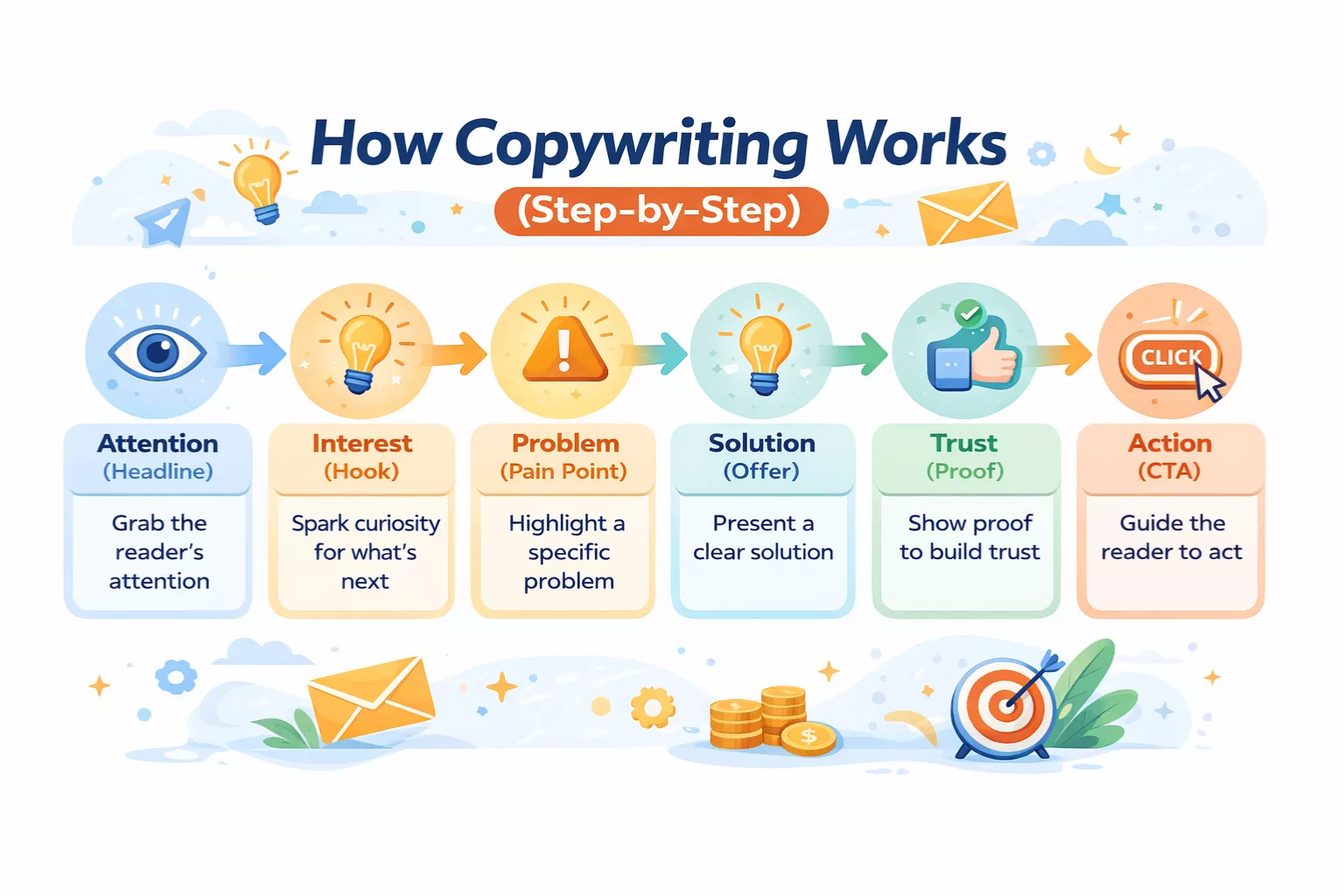
The Copywriting Process (Step-by-Step Breakdown)
When I first tried to write copy, I jumped straight into writing.
That was the mistake.
Good copy doesn’t start with words. It starts with understanding. Once you follow a simple process, writing becomes much easier. You stop guessing what to say.
Here’s the step-by-step breakdown that actually works.
1. Understand the Audience
This is where everything begins.
If you skip this, nothing else works. I learned that the hard way. I wrote pages of copy that sounded fine to me, but no one cared.
Why?
Because it wasn’t written for them.
You need to know:
- Who they are
- What they want right now
- What they struggle with daily
You’re not writing for “everyone.” You’re writing for one specific person with a real problem.
Think about their situation.
- What frustrates them?
- What are they trying to fix?
- What have they already tried that didn’t work?
When you understand that, your copy starts to feel personal. Like you’re speaking directly to them.
And here’s the truth most people miss.
This step matters more than the writing itself. Because once you know the person, the words almost write themselves.
2. Identify the Problem
Now you bring that understanding into the copy.
You need to clearly show the problem your reader feels. Not in a vague way. Specific. Real. Something they recognize instantly.
For example, saying “you want more clients” is weak.
Saying “you send proposals every day and hear nothing back” hits harder.
That’s the difference.
When the reader sees their exact situation in your words, they stop scrolling. They feel understood.
And attention is everything.
If you don’t hold attention here, nothing else gets read.
3. Present the Solution
Once the problem is clear, you introduce the solution.
This is where many beginners overcomplicate things. They try to explain everything at once. Features, details, background.
You don’t need that.
Just show how your product, service, or idea helps solve the problem.
Keep it simple. Keep it believable.
- What is it
- How it helps
- What changes for the reader
That’s enough.
If it feels too complex, people won’t trust it. Simple solutions feel real.
4. Build Trust
Even if your solution sounds good, people hesitate. That’s normal. Your job here is to reduce that hesitation.
You do that with:
- Proof (examples, results, simple logic)
- Addressing common doubts
- Making the next step feel safe
Think about what the reader might question.
- “Will this work for me?”
- "Is this legit?”
- "Is it worth it?”
Answer those before they even ask.
When trust increases, resistance drops.
5. Call to Action
This is where everything leads.
You tell the reader what to do next.
And this is where many people get weak. They hint instead of telling. They soften the message. That kills conversions.
Be direct.
- Click the link
- Sign up here
- Start your free trial
Clear actions work better.
Also, make the benefit obvious. Why should they take that step now?
A strong CTA feels like the natural next move. Not pressure. Not confusion. Just the next step that makes sense.
Once you follow this process a few times, you’ll notice something.
Writing gets easier. Your ideas feel more structured. And your copy starts to work.
The Key Elements of High-Converting Copy
Once you understand the process, the next step is knowing what actually makes copy work on the page.
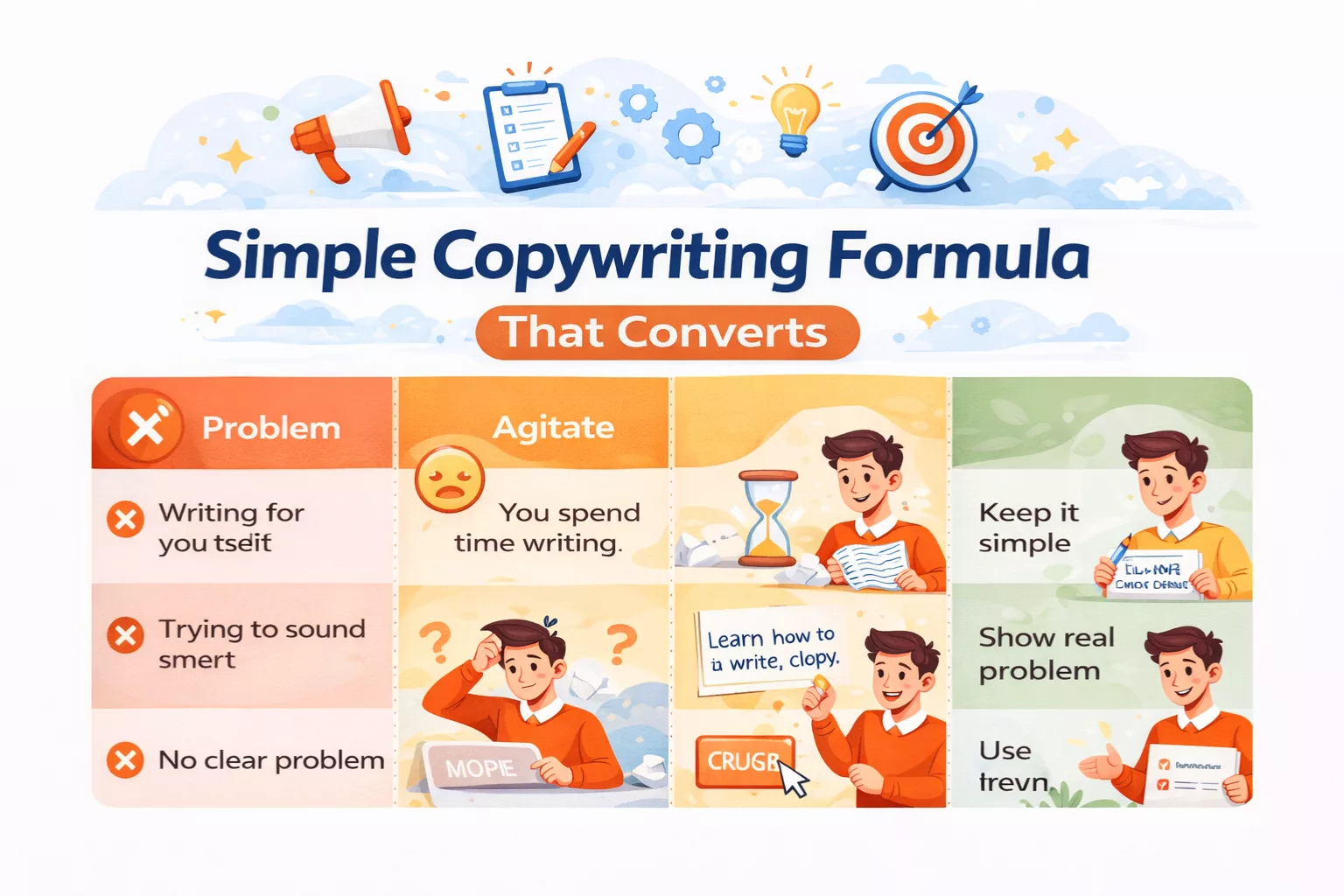
Every strong piece of copy follows the same structure. It’s not random. It’s built from a few key elements that guide the reader from first glance to final action.
When I started focusing on these, my writing improved fast. Before that, I was writing blocks of text with no clear flow. People didn’t stick around.
Here’s what actually matters.
Headline: Grabs Attention Fast
The headline is the first thing people see.
If it doesn’t stop them, nothing else gets read.
This is where most beginners struggle. They try to be clever or vague. But the best headlines are simple and clear.
They show a benefit or call out a problem.
For example:
- Weak: “Improve Your Writing Today”
- Strong: “Write Copy That Gets Clicks (Even If You’re a Beginner)”
See the difference? One is general. The other feels specific and relevant.
Your goal is simple. Make the reader think, “This is for me.”
Hook: Keeps the Reader Engaged
Once the headline gets attention, the hook keeps it.
This is usually the first few lines after the headline. And this is where people decide if they’ll keep reading or leave.
A strong hook can:
- Call out a frustration
- Share a relatable situation
- Ask a question that feels personal
I often start with something the reader already feels.
Something like, “You’ve tried writing copy, but nothing converts.”
That pulls them in because it reflects their reality. If the hook feels flat, they’re gone.
Body: Explains and Persuades
Now you build your message.
This is where you explain the idea, show the solution, and guide the reader forward. But here’s the key.
Don’t overload it.
Keep sentences simple. One idea at a time. Every line should move the reader closer to action.
When I used to write long, complicated paragraphs, people dropped off. Once I simplified everything, engagement improved.
The body is not about saying more. It’s about saying what matters.
Proof: Builds Credibility
At this point, the reader is interested. But they’re also skeptical.
That’s normal. Proof removes that doubt.
This can be:
- Results
- Examples
- Simple logic
- Real outcomes
You don’t always need big claims. Even small, believable proof works.
For example, showing how something helped improve response rates is often enough.
The goal is to make the reader think, “This could work for me too.”
CTA: Drives Action
Everything leads here.
The call to action tells the reader what to do next. And it needs to be clear.
No guessing. No soft language.
- “Download the guide”
- “Start your free trial”
- “Join the email list”
When I first wrote CTAs, I made them vague. Things like “learn more” or “check this out.” They didn’t work well.
Strong CTAs are direct and benefit-focused.
They feel like the natural next step.
When you combine these elements, your copy flows.
Attention → interest → trust → action.
And once you see this structure, you’ll start noticing it everywhere.
How Copywriting Uses Psychology to Work?
This is where copywriting starts to make sense.
It’s not about tricks. It’s about how people already think and make decisions.
Once I understood this, I stopped trying to “write better” and started focusing on how people react. That shift made everything easier.
People Buy Based on Emotion First
Most people believe they make logical decisions.
In reality, they feel first and justify later.
Think about it. You don’t buy something because it has features. You buy it because of what it does for you. Less stress. More money. More time. Less frustration.
That’s emotion.
Good copy taps into that first. It shows the reader a problem they feel or an outcome they want. Then, after that connection is made, it supports it with logic.
If you start with logic, it feels cold. If you start with emotion, it feels relevant.
Fear, Desire, and Curiosity Drive Action
There are a few core drivers behind almost every decision.
- Fear: avoiding loss, mistakes, or missed opportunities
- Desire: wanting something better, easier, or faster
- Curiosity: needing to know what happens next
You don’t need all three at once. But strong copy usually leans on at least one.
For example:
- Fear: “Stop losing clients because of weak copy”
- Desire: “Get more clicks without writing more content”
- Curiosity: “This small change doubled conversions”
These angles work because they connect to something the reader already feels.
The Role of Attention and Pattern Interruption
Before anything else, you need attention.
And attention is hard to get.
People scroll fast. They ignore most of what they see. So your copy needs to interrupt that pattern.
That can be:
- A bold statement
- A specific problem
- A line that feels different from everything else
I noticed this when testing headlines. Small changes made a big difference. When something felt fresh or direct, people stopped.
No attention means no clicks. No clicks means nothing else matters.
Why Simple Language Converts Better?
This is one of the biggest lessons.
Simple wins.
When you use complex words or long sentences, people slow down. When they slow down, they lose interest. When they lose interest, they leave.
Clear, simple language keeps things moving.
Short sentences. Familiar words. One idea at a time.
You’re not writing to impress. You’re writing so the reader understands instantly.
And when they understand, they’re more likely to act.
How Urgency and Scarcity Influence Decisions?
Even when people want something, they delay.
“I’ll do it later.”
That’s where urgency and scarcity come in.
They give the reader a reason to act now instead of later.
- Limited time: “Offer ends tonight”
- Limited spots: “Only 10 spots available”
- Missed opportunity: “Don’t fall behind”
But this only works if it feels real.
Fake urgency breaks trust. Real urgency moves people forward.
Once you understand these psychological drivers, copywriting stops feeling random.
You’re not guessing anymore. You’re working with how people already think.
To better understand why people take action, this guide on persuasion principles explains how psychology influences decisions.
Common Copywriting Mistakes Beginners Make
Most copywriting mistakes are not about skill.
They come from thinking the wrong way.
I made all of these early on. The frustrating part was that I didn’t even realize what I was doing wrong. The writing felt fine. But it didn’t get results.
Once you spot these mistakes, you start fixing them fast.
Writing for Yourself Instead of the Reader
This is the most common one.
You write what you think sounds good. What you want to say. What makes sense to you.
But the reader doesn’t care about that.
They care about their problem.
When your copy focuses on you, it feels distant. When it focuses on them, it feels personal.
A simple shift helps here.
Instead of asking, “What do I want to say?” ask, “What does the reader need to hear right now?”
That one change improves everything.
Trying to Sound Smart Instead of Clear
I used to do this a lot.
Long sentences. Bigger words. Trying to sound like I knew what I was talking about.
It didn’t work.
People don’t read carefully. They scan. If your message takes effort to understand, they move on.
Clear writing wins every time.
Short sentences. Simple words. Direct meaning.
If someone has to reread your sentence, it’s too complicated.
Ignoring the Audience’s Problem
This mistake kills attention fast. If your copy doesn’t reflect a real problem the reader feels, they won’t keep reading.
General statements don’t work.
“You want success” is too vague.
“You’re struggling to get replies from clients” is specific.
When the reader sees their situation in your words, they stop. They pay attention.
If they don’t feel understood, they leave.
Weak or Missing Call to Action
You can write great copy and still get no results.
Why?
Because you didn’t tell the reader what to do next.
Or you said it in a weak way.
Things like “learn more” or “check it out” don’t push action. They feel optional.
Strong copy is direct.
- Sign up now
- Download the guide
- Start here
Clarity matters here more than anything.
Overcomplicating the Message
This happens when you try to say too much.
Too many ideas. Too many details. Too many directions.
The result?
Confusion. And confused readers don’t act.
Good copy focuses on one main idea. One problem. One solution. One next step.
That’s it.
Once I started cutting things down instead of adding more, my copy improved.
Less noise. More focus. Better results.
Simple Example of How Copywriting Works (Real Breakdown)
Let’s make this real.
When I was learning copywriting, theory only helped so much. What actually made it click was seeing a simple example broken down step by step.
So here’s a basic before and after.
Before (Weak Copy)
“Join our copywriting course to improve your writing skills and grow your business.”
There’s nothing wrong with it.
But there’s nothing pulling you in either.
It’s general. It doesn’t speak to a real problem. And it doesn’t give a strong reason to act.
After (Stronger Copy)
“Struggling to get clients because your writing doesn’t convert?
Learn how to write simple copy that gets clicks and brings in clients, even if you’re just starting.
Start the course today.”
Now let’s break it down.
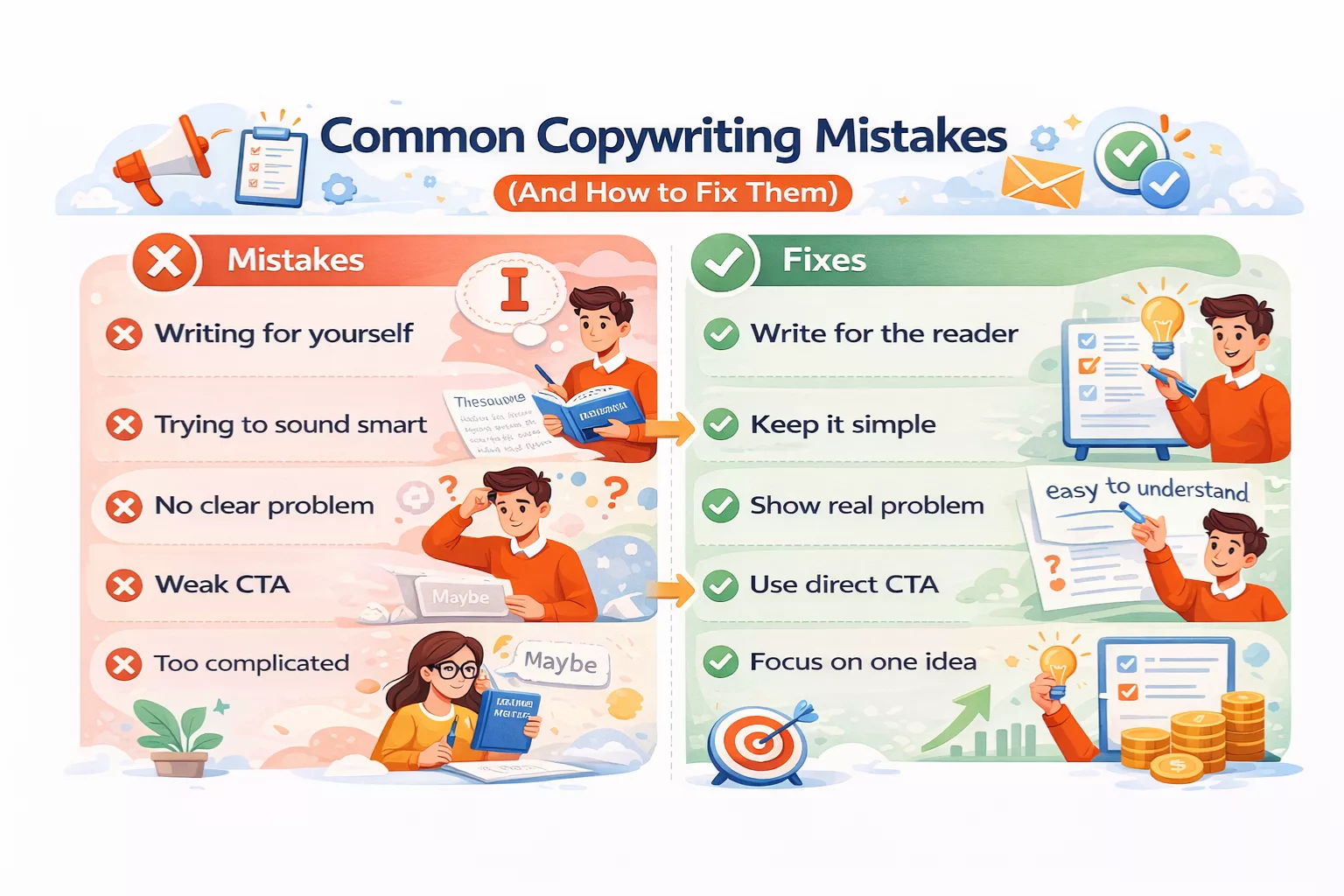
Problem
“Struggling to get clients because your writing doesn’t convert?”
This works because it calls out a specific situation.
Not “you want more clients.”
But “you’re not getting clients because your writing isn’t working.”
That feels real.
The reader either relates to it or moves on. That’s what you want.
Solution
“Learn how to write simple copy that gets clicks and brings in clients…”
This introduces the solution in a clear way.
No complex explanation. Just what it does.
It connects directly to the problem. If the issue is weak writing, the solution is better copy.
Benefit
“…even if you’re just starting.”
This removes doubt.
A beginner might think, “This won’t work for me.” That line answers it right away.
It makes the result feel possible.
Benefits are not features. They show what changes for the reader.
CTA (Call to Action)
“Start the course today.”
Simple. Direct. No confusion.
It tells the reader exactly what to do next.
Why This Works?
It follows a natural flow.
Problem → solution → benefit → action.
Each part leads into the next. Nothing feels forced.
Also, it’s easy to read.
Short sentences. Clear message. No extra noise.
That’s what makes copy work.
Once you start seeing this pattern, you’ll notice it everywhere. And more importantly, you’ll start using it without thinking.
How to Start Practicing Copywriting Today
This is where most people get stuck.
They read about copywriting. They watch videos. They save examples. But they don’t actually practice.
I did the same at the start. I thought I needed more knowledge before I could begin. Turns out, you get better by doing, not by collecting information.
Here’s how to start today, even if you feel like you’re not ready.
Rewrite Existing Ads
This is the fastest way to improve.
Take an ad you see online and rewrite it in your own words. Don’t overthink it. Just try to make it clearer, stronger, or more specific.
I used to do this daily with simple Facebook ads. At first, my versions were worse. But after a while, I started noticing patterns.
- What made a headline work
- How problems were described
- How simple the language was
You don’t need to create from scratch. You learn faster by working with something that already exists.
Get Better at Copywriting by Practicing, Not Guessing
Most beginners stay stuck because they only read about copywriting.
This copywriting practice pack gives you 5 real ads to rewrite, so you can learn by doing. You’ll start seeing what works, what doesn’t, and how to improve your copy fast.
Free. No fluff. Just real ads to rewrite and improve your skills.
Study Landing Pages
Good copy is everywhere if you look for it.
Landing pages are one of the best places to learn. They are built to convert. Every section has a purpose.
Don’t just read them. Break them down.
Ask yourself:
- What is the main problem they highlight?
- How do they present the solution?
- Where do they build trust?
- How do they guide you to act?
When you start analyzing like this, you stop reading like a normal visitor. You start thinking like a copywriter.
Practice Writing Headlines Daily
Headlines are a skill on their own.
And they matter more than most people think. If the headline doesn’t work, nothing else gets read.
A simple exercise is to write 5 to 10 headlines every day.
They don’t need to be perfect. The goal is repetition.
I used to sit down and write headline variations for the same idea. Most were bad. But a few stood out. And over time, that improved my instincts.
Consistency matters more than talent here.
Focus on One Skill at a Time
Trying to learn everything at once slows you down.
I made that mistake. I tried to improve headlines, storytelling, structure, and persuasion all at once. It felt messy.
Instead, pick one thing.
- One week: headlines
- Next week: problem statements
- Next week: CTAs
When you focus, you improve faster.
Track What Works and Improve
This is where real progress happens.
If you’re writing for a blog, emails, or social posts, pay attention to results.
- What gets clicks
- What gets ignored
- What keeps people reading
Even small data helps.
When something works, study it. Why did it work? What made it different?
When something fails, don’t ignore it. That’s feedback.
Copywriting is not about guessing. It’s about testing, learning, and improving over time.
If you take anything from this, take this.
Start small. Practice daily. Keep it simple.
That’s how you get better.
Key Takeaways
- Copywriting is writing that drives action, not just engagement
- It works by guiding the reader from attention to decision
- Understanding the audience matters more than writing itself
- Strong copy focuses on one clear problem and one clear solution
- Emotion drives action first, then logic supports the decision
- Simple, clear language converts better than clever writing
- Every piece of copy follows a structure: headline, hook, body, proof, CTA
- Weak or missing calls to action lead to lost results
- Practice improves skill faster than consuming more information
- The goal is always the same: move the reader to take the next step
Conclusion
Copywriting works when you understand people, not just words.
Once you see the process, everything becomes easier. You stop guessing and start writing with purpose.
If you want to get better, don’t just read. Practice daily. Rewrite real ads. Pay attention to what grabs your attention and why.
That’s how copywriting starts to click.
Ready to Practice Copywriting the Right Way?
You now understand how copywriting works.
The next step is simple. Practice. This copywriting practice pack gives you 5 real ads to rewrite so you can turn what you’ve learned into real skill. No guessing. No overthinking. Just hands-on improvement.
Free download. Use it today and see the difference in your writing.
Frequently Asked Questions
What is copywriting in simple terms?
Copywriting is writing that encourages someone to take action, such as clicking a link, signing up, or buying a product. It focuses on persuasion rather than just sharing information.
How does copywriting work?
Copywriting works by understanding the reader’s problem, presenting a clear solution, building trust, and guiding them to take the next step. It uses psychology to connect with emotions and support decisions with logic.
What is the goal of copywriting?
The main goal of copywriting is to move the reader to act, such as clicking a button, joining an email list, or making a purchase.
What is the difference between copywriting and content writing?
Copywriting focuses on driving action, while content writing focuses on providing information or value. Content builds trust, and copy converts that trust into results.
Can beginners learn copywriting?
Yes. Beginners can learn copywriting by practicing regularly, studying real examples, and focusing on simple, clear writing. Consistent practice is more important than experience.
How can I practice copywriting?
You can practice by rewriting ads, studying landing pages, writing headlines daily, and testing what works. Focusing on one skill at a time helps you improve faster.