
Most beginner copywriters struggle with one thing: turning words into action.
You can write clearly. You can explain things well. But when it comes to getting clicks, signups, or sales, something feels off.
That’s where the AIDA copywriting formula comes in.
AIDA copywriting is a framework that stands for Attention, Interest, Desire, and Action.
It’s one of the oldest and most effective frameworks in marketing. And it still works today because it follows how people actually think and decide.
In this guide, I’ll break down AIDA in simple terms. You’ll see exactly how it works, where to use it, and real examples you can model right away.
AIDA Copywriting Explained (Quick Summary)
AIDA copywriting is a simple framework that guides a reader from first glance to action. It stands for:
- Attention – Grab the reader’s focus with a strong headline or hook
- Interest – Keep them reading by showing a relatable problem or situation
- Desire – Make them want the solution by highlighting benefits and outcomes
- Action – Tell them exactly what to do next with a clear call to action
This formula works because it follows how people make decisions. First, something catches their eye. Then they decide if it matters. Next, they feel motivated. Finally, they act.
When to Use AIDA
- Writing ads
- Creating landing pages
- Sending emails
- Building sales pages
Why AIDA Works
- Matches natural decision-making
- Keeps writing focused and easy to follow
- Removes guesswork for beginners
- Works in both short and long content
Simple AIDA Example
- Attention: “Why your copy sounds good but doesn’t convert”
- Interest: Describe the reader’s struggle
- Desire: Show how AIDA solves it
- Action: “Download the template and start writing better copy today”
Bottom line: AIDA turns scattered writing into a clear path that leads the reader to take action.
Table of Content
- AIDA Copywriting Explained (Quick Summary)
- What Is AIDA Copywriting?
- Why AIDA Still Works in Modern Copywriting?
- AIDA vs PAS Copywriting (Quick Comparison)
- Stage 1: Attention (How to Hook the Reader)
- Stage 2: Interest (How to Keep Them Reading)
- Stage 3: Desire (How to Make Them Want It)
- Stage 4: Action (How to Get the Click or Sale)
- AIDA Copywriting Example (Step-by-Step Breakdown)
- Quick Practice Exercise
- Real-Life AIDA Copywriting Examples
- Common AIDA Copywriting Mistakes
- When to Use AIDA? (And When Not To)
- Key Takeaways
- Conclusion
- Frequently Asked Questions
What Is AIDA Copywriting?
I remember the first time I tried to write “persuasive” copy. I had all the right words, but nothing happened. No clicks. No signups. It felt frustrating because the writing itself wasn’t bad. It just didn’t guide the reader anywhere.
That’s exactly what AIDA fixes.
AIDA copywriting is a simple framework that helps you lead the reader step by step, from first glance to final action. Instead of guessing what to write next, you follow a structure that matches how people naturally think when they decide to buy, click, or sign up.
If you're new to this, it helps to first understand what copywriting is and how it’s different from regular writing.
Definition of AIDA (Attention, Interest, Desire, Action)
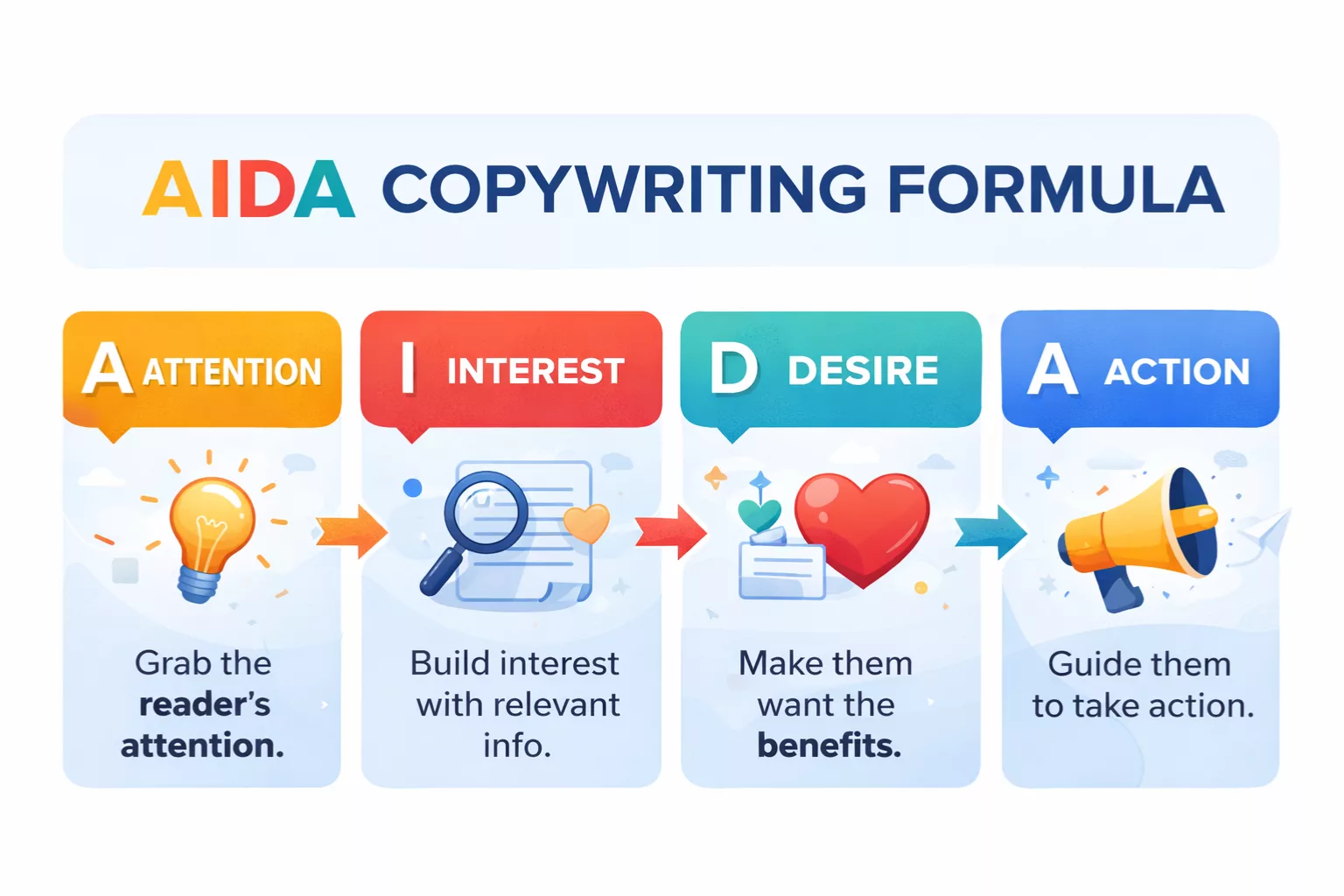
AIDA stands for:
- Attention - Grab the reader’s focus
- Interest - Keep them engaged
- Desire - Make them want what you offer
- Action - Tell them what to do next
It’s not just a formula. It’s a flow. Each step leads to the next, so the reader doesn’t get lost or drop off halfway.
The AIDA model has been used in marketing for decades and is still widely referenced today, as explained by Investopedia.
If you're still learning the fundamentals, this copywriting basics for beginners guide will help you see how AIDA fits into the bigger picture.
Why This Formula Works for Human Psychology?
People don’t make decisions in one step.
First, something catches their eye. Then they decide if it matters to them. If it does, they start to feel something about it. Only after that do they take action.
AIDA follows that exact path.
I used to jump straight into selling. “Buy this. It’s great.” But readers weren’t ready yet. There was no buildup. No connection.
Once I started using AIDA, things changed. I stopped forcing the sale and started guiding the reader instead. And that shift made the writing feel easier and more effective at the same time.
Where AIDA Is Used?
You’ll see AIDA almost everywhere once you notice it:
- Ads (Facebook ads, Google ads, banners)
- Landing pages
- Email marketing campaigns
- Sales pages
- Social media posts
- Video scripts
It works in both short and long formats. A tweet can follow AIDA. A full sales page can too.
That’s why it’s one of the first frameworks beginners learn. It fits almost any situation.
Writing vs Structured Persuasion
There’s a big difference between writing and copywriting.
Writing shares information. Copywriting moves people to act.
Before I understood this, I would explain things clearly but still get no results. The content made sense, but it didn’t lead anywhere.
Structured persuasion, like AIDA, gives your writing direction. Every sentence has a job. Every section moves the reader forward.
You’re not just writing. You’re guiding.
This is where most people realize how copywriting actually works and why structure matters more than just writing clearly.
Quick Overview of Each Stage
Here’s how each part works in practice:
- Attention:
You stop the scroll. This is your headline or first line. If it doesn’t work, nothing else matters. - Interest:
You show the reader this is relevant to them. You talk about their problem or situation in a way that feels familiar. - Desire:
You shift from problem to solution. You show what life looks like after using your product or idea. - Action:
You give a clear next step. Click, sign up, buy, download. No confusion.
When I started treating each step as a separate job, my writing became easier to manage. I didn’t feel stuck anymore because I always knew what came next.
And that’s the real value of AIDA. It removes the guesswork and gives your copy a clear path to follow.
Rewrite 5 Ads and Get Better at Copywriting Fast
Reading about copywriting won’t improve your skills. Practice will.
This simple exercise pack gives you 5 real ads to rewrite using the AIDA framework so you can learn by doing.
You’ll learn how to:
- ✔ Write stronger hooks that grab attention
- ✔ Turn weak copy into clear, structured messages
- ✔ Understand what actually makes copy convert
Free download. No fluff. Just practice that improves your writing.
Why AIDA Still Works in Modern Copywriting?
I used to think AIDA was outdated.
It felt too simple. Too basic. Like something that worked in old-school ads but not in today’s fast, distracted world.
Then I tested it.
Same offer. Same audience. The only thing I changed was the structure. I rewrote the copy using AIDA, and suddenly things started to move. More clicks. More reads. More action.
That’s when it clicked for me. AIDA isn’t outdated. It’s built for how people behave right now.
People Scan Before They Read
Most people don’t read your content line by line.
They skim. They scroll. They decide in seconds if it’s worth their time.
AIDA fits that behavior perfectly. The Attention stage stops the scroll. The Interest stage pulls them into the next line.
Without those two, the rest doesn’t even get seen.
I used to write long intros that slowly built up. Thought it made me sound smart. In reality, people bounced before I got to the point.
Once I started focusing on strong openings, engagement improved right away.
Research from Nielsen Norman Group shows that users scan content before they read it, which is exactly why strong hooks matter.
Decision-Making Is Emotional First, Logical Second
People like to think they make rational decisions.
They don’t.
First comes emotion. Then comes logic to justify it.
AIDA builds that naturally.
- Interest connects with the reader’s situation
- Desire amplifies the feeling and shows a better outcome
Only after that does the reader feel ready to act.
When I ignored this and focused only on features or facts, the copy felt flat. It made sense, but it didn’t move anyone.
Once I leaned into emotion first, everything became more persuasive without sounding pushy.
Structured Copy Removes Confusion
Confused readers don’t convert.
If your message jumps around or tries to do everything at once, people lose track and leave.
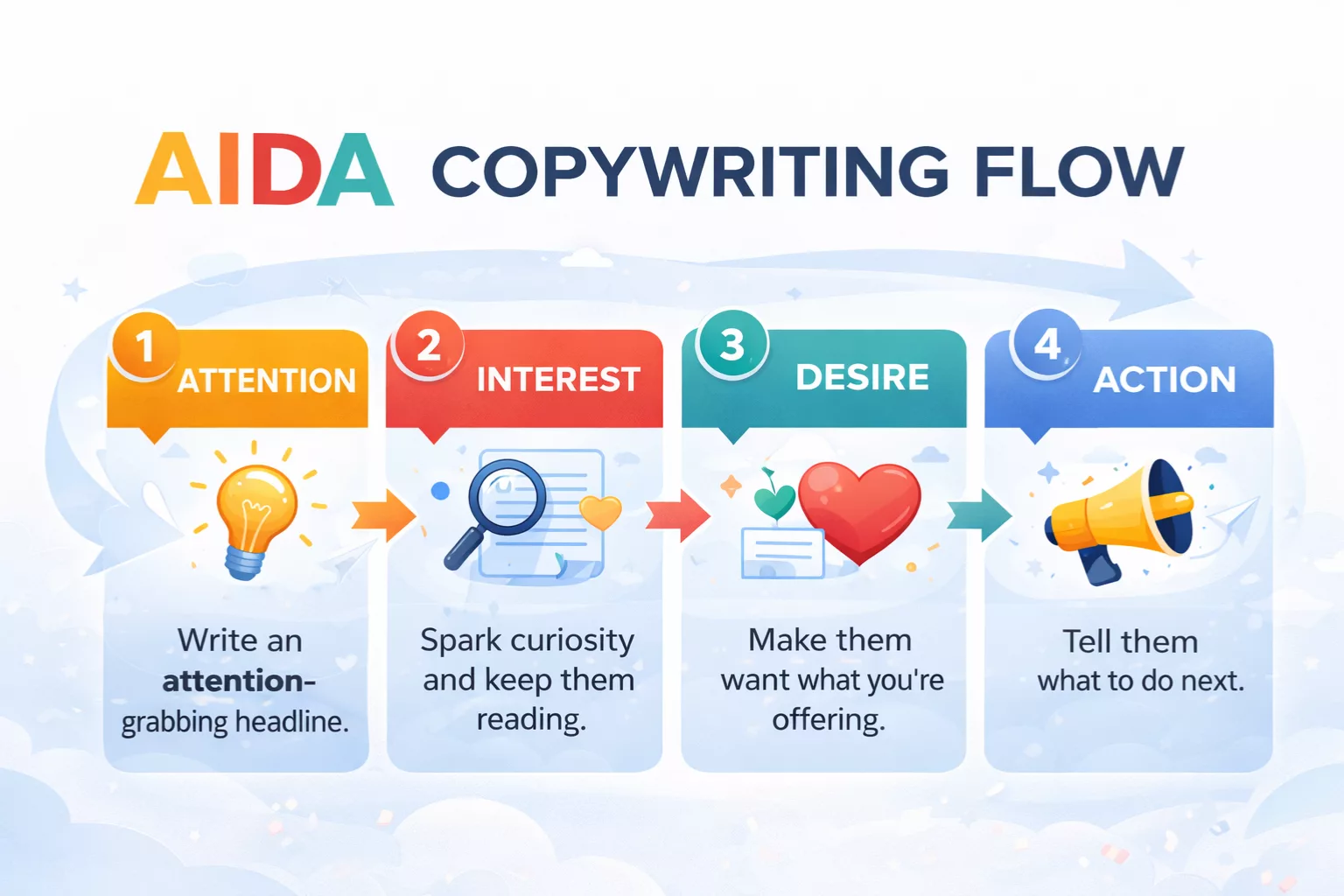
AIDA fixes that by giving your copy a clear path:
- Hook them
- Engage them
- Build desire
- Guide action
Each step has one job.
I used to mix everything together. A bit of selling, then explaining, then another hook. It felt messy, and results showed it.
With structure, the writing became easier to follow. And when it’s easy to follow, people stay longer.
Helps Beginners Avoid “What Do I Write Next?”
This is one of the biggest struggles for new writers.
You sit there staring at the screen, thinking, “What comes next?”
AIDA solves that problem.
You always know where you are:
- Writing the headline? That’s Attention
- Explaining the problem? That’s Interest
- Showing benefits? That’s Desire
- Adding a button or CTA? That’s Action
It removes the blank page feeling.
When I started using it, I stopped overthinking. I didn’t need to be creative all the time. I just needed to follow the flow.
Works Across Formats: Short-Form and Long-Form
One thing I underestimated was how flexible AIDA is.
You can use it in:
- A 10-word ad
- A short social media post
- A 1,000-word email
- A full landing page
The structure stays the same. Only the depth changes.
For short content, each stage might be one sentence. For long content, each stage becomes a full section.
That’s why AIDA keeps showing up everywhere. It adapts without losing its effectiveness.
Once you understand it, you start seeing it in ads, emails, even video scripts. And more importantly, you start using it without thinking about it.
That’s when your writing begins to feel natural and purposeful at the same time.
AIDA vs PAS Copywriting (Quick Comparison)
| Framework | Structure | Best For |
|---|---|---|
| AIDA | Attention → Interest → Desire → Action | Ads, landing pages, emails |
| PAS | Problem → Agitate → Solution | Emotional copy, pain-focused content |
Stage 1: Attention (How to Hook the Reader)
This is where most copy fails.
Not because the offer is bad. Not because the writing is weak. But because no one stops to read it in the first place.
Attention is the gate. If you don’t earn it, nothing else matters.
I learned this the hard way. I used to spend time polishing the middle of my copy, thinking that’s where the magic happens. Meanwhile, my headlines were flat. No hook. No reason to care. People just scrolled past.
Once I fixed that first line, everything else started working better.
What Attention Means in Copywriting?
Attention is about stopping someone mid-scroll.
It’s that moment where a reader thinks, “Wait… this is for me.”
You’re not trying to explain everything here. You’re trying to earn the next second of their time.
That’s it.
If your opening doesn’t create that pause, the rest of your copy doesn’t exist to the reader.
Importance of the First Line or Headline
Your headline does one job. Get the reader to read the next line.
Not impress. Not sound smart. Not be clever.
Just pull them forward.
Most people decide in a few seconds if they’ll keep reading. That decision is based almost entirely on your first line.
I used to overcomplicate headlines. Tried to sound creative. What worked better was simple, direct, and specific.
Clear beats clever every time.
Common Attention Triggers
When you’re stuck, use proven triggers. These tap into how people already think.
Curiosity
You open a loop that the reader wants to close.
Example: "Most beginner copywriters make this mistake without realizing it”
It creates a gap. The reader wants to know what the mistake is.
Pain Points
You call out a real frustration.
Example: "Struggling to get clicks even when your writing sounds good?”
This works because the reader feels seen.
Bold Statements
You challenge a belief or say something unexpected.
Example: "Good writing doesn’t sell. This does.”
It creates tension. That tension pulls attention.
Specific Results
You show a clear outcome.
Example: "How I wrote an email that got 27 replies in one day”
Numbers and specifics make things feel real.
Good vs Bad Headline Examples
Here’s where it becomes obvious.
- Bad headline: "Improve Your Copywriting Skills Today”
It’s vague. No emotion. No reason to care.
- Good headline: "Why Your Copy Sounds Good But Still Doesn’t Convert”
Now there’s tension. A problem. A reason to read.
Another example:
- Bad: "Learn About AIDA Copywriting”
- Good: "AIDA Copywriting: The Simple Formula That Turns Words Into Sales”
One explains. The other promises a result.
Mistakes to Avoid
These kill attention fast:
- Vague headlines
If it could apply to anyone, it connects with no one. - Boring openings
Starting with definitions or general statements loses people. - Trying to be too clever
If the reader has to think too hard, they move on. - Overpromising without clarity
Big claims with no specifics feel fake. - Talking about yourself too early
The reader cares about their problem first.
I still catch myself making these mistakes sometimes. Especially the “trying to be clever” part.
When in doubt, I go back to one question:
Would this make me stop scrolling?
If the answer is no, I rewrite it.
Because if you don’t win attention, you don’t get a second chance.
Stage 2: Interest (How to Keep Them Reading)
Getting attention feels like a win.
But it’s not.
It just gives you a chance to prove you’re worth the reader’s time.
I’ve made this mistake more times than I’d like to admit. I’d write a strong headline, get the click, then lose the reader in the next few lines. The hook worked, but the follow-up didn’t.
That’s where the Interest stage comes in.
Transition From Hook to Engagement
The moment after your headline is critical.
The reader is asking one question:
“Is this actually for me?”
If you don’t answer that fast, they leave.
Your job here is simple. Connect the hook to the reader’s situation.
For example, if your headline calls out a problem, your next lines should expand on that problem in a way that feels familiar. You’re showing them they’re in the right place.
No long build-up. No fluff. Just a clear continuation.
How to Build Relevance Quickly?
Relevance is what keeps someone reading.
And it has to happen fast.
You do that by reflecting the reader’s reality back to them. Their struggle. Their goal. Their frustration.
When they see themselves in your words, they stay.
I used to write broad intros that tried to speak to everyone. It sounded safe, but it didn’t connect. Once I got specific, even if it felt narrow, engagement improved.
Because the right reader felt it was written just for them.
Techniques That Work
You don’t need to overthink this stage. A few simple techniques go a long way.
Storytelling
A short story pulls people in.
Not a long backstory. Just a quick moment they can relate to.
Something like:
“I remember writing an email I thought was solid. Clear message, strong offer. It got two clicks.”
That’s enough. It feels real. It creates interest.
Relatable Problems
Call out what the reader is dealing with.
Be specific.
Instead of:
- “You’re struggling with writing”
Say:
- “You spend an hour writing a post, hit publish, and nothing happens”
That hits harder because it feels true.
Clear Context
Don’t make the reader guess what this is about.
Tell them what they’re about to learn or understand.
This reduces friction. It keeps things easy to follow.
Confusion kills interest fast.
Keep Sentences Simple and Easy to Follow
This part matters more than most people think.
If your sentences are hard to read, people stop.
I used to write longer, complex lines thinking it sounded more professional. It didn’t. It just made the content harder to get through.
Shorter sentences. Clear ideas. One thought at a time.
That’s what keeps momentum.
Weak vs Strong Interest Example
You can feel the difference right away.
Weak version:
- “Copywriting is an important skill in today’s digital world. Many people want to improve their ability to write persuasive content.”
This says nothing new. It feels generic.
Strong version:
- “You sit down to write, thinking this one will be better. But after you hit publish, it’s the same result. No clicks. No responses. Just silence.”
Now there’s tension. It feels real. The reader leans in.
That’s the goal of the Interest stage. Not to impress. Not to explain everything.
Just to make the reader think, "Yeah… this is exactly what I’m dealing with.” And once you have that, they’re ready for the next step.
Stage 3: Desire (How to Make Them Want It)
This is where the shift happens.
Up to this point, the reader is thinking, “This is about me.”
Now they start thinking, “I want this.”
I used to mess this part up a lot. I would list features, explain how things work, and try to sound convincing. But nothing moved.
The problem was simple. I was describing the product, not the outcome.
Desire isn’t built on information. It’s built on what the reader gets and how that feels.
Turning Features Into Benefits
Features tell. Benefits sell.
A feature is what something does.
A benefit is what it does for the reader.
For example:
- Feature: “Includes 10 copywriting templates”
- Benefit: “You don’t have to stare at a blank page again”
Same thing. Different impact.
When I started rewriting features into real-life outcomes, the copy felt more grounded. Easier to connect with.
A good way to check this is to ask:
“So what?”
If the sentence doesn’t answer that, it’s still a feature.
Showing Transformation Instead of Describing the Product
People don’t want tools. They want change.
Instead of focusing on what your product is, show what life looks like after using it.
Before, I would write things like:
“This course teaches AIDA copywriting”
Now I write:
“You’ll know exactly how to turn a blank page into copy that gets clicks”
One explains. The other paints a result.
That’s what creates desire. The reader starts picturing themselves on the other side.
Emotional Triggers That Drive Desire
Logic supports decisions. Emotion drives them.
You don’t need to push hard. Just tap into feelings the reader already wants.
Relief
Remove frustration or pressure.
Example: "Finally feel like you know what to write next”
Confidence
Help them feel capable.
Example: "Write copy without second-guessing every sentence”
Ease
Make the process feel simple.
Example: "Follow a clear structure instead of guessing”
These aren’t exaggerated promises. They’re grounded outcomes that feel achievable.
Using Proof the Right Way
Desire grows when the reader sees that something works.
Not vague claims. Real signals.
You can use:
- Results
“This email got 32 replies in a day” - Examples
Show a short before and after - Specific outcomes
“Reduced bounce rate after rewriting the headline”
I used to say things like “this works really well.” That means nothing.
Once I started adding specifics, the copy felt more credible. And readers trusted it more.
Before and After Positioning
This is one of the simplest ways to build desire.
Show the contrast.
- Before: Stuck, unsure, writing without direction
After:
- Clear structure, confident writing, better results
You’re helping the reader see the gap between where they are and where they could be. And more importantly, you’re showing that the gap can be closed. That’s what makes someone want to move forward.
Desire isn’t about hype. It’s about clarity. When the reader can clearly see the outcome and feel it’s within reach, the decision becomes easier.
And that sets up the final step.
Stage 4: Action (How to Get the Click or Sale)
This is where everything either pays off… or falls apart.
You can hook attention. You can build interest. You can create real desire.
But if the reader doesn’t take action, none of it matters.
I used to end my copy with soft lines like, “Hope this helps” or “Check it out if you want.” It felt polite. It also killed results.
People need direction.
Not pressure. Not hype. Just a clear next step.
What a Strong Call to Action Looks Like?
A good call to action (CTA) tells the reader exactly what to do next.
No guessing. No thinking.
- “Download the copywriting templates”
- “Start your free trial”
- “Get the guide”
That’s it.
Clear, direct, and specific.
A weak CTA sounds like this:
- “Learn more”
- “Click here”
- “Check this out”
These don’t tell the reader what they’re getting or why it matters.
When I started making CTAs more specific, clicks improved almost right away. People respond better when the outcome is clear.
Reducing Friction and Hesitation
Even if someone wants what you offer, they can still hesitate.
That pause usually comes from small doubts:
- “Is this worth it?”
- “Will this work for me?”
- “What if I waste time or money?”
Your job is to remove that friction.
You can do that by:
- Keeping the CTA simple
- Reinforcing the benefit right before the CTA
- Adding small reassurances
For example: "Download the templates and start writing faster today”
It reminds them what they get and makes the step feel easy.
I used to stack too many options. Multiple buttons, different directions. It created confusion. Once I focused on one clear action, results improved.
Examples of Clear vs Weak CTAs
You can feel the difference instantly.
Weak CTA:
- “Click here to learn more”
It’s vague. No reason to act.
Strong CTA:
- “Download your free AIDA template and start writing better copy today”
Now it’s clear. There’s value. There’s a reason to click.
Another example:
Weak:
- “Sign up”
Strong:
- “Get instant access to the copywriting practice pack”
The stronger version answers “what do I get?” before the reader even asks.
Adding Urgency Without Pressure
Urgency helps people act now instead of later.
But it has to feel real.
I used to force urgency with lines like “Act now before it’s too late.” It felt pushy and didn’t build trust.
What works better is subtle urgency tied to value:
- “Start improving your copy today”
- “Get access while it’s still free”
- “Join now and begin writing with a clear structure”
You’re not forcing the reader. You’re reminding them that action now has a benefit.
Placement of CTA in Different Formats
Where you place your CTA matters.
For short-form content (ads, social posts):
- One clear CTA at the end
- Keep it tight and direct
For emails:
- One main CTA
- Sometimes repeated once if the email is longer
For landing pages or long-form content:
- One primary CTA
- Repeated at natural points:
- After building desire
- At the end
I used to hide the CTA at the bottom, almost like I didn’t want to ask for the click. Big mistake.
Now I treat it as the natural next step. If the reader made it this far, they’re ready.
And that’s the key idea.
The CTA isn’t a push. It’s a guide.
You’re simply showing the reader what to do next while the interest is still there.
The best way to improve this skill is through repetition, so start with simple copywriting practice exercises and apply what you learn.
If you want to see more real-world examples, HubSpot shares a variety of effective call-to-action examples and why they work.
AIDA Copywriting Example (Step-by-Step Breakdown)
It’s one thing to understand AIDA in theory.
It’s different when you see it working together in a real example.
I’ll show you a simple email-style example. Then I’ll break down each part so you can see exactly what’s happening and why it works.
Full AIDA Example
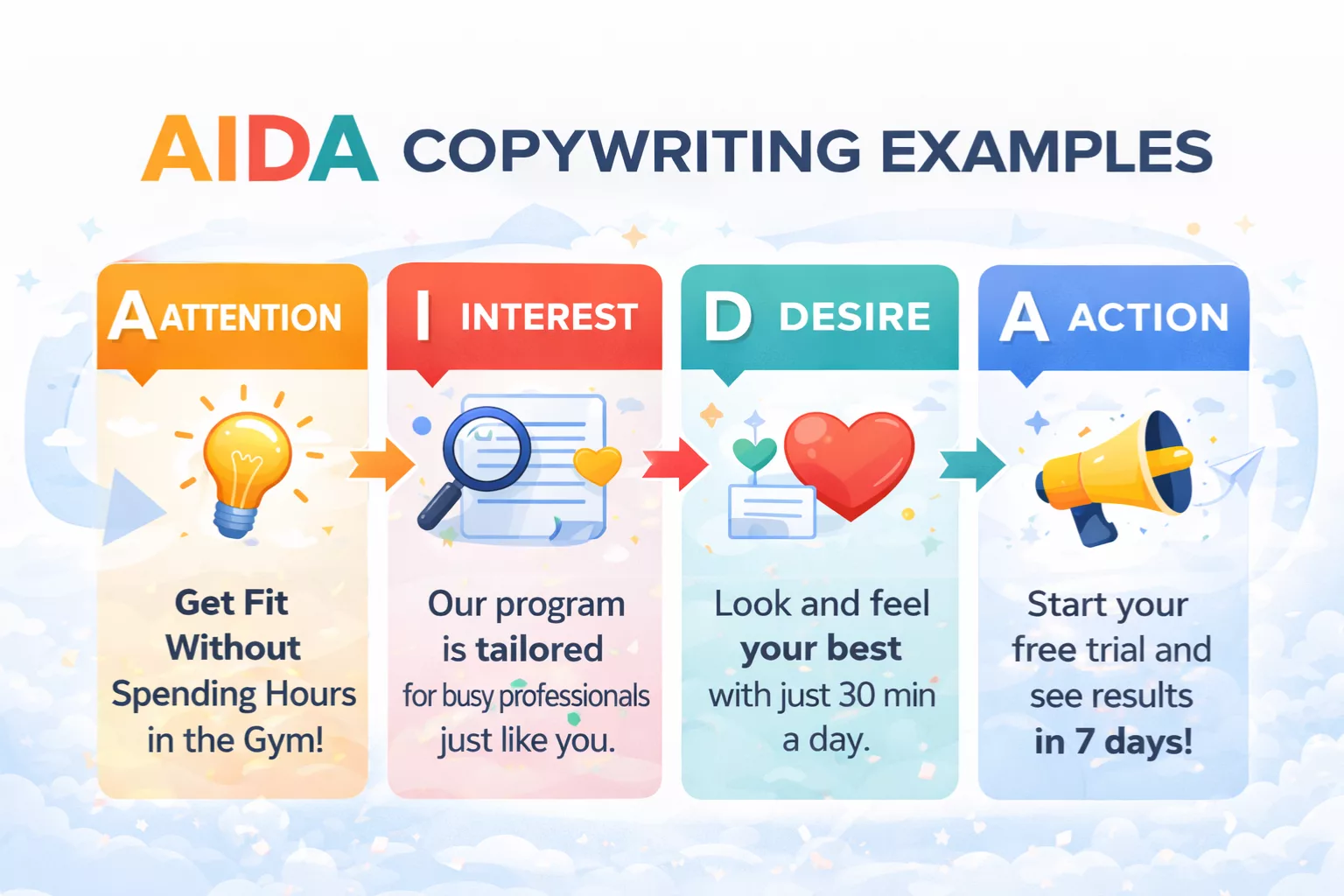
Subject line / Headline (Attention):
“Why your copy sounds good… but still doesn’t convert”
Opening lines (Interest):
You spend time writing. You tweak every sentence. It reads well.
But when you hit publish, nothing happens.
No clicks. No replies. No sales.
It’s frustrating because you know the writing isn’t bad. It just doesn’t lead anywhere.
Middle section (Desire):
That’s usually not a writing problem. It’s a structure problem.
When you use a simple framework like AIDA, your copy starts to flow.
You know how to hook attention, build interest, and guide the reader to act.
Instead of guessing what to write next, you follow a clear path.
And that’s when things start to change.
More engagement. More clicks. More confidence in your writing.
Call to action (Action):
Download the AIDA template and start writing copy that actually converts.
Breakdown of Each Stage
Attention (Headline)
“Why your copy sounds good… but still doesn’t convert”
This works because it creates tension.
It speaks to a real situation. Many beginners feel like their writing is decent, but results don’t follow.
There’s also a gap.
If the copy sounds good, why doesn’t it convert?
That question pulls the reader in.
Interest (Opening Lines)
“You spend time writing… nothing happens.”
This section builds connection fast.
It reflects a specific experience:
- Writing carefully
- Expecting results
- Getting silence
The reader sees themselves in it.
There’s no fluff. No general statements. Just a clear problem described in simple terms.
That keeps them reading.
Desire (Benefits + Outcome)
“Not a writing problem. A structure problem.”
This is where the shift happens.
Instead of just describing AIDA, the copy shows what it changes:
- You stop guessing
- You follow a clear process
- You get better results
It also adds emotional outcomes:
- More confidence
- Less frustration
- Better engagement
The reader starts thinking, “This could fix my problem.”
That’s desire.
Action (CTA)
“Download the AIDA template and start writing copy that actually converts.”
This CTA works because it’s clear and specific.
- What to do: Download
- What you get: AIDA template
- Why it matters: Better converting copy
No confusion. No extra steps.
It feels like a natural next move after everything the reader just learned.
Why This Example Works as a Whole?
Each part builds on the last.
- The headline stops the reader
- The opening makes it personal
- The middle shows a solution and outcome
- The CTA gives a clear next step
Nothing is random.
That’s the key lesson.
When I first tried writing like this, it felt structured, almost too simple. But that structure is what makes it work.
You’re not relying on creativity alone.
You’re guiding the reader through a process that leads to action.
And once you start seeing it this way, writing copy becomes a lot easier to manage.
Simple AIDA Template You Can Use
When I first started using AIDA, I still felt stuck.
I understood the stages. But when it came to actually writing, I’d freeze.
What do I say here? Is this the right way to do it?
That’s why a simple template helps.
It removes the guesswork. You’re not starting from zero. You’re filling in a structure that already works.
Fill-in-the-Blank AIDA Structure
Use this as your base. Keep it simple.
Attention (Hook based on pain or result)
- “Struggling with [specific problem]?”
- “How to [achieve specific result] without [common frustration]”
- “Why your [effort] isn’t getting [desired outcome]”
Interest (Describe the problem or situation)
- “You try to [action], but [what goes wrong]”
- “It feels like [frustration or confusion]”
- “Even when you [effort], the result is [negative outcome]”
Desire (Show solution and outcome)
- “The issue isn’t [common belief]. It’s [real cause]”
- “When you use [solution/framework], you can [clear benefit]”
- “Instead of [struggle], you’ll be able to [positive result]”
Action (Tell reader what to do next)
- “Download [resource] and start [benefit] today”
- “Get access to [offer] and [result]”
- “Try [solution] and see the difference”
You don’t need to make it fancy. Clear beats creative here.
Example Template Filled Out
Let’s say you’re writing about copywriting practice.
- Attention: Why your copy sounds good… but still doesn’t convert
- Interest: You spend time writing. You edit every line. It reads well. But when you publish it, nothing happens. No clicks. No responses. Just silence.
- Desire: That’s usually not a talent problem. It’s a structure problem. When you use a simple framework like AIDA, your writing has direction. You know what to say next. You guide the reader instead of guessing. And that’s when results start to improve.
- Action: Download the copywriting practice pack and start writing with a clear structure today.
This isn’t complicated. But it works because each part has a job.
Tips for Adapting to Different Niches
The structure stays the same. Only the message changes.
Here’s how to adjust it without overthinking:
- Know the real problem
Don’t guess. Use the exact frustration your audience feels. - Match the tone to the niche
A business audience wants direct and practical.
A lifestyle audience may respond better to a softer tone. - Change the outcome, not the structure
The “Desire” stage should reflect what your audience actually wants:- More income
- Less stress
- Better results
- More time
- Keep it grounded
Avoid big claims that feel unrealistic. Simple, believable outcomes convert better. - Short vs long format
For short content, each stage might be one sentence.
For longer content, expand each stage into a few paragraphs.
I still use this template when I feel stuck.
Not every piece ends up looking like it. But starting with it keeps me focused. It gives the writing direction.
And once you practice it a few times, you stop thinking about the structure.
You just write… and it naturally flows in a way that leads people to act.
Quick Practice Exercise
Pick any product and write one sentence for each stage:
- Attention: Write a headline
- Interest: Describe the problem
- Desire: Show the outcome
- Action: Write a clear CTA
This simple exercise will help you understand AIDA faster than just reading about it.
Real-Life AIDA Copywriting Examples
- Facebook Ad: Hook → problem → benefit → click
- Email: Subject line → story → solution → CTA
- Landing Page: Headline → problem → benefits → signup
Common AIDA Copywriting Mistakes
AIDA looks simple on paper.
That’s why it’s easy to misuse.
I’ve made all of these mistakes at some point. Most beginners do. The frustrating part is you can follow the formula and still get weak results if you miss how each part is supposed to work.
Here are the ones that show up the most.
Jumping Straight to Selling
This is the fastest way to lose the reader.
You skip attention. You skip connection. You go straight to “buy this.”
I used to do this because I thought being direct meant being effective. It doesn’t.
People aren’t ready yet.
They need to see themselves in the message first. They need to feel understood before they care about your offer.
If you jump ahead, it feels forced. And when it feels forced, people pull back.
Writing Too Much Without Structure
More words don’t mean better copy.
In fact, they often hide the message.
I’ve written pieces where I kept adding lines, thinking I was making it stronger. What I actually did was blur the flow. The reader had no clear path to follow.
AIDA fixes this, but only if you respect the structure.
Each stage has a role:
- Hook
- Engage
- Build desire
- Guide action
If you mix them together or drag one part too long, the copy loses momentum.
Clear beats long every time.
Weak or Unclear CTA
You’ve done all the work.
The reader is interested. They want the result. And then…
“Click here.”
That’s it?
A weak CTA breaks the flow right at the end.
I used to soften my CTAs because I didn’t want to sound pushy. The result was lower clicks.
People need direction.
Tell them exactly what to do and what they’ll get:
- “Download the template and start writing faster today”
- “Get access to the guide and improve your copy now”
Clear action. Clear outcome.
Overcomplicating the Message
This one is subtle.
You try to sound smart. You add extra explanations. You use longer words or layered ideas.
It feels like you’re adding value.
But the reader feels friction.
If they have to stop and think too much, they stop reading.
I still catch myself doing this when I overthink the topic. The fix is simple. Shorter sentences. One idea at a time. Say it like you would explain it to someone sitting next to you.
Simple writing is easier to follow. And easier to act on.
Ignoring the Reader’s Real Problem
This is the biggest mistake.
If your copy talks about what you want to say instead of what the reader is dealing with, it misses.
I’ve written copy that sounded polished but didn’t connect. Why? Because I was focused on the idea, not the person reading it.
When you miss the real problem:
- The hook feels weak
- The interest doesn’t land
- The desire feels forced
Everything breaks.
When you hit the real problem:
- The reader leans in
- The message feels relevant
- The solution makes sense
That’s when AIDA works the way it should.
Most of these mistakes come from the same place.
Trying to do too much. Or skipping steps.
When you slow down and focus on each stage doing its job, the whole thing becomes easier.
And the results follow.
When to Use AIDA? (And When Not To)
AIDA is one of the most reliable frameworks you can use.
But it’s not something you force into every piece of content.
I used to try that. Every post, every email, every page had to follow AIDA exactly. It worked sometimes. Other times it felt stiff. Like I was following a script instead of writing something real.
Once I understood where AIDA fits best, the writing became more natural and more effective.
Best Use Cases for AIDA
AIDA works best when your goal is simple.
You want the reader to take action.
That’s it.
Here’s where it performs consistently well:
- Sales pages
You guide the reader from problem to solution to action in a clear flow. AIDA helps you structure the entire page without losing direction. - Ads
Short space. Limited attention. AIDA keeps the message focused:
Hook → interest → desire → click. - Emails
Especially promotional emails. You grab attention with the subject line, build interest in the opening, create desire in the middle, and close with a clear CTA. - Landing pages
AIDA gives you a clean path. No distractions. Just a focused journey toward one action.
In all these cases, the reader already has some level of intent. AIDA helps you guide that intent toward a decision.
When to Combine AIDA With Other Frameworks?
AIDA is strong, but it becomes even more effective when you blend it with other approaches.
For example:
- PAS (Problem, Agitate, Solution)
You can use PAS inside the Interest and Desire stages to deepen the problem and make the solution more compelling. - Storytelling
A short story can replace or enhance the Interest stage. It makes the message feel more human and less structured. - Simple teaching
Sometimes you explain a concept first, then move into AIDA to guide action.
I do this often.
Instead of forcing AIDA from the first line, I ease into it. A quick story or insight, then the structure takes over in the background.
The reader doesn’t feel the framework. They just follow the flow.
When AIDA Feels Too Rigid?
There are times when AIDA alone doesn’t fit well.
- Educational blog posts
If the goal is to teach, not sell, a strict AIDA structure can feel forced. You still use parts of it, but not the full flow. - Personal content or storytelling pieces
These need space to breathe. Too much structure can break the tone. - Exploratory or opinion-based content
When you’re sharing ideas rather than guiding a decision, AIDA can feel limiting.
I’ve written articles where I tried to force a CTA at the end just because “that’s what you’re supposed to do.” It didn’t fit. It felt off.
Now I treat AIDA as a tool, not a rule.
If the goal is action, I lean into it fully.
If the goal is to inform or connect, I use parts of it without forcing the full structure.
That’s the balance.
AIDA works because it aligns with how people make decisions.
But good writing still needs to feel natural.
Use the framework to guide your message, not control it.
Key Takeaways
- AIDA is a simple copywriting framework that guides readers from attention to action
- Attention is critical because if you don’t hook the reader, nothing else gets read
- Interest builds connection by showing the reader you understand their problem
- Desire focuses on outcomes by turning features into real benefits and results
- Action must be clear so the reader knows exactly what to do next
- AIDA works because it matches human behavior from curiosity to decision
- It removes guesswork for beginners by giving a clear structure to follow
- Strong copy is simple and direct not complex or overly clever
- Most mistakes come from skipping steps or trying to sell too early
- You can use AIDA in any format including ads, emails, and landing pages
Conclusion
AIDA works because it matches how people think.
First, you grab attention. Then you build interest. Next, you create desire. And finally, you guide action.
If your copy feels scattered or weak, this structure fixes that fast.
Start simple. Use the template. Practice on real examples.
That’s how you move from writing words… to writing copy that gets results.
Rewrite 5 Ads and Get Better at Copywriting Fast
Reading about copywriting won’t improve your skills. Practice will.
This simple exercise pack gives you 5 real ads to rewrite using the AIDA framework so you can learn by doing.
You’ll learn how to:
- ✔ Write stronger hooks that grab attention
- ✔ Turn weak copy into clear, structured messages
- ✔ Understand what actually makes copy convert
Free download. No fluff. Just practice that improves your writing.
Frequently Asked Questions
What is AIDA in copywriting?
AIDA is a copywriting framework that stands for Attention, Interest, Desire, and Action. It helps you guide readers from noticing your message to taking a specific action like clicking, signing up, or buying.
Why is AIDA important in copywriting?
AIDA is important because it follows how people naturally make decisions. It keeps your writing focused, easy to follow, and more effective at turning readers into customers.
Where can you use AIDA copywriting?
You can use AIDA in ads, emails, landing pages, sales pages, and even social media posts. It works in both short and long content formats.
Is AIDA good for beginners?
Yes, AIDA is one of the best frameworks for beginners because it removes guesswork. It gives you a clear structure so you always know what to write next.
What is an example of AIDA copywriting?
An example of AIDA would be: a headline that grabs attention, followed by a relatable problem, then a solution that shows benefits, and finally a clear call to action telling the reader what to do next.
What is the difference between AIDA and PAS?
AIDA focuses on guiding the reader through attention, interest, desire, and action. PAS (Problem, Agitate, Solution) focuses more on highlighting a problem, intensifying it, and then offering a solution. Both can be used together.
Does AIDA still work today?
Yes, AIDA still works because it matches modern reading behavior. People scan content, respond to emotion, and need clear direction. AIDA supports all of that.
Can AIDA be used for content writing?
Yes, but it works best when your goal is action. For purely educational content, you can still use parts of AIDA without following the full structure.