
AI can write a decent article in seconds. That fact alone has changed how many professional writers think about their future.
You may feel pressure to use AI to work faster, produce more, and stay competitive. At the same time, there is a valid concern: What happens when the tool that helps you write also starts shaping how you think and sound?
Your writing voice is not an accident. It comes from your experience, judgment, opinions, and the thousands of choices you make every time you write. It's also one of the reasons clients and readers choose your work over someone else's.
The good news is that using AI does not mean giving that up.
AI can handle research, brainstorming, organization, editing, and other time-consuming parts of the writing process. However, you need to decide where the tool ends and your own judgment begins.
In this article, you'll learn how professional writers can use AI to work more efficiently while keeping their ideas, perspective, and writing voice firmly their own.
Quick Answer
Professional writers can use AI without losing their voice by treating it as a tool that supports their work rather than replaces it. AI can help with research, brainstorming, organization, editing, and analysis, while writers should retain control of their ideas, judgment, perspective, and final message. The most effective approach is human-led and AI-assisted: use technology to save time on routine tasks so you can focus on the thinking and expertise that make your writing valuable.
Table of Content
- Why Professional Writers Worry About AI and Their Writing Voice
- The Problem Is Not AI. It Is How You Use It
- Start With Your Own Ideas Before Asking AI for Help
- Use AI for the Parts of Writing That Do Not Require Your Unique Voice
- Keep Control of the Creative and Strategic Decisions
- Use AI as a Research Assistant, Not an Author
- Let AI Help You Edit Your Work Instead of Writing It for You
- Build Your Own AI Writing Workflow
- Give AI Context Instead of Expecting It to Read Your Mind
- Do Not Try to Make AI Copy Your Voice Perfectly
- Add What AI Cannot Easily Add to the Work
- Never Publish the First AI Output
- Treat AI Output as a Starting Point
- Use AI to Identify Your Own Writing Blind Spots
- Turn AI Into a Learning Tool
- The Future of Professional Writing Is Human-Led and AI-Assisted
- Common Mistakes Professional Writers Make With AI
- Key Takeaways
- Conclusion: The Best AI Workflow Still Starts With You
- Frequently Asked Questions
Why Professional Writers Worry About AI and Their Writing Voice
AI creates a particular kind of concern for experienced writers. Someone who writes occasionally may see it as a convenient way to finish an email or create a social media post. Professional writers see something more complicated.
Writing is how they make their living.
Clients do not hire experienced writers simply because they can produce grammatically correct sentences or organize information into a readable article. Plenty of people can do that. What separates one professional writer from another is often harder to define. It is how they approach a subject, what they notice, which ideas they choose to develop, and how they communicate them.
That is where AI creates understandable anxiety.
If a writer starts relying on AI to generate ideas, structure arguments, and produce first drafts, where does their own contribution begin? And if thousands of writers use similar tools and prompts, will their work eventually start to sound the same?
These concerns are not irrational. AI can produce competent writing, but competence is not the same as originality. A clean, well-structured article can still feel empty if it contains no real perspective or judgment.
Professional writers tend to worry about five things in particular:
- Sounding generic: AI often relies on familiar patterns and predictable language, which can remove the personality from a piece of writing.
- Losing originality: Writers may worry that relying on AI-generated ideas will gradually weaken their ability to develop their own angles and arguments.
- Becoming dependent on AI: A tool that saves time can become a crutch if a writer stops trusting their own ability to solve writing problems.
- Producing content that sounds like everyone else's: When many people use the same tools, there is a real risk of repeating the same structures, phrases, and ideas.
- Losing confidence in their own writing ability: Some writers may begin questioning whether their work is good enough without AI assistance.
The concern, then, is not simply that AI can write. It is that writers could gradually hand over the parts of the process that make their work distinct.
What Makes a Professional Writer's Voice Unique?
A writing voice is the recognizable way a person communicates through words. It is the combination of choices that makes one writer sound different from another, even when both are writing about the same subject.
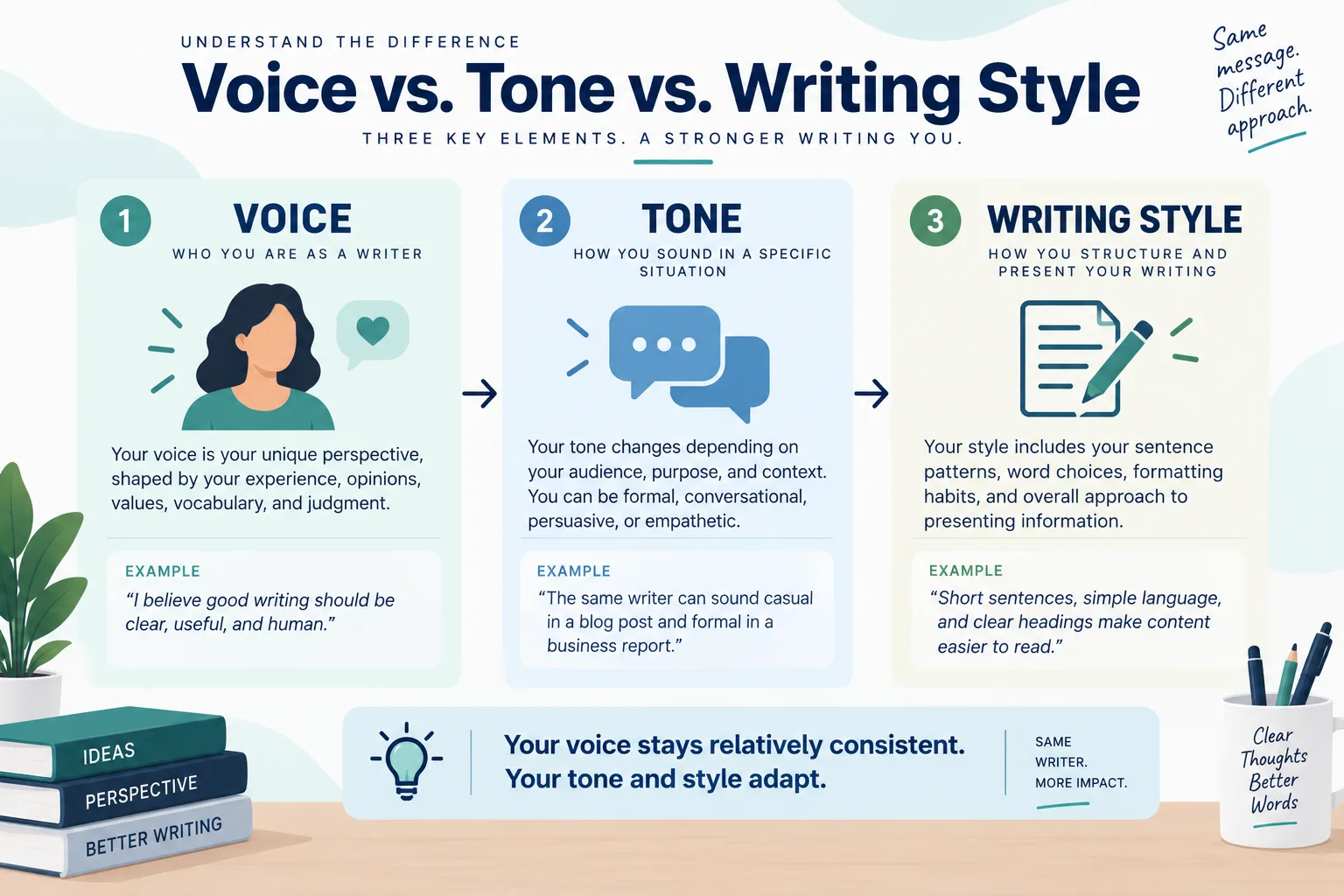
Voice is often confused with tone and writing style, but they are not the same thing.
Voice is your overall personality on the page. It tends to remain relatively consistent because it grows from how you think, what you notice, and how you naturally communicate.
Tone changes depending on the situation. You might use a serious tone for a technical guide and a conversational tone for a blog post while still sounding like the same writer.
Writing style refers more to the technical and creative choices you make. This can include sentence length, word choice, formatting, pacing, and how you structure information.
Here is a simple example. Imagine three professional writers explaining the same idea: why businesses should update old blog content.
Writer A might write:
Updating old content helps businesses maintain accurate information and improve their search engine performance.
Writer B might write:
Most businesses focus so heavily on publishing new content that they forget about the articles already bringing them traffic. That can be an expensive mistake.
Writer C might write:
Before you publish another blog post, look at what is already sitting on your website. Some of your best opportunities may already be there.
All three writers communicate a similar idea. However, each approaches it differently.
The first writer is direct and instructional. The second uses contrast and introduces a consequence. The third speaks directly to the reader and creates a conversational transition into the topic.
That difference is part of writing voice.
A professional writer's voice develops over time. It is shaped by experience, successful and unsuccessful projects, subjects they have studied, clients they have worked with, and opinions they have formed.
For example, one writer may naturally start articles by identifying a practical problem. Another may prefer opening with an observation that challenges a common assumption. One writer might explain complex ideas through simple comparisons, while another relies on step-by-step examples.
Vocabulary also plays a role. So does sentence rhythm.
One writer may prefer short, direct sentences:
The problem is not the tool. The problem is how you use it.
Another might naturally write:
AI itself is not the problem for professional writers, but relying on it without understanding where its role should end can gradually affect the way they approach their work.
Neither approach is automatically better. They simply reflect different writing preferences and communication habits.
Professional judgment may matter most. Two writers can receive the same brief, research the same topic, and use the same AI tool. They will still make different decisions about what information matters, what questions the reader needs answered, and which ideas deserve the most attention.
For instance, when writing about AI and professional writers, one writer might focus on productivity. Another might focus on job security. A third might argue that the biggest change is not AI replacing writers but AI changing what clients expect writers to do.
Those decisions come before the writing itself. They reflect perspective and judgment, which are important parts of what makes professional writing distinctive.
That is why a strong writing voice cannot be captured completely in a prompt or a list of stylistic instructions.
You can tell AI to use short paragraphs, avoid jargon, write conversationally, or follow a particular reading level. Those instructions may influence the surface of the writing. They cannot automatically reproduce the experience and judgment behind it.
Your voice is not just how you write.
It is also how you think.
This approach also aligns with Google's guidance on creating helpful, reliable, people-first content, which emphasizes original information, useful analysis, first-hand expertise, and content created primarily to help people.
From My Experience
After years of writing professionally, I have found that AI is most useful when it helps me think more critically about my work rather than when it tries to do the work for me.
I use AI to explore ideas, identify gaps, challenge assumptions, and review drafts from a different perspective. However, I do not rely on it to decide what I want to say or how I want to say it. Those decisions still depend on my understanding of the subject, the audience, and the purpose of the piece.
For me, the most productive relationship with AI is not writer versus machine. It is using the technology to strengthen my process while keeping my own judgment and voice at the center of the work.
The Problem Is Not AI. It Is How You Use It
AI does not automatically erase your writing voice.
The problem begins when you give the tool control over too much of the writing process.
There is a significant difference between using AI to help you work and allowing AI to make the decisions that shape your work. In the first case, AI supports the writer. In the second, the writer becomes an editor of machine-generated content.
That distinction matters.
Think about a calculator. Using one does not make you incapable of understanding numbers. However, you would not want to use a calculator to solve a problem you do not understand in the first place. You still need to know what you are calculating, why you are doing it, and whether the answer makes sense.
AI works in a similar way.
It can help writers research a topic, organize information, identify gaps, generate alternatives, or review a draft. Those tasks can save considerable time without requiring the writer to give up control of the central message.
Problems arise when the writer starts outsourcing the more important decisions.
What should this article say? What is the most interesting angle? Which information matters to the reader? What examples would make this clearer? What is my position on this subject?
Those decisions shape the final piece.
If AI makes all of them, the resulting article may be well organized and grammatically correct. It may even be useful. However, it is less likely to reflect anything distinctive about the writer behind it.
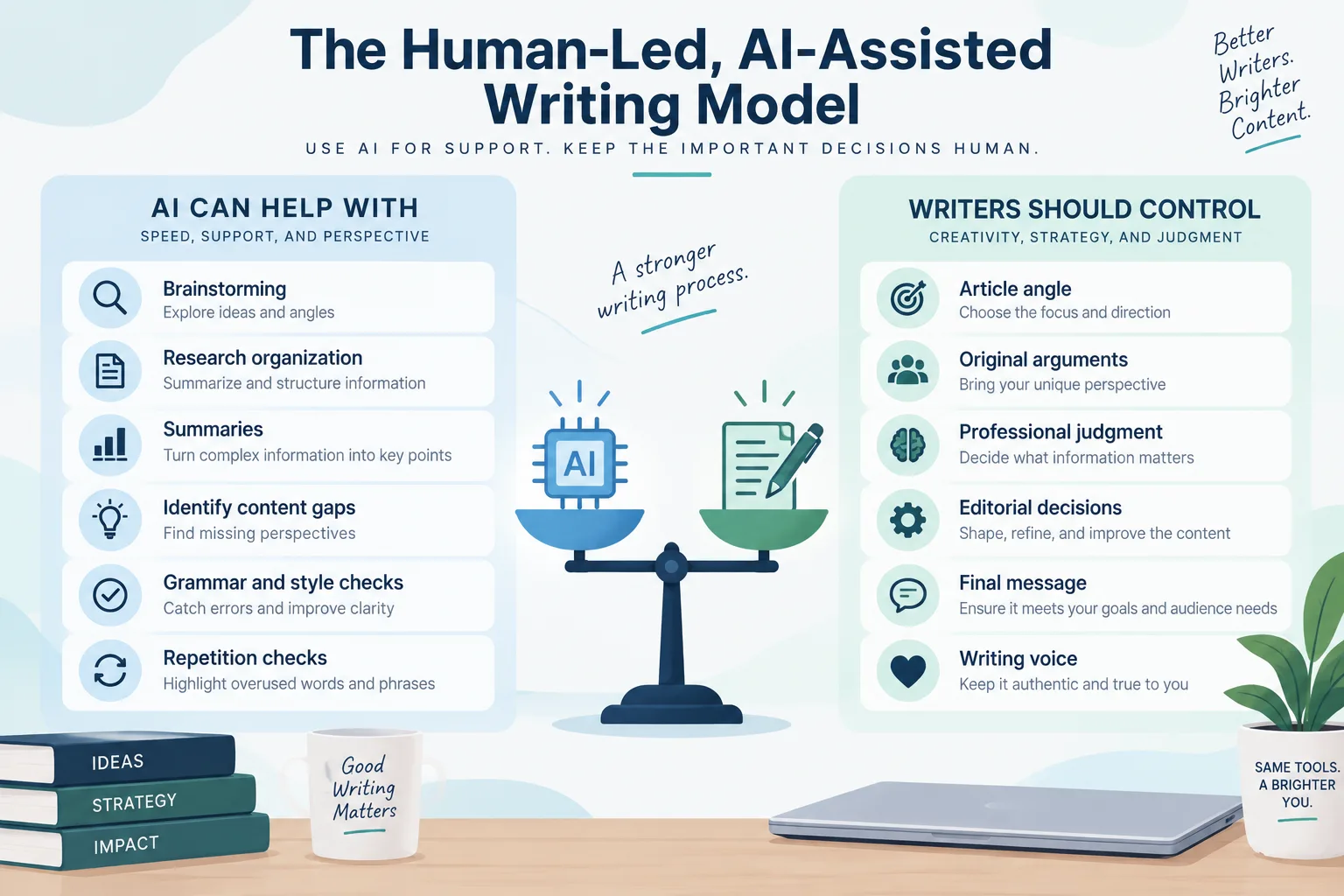
A better approach is human-led, AI-assisted writing.
The writer remains in charge of the assignment, strategy, ideas, judgment, and final message. AI supports specific parts of the process where it can save time or provide useful feedback.
This does not mean writers must avoid AI-generated text completely. It means they should decide how much of the process to delegate based on the importance of the task.
The final responsibility should always remain with the writer.
After all, your name, reputation, and professional relationship with the client are attached to the finished work, not the AI tool you used to help create it.
AI Assistance vs. AI Replacement
The easiest way to understand the difference is to look at how AI fits into the writing process.
AI assistance means using the tool to support your existing skills and decisions.
For example, you might ask AI to:
- Suggest questions readers may have about a topic.
- Help organize research notes.
- Identify gaps in an outline you created.
- Find repetitive ideas in your draft.
- Suggest clearer ways to explain a complex sentence.
- Challenge an argument or identify possible weaknesses.
In each case, you remain in control. You decide what to ask, what information matters, and whether the output is useful.
AI replacement, on the other hand, means asking the tool to handle most of the work:
Write a 2,000-word article about how professional writers can use AI.
The AI chooses the angle, structure, arguments, examples, wording, and often the conclusion. The writer then makes a few edits before publishing.
The result may save time. However, it also creates a greater risk of producing content that could have been generated for anyone.
Consider two approaches to the same assignment.
Approach One: AI Replaces the Process
A writer receives an assignment about AI and professional writing.
They enter the topic into an AI tool and ask for a complete article. The tool creates an outline, writes the introduction, develops the main arguments, and produces a conclusion.
The writer changes a few sentences, removes obvious errors, and publishes the article.
The finished piece may be readable. But the writer contributed very little beyond approving the output.
Approach Two: AI Supports the Process
Another writer starts by researching the topic and considering their own experience with AI. They identify the main concern they want to address: professional writers need to learn how to use AI, but they also need to protect the skills that make their work valuable.
The writer develops the central argument and creates an initial outline.
Then they use AI to identify questions they may have missed, challenge their assumptions, and review the structure. They write the article themselves and later use AI to check for repetition and unclear explanations.
Both writers used AI.
Only one kept control of the thinking behind the article.
This becomes more important as you delegate increasingly creative and strategic decisions.
Letting AI check your grammar carries little risk to your writing voice. Asking it to suggest alternative headlines gives it slightly more influence. Asking it to develop your entire content strategy gives it much more.
There is no universal rule about how much AI a writer should use. The important question is whether you are still responsible for the decisions that make the work yours.
The more you delegate your thinking, perspective, and creative judgment, the more likely your writing is to become generic.
AI should help you do your work better.
It should not quietly take over the parts that made your work valuable in the first place.
This distinction is also consistent with Google's guidance on AI-generated content, which focuses on the quality and usefulness of content rather than simply how it was produced.
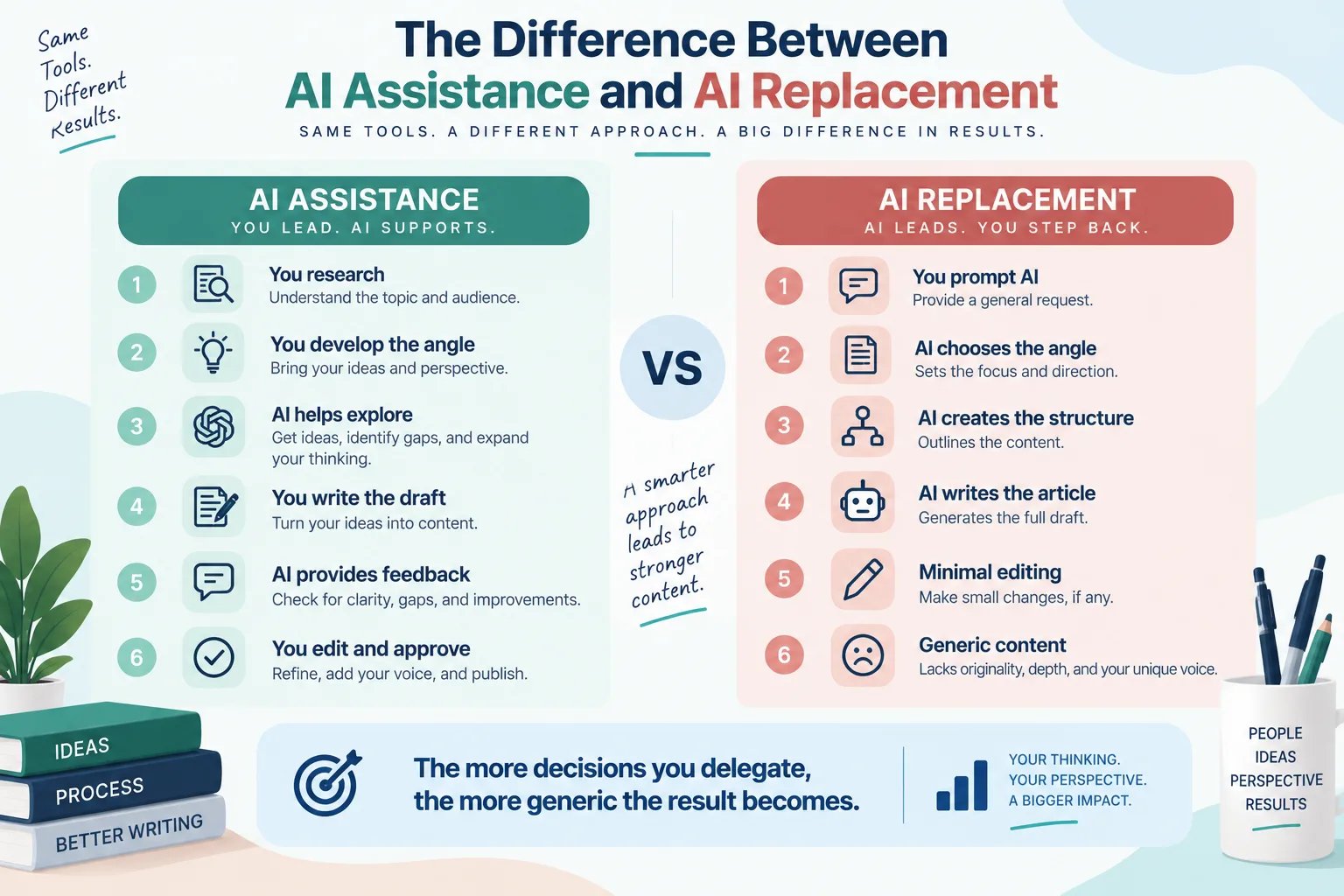
Good vs. Bad AI Use for Professional Writers
The difference is not whether you use AI. It is how much of the writing process and professional decision-making you hand over to it.
The pattern is simple: the more creative and strategic decisions you delegate to AI, the greater the risk of producing generic work.
A Practical AI-Use Framework for Professional Writers
When deciding whether to use AI for a particular task, ask one simple question:
Does this task require my unique experience, judgment, or perspective?
If the answer is yes, you should remain in control.
If the task is repetitive, administrative, analytical, or requires a second perspective, AI can probably help.
A useful framework is to divide your writing process into three levels.
Level 1: Let AI Handle the Support Work
These tasks have the lowest risk of affecting your writing voice.
Use AI to help with:
- Organizing research notes
- Summarizing long documents
- Generating topic questions
- Identifying content gaps
- Checking grammar and spelling
- Finding repetition
- Creating checklists
- Formatting information
- Reviewing readability
AI saves time here without making important creative decisions for you.
Level 2: Work With AI Collaboratively
These tasks require more involvement from both you and the tool.
Use AI as a thinking partner for:
- Brainstorming article angles
- Exploring different approaches
- Building on an outline
- Challenging your assumptions
- Identifying counterarguments
- Suggesting ways to improve clarity
- Reviewing the structure of a draft
However, do not accept the output automatically. Use it as input for your own decisions.
For example, instead of asking:
Write an outline about AI and professional writers.
You could ask:
Here is my outline and central argument. What important questions or perspectives might I be missing?
The second approach keeps you in control of the article while allowing AI to contribute useful feedback.
Level 3: Keep the Final Decisions Human
Some parts of professional writing should remain firmly under your control.
These include:
- Your main argument
- Your opinions and perspective
- Strategic decisions
- Personal experiences
- Original examples
- Client messaging
- Brand positioning
- Final editorial decisions
- Fact verification
These are the areas where your professional value matters most.
A simple way to remember the framework is:
Delegate the mechanical work. Collaborate on the analytical work. Own the creative and strategic work.
That approach allows you to benefit from AI without gradually handing over the parts of writing that make your work distinctive.
Start With Your Own Ideas Before Asking AI for Help
One of the easiest ways to lose control of your writing process is to begin every assignment with an AI prompt.
You receive a brief, open ChatGPT or another AI tool, and ask it what you should write.
It seems efficient. However, there is a problem.
The first ideas you see can influence everything that follows.
If AI gives you five article angles, a detailed outline, and a list of key points before you have spent time thinking about the assignment yourself, you may unconsciously start building your work around its interpretation of the topic.
That does not leave much room for your own perspective.
Professional writers should understand a subject before asking AI to explain it to them. This does not mean you need to become an expert before using AI. It means you should give yourself an opportunity to research, observe, question, and think independently before introducing another source of ideas.
Start with the assignment.
What does the client actually need? Who will read the finished piece? What problem does the content need to solve? What does the reader already know, and what do they need to understand?
Then research the topic. Read credible sources. Review your notes. Look at examples. Draw on previous experience. Write down questions and observations that stand out to you.
This process gives you something important: a starting point that belongs to you.
For example, imagine you are writing an article about AI and professional writers. If you immediately ask AI for an outline, you will probably receive a predictable structure covering productivity, writing tools, risks, and the future of writing.
Those topics may be relevant. But after researching and thinking about the issue yourself, you might notice something more interesting.
Perhaps the real concern is not whether AI can write well. Perhaps it is whether writers will gradually stop practicing the thinking skills that made them good writers in the first place.
That observation could become your central angle.
AI can still help. In fact, it may become more useful once you have developed your own ideas. You can ask it to identify gaps, challenge your argument, suggest alternative perspectives, or organize your research.
The difference is simple.
You are no longer asking AI what to think.
You are asking it to help you think more thoroughly.
Before using AI to develop content, it also helps to understand search intent so you know what the reader is actually trying to accomplish.
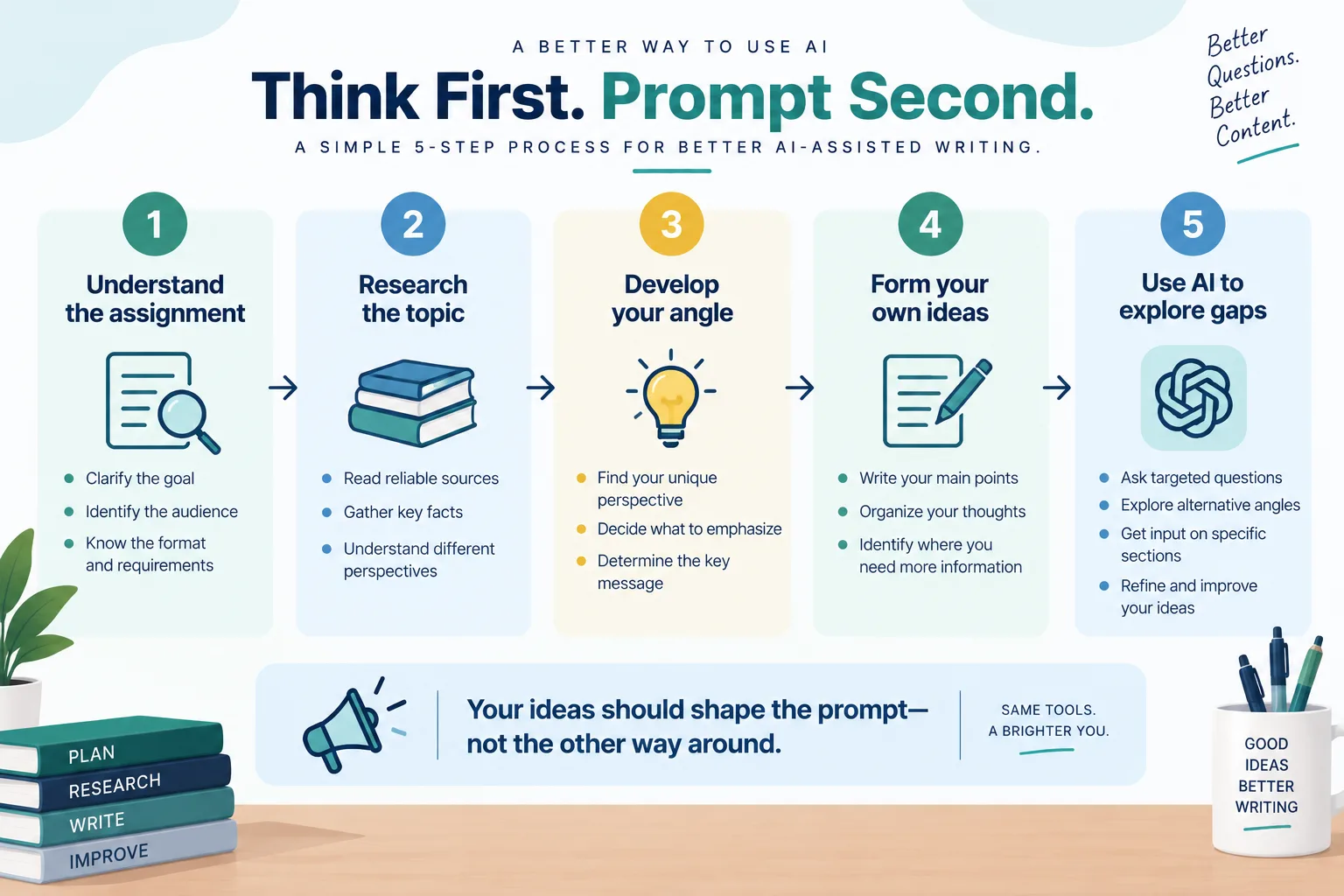
Think First, Prompt Second
A simple process can help you keep your ideas at the center of the writing process.
1. Understand the Assignment and Audience
Before researching or prompting AI, make sure you understand what you are trying to achieve.
Ask yourself:
- What is the purpose of this piece?
- Who is the reader?
- What problem are they trying to solve?
- What should they understand or do after reading it?
- What does the client expect from the content?
This gives you a clear direction before outside suggestions start influencing the project.
2. Research the Topic
Explore the subject using reliable sources and your own professional knowledge.
Take notes as you go. Pay attention to information that surprises you, challenges your assumptions, or connects with your previous experience.
Do not just collect facts. Look for patterns, disagreements, unanswered questions, and useful examples.
Those observations often lead to a stronger article than simply summarizing what everyone else has already said.
3. Identify Your Main Angle
Most topics can be approached in several ways.
An article about AI for writers could focus on productivity, career opportunities, ethical concerns, creativity, or writing quality. Your job is to decide which angle best serves the assignment and the reader.
Ask:
What is the most useful or interesting point I can make about this topic?
You do not need to have every section planned yet. However, identifying a central angle gives the article direction.
4. Develop Your Own Ideas and Opinions
Before asking AI for suggestions, spend time developing your initial thoughts.
Write down:
- Your main argument
- Important supporting points
- Questions you want to answer
- Examples you could include
- Opinions based on your experience
- Assumptions you want to challenge
This does not need to be polished. A page of rough notes is enough.
The goal is to ensure that your first contribution to the project comes from your own thinking.
5. Use AI to Explore Gaps or Alternative Perspectives
Now bring AI into the process.
You have research. You have notes. You have an initial angle.
Instead of asking AI to start from scratch, give it context.
For example:
I am writing an article for professional writers about using AI without losing their writing voice. My central argument is that writers should use AI for support and analysis while keeping creative and strategic decisions under human control. Here are my main points. What important perspectives or questions might I be missing?
This type of prompt produces a different relationship with AI.
You remain the person directing the work. AI becomes a tool for testing and expanding your thinking.
That is the real value of starting with your own ideas.
Your perspective gives the work direction. AI can then help you see what you may have missed.
For SEO-focused projects, that thinking should include understanding the topic and researching the terms your audience actually uses. My guide to keyword research for writers covers that process in more detail.
Use AI for the Parts of Writing That Do Not Require Your Unique Voice
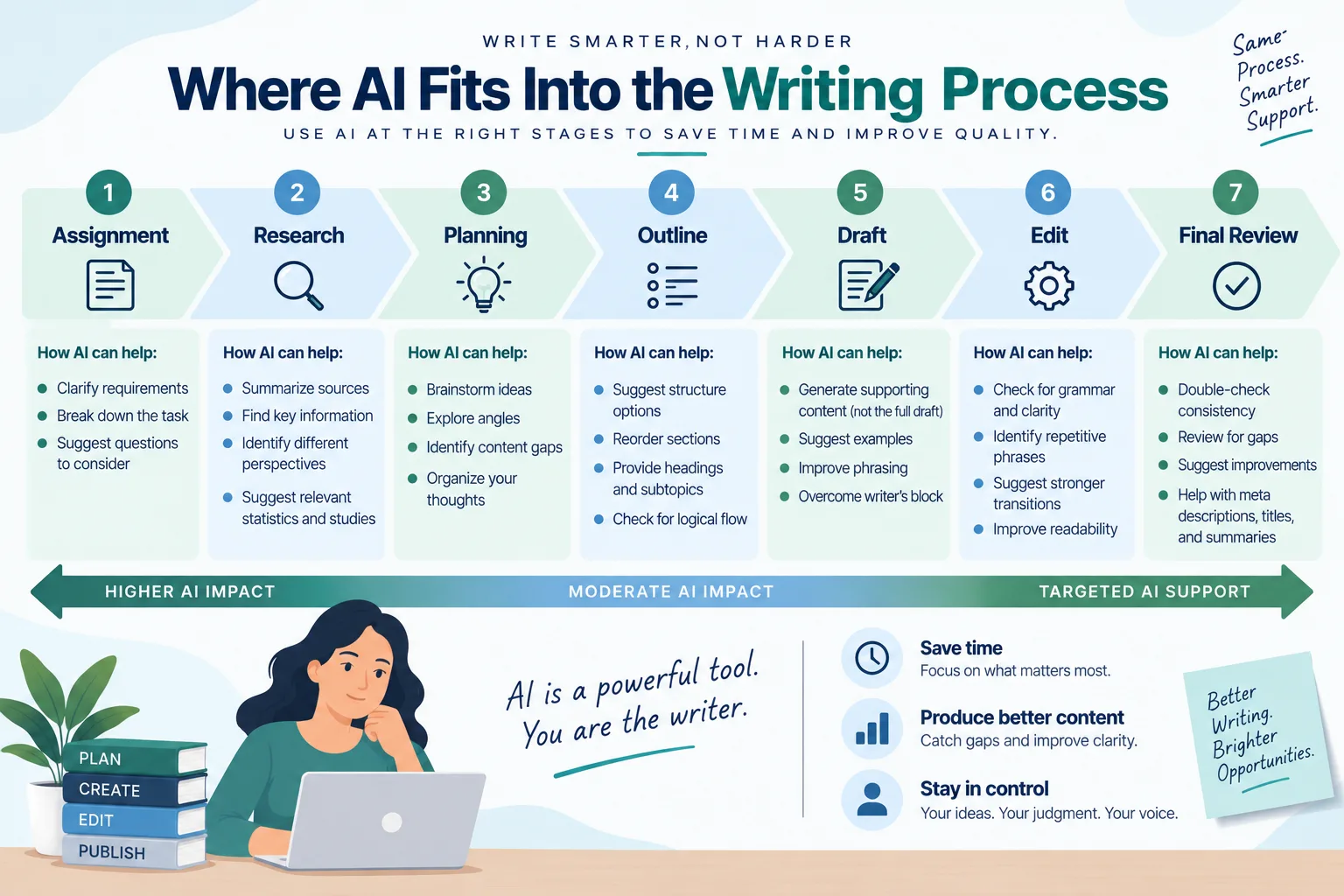
Not every part of the writing process requires the same level of creativity or personal judgment.
Professional writers also spend time organizing research, reviewing drafts, checking for errors, and handling other tasks that support the writing process. AI can make these tasks faster and easier.
Brainstorming Ideas
AI can help explore different angles, questions, and approaches when you need fresh ideas.
For example, if you are writing about AI and professional writers, you could ask:
What are five different angles for an article about how professional writers can use AI?
The suggestions may help you see possibilities you had not considered.
Organizing Research
Long-form content often involves notes from multiple sources, interviews, reports, and articles.
AI can help group related information, identify common themes, and organize notes into categories. This makes large amounts of research easier to work with.
Creating Initial Outlines
Once you have collected your ideas and research, AI can help organize them into a logical structure.
You can provide your notes and ask AI to group related points, suggest a sequence, or identify sections that overlap.
This can speed up the planning stage, particularly for longer articles.
Summarizing Information
Professional writers often work with lengthy reports, research papers, transcripts, and other source materials.
AI can summarize long documents and highlight key points, helping you identify information worth exploring further.
This is particularly useful when you need to review a large volume of material in limited time.
Generating Questions
AI can generate questions that readers may have about a topic.
These questions can help with article planning, research, and identifying areas that need clearer explanations.
For example:
What questions might a freelance writer have about using AI in their writing workflow?
The answers may reveal concerns or angles worth addressing.
Identifying Content Gaps
Once you have an outline or draft, AI can help identify missing information.
Ask it to review the content and highlight questions that remain unanswered or topics that need further explanation.
This can be useful for making sure a comprehensive article does not overlook important reader concerns.
Checking for Repetition
Repetition is easy to miss in long articles.
AI can scan a draft and identify similar ideas, repeated phrases, or sections that cover the same ground. This can speed up editing and help tighten the final piece.
Improving Readability
AI can identify sentences that may be difficult to understand, overly long paragraphs, or sections that need clearer explanations.
Rather than asking it to rewrite everything, ask for specific feedback on readability issues.
For example:
Identify sentences in this draft that may confuse a general audience and explain why.
Finding Grammatical Errors
AI can catch spelling mistakes, grammatical errors, and punctuation issues that are easy to overlook.
It can also provide a useful final review after you have spent hours working on the same draft.
Use the Time You Save for Higher-Value Work
The greatest benefit of AI is not simply producing more words in less time.
It is creating more time for the work that often gets rushed when deadlines are tight.
You can use that time to:
- Research a subject more deeply
- Interview experts
- Find better examples
- Develop a stronger angle
- Improve your argument
- Edit more carefully
- Add original insights
AI can reduce friction throughout the writing process. Used well, it gives professional writers more time to focus on the parts of their work that require deeper thinking, experience, and creativity.
AI can also help you review routine SEO elements, but writers still need to understand how those elements work. See my guide to on-page SEO for writers for the fundamentals.
Keep Control of the Creative and Strategic Decisions
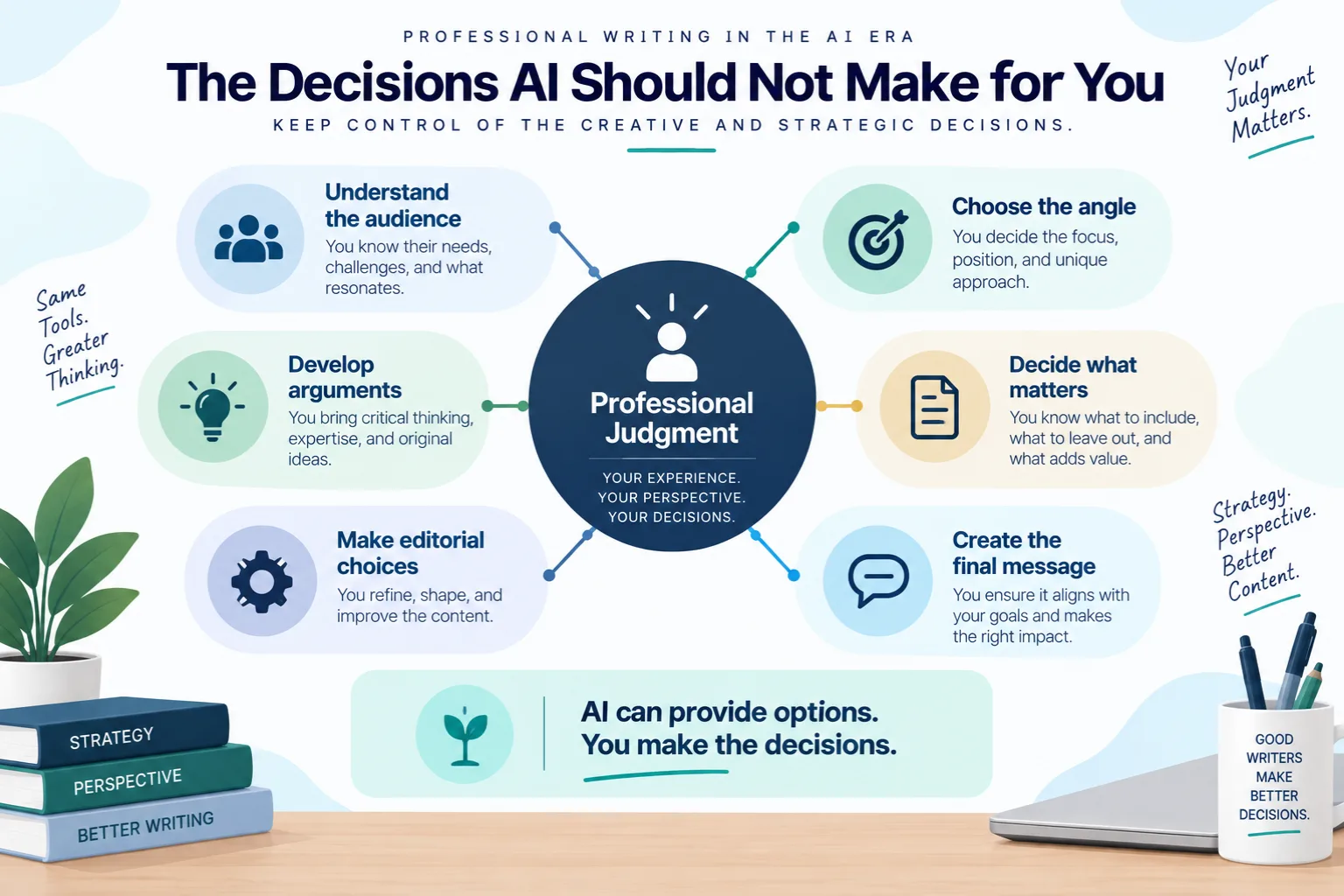
AI can organize information, recognize patterns, and generate plausible responses in seconds. However, some parts of professional writing depend on something more difficult to automate: judgment.
Writing is a series of decisions.
You decide who the reader is and what they need. You choose which angle will make the topic relevant. You determine which information deserves attention and which details will only distract from the main point.
AI can contribute to these decisions. It can provide options and surface possibilities you may not have considered. But it cannot take responsibility for whether those decisions are right for a particular client, audience, or situation.
Several parts of the writing process should therefore remain primarily human.
Understanding the Audience
AI can help generate audience profiles or suggest common questions. However, understanding a real audience requires context.
An experienced writer learns what concerns clients' customers raise, which language they use, what they already know, and where they need more explanation. That understanding often comes from research, conversations, previous projects, and direct experience.
Choosing the Article Angle
Most topics can support dozens of different articles.
The challenge is deciding which angle will be most useful for a specific audience at a specific moment.
An article about AI for writers could focus on productivity, job security, creativity, ethics, or professional development. AI can suggest all of these. Choosing the right one requires an understanding of the assignment and the reader.
Developing Original Arguments
AI can generate arguments based on patterns in the information it has learned from. Original arguments require writers to connect ideas, challenge assumptions, and reach their own conclusions.
This does not mean every article needs a groundbreaking opinion. Even a practical guide benefits from a clear perspective that gives the information direction.
Adding Professional Insight
Experience changes how writers approach a topic.
A writer who has spent years working with clients, testing writing processes, or solving specific problems can recognize details that someone without that experience might overlook.
Those insights can make an article more useful because they move beyond general advice.
Making Editorial Decisions
Good writing often depends as much on what you remove as what you include.
Should this section be shorter? Does the example actually help? Is this point necessary? Have you explained the idea clearly enough?
AI can identify potential problems, but editorial decisions require a sense of the overall piece and its intended outcome.
Deciding What Information Matters
More information does not automatically create better content.
Professional writers filter information. They decide what the reader needs to know, what can be left out, and what deserves further explanation.
That ability to prioritize is particularly valuable when AI can generate almost unlimited amounts of information.
Creating the Final Message
The final message brings everything together.
It reflects the article's purpose, the audience's needs, the writer's perspective, and the desired outcome. It is the conclusion the reader should leave with after everything else has been considered.
AI can help refine that message. However, deciding what you ultimately want to say remains one of the writer's most important responsibilities.
Your Judgment Is Part of What Clients Pay For
Professional writers provide more than words.
A client can already find thousands of words on almost any subject. What they need is someone who can turn information into communication that serves a specific purpose.
That requires experience and decision-making.
Consider two writers working from the same client brief. Both have access to the same research and AI tools. They may still produce completely different articles because they make different decisions throughout the process.
One may identify the wrong audience problem. Another may choose a stronger angle. One may include every available piece of information, while another knows which details to remove. One may follow the brief literally, while another recognizes an opportunity the client had not considered.
Those differences affect the final result.
This is why professional judgment has value. Clients hire writers to interpret a brief, understand an audience, solve communication problems, and make informed decisions throughout the project.
AI can process information quickly. It can suggest options, identify patterns, and generate alternatives.
It cannot take responsibility for the finished work.
The writer still has to decide whether the article achieves its purpose, whether the message is right for the audience, and whether the final piece is good enough to put their name behind.
That responsibility is not separate from professional writing.
It is part of the job.
Use AI as a Research Assistant, Not an Author
One of the most useful ways professional writers can use AI is during research.
Research often involves more than finding information. You also need to understand the topic, identify unanswered questions, explore different perspectives, and decide what deserves further investigation.
AI can help with that exploratory work.
For example, once you have researched a topic and developed an initial direction, you can ask AI to look for gaps in your thinking. It can suggest questions you have not considered, identify related subtopics, or present arguments that challenge your position.
This can be particularly useful when writing about a complex or unfamiliar subject.
Suppose you are preparing an article about remote work. You may already plan to cover productivity, communication, and employee management. AI could suggest related issues such as legal compliance, employee isolation, cybersecurity, or career development.
That does not mean every suggestion belongs in your article. However, it gives you additional areas to consider before deciding what to research further.
AI can also help challenge your assumptions.
Writers sometimes become attached to their initial angle or argument. Asking AI to present opposing viewpoints can reveal weaknesses in your reasoning or highlight perspectives your article should acknowledge.
For example, if your article argues that AI improves writer productivity, you could ask:
What are the strongest arguments against the idea that AI makes professional writers more productive?
The answer may reveal issues such as editing time, fact-checking requirements, dependency, or declining content quality. You can then decide whether those arguments strengthen, weaken, or add necessary nuance to your article.
This makes AI useful as a research companion because it can help you ask better questions.
However, there is an important distinction between using AI to identify what you should investigate and treating its answers as verified research.
AI-generated information can contain errors, outdated information, incomplete context, or fabricated sources. Even when an answer sounds convincing, that does not make it accurate.
Use AI to help you find questions.
Use reliable sources to find answers.
If AI provides a fact, statistic, study, quote, or source, verify it independently before including it in your work. Check the original source rather than relying on AI's summary or interpretation.
The same principle applies to research recommendations. If AI identifies an important trend or perspective, investigate it yourself before treating it as evidence.
AI can make the research process faster.
It should not become your only source of information.
Useful Questions to Ask AI During Research
The quality of your research often depends on the questions you ask. AI can help you explore a topic more thoroughly by identifying questions and perspectives you may have missed.
Here are several useful prompts.
What Questions Might My Audience Have About This Topic?
This can help you identify the practical concerns readers want answered.
For example:
What questions might professional writers have about using AI without losing their writing voice?
The results can help you identify concerns worth researching or addressing in the article.
What Important Subtopics Could I Be Missing?
Use this question after developing an initial outline or list of ideas.
For example:
I am writing an article about AI and professional writers. I plan to cover writing voice, productivity, AI dependency, editing, and research. What important subtopics could I be missing?
This can reveal gaps without requiring AI to create the entire structure for you.
What Arguments Challenge My Main Position?
Every strong argument benefits from scrutiny.
Ask AI to challenge your position and identify reasonable objections. This can help you avoid one-sided content and develop a more balanced perspective.
Which Concepts Need Clearer Explanations?
If you are writing about a technical or complex subject, AI can help identify concepts that may confuse readers.
Provide your outline or draft and ask:
Which concepts in this article may require additional explanation for a beginner?
This can help you identify areas where readers may need more context.
Where Might a Beginner Become Confused?
Experienced writers and subject matter experts often assume readers understand more than they actually do.
AI can review a draft from the perspective of someone unfamiliar with the topic and identify potential points of confusion.
This is particularly useful when writing for beginners or explaining complex subjects in simple language.
Used this way, AI does not replace research.
It helps you approach research with more questions, perspectives, and awareness of what you may not know.
How to Verify AI-Generated Information
When AI gives you information you may want to use in an article, do not treat the response itself as a source.
Treat it as a lead.
For example, AI might tell you:
A recent study found that 75% of marketers use generative AI for content creation.
Before using that statistic, you need to find out:
- Which study produced the statistic?
- Who conducted it?
- When was it published?
- What exactly did researchers ask?
- Who participated in the study?
- Does the original source actually support the claim?
Do not simply ask the AI to confirm its own answer. Asking the same tool, or another AI tool, whether a fact is correct does not count as verification.
Instead, use the information AI gives you to locate the original source.
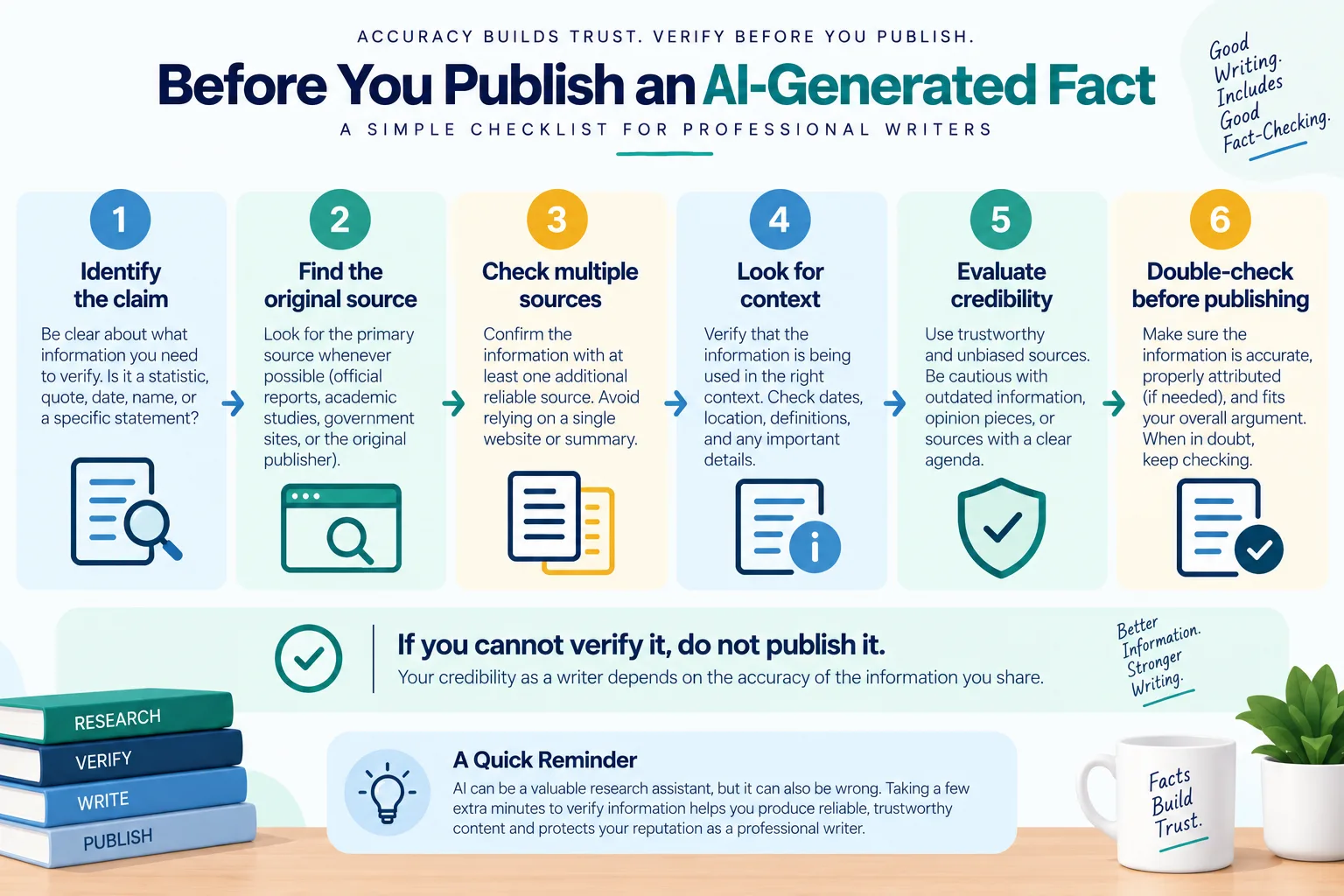
A practical verification process looks like this:
1. Identify the Exact Claim
Break the AI response into individual claims that need verification.
These may include:
- Statistics
- Dates
- Names
- Quotes
- Research findings
- Historical events
- Legal or regulatory information
- Product features
- Industry trends
Specific claims are easier to verify than an entire AI-generated paragraph.
2. Find the Original Source
Search for the primary source whenever possible.
For example:
- Find the original research paper rather than an article summarizing it.
- Check a government website for laws and regulations.
- Read the company's official documentation for product information.
- Locate the original interview before quoting someone.
- Find the original report behind a statistic.
Secondary sources can help provide context, but the original source gives you the strongest basis for verification.
3. Check Whether the Source Actually Supports the Claim
Finding a source with a similar statistic is not enough.
Read the relevant section and compare it with the AI-generated claim.
Check whether:
- The numbers match.
- The date is correct.
- The context is the same.
- The conclusion has not been exaggerated.
- Important qualifications have not been removed.
AI can take accurate information and present it in a misleading way by removing context.
4. Verify Important Claims With More Than One Source
For significant or controversial claims, look for confirmation from additional credible sources.
This is particularly important when writing about:
- Health
- Finance
- Law
- Technology
- Politics
- Scientific research
Multiple reliable sources can help you identify disagreements, outdated information, or claims that require more nuance.
5. Remove Anything You Cannot Verify
If you cannot find a reliable source supporting the information, do not include it as fact.
You may be able to research the topic further or replace the unsupported claim with verified information.
The simplest rule is:
If you cannot verify it, you cannot confidently publish it.
AI can help professional writers discover information faster and identify useful research directions. However, the responsibility for accuracy remains with the person whose name appears on the finished work.
That is why AI works best at the beginning of the research trail, not at the end of it.
The need for verification is not just a writing preference. The NIST Generative AI Risk Management Profile identifies risks associated with generative AI, including the possibility of confidently presented false or misleading information.
When You Should Not Use AI
AI can be useful throughout the writing process, but it is not the right tool for every situation. In some cases, using it can create unnecessary risks or simply add another step to a task you could complete yourself.
Consider avoiding AI when:
- You are working with confidential client information.
- You are handling unpublished proprietary research or sensitive internal documents.
- You need to make decisions that require specialist expertise you cannot independently evaluate.
- You are writing highly personal first-person content where the experience and expression need to come directly from you.
- You are relying on information that cannot be independently verified.
- The task is simple enough to complete faster yourself without involving AI.
Using AI effectively also means knowing when not to use it. The best workflow is not the one that automates the most tasks. It is the one that helps you do better work without creating unnecessary risks or complexity.
Let AI Help You Edit Your Work Instead of Writing It for You
Writing and editing require different skills.
When you write a first draft, you are developing ideas, making arguments, and deciding how to communicate with the reader. Editing gives you distance from those decisions and helps you see problems you may have missed while writing.
That is one reason AI can be particularly useful during the editing stage.
After spending hours working on an article, it becomes difficult to see your own mistakes. You know what you intended to say, so unclear sentences may seem perfectly understandable. You may also miss repeated ideas, weak transitions, or gaps in your explanation because you already understand the subject.
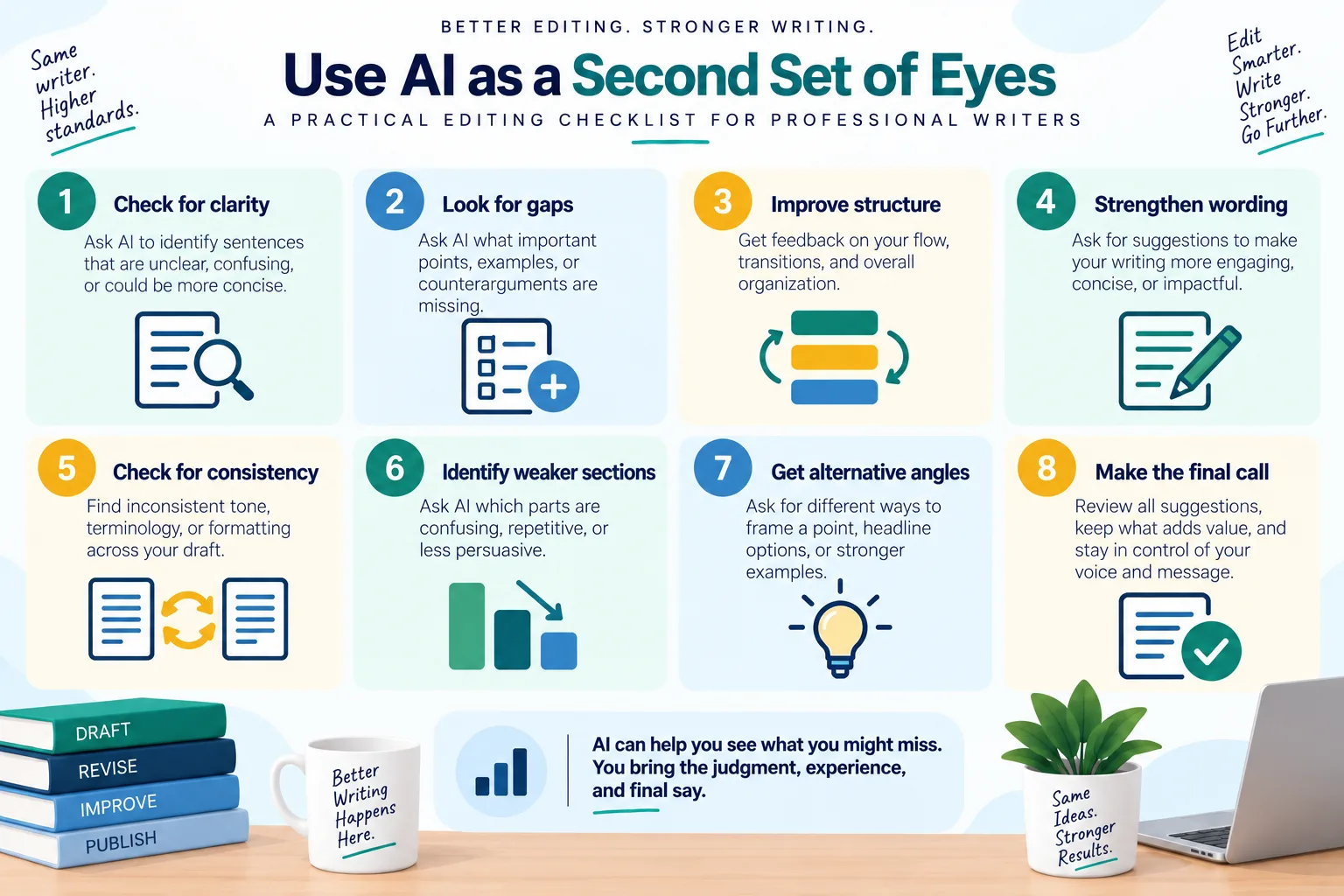
AI can provide a second set of eyes.
You can use it to review a finished draft and identify potential weaknesses, including:
- Repetitive phrases or ideas
- Unclear or awkward sentences
- Weak transitions between sections
- Overly complex language
- Missing explanations
- Gaps in logic
- Inconsistent tone
This type of feedback can be valuable because it directs your attention to problems you may not have noticed yourself.
However, identifying a problem and deciding how to fix it are two different things.
AI may correctly identify that a paragraph feels repetitive while suggesting a rewrite that sounds nothing like the rest of your article. It may recommend simplifying a sentence that needs nuance. It may flag an intentional stylistic choice as inconsistent.
That is why editing with AI works best when you treat its feedback as feedback rather than instructions.
Ask the tool to identify potential problems. Review its reasoning. Then decide whether a change is necessary and how you want to make it.
Ask AI to Critique Your Draft
Many writers use AI editing tools by pasting in a paragraph and asking:
Rewrite this to make it better.
That approach may produce cleaner writing, but it also gives AI considerable influence over the final text.
A critique-based approach can be more useful.
Instead of asking AI to rewrite your work, ask it to explain what it sees.
For example:
Review this section for clarity. Identify any sentences that may confuse the reader and explain why.
Or:
Analyze the transitions between these paragraphs. Where does the logical flow feel weak?
Or:
Identify repeated ideas in this draft. Do not rewrite anything. Explain where the repetition occurs and whether it weakens the article.
These prompts give you specific feedback while preserving the original draft.
You can also ask AI to take on different editorial roles depending on what you need.
For example:
- Review this article as a first-time reader. What questions remain unanswered?
- Review this section for logical gaps or unsupported conclusions.
- Identify places where the language is more complicated than necessary.
- Check whether the tone remains consistent throughout the article.
- Find paragraphs that repeat information already covered elsewhere.
The goal is not to accept every criticism automatically. AI may identify something that is not actually a problem or miss the reason you made a particular choice.
Instead, use its feedback to ask yourself better questions.
Is this sentence really unclear?
Does this transition need work?
Have I explained this concept well enough for the intended reader?
Is this repetition unnecessary, or does it reinforce an important point?
This approach turns AI into a useful editorial assistant.
It helps you see your work from another perspective without taking over the editing process. And because you make the final changes yourself, the finished article is more likely to retain the voice and choices that made it yours in the first place.
Build Your Own AI Writing Workflow
There is no single AI workflow that works for every professional writer.
The way you use AI should depend on the type of work you do, the skills you already have, and the parts of your process that take the most time.
A copywriter may use AI to generate alternative headline ideas or identify objections a potential customer might have. An SEO writer may use it to organize keyword research, identify content gaps, or analyze search intent. A technical writer may use AI to simplify complex concepts or check whether instructions are clear enough for beginners.
The same tool can serve different purposes depending on the writer.
Your weaknesses matter too. If you struggle to organize large amounts of research, AI may be most useful during the planning stage. If you tend to repeat yourself in long articles, you may get more value from using it as an editing tool. If brainstorming slows you down, AI can help you explore different possibilities before you start writing.
This is why copying another writer's AI workflow rarely makes sense.
A workflow that saves one writer three hours may add unnecessary steps to someone else's process. The goal is not to use AI at every possible stage. It is to find the points where it genuinely improves your work.
Start small.
Experiment with AI during one part of your writing process. Pay attention to whether it saves time, improves the result, or creates more work through fact-checking and editing. Keep the uses that provide real value and remove the ones that do not.
Over time, you can build a workflow that supports the way you already work rather than forcing yourself to adapt to someone else's system.
A Simple AI Workflow for Professional Writers
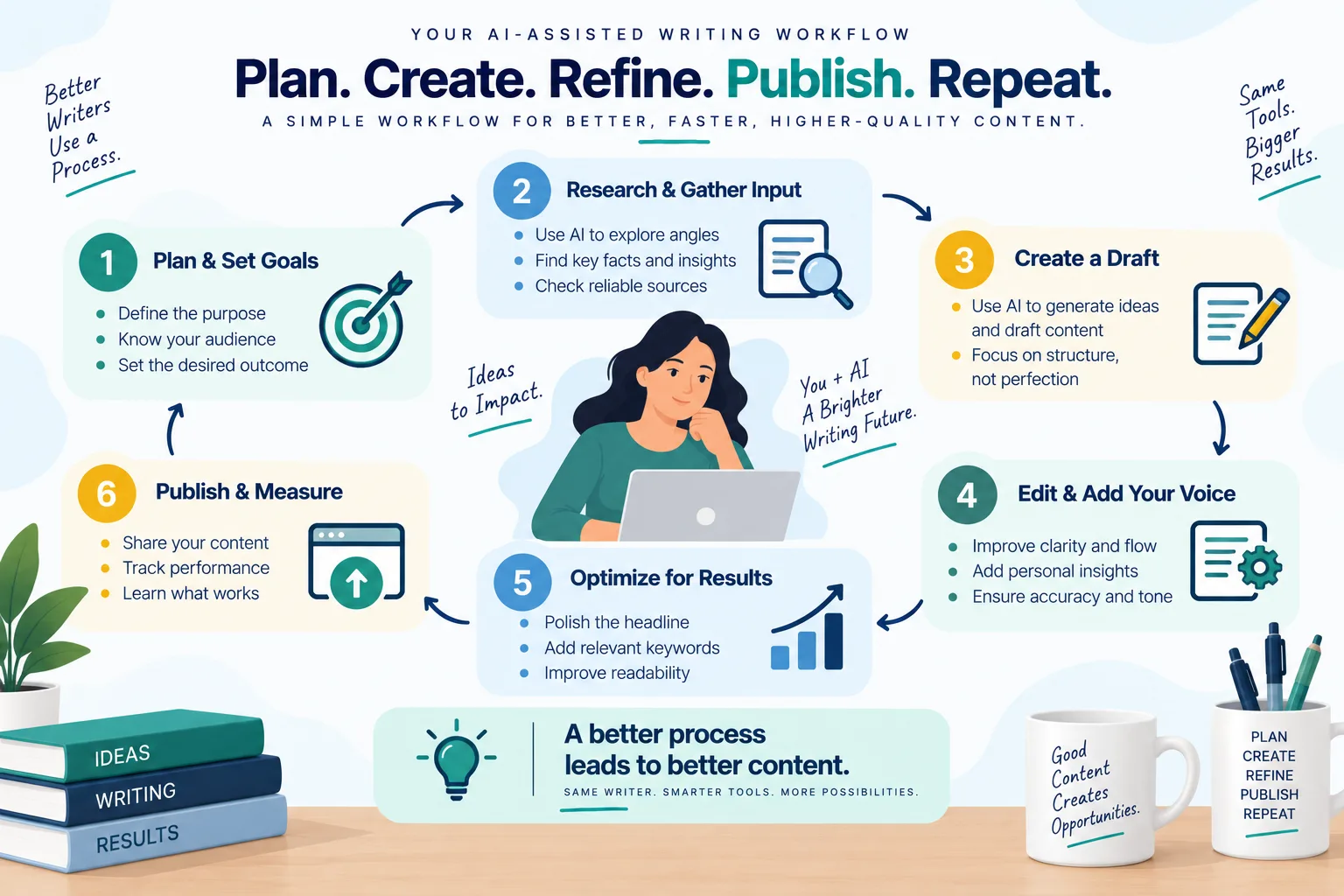
The following workflow provides a starting point. You can adapt it based on the type of writing you do and where AI provides the most value.
1. Receive and Understand the Assignment
Start by understanding the purpose of the project, the target audience, the client's expectations, and the desired outcome.
Do this before involving AI. A clear understanding of the assignment gives the entire process direction.
2. Research Independently
Explore the topic using reliable sources, your professional knowledge, and relevant first-hand information.
Take notes, collect useful examples, and identify questions that need answers.
3. Develop the Main Angle
Decide what the piece should focus on.
Identify the central argument, key message, or primary problem the content needs to address. This gives the article a clear direction before you begin organizing the details.
4. Use AI to Explore Gaps and Organize Ideas
Once you have research and an initial direction, use AI to help identify missing questions, alternative perspectives, or gaps in your thinking.
You can also use it to organize research notes and group related ideas.
5. Create the Outline
Build the structure for the piece based on your research, angle, and the needs of the reader.
At this stage, you should know what each section needs to accomplish before you begin writing.
6. Write the Draft
Write the first draft.
Focus on developing the ideas, explaining the information clearly, and creating a logical flow from one section to the next.
You do not need to use AI at this stage unless it serves a specific purpose.
7. Use AI to Review Specific Elements
After completing the draft, use AI to review individual aspects of the work.
For example, ask it to check for:
- Repetition
- Unclear explanations
- Logical gaps
- Weak transitions
- Inconsistent tone
- Overly complex language
Specific review requests usually produce more useful feedback than asking AI to review the entire article without clear criteria.
8. Edit the Work Yourself
Review the feedback and make the necessary changes.
You may agree with some suggestions and reject others. Edit the article based on your understanding of the audience, purpose, and overall message.
9. Verify Facts and Make Final Decisions
Before publishing or submitting the work, verify factual claims, statistics, quotes, and sources.
Then review the finished piece as a whole.
Does it achieve its purpose? Does it answer the reader's questions? Does the structure make sense? Does the final message reflect what you intended to communicate?
Your workflow may look different from this one.
That is the point.
Use this process as a starting framework, then adjust it until AI fits naturally into the way you work.
Give AI Context Instead of Expecting It to Read Your Mind
The quality of AI output often depends on the quality of the information you provide.
A vague prompt gives AI very little to work with. If you ask:
Write an article about AI for writers.
AI has to make several assumptions. Who is the audience? What does the reader already know? What is the purpose of the article? Should it be practical, persuasive, technical, or conversational?
Those missing details often lead to generic output.
Now compare that with:
Help me develop an article for professional writers who already have experience using AI. The goal is to show them how to use AI more effectively without losing their writing voice. The article should be practical and conversational, written for an audience with intermediate knowledge of AI writing tools.
The second prompt gives AI a clearer job.
It does not need to guess who you are writing for or what you want to achieve. As a result, its suggestions are more likely to be relevant.
Context matters because AI cannot read your mind.
It does not automatically know your client, your audience, your previous research, or the purpose behind a particular piece of content. If that information affects the quality of the task, you need to provide it.
This is one reason good prompting is less about finding the perfect command and more about communicating clearly.
Think about assigning work to a human assistant. You would not simply say, "Research this topic," and expect perfect results without explaining what you need. You would provide background information, define the goal, and explain any relevant requirements.
AI works in much the same way.
The more relevant context you provide, the less AI has to rely on assumptions.
What Context Should Writers Give AI?
You do not need to write a long briefing document for every prompt. However, when the quality of the output matters, certain information can help AI provide more useful assistance.
Target Audience
Explain who the content is for.
Include relevant details such as their role, interests, problems, or level of experience.
For example:
The audience consists of professional freelance writers with several years of experience.
This gives AI a very different starting point than simply asking it to write for "writers."
Purpose of the Content
Explain what the content needs to accomplish.
Are you trying to inform, persuade, educate, generate leads, or help readers solve a specific problem?
For example:
The purpose of this article is to help experienced writers develop a practical approach to using AI without becoming dependent on it.
A clear purpose helps AI evaluate whether its suggestions support the intended outcome.
Reader's Level of Knowledge
Tell AI what the reader already understands about the topic.
A beginner may need basic concepts explained. An experienced audience may find those explanations unnecessary.
For example:
Assume the reader already understands what generative AI is and has used tools such as ChatGPT.
This helps prevent AI from filling the content with introductory information your audience does not need.
Desired Outcome
Explain what you want the reader to think, understand, or do after engaging with the content.
For example:
By the end of the article, readers should understand which parts of their workflow they can delegate to AI and which decisions they should continue making themselves.
This gives the AI a clearer sense of direction.
Brand Requirements
If you are writing for a client, provide relevant brand guidelines.
This might include:
- Topics to avoid
- Preferred terminology
- Required messages
- Brand values
- Editorial standards
- Formatting requirements
Without this information, AI cannot account for requirements it does not know exist.
Tone
Describe how the content should sound.
Avoid vague instructions such as "make it engaging" when you can be more specific.
For example:
Use a professional but conversational tone. Keep the language clear and practical. Avoid jargon and exaggerated claims.
Specific guidance gives AI a better understanding of the communication style you need.
Important Background Information
Provide any information that affects the task.
This could include:
- Previous research
- The client's position on the topic
- Industry developments
- The main argument you want to make
- Information already covered elsewhere
- Constraints or requirements
The more relevant background AI has, the less likely it is to make incorrect assumptions.
Examples of Relevant Writing
Examples can help when you want AI to understand the type of content you are creating.
You might provide:
- A previous article
- A section of approved client content
- An example of the desired structure
- A sample that demonstrates the appropriate tone
However, examples should provide guidance rather than become a substitute for your own writing decisions.
Better Context Produces Better Assistance
Giving AI more context does not guarantee perfect output.
It does, however, improve the starting point.
A vague prompt forces AI to fill in the gaps with assumptions. A well-contextualized prompt reduces those assumptions and makes its response more relevant to the actual task.
Before asking AI for help, consider what information you would give a capable human assistant.
That is often the context AI needs as well.
A Reusable AI Context Prompt Template
You do not need to explain everything from scratch every time you use AI.
Create a simple context template and adapt it for different assignments.
Use this framework:
Context: I am working on [describe the project or task].
Audience: The content is for [describe the target audience].
Audience knowledge: The reader has [beginner/intermediate/advanced] knowledge of [topic].
Purpose: The goal is to [inform, educate, persuade, solve a problem, or describe another goal].
Desired outcome: After reading this content, the audience should [describe what they should understand, believe, or do].
Main angle: The central idea or argument is [describe your main perspective].
Tone: Use a [describe tone] tone.
Brand or client requirements: [Include relevant terminology, messages, restrictions, or style requirements].
Background information: [Add research, notes, previous decisions, or other relevant context].
Examples: [Include links, excerpts, or descriptions of relevant writing if useful].
Task: [Explain exactly what you want AI to do].
For example, you could adapt the template for an article assignment like this:
Context: I am writing a long-form article about how professional writers can use AI without losing their writing voice.
Audience: Professional freelance writers and content writers.
Audience knowledge: Intermediate. They already understand generative AI and have used AI writing tools.
Purpose: Educate readers and provide practical guidance.
Desired outcome: Readers should understand how to integrate AI into their workflow while keeping control of creative and strategic decisions.
Main angle: AI should support professional writers rather than replace their thinking and judgment.
Tone: Professional, conversational, practical, and clear. Avoid hype and exaggerated claims.
Background information: The article focuses on practical AI use throughout the writing process, including research, outlining, editing, and fact-checking.
Task: Review my outline and identify important reader questions or perspectives that may be missing.
Save a version of this template somewhere accessible. Then adjust the details for each new project.
You will not need every section for every prompt. A simple grammar check does not require a detailed brief. However, for complex tasks such as research, outlining, content analysis, or strategic feedback, providing context can significantly improve the usefulness of AI's response.
The template also has another benefit: it forces you to clarify the assignment before you ask AI for help.
Sometimes the problem is not that AI needs more context.
It is that you have not yet defined the task clearly enough yourself.
Do Not Try to Make AI Copy Your Voice Perfectly
As AI writing tools have become more advanced, many writers have started training them on samples of their own work.
The process is straightforward. You upload previous articles, blog posts, or other writing samples and ask AI to analyze your voice. Some writers then create detailed prompts or custom instructions designed to make future output sound like them.
Style analysis can be useful.
AI can identify patterns you may not notice yourself. It may recognize that you prefer short paragraphs, use direct language, ask rhetorical questions, or tend to explain complex ideas through examples. This can help you understand your own writing habits and create more consistent work.
However, there is a difference between understanding your writing patterns and trying to automate your voice.
A professional writer's voice is not fixed.
You probably do not write exactly the same way for every client, audience, or assignment. The article you write for beginners may require more explanation than one written for industry professionals. A persuasive sales page will sound different from an educational guide. Your tone may become more formal for one client and more conversational for another.
The underlying voice remains yours, but how you express it changes with the situation.
That makes perfect imitation a questionable goal.
If you ask AI to "write exactly like me," you are asking it to reproduce patterns from previous work. Those patterns may represent only one part of how you write. They may also capture habits you would prefer to change.
For example, AI might learn that you often begin paragraphs with questions. If it applies that pattern too consistently, your writing can become more predictable than your original work.
The same applies to favorite phrases, sentence structures, transitions, and other recognizable habits. What makes a style natural in human writing can become exaggerated when AI tries to reproduce it repeatedly.
There is also a broader problem.
Your voice should continue developing.
As you gain experience, work with different clients, learn more about your subject areas, and improve your craft, your writing naturally changes. A rigid AI voice profile based on your past work can encourage you to keep reproducing an older version of yourself.
Instead of asking AI to copy your voice perfectly, use it to understand your preferences and support the writing standards you want to maintain.
Use a Writing Style Guide Instead
A writing style guide gives you more control than a simple instruction such as:
Write exactly like me.
Rather than asking AI to guess which patterns define your voice, document the choices you want it to follow for a specific project, client, or type of content.
Your style guide can include:
Preferred Tone
Describe how the writing should feel to the reader.
For example:
- Professional but conversational
- Clear and practical
- Confident without sounding promotional
- Friendly without becoming overly casual
Words and Phrases to Avoid
List expressions that do not fit your writing or the client's brand.
This might include:
- Industry jargon
- Overused marketing phrases
- Generic AI expressions
- Unnecessary intensifiers
- Clichés
Sentence Preferences
Document patterns you want to encourage or avoid.
For example:
- Use a mix of short and longer sentences.
- Prefer active voice.
- Keep sentences focused on one main idea.
- Avoid overly complicated sentence structures.
- Use questions selectively.
Formatting Habits
Specify how you structure content.
You might include preferences for:
- Paragraph length
- Heading structure
- Bullet points
- Numbered lists
- Use of bold text
- Introduction and conclusion length
Editorial Rules
Add the standards you apply when reviewing a draft.
For example:
- Explain unfamiliar concepts.
- Support factual claims with reliable sources.
- Remove unnecessary repetition.
- Use examples when explaining abstract ideas.
- Prioritize clarity over clever wording.
Brand Requirements
For client work, add requirements specific to that brand.
These may include preferred terminology, prohibited claims, audience considerations, product names, messaging priorities, and other editorial rules.
The result is more useful than a vague request to imitate your writing.
AI receives clear instructions about the decisions that matter for the current project. You can also adjust those instructions when the audience, client, or assignment changes.
A Style Guide Gives You More Flexibility
Your voice is personal, but professional writing is also adaptive.
You need to adjust your language depending on who you are writing for and what you are trying to achieve. A detailed style guide lets you provide AI with the right context for each situation without forcing it to imitate every habit found in your previous work.
Think of it as giving AI editorial boundaries rather than asking it to become you.
It can follow your preferred standards while leaving room for your writing to develop, adapt, and respond to the needs of each assignment.
Add What AI Cannot Easily Add to the Work
AI can generate a large amount of competent content.
It can explain familiar concepts, summarize information, organize ideas, and produce readable drafts in seconds. However, competent content is not always valuable content.
The difference often comes from what the writer adds to the process.
AI can tell readers what is already known about a subject. A professional writer can decide what that information means for a specific audience.
That difference becomes more important as AI-generated content becomes easier to produce.
Original Thinking
Original thinking does not always mean inventing an idea nobody has ever had before.
It can mean connecting familiar ideas in a new way, questioning a common assumption, or approaching a problem from a perspective others have overlooked.
For example, many articles about AI focus on whether it will replace writers. A writer with industry experience might see a more useful question: how will AI change what clients expect writers to do?
That shift in perspective can change the entire article.
Professional Judgment
Information alone does not tell you what belongs in a piece of content.
Writers need to decide which points deserve attention, which arguments need more evidence, and which details will distract from the reader's main problem.
Those decisions depend on the assignment, audience, and purpose of the work.
Professional judgment also helps writers recognize when the obvious answer is not the best one.
Industry Knowledge
Subject knowledge changes the quality of writing.
A writer who understands an industry can recognize important details, ask better questions, and spot oversimplified explanations. They can also connect new information with existing knowledge and experience.
AI may provide a broad overview of a topic. Industry knowledge helps you identify what matters within that overview.
Interpretation
Facts rarely speak for themselves.
A report can contain useful statistics, but the writer still needs to explain why those numbers matter to the reader. A new industry development may affect different audiences in different ways.
Interpretation turns information into something useful.
Instead of simply reporting what happened, professional writers can explain the implications, connections, and possible consequences.
Nuance
AI often works best with clear patterns and common explanations. Real-world subjects are often less straightforward.
Professional writers can add qualifications, acknowledge exceptions, and explain where a general rule may not apply.
Nuance does not mean making every article more complicated.
It means resisting the temptation to present complex issues as simple when they are not.
Relevant Examples
Examples help readers connect abstract ideas with real situations.
A professional writer can draw on client work, industry experience, research, observations, and familiar problems to choose examples that genuinely help the intended audience.
The right example can make a complicated idea easier to understand.
The wrong example can make an article feel generic, even when the information itself is accurate.
Strong Editorial Choices
Good content is shaped by decisions.
A strong writer knows when to expand on an important point, when to remove unnecessary information, and when to challenge the obvious structure.
These choices affect how useful and memorable the finished piece becomes.
AI can suggest options. The writer decides which option best serves the work.
The Human Value in Professional Writing
Professional writers should not try to compete with AI at producing more words.
That is not a contest they need to win.
AI can generate thousands of words faster than any human writer. Producing content faster is also becoming less valuable when almost anyone can create a competent first draft in seconds.
The greater opportunity lies elsewhere.
Writers can focus on producing better decisions.
Better decisions about what the audience needs. Better decisions about which information matters. Better decisions about the angle, examples, structure, and final message.
This is where professional value becomes harder to replace.
A client may be able to use AI to generate an article. But generating an article and creating content that solves a real communication problem are not the same thing.
The most valuable writers will focus on the gap between those two things.
They will use AI where it improves efficiency while investing their own time in the parts of the work that require experience, insight, and judgment.
The goal is not to prove that humans can write more words than machines.
The goal is to create work that is more useful because a thoughtful human made the decisions behind it.
Developing genuine expertise also means building depth around a subject rather than publishing isolated pieces of content. My guide to topical authority explains how writers can approach that process.
How Dependent Are You on AI as a Writer?
Answer each question honestly. There are no right or wrong answers. This short assessment can help you identify whether AI is supporting your writing process or starting to make too many decisions for you.
1. Do you ask AI to start articles before researching the topic yourself?
2. Do you regularly publish AI-generated paragraphs with minimal changes?
3. Do you ask AI to make simple writing decisions you could make yourself?
4. Do you struggle to write without AI open beside you?
5. Do you use the same AI prompt for unrelated writing projects?
Please answer all five questions before viewing your result.
Never Publish the First AI Output
The first response AI gives you is rarely the best version of the work.
That is partly because AI tends to rely on familiar patterns. It predicts what a typical article, paragraph, or answer about a subject should look like based on the patterns it has learned.
The result can be competent. It can also be predictable.
If you ask AI to write an article from a short prompt, it has to make assumptions about the structure, audience, angle, and level of detail. Those assumptions often lead to content that looks polished on the surface but says little that is distinctive.
This is why first AI outputs should be treated as raw material, not finished work.
You might use the output to find ideas, identify useful questions, test a possible structure, or see how AI approaches the topic. However, publishing it with only minor edits creates several problems.
Generic Introductions
AI introductions often begin with broad statements that could introduce almost any article.
For example:
In today's rapidly evolving digital landscape, artificial intelligence is transforming the way we work.
The sentence is not necessarily wrong. The problem is that it gives the reader little reason to continue.
A strong introduction should establish why this particular topic matters to this particular reader. Generic opening statements rarely do that.
Repetitive Sentence Structures
AI-generated text can develop a noticeable rhythm.
Several sentences may follow the same structure. Paragraphs may begin in similar ways. Points may be introduced and explained using the same formula throughout the article.
This repetition can make a long piece feel mechanical, even when individual sentences are clear.
Obvious Conclusions
AI often concludes by repeating the main point in slightly different words.
For example:
In conclusion, AI is changing the writing industry. By embracing AI while maintaining their unique skills, writers can succeed in the future.
This tells the reader what they already know.
A stronger conclusion should leave the reader with a useful final insight, a clear implication, or a new way of thinking about the subject.
Empty Statements
AI can produce sentences that sound meaningful without adding much information.
For example:
The future of writing will depend on the ability of professionals to adapt to changing technologies.
This sounds reasonable, but what does it actually tell the reader? Which technologies? How should writers adapt? What specific skills matter?
When editing AI output, look for statements that could apply to almost any situation. Replace them with specific information, examples, or explanations.
Overused Transitions
AI often relies heavily on familiar transitions such as:
- Furthermore
- Moreover
- Additionally
- However
- In conclusion
- Ultimately
Transitions are useful when they clarify the relationship between ideas. However, using them repeatedly can make the writing feel formulaic.
Sometimes the best transition is simply a well-structured paragraph that naturally leads to the next point.
Excessive Explanations
AI often explains a point, repeats it in different words, and then adds another sentence reinforcing the same idea.
This can make content longer without making it more useful.
For example, an AI-generated paragraph may need three sentences to communicate an idea that an experienced writer could express in one.
Editing for conciseness is therefore particularly important when working with AI-generated material.
Lack of a Clear Perspective
Perhaps the biggest weakness of first AI outputs is that they often take the safest possible position.
AI may present both sides of an issue, summarize common opinions, and avoid making a strong judgment. The result can be balanced, but it can also lack direction.
A useful article needs more than accurate information. It needs a reason for existing.
What does the writer want the reader to understand? What is the central argument? Why does this perspective matter?
Those questions should shape the finished work.
Treat AI Output as a Starting Point
There is nothing wrong with using AI-generated text as part of your process.
The problem is treating the first output as if it were ready to publish.
Read it critically. Question its assumptions. Remove what adds no value. Verify its claims. Rewrite sections that sound generic. Add your own examples, experience, and perspective.
The first AI output can save you time.
It should not be the final version your reader sees.
Use AI to Identify Your Own Writing Blind Spots
AI can do more than help you produce content.
Used carefully, it can also help you become a better writer.
Every writer develops habits. Some are useful and become part of their voice. Others can weaken the writing without the writer noticing. You may rely on the same transition phrases, structure sentences in similar ways, or repeatedly explain ideas with more words than necessary.
These patterns are difficult to spot in your own work.
You read your writing with the benefit of knowing what you intended to say. You also become familiar with your own habits, which means they can disappear into the background.
AI can help make those patterns visible.
Instead of using it to rewrite your work, ask it to analyze several samples and look for recurring strengths and weaknesses. The goal is not to make every piece conform to AI's preferences. It is to identify patterns you may want to examine yourself.
AI can help you notice:
Overused Words
Most writers have words and phrases they rely on too often.
You may not notice them when editing a single article. However, patterns become easier to identify when you analyze several pieces of writing together.
Ask AI to review a selection of your work and identify words, phrases, or expressions that appear frequently.
The results may reveal habits you want to reduce or simply become more aware of.
Repetitive Sentence Patterns
Sentence variety affects rhythm and readability.
Some writers rely heavily on short sentences. Others repeatedly begin sentences the same way or use similar grammatical structures throughout a piece.
These patterns are not always problems. However, excessive repetition can make writing feel predictable.
AI can analyze sentence structures across a draft and identify recurring patterns that may affect the flow.
Unclear Explanations
Writers often understand their subject so well that they skip important steps in an explanation.
This is sometimes called the curse of knowledge: once you understand something, it can be difficult to recognize what a beginner does not know.
AI can review your work from the perspective of a less experienced reader and identify places where you move too quickly or assume knowledge without explaining it.
Unnecessary Jargon
Industry terminology can make writing efficient for experts but confusing for everyone else.
AI can help identify terms that may need explanation or replacement, particularly when writing for a general audience.
This does not mean removing every technical term. Sometimes the correct term is also the clearest one.
The important question is whether the intended reader understands it.
Weak Transitions
Individual paragraphs can be strong while the overall article still feels disconnected.
Weak transitions often make readers feel as though the content jumps from one point to another without a clear logical connection.
AI can review how ideas move from section to section and identify places where the flow breaks down.
Gaps in Logical Flow
A writer may make an argument that feels logical because they understand the reasoning behind it. However, the reader only sees what appears on the page.
AI can help identify missing steps between one idea and the next.
For example, you might make a claim in one paragraph and move directly to a conclusion without providing enough explanation or evidence in between.
Identifying these gaps can help you strengthen both the writing and the thinking behind it.
AI can support that development, but it should complement the broader digital writing skills you need to communicate effectively online.
Turn AI Into a Learning Tool
The most useful question is not always:
Can AI improve this paragraph?
Sometimes it is:
What does this paragraph reveal about how I write?
That shift changes how you use the tool.
Instead of treating AI as a content generator, you use it as a source of feedback. Over time, you can identify recurring weaknesses, understand your habits, and make more deliberate choices about your writing.
For example, you might discover that you consistently over-explain simple ideas, rely too heavily on rhetorical questions, or repeat your main argument in different words throughout an article.
Once you recognize a pattern, you can work on it.
This is one of the more valuable long-term uses of AI for professional writers. It can help you analyze your work at scale and notice patterns that would be difficult to identify on your own.
The goal is not to write the way AI thinks you should write.
It is to understand your own writing well enough to improve it deliberately.
The Future of Professional Writing Is Human-Led and AI-Assisted
AI is changing professional writing, but not in the simple way many early predictions suggested.
It is making basic content production easier.
Tasks that once required significant time can now be completed in minutes. AI can generate outlines, summarize research, produce rough drafts, suggest headlines, and identify grammatical errors.
As these capabilities become widely available, the ability to produce a large number of words may become less valuable on its own.
That does not mean professional writers become less valuable.
It means the skills that distinguish good writers may become more important.
Research
AI can help writers explore topics and identify useful questions. However, finding reliable information, evaluating sources, and understanding a subject remain essential skills.
Writers who can research thoroughly will have an advantage over those who simply repeat AI-generated information.
Critical Thinking
AI can present information and arguments, but professional writers need to evaluate them.
They need to question assumptions, recognize weak arguments, identify missing context, and decide whether information is relevant.
As AI makes information easier to generate, the ability to evaluate that information becomes more valuable.
Editing
Producing a draft is only one part of creating good content.
Editing determines whether the final work is clear, focused, accurate, and useful. Writers who can identify weak ideas, improve structure, remove unnecessary content, and strengthen a message will continue to provide value.
Strategy
Content needs a purpose.
Professional writers increasingly need to understand where a piece fits within a broader content strategy, what it should accomplish, and how it supports a client's business goals.
Writing words is one skill. Knowing which words need to be written and why is another.
Subject Expertise
Generic knowledge is becoming easier to access.
Deep knowledge is not.
Writers who understand specific industries can ask better questions, recognize important developments, and create content with greater depth and accuracy.
Subject expertise also helps writers move beyond repeating information that is already widely available.
Audience Understanding
AI can generate audience profiles and summarize common concerns. However, understanding what a particular audience needs requires research, context, and professional experience.
The best writers know how to adapt information, language, and examples to the people they are trying to reach.
Original Thinking
When anyone can generate a competent article in seconds, a distinctive perspective becomes more valuable.
Professional writers can connect ideas, challenge assumptions, identify overlooked problems, and develop arguments that give content a reason to exist.
Original thinking does not replace writing skill.
It gives writing something worth communicating.
Communication
The ability to communicate clearly remains fundamental.
AI can generate grammatically correct sentences. However, clear communication requires understanding what matters to the reader and presenting information in a way that makes sense to them.
Writers who can make complex ideas understandable, build convincing arguments, and create useful content will remain valuable regardless of which tools they use.
These Skills Matter Because Clients Pay for Results
The changing role of the professional writer is not just about adapting to new technology.
It is about understanding what clients actually pay for.
Clients rarely hire writers because they need someone to produce a specific number of words. They hire writers because they have a communication problem to solve.
They may need to attract organic traffic, explain a complex service, build trust with potential customers, generate leads, support a sales process, or establish authority in their industry.
The writing is the deliverable. The outcome is the reason they hired you.
This is where skills such as research, strategy, audience understanding, and critical thinking become commercially valuable.
A writer with strong research skills can create more accurate and credible content. That reduces the risk of publishing weak or misleading information.
A writer who understands the audience can create content that addresses real questions and concerns instead of producing generic information.
A writer with strategic knowledge can see how an individual article fits into a larger business goal.
A writer with subject expertise can create content that requires less explanation, less client input, and fewer corrections.
A strong editor can turn a rough collection of ideas into a clear and focused message.
And a writer with original thinking can help a client publish something that gives readers a reason to choose their content over dozens of similar articles.
These skills create value beyond word production.
These skills are especially important in SEO writing, where success depends on more than producing text. Writers need to understand search intent, readers, structure, and the purpose behind the content.
This matters even more as search evolves. Google's guidance on generative AI features in Search emphasizes valuable, unique, non-commodity content and points to the importance of original viewpoints and first-hand experience.
As search continues to change, writers also need to understand how content can remain visible in AI-driven search experiences. See my guide to AI search visibility for more on this topic.
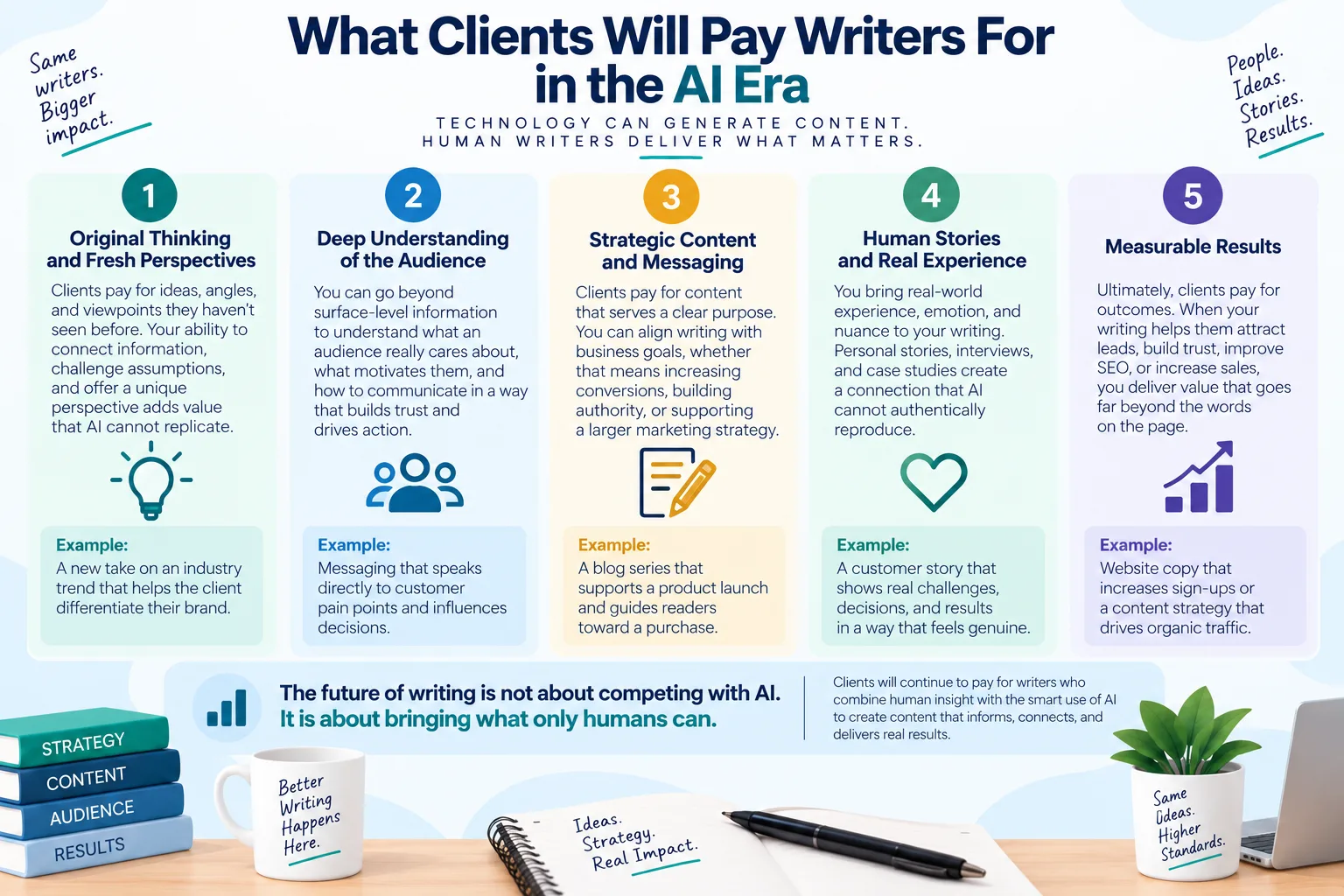
AI Makes the Difference More Visible
When basic content becomes easier to generate, clients can compare a cheap AI-generated draft with professional work more easily.
The difference should not simply be that the professional version has better grammar.
The difference should be visible in the thinking behind the work.
A strong professional writer should be able to provide:
- A clearer understanding of the target audience
- A stronger content angle
- Better research
- More useful examples
- Greater subject depth
- A clearer message
- Stronger structure
- Better alignment with business goals
- More thoughtful editorial decisions
These are outcomes clients can understand and value.
AI may reduce the value of basic word production. However, it can increase the importance of writers who solve problems that require more than generating text.
Sell the Thinking, Not Just the Writing
This may also change how professional writers position their services.
Instead of presenting yourself only as someone who writes blog posts, articles, web pages, or other deliverables, consider the broader value you provide.
For example, you may help clients:
- Turn complex expertise into useful content
- Identify gaps in their existing content
- Communicate more clearly with their audience
- Develop stronger content angles
- Build authority in a competitive market
- Create content that supports business goals
- Make better decisions about what to publish
The words still matter.
However, the research, strategy, judgment, and communication decisions behind those words may become an even greater part of what clients are paying for.
That is an important distinction for professional writers.
As AI makes content production faster and more accessible, writers who compete primarily on speed and word count may face increasing pressure.
Writers who demonstrate strategic value, subject knowledge, audience understanding, and sound judgment can compete on something more difficult to automate.
They are not simply selling words.
They are helping clients make better communication decisions.
AI Literacy Is Becoming Part of Professional Writing
Professional writers do not need to become AI engineers.
However, understanding how to work effectively with AI is becoming a useful professional skill.
AI literacy means knowing what these tools can and cannot do. It means understanding how to provide useful context, ask better questions, evaluate output, verify information, and recognize when AI is not the right tool for the task.
It also means understanding where AI fits into your own workflow.
The most useful approach is not to treat AI expertise and writing expertise as competing skills.
They complement each other.
Strong writing skills help you evaluate and improve AI output. Research and subject knowledge help you identify inaccurate or shallow information. Editorial judgment helps you decide what should stay and what should go.
At the same time, AI can help experienced writers work more efficiently, explore ideas from different perspectives, and spend less time on routine tasks.
The future of professional writing is unlikely to be entirely human or entirely automated.
It will increasingly be human-led and AI-assisted.
The writers who benefit most will not necessarily be those who use AI to produce the most content.
They will be the ones who learn how to combine technology with the skills that remain distinctly valuable: judgment, expertise, curiosity, critical thinking, and the ability to communicate something that matters.
Common Mistakes Professional Writers Make With AI
AI can improve a writing workflow, but only when used with intention.
Many problems writers experience with AI do not come from the technology itself. They come from using it too early, trusting it too easily, or allowing it to take over decisions that should remain part of the writing process.
Here are some of the most common mistakes.
Asking AI to Write Before Thinking About the Topic
Opening an AI tool before developing your own understanding of the assignment can shape the entire project around AI's assumptions.
The first response may suggest the article angle, structure, and key points before you have had an opportunity to research or think independently.
Start with the assignment. Understand the audience, research the topic, and develop an initial perspective. Then use AI to explore gaps, alternatives, or questions you may have missed.
Publishing AI Output With Minimal Editing
A polished AI response can create the impression that little work remains.
That is often misleading.
Even readable output may contain generic language, repeated ideas, weak examples, unsupported claims, and predictable conclusions. Light editing may remove obvious problems without addressing the underlying weaknesses.
Treat AI-generated text as a draft that needs the same critical review you would apply to any other source of material.
Trusting AI-Generated Facts Without Verification
AI can present incorrect information with complete confidence.
It may confuse dates, misrepresent research, invent sources, or combine information from different contexts into a claim that sounds plausible but is inaccurate.
Every factual claim that matters should be checked against a reliable source. Find the original study, report, document, interview, or official source rather than relying on the AI's explanation.
Using the Same Prompts for Every Project
A prompt that works well for one article may be unsuitable for another.
Different projects have different audiences, goals, levels of subject knowledge, brand requirements, and desired outcomes.
Reusable templates can save time, but they should provide a starting point rather than replace project-specific context.
Adapt your instructions to the assignment in front of you.
Allowing AI to Determine the Entire Article Structure
AI can create a logical outline quickly. The problem is that logical does not always mean useful.
When AI determines the entire structure, articles can follow predictable patterns based on what already exists around the topic. Important points may receive too much or too little attention, and the structure may not support your strongest argument.
Use AI to organize ideas or suggest possible structures, but make sure the final outline reflects the purpose and angle of the article.
Removing Personality in the Name of Efficiency
Writers sometimes accept AI rewrites because they are cleaner or more concise than the original.
However, repeated rewriting can gradually remove the characteristics that make the work distinctive.
Not every unusual phrase needs to be simplified. Not every conversational sentence needs to become more formal. Not every personal observation needs to be replaced with a generic explanation.
Efficiency matters, but content that sounds interchangeable with everything else may cost more than the time you saved.
Becoming Dependent on AI for Simple Writing Decisions
AI is easy to consult.
That convenience can become a problem when writers begin asking it to make decisions they could make themselves.
Should this sentence be shorter? Is this transition good enough? Which word should I use? How should I begin this paragraph?
Occasional feedback is useful. Asking AI to resolve every small uncertainty can weaken confidence in your own judgment and interrupt the natural writing process.
Use the tool when it provides meaningful value, not simply because it is available.
Focusing Only on Producing Content Faster
Speed is one of AI's most obvious benefits.
However, producing more content is not always the best use of the time you save.
You could use that time to research more deeply, improve your editing, interview experts, find stronger examples, or develop a better content angle.
Professional writers should ask a broader question than:
How can AI help me write faster?
A more useful question is:
How can AI help me spend more time on the parts of my work that create the most value?
That distinction can shape your entire relationship with AI.
The goal is not to automate as much of your writing process as possible.
It is to use automation where it helps while protecting the thinking, judgment, and perspective that make professional writing worth paying for.
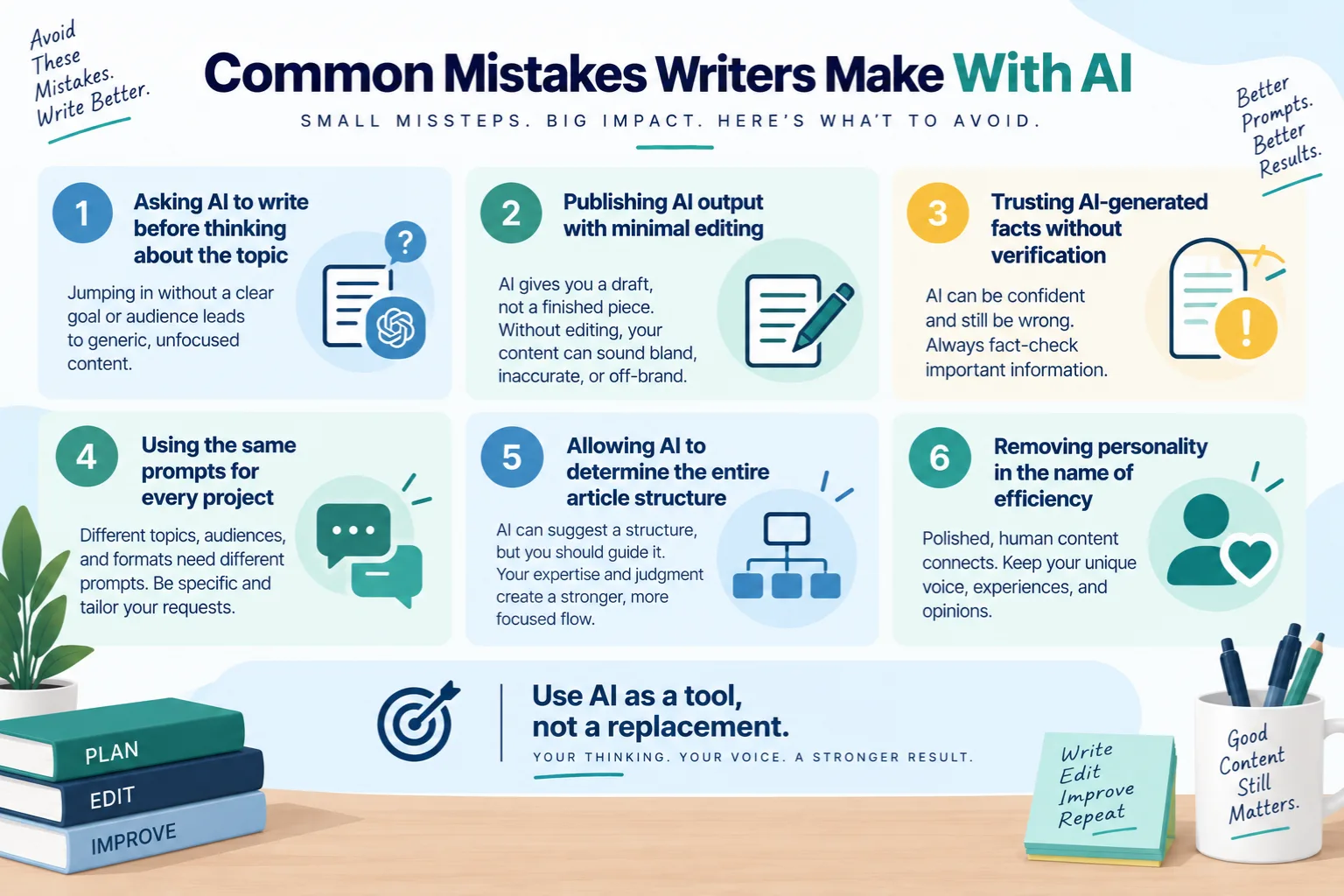
Key Takeaways
- Use AI to support your writing process, not replace your thinking.
- Start with your own research, ideas, and perspective before asking AI for help.
- Save AI for tasks such as brainstorming, research organization, analysis, and editing.
- Keep creative, strategic, and editorial decisions under your control.
- Verify AI-generated facts, statistics, quotes, and sources before publishing.
- Give AI clear context about the audience, purpose, and requirements of each project.
- Use AI feedback to identify weaknesses and blind spots in your writing.
- Add the experience, judgment, insight, and perspective that AI cannot easily provide.
- Focus on creating better and more useful content, not simply producing more words faster.
Conclusion: The Best AI Workflow Still Starts With You
Professional writers do not need to choose between rejecting AI and allowing it to take over their work.
The better approach is to decide where the technology genuinely helps.
AI can save time on research, organization, brainstorming, analysis, and editing. It can help you identify gaps in your thinking, spot weaknesses in your writing, and explore perspectives you may not have considered.
However, efficiency should not come at the expense of the qualities that make professional writing valuable.
Your understanding of the audience matters. Your experience matters. Your ability to interpret information, develop an angle, make editorial decisions, and communicate a useful message matters.
Those are the parts of the process worth protecting.
The most effective professional writers will not use AI to avoid thinking or replace their skills. They will use it to reduce routine work and create more time for the work that requires their judgment and expertise.
Start by developing your own ideas. Give AI enough context to provide useful assistance. Use it to research, question, analyze, and critique. Verify the information it provides. Then make the final decisions yourself.
You do not need AI to write exactly like you.
You need to build a workflow where AI supports the way you work without taking away the perspective that makes your work yours.
That is the balance professional writers should aim for.
Use AI to work more effectively. Keep your thinking, judgment, and voice at the center of the process.
Frequently Asked Questions
Can professional writers use AI without losing their writing voice?
Yes. Professional writers can use AI without losing their voice when they treat it as a supporting tool rather than a replacement for their thinking. AI can help with research, brainstorming, organization, editing, and analysis while the writer retains control of the ideas, perspective, and final message.
Will using AI make my writing sound generic?
It can if you rely heavily on AI-generated drafts or publish its output with minimal editing. Generic content often results when AI is given little context and asked to produce an entire piece of writing. Using AI for specific tasks and adding your own perspective, examples, and editorial judgment reduces this risk.
What parts of the writing process should I use AI for?
AI can be useful for brainstorming ideas, organizing research, identifying content gaps, generating questions, summarizing information, checking for repetition, improving readability, and finding grammatical errors. These tasks can save time without requiring AI to make the most important creative and strategic decisions.
What parts of writing should remain human?
Professional writers should remain primarily responsible for understanding the audience, choosing the article angle, developing original arguments, adding professional insight, making editorial decisions, deciding what information matters, and creating the final message.
Should I trust facts generated by AI?
No. AI-generated information should be treated as a starting point for further research rather than a verified source. Check important facts, statistics, quotes, studies, and claims against reliable original sources before including them in published work.
Can AI help me become a better writer?
Yes. AI can help identify writing blind spots by analyzing patterns in your work. It can highlight overused words, repetitive sentence structures, unclear explanations, unnecessary jargon, weak transitions, and gaps in logical flow. This makes AI useful as a feedback and learning tool.
Should I train AI to write exactly like me?
Trying to make AI perfectly copy your voice can lead to exaggerated writing habits and predictable patterns. A better approach is to create a writing style guide that documents your preferred tone, sentence preferences, words to avoid, formatting habits, editorial rules, and brand requirements.
How can professional writers stay valuable in the age of AI?
Professional writers can increase their value by focusing on skills that go beyond producing words. These include research, critical thinking, editing, strategy, subject expertise, audience understanding, original thinking, and communication. AI can assist with the process, but these skills help writers create more useful and strategically valuable work.