

Updated September 16, 2026
Many new writers believe motivation is what they lack.
Some days writing feels easy. Other days it feels impossible. When that happens, it is natural to blame motivation and assume something is wrong with you. Maybe you do not want it enough. Maybe you are not cut out for this.
The truth is simpler.
Motivation is unpredictable. It rises and falls based on mood, energy, and confidence. That makes it a weak foundation for writing consistently. The problem is not desire, talent, or discipline. Most beginners have all three.
What is missing is structure.
When writing depends on feeling inspired, progress becomes uneven. You start, stop, and then lose trust in yourself. This article helps reset that thinking and shows why consistency comes from having a clear system, not chasing the right feeling.
Building a writing habit takes more than motivation alone. The Writing Basics Hub offers practical guidance on developing the skills and habits that support steady progress.
TL;DR: Why Motivation Fails New Writers?
Motivation fails new writers because it depends on mood and confidence. Writing stays consistent when you use a simple system that removes decisions, lowers friction, and helps you show up even on low-energy days.
Table of Content
- Why Motivation Is a Weak Foundation for Writing?
- The Hidden Cost of Relying on Motivation
- What Actually Keeps Writers Going When Motivation Fades?
- The Difference Between Wanting to Write and Having a Writing System
- Small Wins Beat Motivation Every Time
- How This Connects to a Simple Writing System for Beginners?
- Related Guides
- Conclusion: Stop Chasing Motivation. Build Something That Carries You.
- FAQs
Why Motivation Is a Weak Foundation for Writing?
Motivation feels powerful at the start.
You feel excited about an idea. You imagine the finished piece. For a moment, writing feels light. That feeling convinces many new writers that motivation is what drives progress.
The problem is that motivation depends on things you cannot control.
It rises when you are rested. It drops when you are tired. It shows up when confidence is high and disappears when doubt creeps in. Mood, energy, and outside stress all affect it. That makes motivation unstable by nature.
Writing, on the other hand, creates friction.
Every session asks you to think, choose words, and sit with uncertainty. Even simple writing requires focus. When motivation meets friction, friction usually wins. This is where many writers stall. They want to write, but the effort feels heavier than expected.
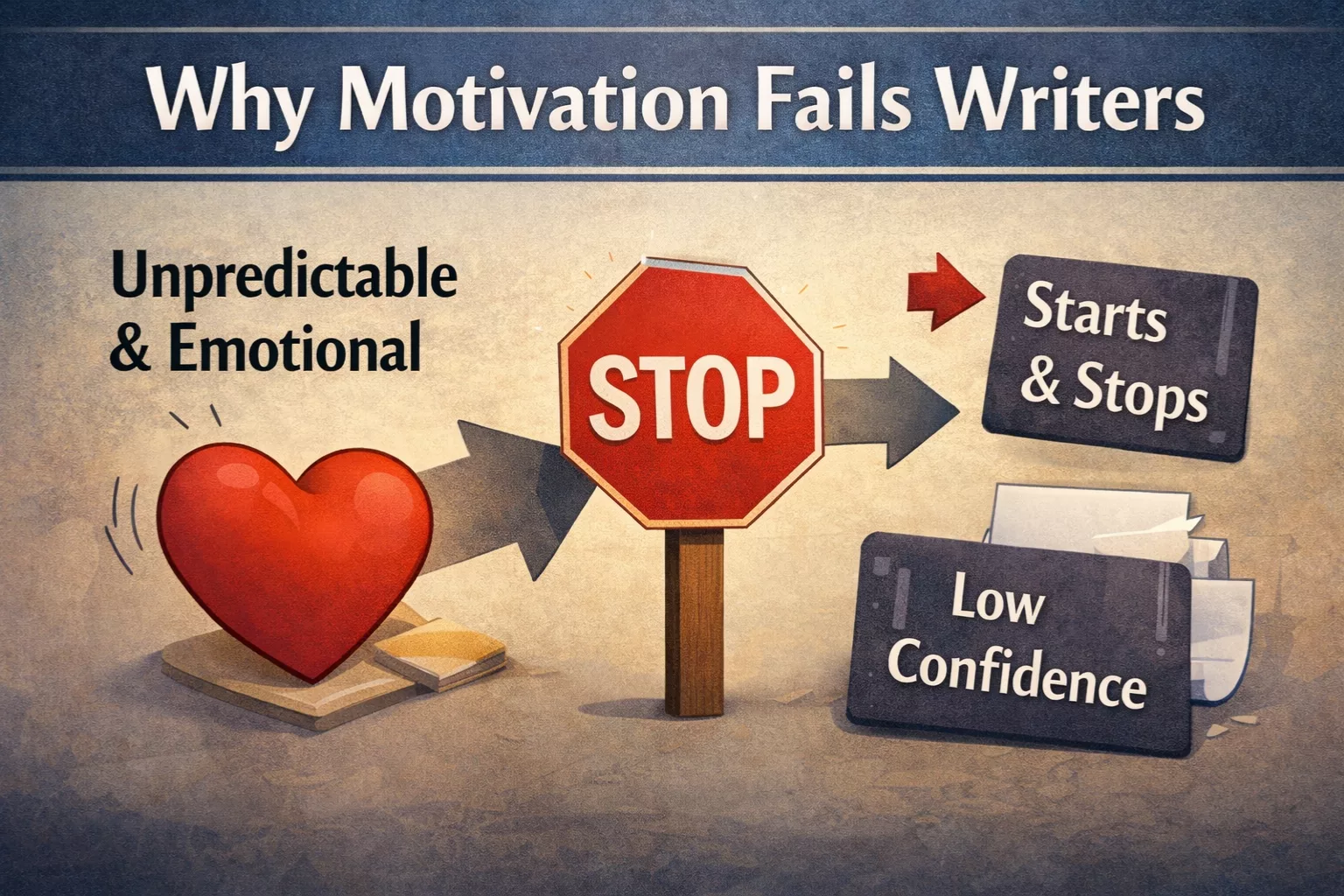
That is when waiting begins.
Beginners often tell themselves they will write later. Later when they feel clearer. Later when they feel more confident. Later when they feel ready. This delay feels responsible, but it quietly blocks progress. Writing skill only grows through doing, not through waiting for the right internal state.
Motivation also fades fastest when results feel slow.
Early writing rarely looks the way you hoped it would. Pages feel messy. Feedback is limited or missing. Improvement is hard to see day to day. Motivation struggles in this environment because it feeds on visible rewards. When progress is subtle, motivation has nothing to latch onto.
This creates a familiar pattern.
You write in short bursts when motivation spikes. You stop when it drops. Days or weeks pass. Guilt builds. Starting again feels harder than before. Over time, this stop-start cycle becomes the habit itself.
This is why motivation fails writers as a long-term strategy.
It is reactive, not reliable. It asks you to feel a certain way before you act. Writing does not work that way. Consistent writers do not avoid friction. They reduce it. They remove decisions. They rely on clear steps instead of emotional readiness.
Once you see this, the problem shifts.
The question stops being “How do I stay motivated?” and becomes “How do I make writing easier to start?” That change matters. It moves you away from self-blame and toward practical solutions that actually support steady writing.
Research on behavior change shows that relying on motivation alone leads to inconsistent action, which is why systems outperform willpower over time. This idea is also discussed in a Harvard Business Review article on why habits matter more than motivation. Read the article.
The Hidden Cost of Relying on Motivation
Relying on motivation does not just slow your writing. It quietly changes how writing feels.
The first cost is inconsistency.
When motivation is the trigger, writing sessions happen at random. You write when energy is high and skip days when it is not. There is no rhythm to fall back on. Without a steady pattern, writing never becomes familiar. Each session feels like starting over.
Then comes overthinking.
Before you even write a sentence, your mind starts negotiating. Is this the right time? Should you wait until you feel clearer? Should you fix yesterday’s draft first? This thinking feels productive, but it delays action. The longer you hesitate, the heavier starting becomes.
Missed days create another problem.
When you skip a session, guilt sneaks in. One missed day turns into two. Instead of restarting easily, you replay the gap in your head. You promise yourself you will make up for it later. That promise adds pressure, not progress.
Over time, confidence erodes.
Each broken promise, even small ones, chips away at trust in yourself. You begin to see yourself as inconsistent, even if the situation caused the break. Writing starts to feel like proof of failure instead of a place to learn. This is how writing gets heavier.
Not because you lack effort. Not because you are lazy. But because every session carries the weight of past stops and false starts. The task itself has not changed, but your relationship with it has.
The key takeaway is simple.
Nothing is wrong with you. What is missing is a system that removes pressure, shortens the distance to starting, and allows you to show up without needing the right mood. When structure replaces motivation, writing begins to feel lighter again.
If you also struggle to keep writing when the initial enthusiasm fades, Why Writing Consistently Feels Hard at First explains why consistency feels difficult and what helps.
What Actually Keeps Writers Going When Motivation Fades?
When motivation fades, something else has to carry the work.
That something is not willpower. It is not discipline in the harsh sense either. What keeps writers going is a system they can rely on when energy is low and confidence is quiet.
Writing systems remove decision fatigue.
Instead of asking yourself what to write, how long to write, or where to start, the system answers those questions for you. Fewer choices mean less resistance. When the path is clear, starting takes less effort. That alone changes how often writing happens.
Small repeatable steps matter more than big emotional pushes.
Motivation encourages bursts. Systems encourage repetition. Writing a small amount the same way each time builds momentum without drama. You are not trying to feel inspired. You are simply following the next step. Over time, those small steps add up to real output.
This is where confidence actually comes from.
Many writers believe they need confidence before they can be consistent. In practice, it works the opposite way. Showing up regularly creates proof. Proof builds trust. Trust turns into confidence. The feeling follows the action, not the other way around.
Systems also work on low-energy days.
Not every day is sharp or creative. Some days you are tired. Some days life pulls your attention elsewhere. A writing system accounts for that. It lowers the bar enough that you can still show up without forcing yourself. Even imperfect sessions count when they are part of a repeatable process.
This is why professional writers do not rely on motivation.
They know motivation comes and goes. Deadlines still arrive. Work still needs to be done. Systems protect their output from their mood. The goal is not to write brilliantly every day. The goal is to keep writing moving forward.
For beginners, this shift is especially important.
You do not need more pressure or inspiration. You need a clear way to begin, a clear way to continue, and a clear stopping point. That is what a simple writing system provides. It turns writing into something you do, not something you wait to feel ready for.
If you want to see how this works in practice, the next step is understanding A Simple Writing System for Beginners, where structure replaces guesswork and consistency becomes easier to maintain.
The Difference Between Wanting to Write and Having a Writing System
Wanting to write comes from emotion.
You feel the pull of an idea. You imagine what writing could lead to. That desire matters. It is often what brings people to writing in the first place. But emotion alone does not tell you what to do when you sit down.
A writing system works differently.
It is mechanical and repeatable. It does not depend on how inspired you feel. It gives you a fixed starting point, a clear action, and a clear place to stop. You follow the steps the same way each time, even when your mind feels scattered.
This difference shows up most at the start of a session.
Motivation asks questions. What should I write today? How long should this take? Is this good enough? Those questions slow you down before you type a single word. They create friction that feels like resistance.
Systems remove those questions.
A system tells you exactly what comes next. Open this document. Write for this amount of time. Focus on this part only. When the step is clear, starting feels lighter. You are not deciding. You are executing.
This is why beginners need fewer choices, not more inspiration.
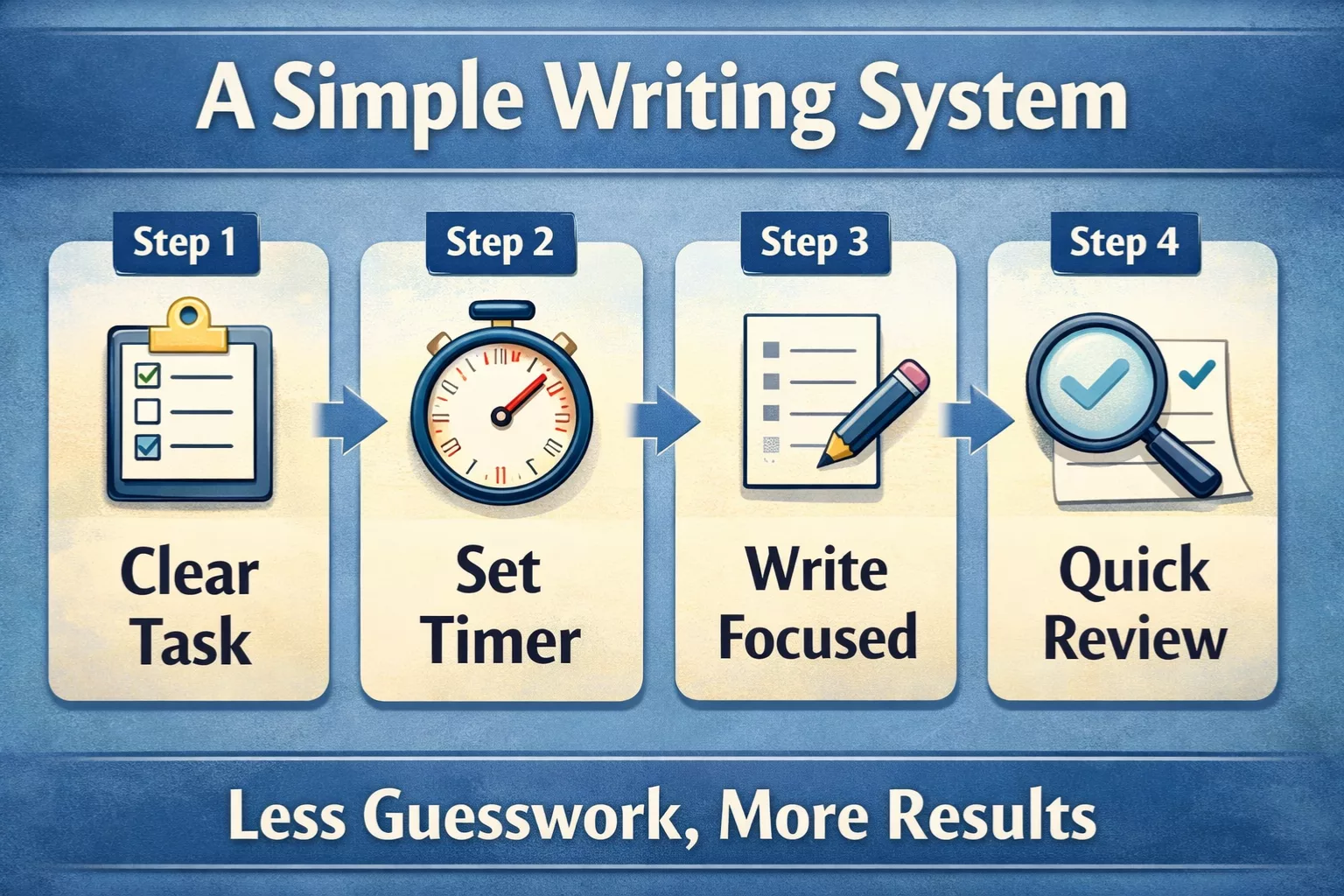
Too many options increase pressure. More advice adds noise. More ideas create confusion. A simple system limits decisions so energy can go into writing itself, not planning or second-guessing.
This is the core of the writing system vs motivation difference.
Motivation depends on how you feel. A system depends on what you do. Feelings change. Actions can repeat. When beginners understand this, writing stops being a test of passion and becomes a process they can rely on.
If you are still unsure whether your writing process is moving in the right direction, The Fastest Way to Know If Your Writing Is Working shows you what signals to look for.
Small Wins Beat Motivation Every Time
Progress in writing rarely comes from big moments.
It comes from showing up when the session feels ordinary. Each time you sit down and complete a small piece of work, something shifts. You prove to yourself that writing can happen without waiting for the right mood. That proof matters more than enthusiasm.
Showing up creates momentum.
Not the loud kind that feels exciting, but the quiet kind that carries you forward. When writing becomes part of your routine, starting feels familiar. Familiar tasks require less energy. That makes the next session easier to begin.
Finished drafts matter more than inspired ones.
Inspired writing feels good, but it is unreliable. Finished drafts create movement. Even rough drafts count because they exist. They can be improved, shortened, or reshaped. An unfinished idea cannot. Completion builds forward motion.
Small outputs also build trust with yourself.
Every time you complete what you planned, even if it is brief, you keep a promise. Over time, those small promises stack. You begin to see yourself as someone who follows through. That identity change is powerful and stable.
This is how momentum replaces motivation.
When momentum is present, you no longer ask if you feel like writing. You write because it is the next step. The action comes first. The feeling follows. Motivation becomes a side effect, not a requirement.
This fits naturally into daily or weekly writing routines.
You are not trying to win the day. You are trying to keep the chain unbroken. A short session done consistently beats long sessions done rarely. Small wins lower pressure and increase repetition.
That is why they work.
They turn writing into a habit instead of a performance. And habits last longer than motivation ever does.
Consistent small actions create momentum because they reduce friction and build identity over time. James Clear explains this clearly when he shows how tiny habits compound into real progress. Learn more about habit building.
How This Connects to a Simple Writing System for Beginners?
Everything covered so far points to one core issue.
Motivation fails because it has no structure. It relies on feelings that change and energy that runs out. When writing depends on that, progress becomes fragile. The moment life gets busy or confidence dips, writing stops.
A simple writing system fixes that gap.
Structure gives direction when energy is low. You do not have to decide what to do or how to begin. The system carries you through the session step by step. That support matters most on the days when motivation is quiet.
This is especially important for beginners.
New writers do not need more pressure to perform or more advice to sort through. They need guidance that narrows the focus and removes uncertainty. Clear steps reduce overwhelm and make writing feel manageable again.
This article handles the mindset side of the problem.
It helps you see why motivation was never meant to carry your writing. It removes the blame and explains why inconsistency happens even when you care about the work.
The next step is execution.
That is where A Simple Writing System for Beginners comes in. It takes this shift in thinking and turns it into a practical way to write with more consistency and less friction. Not as a big change, but as a steady one you can repeat.
Key Takeaways
- Motivation is unpredictable, so it cannot support consistent writing.
- Writing creates friction, and friction beats motivation on most days.
- Relying on motivation leads to stop-start habits, guilt, and lower confidence.
- Small repeatable steps build momentum faster than big emotional pushes.
- Systems reduce decision fatigue by telling you what to do next.
- Consistency creates confidence, not the other way around.
- A simple writing system keeps you moving even when energy is low.
Conclusion: Stop Chasing Motivation. Build Something That Carries You.
There is nothing wrong with your motivation.
It is not broken. It is just unreliable. Some days it shows up. Many days it does not. Writing was never meant to depend on something that fragile.
Consistency comes from systems.
When writing has structure, progress does not depend on mood or confidence. You do not need to feel ready to move forward. You only need a clear next step you can repeat.
One simple structure can change how writing feels.
It reduces pressure. It shortens the distance to starting. It helps you show up even on ordinary days. Over time, that changes your relationship with writing from effort to rhythm.
If you want to take the next step, read A Simple Writing System for Beginners. It shows how to turn this mindset shift into a practical way of writing that is easier to maintain and easier to trust.
Motivation becomes less important once you understand how writing actually works. If you are working through the fundamentals, the Writing Basics Hub brings these beginner writing skills together in one learning path.
FAQs
Why does motivation fail new writers?
Motivation depends on mood, energy, and confidence. Writing creates friction, and when effort increases, motivation drops. Without structure, consistency becomes hard to maintain.
Is it normal to feel unmotivated even if I want to write?
Yes. Wanting to write and feeling motivated are different things. Many writers care deeply about writing but struggle because they rely on emotion instead of a repeatable process.
Do professional writers feel motivated all the time?
No. Professional writers do not depend on motivation. They use systems and routines that allow them to write even when they feel tired, distracted, or uninspired.
What helps more than motivation when writing feels hard?
Clear structure helps more than motivation. A simple writing system reduces decisions, lowers pressure, and gives you a clear next step so you can start without feeling ready.
Can a writing system really help beginners stay consistent?
Yes. Beginners benefit the most from systems because they remove guesswork. When you know exactly how to begin and what to work on, writing becomes easier to repeat.