

How much should you charge for writing?
If you search for freelance writing rates, you’ll see everything from $50 blog posts to $5,000 landing pages. That range feels confusing at first.
The reason is simple. Digital writing rates vary based on experience, project type, and the business value of the content.
A basic blog post might cost a few hundred dollars. A sales page designed to generate revenue can cost thousands. Both are writing, but they serve very different purposes.
In most cases, writers charge using a few common models. Some use per-word rates. Others charge hourly. Many experienced writers use project-based pricing that reflects the results their content can deliver.
In this guide, you’ll learn:
- Real freelance writing rates for different types of content
- Typical pricing for blog posts, websites, and email marketing
- How writers calculate their rates based on income goals
- What beginners should charge when starting out
By the end, you’ll understand how digital writing rates work and how to price your services with confidence.
If you're just getting started, this guide on how to start writing online will help you build the foundation before setting your rates.
Not Sure Which Type of Writer You Are?
You don’t need to figure this out alone. Most beginners feel stuck at this stage.
This short quiz shows you the writing path that fits you right now.
Take the Free QuizDigital Writing Rates (Quick Summary)
Digital writing rates are the prices writers charge for creating online content such as blog posts, website pages, landing pages, and email marketing. Rates vary based on experience, specialization, and the business value of the content.
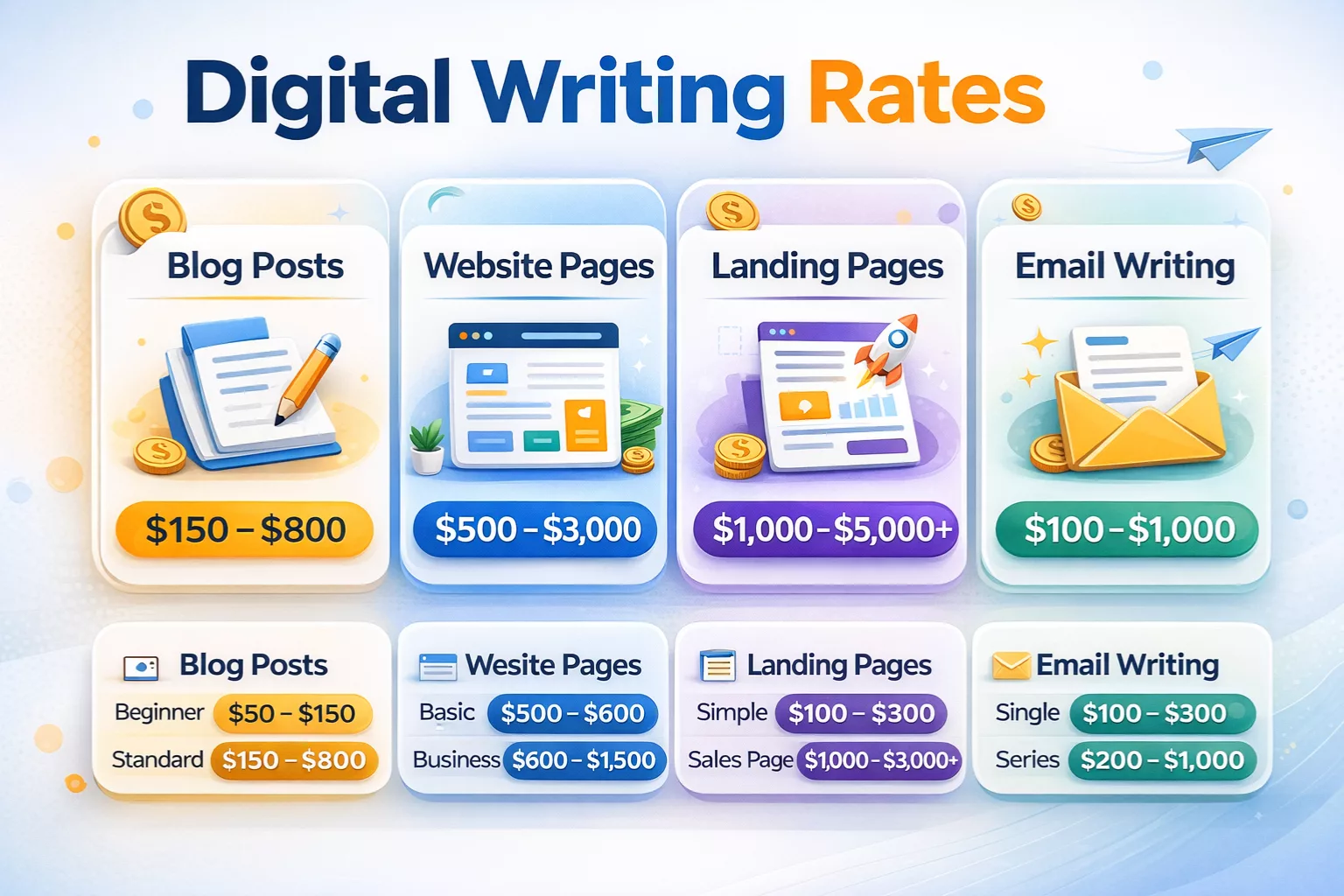
- Blog posts typically cost $150 to $800
- Long-form SEO articles range from $500 to $2,000
- Website homepage copy usually costs $1,000 to $3,000
- Landing page copywriting ranges from $1,000 to $5,000+
- Email marketing copy often costs $100 to $1,000 per email
- Rates increase with experience, niche expertise, and results
Table of Content
- Digital Writing Rates (Quick Summary)
- What Are Freelance Writing Rates?
- Common Pricing Models for Digital Writers
- Digital Writing Rates by Project Type
- Digital Writing Rates by Experience Level
- Highest Paid Digital Writing Projects
- Digital Writing Rate Calculator
- Factors That Affect Digital Writing Rates
- Common Mistakes Writers Make When Setting Rates
- How Beginners Should Price Digital Writing Services?
- Conclusion
- Frequently Asked Questions
What Are Freelance Writing Rates?
When I first started learning about freelance writing rates, I honestly thought pricing would be simple. I assumed writers charged something like $50 or $100 per article, and that was the standard everywhere. After a few weeks of digging into freelance writing forums and agency pricing pages, I realized how wrong that assumption was.
Freelance writing rates are simply the prices writers charge for creating online content. That includes blog posts, website copy, landing pages, email newsletters, product descriptions, social media content, and many other types of digital content.
The key word here is digital. The content is written specifically for websites, online marketing campaigns, or digital platforms.
In most cases, writers price this work using a few common structures. Some charge per word, others charge per hour, and many experienced writers charge per project. The exact structure matters less than the value of the content being created.
One thing that confused me early on was how different digital writing is from traditional writing.
Traditional writing usually refers to things like books, magazine articles, or newspaper journalism. Those industries often follow fixed editorial budgets or publication rates.
Digital writing works differently because the content is tied directly to marketing and business results.
For example, a blog post on a company website might help that business rank in search engines and attract customers. A landing page might generate thousands of dollars in sales. Because of that connection to revenue, companies often pay much higher rates for strong digital content.
Another reason pricing varies so much is the type of content being written.
A simple blog post that summarizes a topic might require a couple of hours of work. On the other hand, a long sales page or a technical article can require research, competitor analysis, SEO optimization, and several rounds of editing.
Those differences dramatically affect pricing.
I remember writing my first long-form SEO article and thinking it would take two hours. It ended up taking almost six. Research alone took longer than expected. That was the moment I realized why experienced writers charge higher rates.
High-quality content plays a key role in search visibility. According to Google’s helpful content guidelines, content should be created for people first, not just for search engines.
Skill level also plays a big role in digital writing rates.
A beginner writer may charge much less while building a portfolio. As writers gain experience, learn SEO, and understand how content supports marketing goals, their pricing usually increases.
Specialization makes an even bigger difference.
Writers who focus on complex industries like finance, technology, or healthcare often command higher fees. Those topics require deeper research and stronger subject knowledge.
Businesses are usually willing to pay those higher rates because quality content produces measurable results.
A well-written blog post can drive traffic for years. A strong landing page can increase conversions. A clear product page can improve sales.
Once companies see that connection, investing in professional digital writing starts to make a lot of sense.
Common Pricing Models for Digital Writers
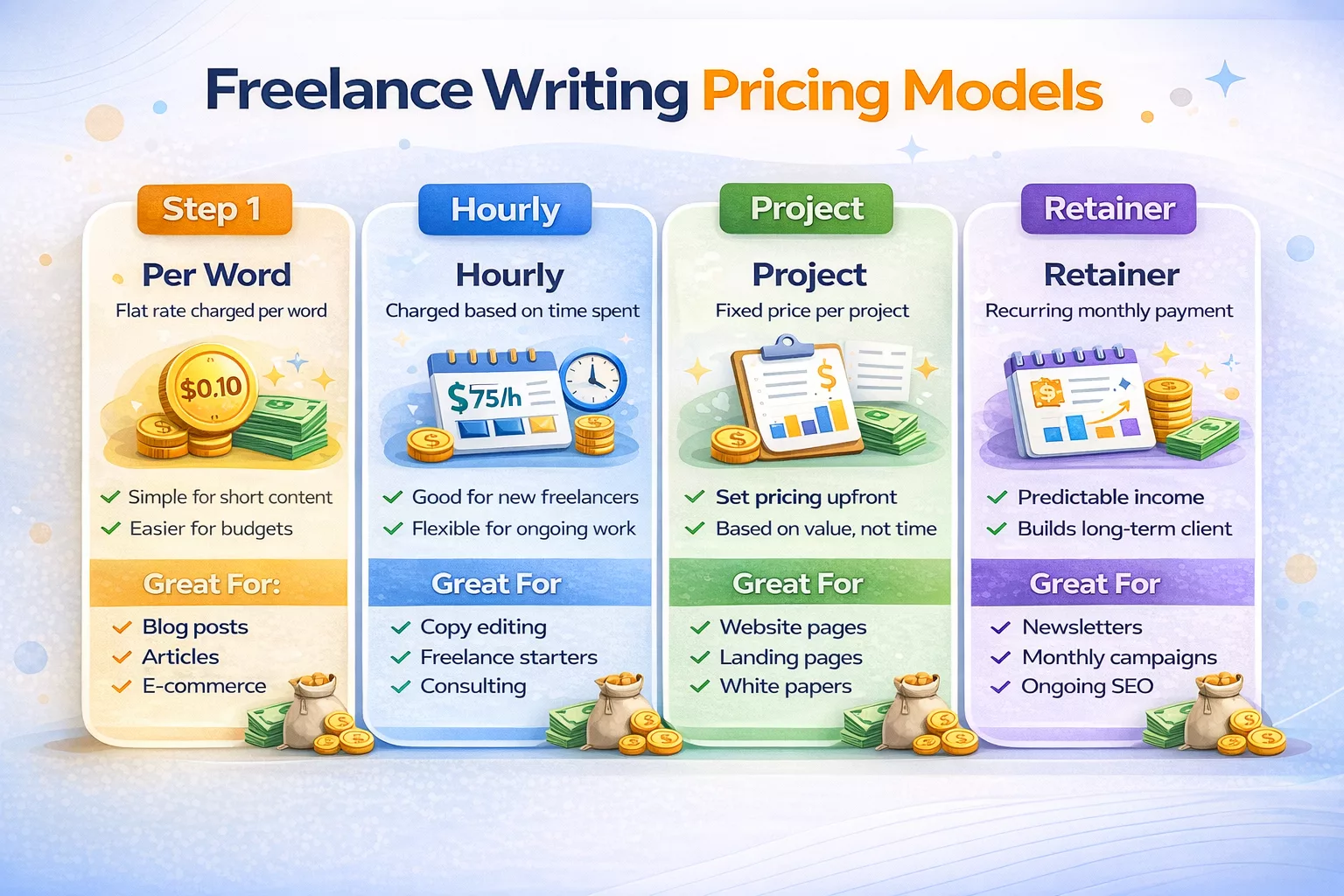
One of the first confusing things I noticed when researching digital writing rates was that writers don’t all charge the same way. Some quote a price per word. Others give an hourly rate. And many experienced writers send a flat project quote.
At first, that seemed messy. I wondered why there wasn’t one standard system.
After working through a few writing projects and talking to other freelancers, I realized something important. Different pricing models exist because writing projects vary so much in scope and value.
A short SEO blog post, a homepage rewrite, and a sales landing page are completely different types of work. The pricing method often depends on how predictable the workload is and how much strategy is involved.
Over time, most digital writers experiment with several pricing models before settling on what works best.
Per Word Pricing
Per-word pricing is probably the most common model beginners see when they start researching freelance writing.
The concept is simple. A writer charges a fixed rate for every word written. For example, if a writer charges $0.10 per word, a 1,000-word article would cost $100.
Many content agencies and SEO companies still use this pricing model because it makes budgeting easy. If they need a 1,500-word blog post, they can quickly estimate the cost.
Typical per-word rates vary widely depending on experience and niche.
Beginner writers sometimes charge around $0.03 to $0.08 per word. Intermediate writers may charge $0.10 to $0.30 per word. Experienced specialists can charge $0.50 per word or more.
When I first learned about per-word pricing, I thought it made perfect sense. The longer the article, the higher the price.
But after writing a few research-heavy articles, I realized something. Word count doesn’t always reflect the amount of work involved.
Sometimes a 900-word article with technical research takes longer than a 1,500-word opinion piece. That’s one of the main limitations of per-word pricing.
It works well for predictable blog content, but it can underprice complex projects.
Hourly Pricing
Hourly pricing is another common model, especially when writers provide editing, consulting, or content strategy work.
In this model, the writer charges for the time spent working on a project. For example, a writer might charge $40, $75, or $120 per hour depending on experience and specialization.
This model can work well when the scope of a project is unclear.
I’ve seen writers use hourly pricing for things like website audits, SEO content reviews, or content strategy planning. Those projects often evolve as the work progresses.
However, hourly pricing has its own challenges.
Clients sometimes feel uncomfortable with open-ended billing because they don’t know the final cost in advance. Writers also run into situations where their efficiency works against them.
If a writer becomes faster and more experienced, they might complete work quickly but earn less money compared to a slower process.
That’s one reason many experienced digital writers move away from hourly billing.
Project-Based Pricing
Project-based pricing is where things start to shift toward professional copywriting and content strategy.
Instead of charging for time or word count, the writer quotes a flat fee for the entire project.
For example, a writer might charge:
- $800 for a website homepage
- $400 for a long-form blog post
- $2,500 for a sales landing page
This approach focuses more on the value of the deliverable rather than the time spent creating it.
When I first saw project-based pricing, I wondered how writers decided on those numbers. After digging deeper, I realized experienced writers estimate the work involved, the research required, and the potential value of the content.
Project pricing benefits both sides.
Clients know exactly what they will pay before the work begins. Writers can become more efficient without reducing their income.
That’s why many professional copywriters and SEO writers prefer this model.
Retainer Pricing
Retainer pricing is common when businesses need ongoing content production.
Instead of hiring a writer for a single project, the company agrees to pay a fixed monthly fee for a certain amount of work.
For example, a retainer might include:
- Four blog posts per month
- Weekly email newsletters
- Social media content creation
- Ongoing SEO content writing
Retainers often range from $1,000 to $5,000 or more per month, depending on the amount of content and the writer’s expertise.
From a business perspective, this arrangement provides consistent content production without constantly searching for new freelancers.
For writers, retainers can create something extremely valuable: predictable income.
I remember talking to a freelance writer who said the moment they secured three steady retainer clients, their entire business changed. Instead of chasing new projects every week, they could focus on delivering better work for existing clients.
That stability is why many experienced digital writers eventually build their business around retainer contracts rather than one-off assignments.
Digital Writing Rates by Project Type
One thing I wish someone had shown me earlier was real project pricing examples. When you first research digital writing rates, most articles talk about per-word pricing or hourly rates. That helps a little, but it doesn’t tell you what companies actually pay for specific content.
Once I started looking at real writing projects, the pricing started to make more sense. Businesses don’t usually think in terms of word counts. They think in terms of projects that solve a problem.
A homepage needs to explain a company clearly. A landing page needs to generate leads or sales. A blog post needs to bring traffic from search engines.
Because each project has a different purpose, the pricing varies a lot.
Website Copywriting
Website copywriting is one of the most common digital writing projects. Businesses often hire writers when launching a new website or improving an existing one.
Editing or improving an existing homepage usually costs around $500 to $1,000. This type of project often involves tightening the messaging, improving clarity, and adding SEO keywords.
Writing a completely new homepage with SEO optimization typically ranges from $1,000 to $2,000. That work usually includes keyword research, competitor analysis, and structuring the page to perform well in search engines.
If the homepage also focuses on conversion optimization, the price can increase to $1,500 to $3,000. Those projects require deeper marketing strategy because the content must guide visitors toward taking action.
Landing Pages
Landing pages are often priced higher than standard website pages because they are designed to generate leads or sales.
A simple lead generation landing page may cost around $500 to $1,500. These pages typically collect email signups or offer a downloadable resource.
Short sales pages usually range from $1,000 to $2,000. They contain persuasive copy that explains a product or service and encourages the reader to buy.
Long-form sales pages are often the highest priced landing page projects. These pages can range from $2,000 to $5,000 or more because they require strong copywriting skills and detailed research into the target audience.
Blog Posts and Articles
Blog writing is one of the most common entry points for digital writers.
A standard blog post often falls between $150 and $800, depending on the writer’s experience and the complexity of the topic.
Long-form blog content, especially SEO articles designed to rank in search engines, can range from $500 to $2,000. These pieces usually require keyword research, competitor analysis, and detailed explanations.
Some writers also help businesses plan their blog strategy. An editorial calendar for the year may cost around $500 to $800, depending on the amount of research and planning involved.
If you're unsure how much to charge per article, use the blog post pricing calculator to estimate your rate based on word count and experience.
Product Pages
Product page writing focuses on explaining features and convincing customers to purchase.
Updating an existing product page with improved SEO and stronger messaging may cost around $100 to $250 per page. These projects usually involve improving descriptions and adding persuasive language.
Writing a completely new product page typically ranges from $500 to $1,250. The work often includes researching the product, highlighting benefits, and structuring the page to improve conversions.
Email Writing
Email marketing remains one of the highest return marketing channels, so businesses often invest in experienced writers.
Sales funnel emails usually range from $100 to $1,000 per email, depending on the complexity of the campaign.
Educational or tutorial email series often cost $200 to $500 per message. These emails usually guide subscribers through a sequence that builds trust and explains a product or service.
Transactional emails, such as confirmation messages or account notifications, are usually simpler. Those often range from $50 to $200 per email.
Email remains one of the highest-performing channels. Data from HubSpot shows that email marketing continues to deliver strong ROI compared to other channels.
Email Newsletters
Some companies send newsletters regularly to maintain relationships with their audience.
Planning and setting up a newsletter strategy may cost around $750 to $2,000. That work often includes defining topics, scheduling content, and aligning the newsletter with marketing goals.
Writing a full newsletter issue typically ranges from $800 to $1,500, depending on length and research requirements.
If a newsletter includes a single article or feature piece, the price may fall between $300 and $900.
Podcast Show Notes
Podcast show notes are another growing type of digital writing project.
A simple episode summary usually costs around $150 to $500. These summaries highlight the key points of the episode and provide timestamps or resources.
Some creators prefer more detailed show notes that read like blog posts. Those blog-style show notes typically range from $250 to $800 per episode.
Once I started seeing pricing broken down by project like this, digital writing rates made much more sense. The price reflects not just the writing itself, but the purpose and impact of the content.
Digital Writing Rates by Project
Website Copywriting
- Editing homepage: $500 – $1,000
- New homepage (SEO): $1,000 – $2,000
- SEO + conversion homepage: $1,500 – $3,000
Landing Pages
- Lead generation page: $500 – $1,500
- Short sales page: $1,000 – $2,000
- Long-form sales page: $2,000 – $5,000+
Blog Posts & Articles
- Standard blog post: $150 – $800
- Long-form blog post: $500 – $2,000
- Editorial calendar (year): $500 – $800
Product Pages
- Update product page: $100 – $250
- New product page: $500 – $1,250
Email Writing
- Sales funnel email: $100 – $1,000
- Email series: $200 – $500 per email
- Transactional email: $50 – $200
Email Newsletters
- Newsletter setup: $750 – $2,000
- Newsletter (per issue): $800 – $1,500
- Newsletter article: $300 – $900
Podcast Show Notes
- Standard notes: $150 – $500
- Blog-style notes: $250 – $800
Digital Writing Rates by Experience Level
One thing I didn’t understand when I first looked into digital writing rates was how much experience changes pricing. At the beginning, I assumed writers charged based on word count or time spent writing. But after seeing how the industry actually works, I realized pricing is closely tied to skill, results, and specialization.
A writer who just started freelancing might charge a small fee for a blog post. Another writer with ten years of marketing experience might charge thousands of dollars for a single landing page.
The difference is not just writing ability. It’s the ability to solve business problems with content.
As writers gain experience, they usually move through three broad stages: beginner, intermediate, and expert. Each stage brings different pricing levels and different types of projects.
Beginner Writers
Most digital writers start in the beginner stage while they are still building a portfolio.
At this point, the main goal is not maximizing income. The goal is gaining experience, understanding how client projects work, and learning how to deliver content that meets business needs.
Typical beginner rates vary widely, but many new writers charge somewhere between $50 and $150 for a blog post. Some beginners start even lower while trying to secure their first clients.
I remember seeing job listings for simple blog articles paying around $40 or $60 and thinking that was normal. It took a while to realize those projects were usually entry-level work meant for writers who were still learning the ropes.
During this stage, writers often work on smaller assignments like:
- Blog posts for small websites
- Product descriptions for online stores
- Basic SEO articles
- Short website content updates
These projects help writers build samples and learn important skills like research, formatting, and working with client feedback.
Even though the rates are lower at this stage, the experience gained can be extremely valuable.
Intermediate Writers
Once writers gain experience and develop a portfolio, their pricing usually begins to increase.
Intermediate writers typically understand SEO basics, content structure, and how businesses use content to attract customers. They also tend to work faster and produce higher quality writing.
At this stage, blog posts often range between $150 and $500, depending on research requirements and niche expertise.
Many writers also begin shifting away from per-word pricing and moving toward project-based pricing.
Instead of charging by word count, they may charge a flat rate for a blog post, website page, or content project. This approach reflects the full value of the work rather than just the number of words written.
Another important change during this stage is niche specialization.
Some writers start focusing on industries such as technology, finance, SaaS, health, or digital marketing. When writers develop expertise in a specific industry, they become more valuable to clients.
That specialization allows them to charge higher rates while also attracting better clients.
Expert Writers
Expert digital writers operate at a very different level.
These writers usually have years of experience and strong portfolios showing measurable results from their work. Many of them specialize in areas like conversion copywriting, technical writing, or high-level SEO strategy.
Because their work directly impacts revenue and marketing performance, their pricing reflects that value.
For example, experienced writers might charge:
- $500 to $2,000 for long-form blog content
- $1,500 to $3,000 for website homepage copy
- $2,000 to $5,000 or more for sales landing pages
At this stage, pricing often shifts toward value-based pricing.
Instead of thinking about hours worked, expert writers focus on the business outcome their content creates. If a landing page helps a company generate thousands of dollars in sales, the writing itself becomes far more valuable.
That’s why the highest paid digital writers often focus on projects where strong writing directly improves marketing performance.
Once I started seeing pricing through that lens, digital writing rates made much more sense. Experience doesn’t just improve writing quality. It increases the strategic value of the content itself.

Beginner Writer
- Blog posts: $50 – $150
- Website pages: $200 – $600
- Landing pages: $300 – $800
Intermediate Writer
- Blog posts: $150 – $500
- Website pages: $600 – $1,500
- Landing pages: $800 – $2,500
Expert Writer
- Blog posts: $500 – $2,000+
- Website pages: $1,500 – $3,000+
- Landing pages: $2,000 – $5,000+
Highest Paid Digital Writing Projects
When people first explore digital writing rates, they usually look at blog writing prices. That makes sense because blog posts are the most visible type of online content. But after spending time studying real projects and agency pricing, I noticed something interesting.
The highest paid writing work rarely comes from blog articles.
The projects that pay the most are usually tied directly to marketing performance and revenue generation. When a piece of content helps a business generate leads, sell products, or improve conversions, companies are willing to pay much higher rates.
Over time I started noticing a pattern. Certain types of digital writing consistently command premium prices because they require deeper strategy, research, and marketing understanding.
Conversion-focused writing can significantly impact revenue. According to conversion optimization research, small improvements in messaging can lead to major increases in conversions.
Long-Form Sales Pages
Long-form sales pages are one of the most profitable types of digital writing.
These pages are designed to persuade readers to buy a product, sign up for a program, or join a service. Instead of a few paragraphs, they often include detailed explanations, testimonials, benefit sections, and multiple calls to action.
Writing one properly takes time. Research alone can involve studying competitors, analyzing customer objections, and understanding the target audience.
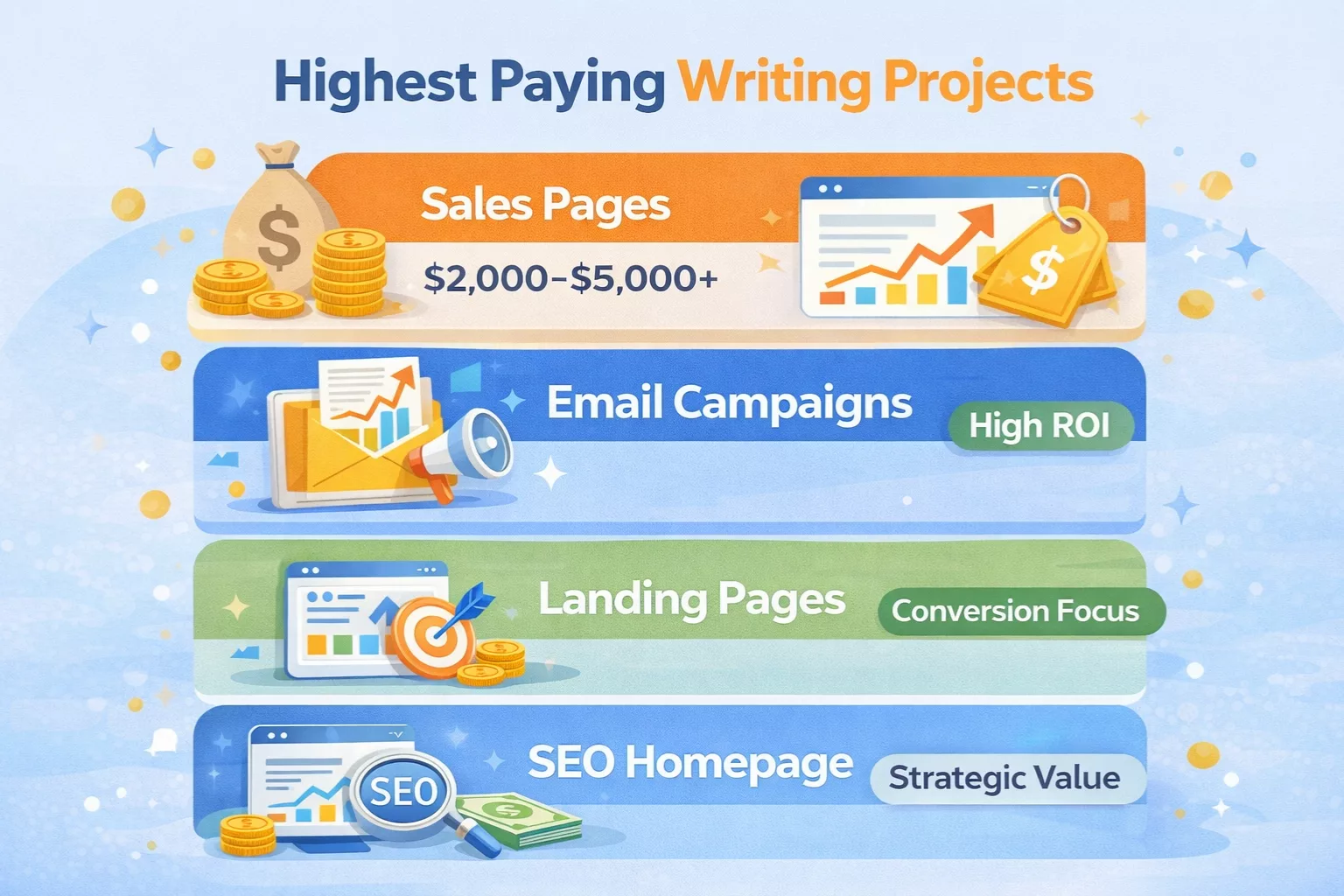
Because these pages directly influence revenue, experienced copywriters often charge $2,000 to $5,000 or more for a single long-form sales page.
The price reflects the impact the page can have on a business.
Promotional Email Campaigns
Email marketing remains one of the most powerful marketing channels available to businesses. A strong email campaign can generate thousands of dollars in sales with a single message.
That’s why promotional email writing is another high-paying area in digital writing.
Instead of writing a single email, writers often create email sequences that guide subscribers through a funnel. These sequences may include welcome emails, educational messages, and promotional offers.
Writing effective email campaigns requires understanding customer psychology, timing, and persuasive messaging. Because of that complexity, experienced writers may charge hundreds or even thousands of dollars per email sequence.
Businesses invest in these campaigns because email continues to deliver strong marketing returns.
SEO Homepage Copywriting
A company’s homepage is often the most important page on its website.
It needs to explain what the company does, build trust with visitors, and guide users toward the next step. At the same time, it must be optimized for search engines so that potential customers can find the site.
Balancing SEO strategy with clear messaging takes experience.
That’s why SEO homepage copywriting projects often range from $1,500 to $3,000 or more. The work typically includes keyword research, competitor analysis, and structuring the content so both users and search engines understand the page.
Conversion-Focused Landing Pages
Landing pages are built for one purpose: conversion.
That conversion might be an email signup, a product purchase, or a consultation booking. Because these pages directly influence revenue, businesses treat them as important marketing assets.
Writing a conversion-focused landing page involves more than just writing text. Writers often analyze the target audience, study customer objections, and design a persuasive message that moves readers toward action.
When done well, even small improvements in conversion rates can dramatically increase revenue. That’s why landing page projects often command prices between $1,000 and $5,000 depending on complexity.
Specialized Industry Writing
Another area where digital writing rates increase significantly is specialization.
Writers who focus on complex industries such as technology, finance, healthcare, or software often charge higher rates because the topics require deeper knowledge.
For example, writing about cloud computing or medical topics requires research and an understanding of technical concepts. Businesses in those industries need writers who can explain complex ideas clearly while maintaining accuracy.
Because qualified writers in these niches are harder to find, companies are usually willing to pay premium rates.
When I first noticed this pattern, it changed how I thought about digital writing entirely. The highest paid projects aren’t necessarily the longest ones. They are the projects where strong writing directly affects business results.
Businesses invest in content because it drives long-term results. Research from Content Marketing Institute shows that strong content strategies generate consistent traffic and leads over time.
For higher-value projects like landing pages and sales pages, try the copywriting rates calculator to estimate realistic pricing.
Digital Writing Rate Calculator
One thing that confused me when I first started learning about digital writing rates was how writers decide what to charge in the first place. I saw articles listing prices, forums full of opinions, and job boards with wildly different budgets. It felt random.
Eventually I learned that many professional writers actually work backwards from a simple idea: their income goal.
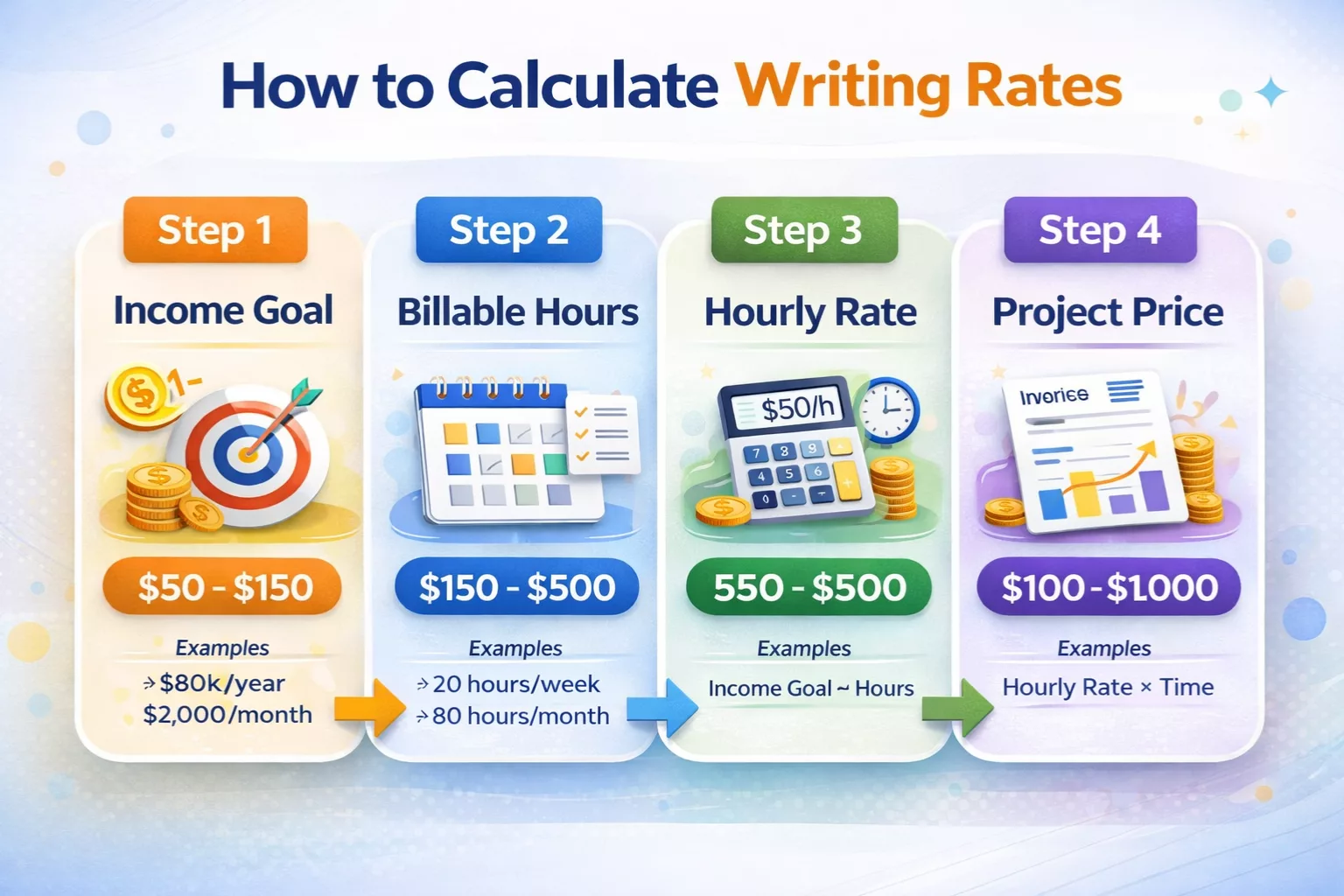
Instead of guessing a price for each project, they first decide how much money they want their writing business to generate each year. From there, they calculate the hourly rate needed to reach that goal.
That small shift makes pricing much easier to understand.
Income Goal Calculation
The first step is deciding what annual income you want your writing business to produce.
For example, a writer might set a goal of $60,000 per year. Another writer running a larger freelance business might aim for $100,000 or more.
Once that number is clear, the next step is estimating how many hours you can realistically spend on paid writing work.
This part surprised me at first. Freelancers rarely work forty billable hours every week. Time is also spent on marketing, client communication, editing, and administration.
Many experienced freelancers estimate around 20 billable hours per week.
If a writer works about fifty weeks per year, that equals roughly 1,000 billable hours annually.
Hourly Rate Formula
Once you know your income goal and estimated billable hours, the hourly rate becomes easy to calculate.
The basic formula looks like this:
Income goal ÷ yearly billable hours = hourly writing rate
Using the earlier example:
$60,000 ÷ 1,000 hours = $60 per hour
That means the writer needs to average about $60 per hour of billable work to reach their income goal.
When I first saw this formula, it was a bit of an eye-opener. Many writers undercharge simply because they never calculate what they actually need to earn.
Estimating Project Time
After determining the hourly rate, the next step is estimating how long different projects take to complete.
For example, a writer might estimate:
- Research for a blog post: 1 hour
- Writing the article: 2 hours
- Editing and formatting: 1 hour
That means the project requires roughly four hours of work.
These estimates improve over time. As writers complete more projects, they become better at predicting how long similar tasks will take.
Converting Hourly Rates Into Project Pricing
Most experienced digital writers don’t bill clients hourly for every assignment. Instead, they convert their hourly rate into project pricing.
Using the previous example:
Hourly rate: $60
Estimated project time: 4 hours
Project price:
4 × $60 = $240
The writer can now quote a flat project rate of $240 for the blog post.
This approach keeps pricing consistent while giving clients a clear, predictable cost.
Example Calculation
Here’s a simple example showing how the process works.
Income goal: $60,000 per year
Billable hours per year: 1,000
Hourly rate:
$60,000 ÷ 1,000 = $60 per hour
Estimated time for a 1,200-word blog post:
- Research: 1 hour
- Writing: 2 hours
- Editing: 1 hour
Total time: 4 hours
Final project price:
4 × $60 = $240 per article
Once I started thinking about digital writing rates this way, pricing stopped feeling random. It became a simple system that connects income goals, time estimates, and project value.
You can also use the calculator below to estimate your own digital writing rates based on your income goals and working hours.
Digital Writing Rate Calculator
Estimate your writing rates based on income goals and working hours.
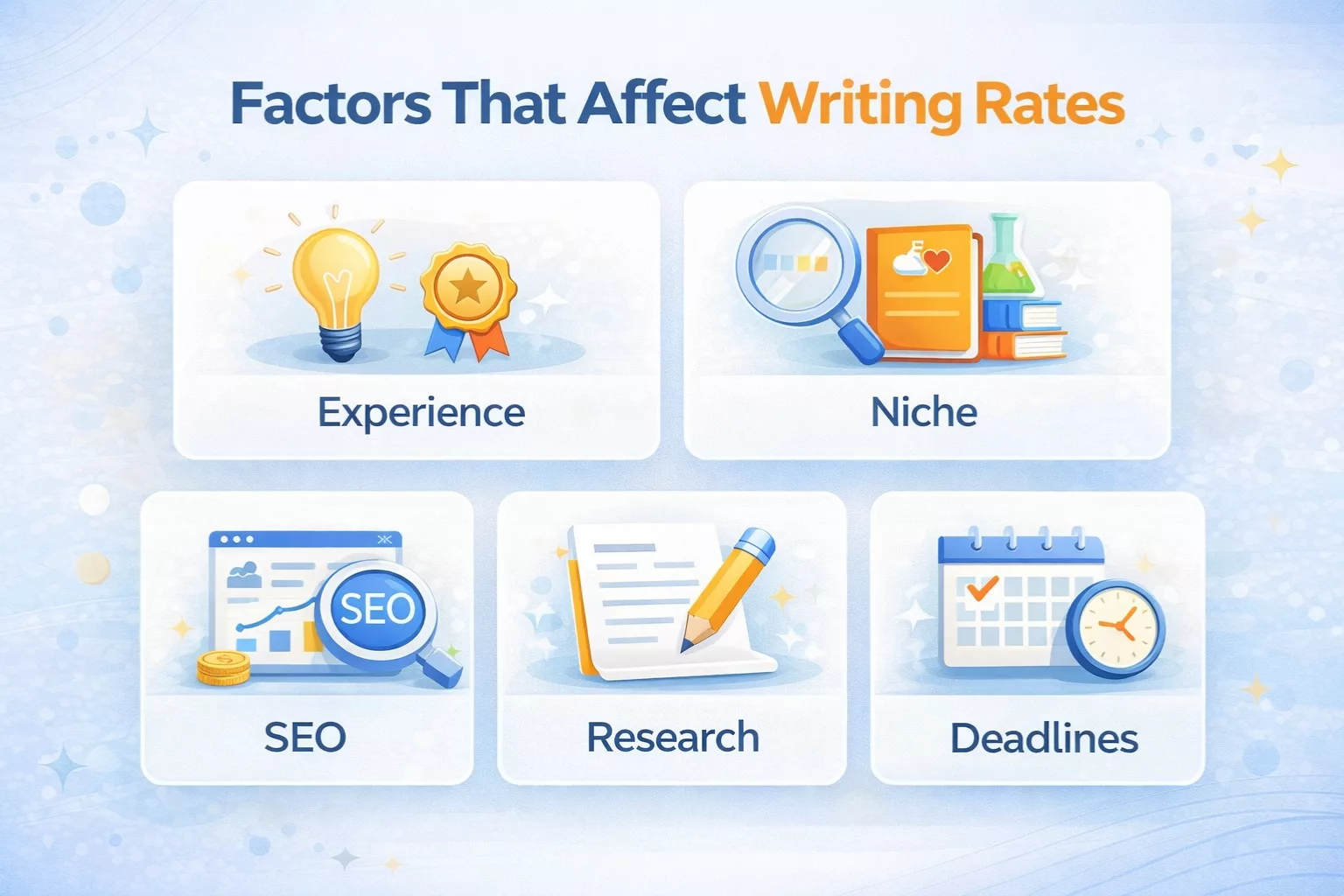
Factors That Affect Digital Writing Rates
One of the biggest misconceptions about digital writing is that pricing is based only on word count or article length. I believed that early on. If two blog posts were both 1,000 words, I assumed they should cost roughly the same.
But after working through different writing projects, it became obvious that word count is only a small part of the picture.
Digital writing rates are influenced by several factors that determine how complex the work is and how much value the content brings to a business. A simple blog article and a high-converting landing page might have the same word count, yet the price difference can be huge.
Once you understand the main factors that affect pricing, digital writing rates start to make much more sense.
Writer Experience
Experience is one of the most important factors influencing writing rates.
A writer who has just started freelancing may still be learning how to research topics, structure content, and meet client expectations. Because of that learning stage, beginner writers usually charge lower rates.
As writers gain experience, their pricing increases. They write faster, make fewer mistakes, and produce content that performs better.
Clients are often willing to pay more for experienced writers because they trust them to deliver reliable results.
Industry Specialization
Writers who specialize in specific industries often command higher rates.
For example, writing about topics like finance, cybersecurity, healthcare, or SaaS requires deeper subject knowledge. Businesses in those industries prefer writers who already understand the terminology and concepts.
Specialized writers save companies time because they need less explanation and produce more accurate content.
That expertise makes them more valuable than generalist writers who cover many unrelated topics.
SEO Expertise
Search engine optimization has become a major part of digital writing.
Content that ranks well in search engines can bring consistent traffic to a website for months or even years. Because of that long-term value, businesses often pay more for writers who understand SEO.
SEO writing involves more than adding keywords. It includes researching search intent, structuring headings properly, optimizing meta descriptions, and analyzing competing pages.
Writers who combine strong writing skills with SEO knowledge can often charge significantly higher rates.
Research Requirements
The amount of research required for a project also affects pricing.
Some articles are straightforward and rely on general knowledge or simple sources. Others require reviewing reports, studying competitors, or analyzing technical documentation.
I remember working on an article about cloud computing that required hours of reading before I could even begin writing. That type of project naturally takes more time and effort.
When research demands increase, writers usually raise their rates to reflect the extra work involved.
Content Length
Length still plays a role in digital writing rates, even though it isn’t the only factor.
Longer articles typically require more writing time, editing, and formatting. A 2,000-word guide will usually cost more than a short 500-word post.
However, experienced writers often combine length with other considerations such as research, SEO strategy, and the complexity of the topic.
That’s why two articles with the same word count can still have very different prices.
Business Impact
The potential business impact of the content is another major factor.
A blog post written for brand awareness may have a modest budget. A sales page designed to generate thousands of dollars in revenue is much more valuable.
Because of that difference, businesses often allocate larger budgets for content that directly influences leads or sales.
Writers who create marketing content such as landing pages, sales emails, and product pages often charge higher rates for this reason.
Project Deadlines
Tight deadlines can also increase writing rates.
If a client needs a project completed quickly, the writer may need to rearrange their schedule or delay other work. That urgency usually comes with an additional fee.
Rush projects often require focused work within a short time frame, which justifies a higher price.
Client Budget
Finally, the client’s budget can influence pricing.
Large companies or well-funded startups often have higher marketing budgets. They may invest heavily in content because they understand its long-term value.
Smaller businesses sometimes have tighter budgets, especially when they are just starting out.
Experienced writers usually learn how to evaluate projects based on both the workload and the client’s expectations.
Once I started looking at digital writing rates through these factors instead of just word counts, pricing became much easier to understand. Rates reflect not just the writing itself, but the expertise, research, and business value behind the content.
Freelance rates vary widely depending on experience and niche. Platforms like Upwork show how pricing ranges can differ across projects and industries.
Common Mistakes Writers Make When Setting Rates
When I first started learning about digital writing rates, I assumed pricing would become obvious after seeing a few examples. I thought I could simply look at what other writers charged and follow the same pattern.
That assumption turned out to be one of the biggest mistakes beginners make.
Setting writing rates is more complicated than copying numbers from a forum or job board. Many writers struggle with pricing because they underestimate the amount of work involved or they lack confidence in their skills.
Over time, I noticed several mistakes that appear again and again when writers try to price their services.
Charging Too Little
The most common mistake new writers make is charging far less than their work is worth.
It’s easy to understand why this happens. When someone is starting out, they want to get their first clients quickly. Lower prices feel like an easy way to stand out.
I remember seeing job listings offering $25 or $30 for full blog posts and thinking that might be normal. Many beginners accept those projects because they want to build experience.
The problem is that extremely low pricing often leads to burnout. Writers end up spending hours researching and editing content while earning very little.
Low pricing can also attract clients who focus only on cost instead of quality.
Copying Rates From Other Writers
Another mistake is setting rates based entirely on what other writers charge.
Freelance communities are full of advice about pricing. Some writers share their rates openly, which can be helpful for understanding the market.
However, copying someone else’s pricing without understanding their experience or niche can lead to problems.
For example, a writer who specializes in SaaS marketing or financial content may charge much higher rates because their work requires specialized knowledge.
A beginner writer trying to copy those rates without the same expertise might struggle to justify the price.
Ignoring Research and Revisions
Many writers underestimate how much time a project actually takes.
Writing the first draft is only one part of the process. Most projects also include research, outlining, editing, formatting, and communication with the client.
Early in my research on writing rates, I noticed that beginners often price projects based only on the writing time itself.
After completing a few articles that required extensive research, it became obvious that those extra steps matter. Ignoring research and revision time can lead to underpricing.
Offering Unlimited Edits
Another mistake that shows up frequently is offering unlimited revisions.
At first this sounds like a great way to reassure clients. Writers sometimes promise unlimited edits to make the offer feel more attractive.
The problem is that unlimited revisions can quickly turn a small project into a long series of changes.
Most experienced writers set clear boundaries around revisions. For example, they might include one or two rounds of edits within the project price.
This keeps the scope manageable and prevents small projects from turning into endless work.
Not Increasing Rates Over Time
One of the most important lessons many writers eventually learn is that pricing should evolve.
As writers gain experience, improve their skills, and develop expertise in certain industries, their value increases.
Yet many freelancers keep charging the same rates they used when they first started.
That hesitation usually comes from uncertainty about how clients will respond. But raising rates gradually is a normal part of building a writing business.
Writers who continue developing their skills, learning SEO, and working with better clients often find that higher rates become easier to justify.
Once I started seeing these patterns, it became clear that digital writing rates are not fixed numbers. They grow as writers gain experience, improve their processes, and understand the real value of the work they provide.
How Beginners Should Price Digital Writing Services?
When someone first starts exploring digital writing, pricing usually feels like the hardest part of the entire process. I remember reading different guides and seeing completely different numbers everywhere. One article would say writers charge $0.05 per word, another would suggest $0.50 per word, and some copywriters talked about charging thousands for a single project.
That range can make beginners feel stuck.
The truth is that early pricing doesn’t need to be perfect. In the beginning, the goal is not to maximize income. The goal is to gain experience, build confidence, and learn how client projects actually work.
Once those things start coming together, pricing becomes much easier to adjust.
Setting Starting Rates
Most beginners start with modest rates while they are learning the basics of digital writing.
Typical starting prices might include things like $50 to $150 for a blog post or a similar range for short website content. These projects help writers practice research, formatting, and writing for online audiences.
When I first looked at beginner pricing, I expected there to be a strict standard. Instead, I noticed that many writers experiment with different price points until they find something that works.
The important thing is choosing a rate that still respects your time. Even when starting out, pricing should reflect the effort required to complete the work.
Building a Portfolio
Before writers can raise their rates, they need examples that show what they can do.
That’s where a portfolio becomes essential. Clients often want to see writing samples before hiring someone, especially if the project involves website copy or marketing content.
Many beginners build their portfolio by writing a few sample blog posts or articles in industries they enjoy. Some writers publish their samples on personal blogs or platforms like Medium.
Over time, these samples demonstrate writing style, topic knowledge, and content structure.
A strong portfolio often makes it much easier to justify higher rates.
Here’s how to build writing samples that get clients instead of being ignored.
Finding First Clients
The next step is gaining real client experience.
Many beginners find their first writing projects through freelance platforms, job boards, or small business websites that need content updates.
Early projects often involve tasks like:
- Writing blog posts
- Updating website content
- Creating product descriptions
- Drafting simple email messages
Even though these projects may not pay premium rates, they provide valuable experience working with real clients and deadlines.
Once writers complete several successful projects, their confidence and reputation begin to grow.
The next step is learning how to get writing clients so you can actually apply your rates in real situations.
Gradually Increasing Prices
One mistake I noticed many new writers make is keeping the same pricing for too long.
As writers gain experience and improve their workflow, they usually complete projects faster and produce better results. That increased efficiency means their time becomes more valuable.
Gradually increasing rates is a natural step in the process.
For example, a writer who started charging $75 per article might increase the price to $150 after gaining experience and building a portfolio.
Small increases over time help writers move toward sustainable pricing while maintaining strong relationships with clients.
Positioning as a Specialist
Eventually many writers discover that specialization helps them increase their rates more quickly.
Instead of writing about dozens of unrelated topics, some writers focus on a specific industry such as technology, finance, SaaS, or digital marketing.
Specialists often understand the industry vocabulary, common problems, and audience expectations much better than general writers.
Because of that expertise, businesses in those industries are often willing to pay higher rates.
Once I started noticing this pattern, the path forward became clearer. Beginners usually start with general writing work, but as they gain experience and identify industries they enjoy, specializing can open the door to higher-paying digital writing projects.

Key Takeaways
- Digital writing rates vary widely depending on experience, niche expertise, and project complexity.
- Common pricing models include per-word rates, hourly pricing, project-based pricing, and monthly retainers.
- Blog posts typically range from $150 to $800, while long-form SEO content may reach $2,000.
- High-impact marketing content such as sales pages and email campaigns often commands the highest rates.
- Specializing in industries like SaaS, finance, or healthcare can significantly increase writing income.
- Using an income-based pricing formula helps writers set sustainable and profitable rates.
Conclusion
Digital writing rates vary widely because writing projects differ in complexity, expertise, and business value.
Simple blog posts may cost a few hundred dollars, while high-impact marketing content can cost several thousand.
For writers, understanding pricing models and market rates helps build a sustainable career.
For businesses, investing in experienced writers often leads to better content, stronger search rankings, and higher conversions.
If you want to understand how strong copy drives higher rates, this marketing newsletter review breaks down real-world strategies.
Frequently Asked Questions
How much do freelance writers charge?
Freelance writing rates typically range from $50 to $800 per blog post, depending on experience, niche, and complexity. High-value projects like sales pages can cost $2,000 or more.
What is a good rate for beginner writers?
Beginner writers often charge between $50 and $150 per article while building a portfolio. Rates usually increase as writers gain experience and specialize.
How are digital writing rates calculated?
Digital writing rates are based on income goals, available working hours, project complexity, and the business value of the content. Many writers convert hourly goals into project-based pricing.
Do freelance writers charge per word or per project?
Writers may charge per word, per hour, or per project. Experienced writers often prefer project-based pricing because it reflects the value of the content rather than time spent.
Why do writing rates vary so much?
Rates vary due to experience, specialization, research requirements, SEO expertise, and the impact the content has on business results. Conversion-focused writing usually commands higher prices.