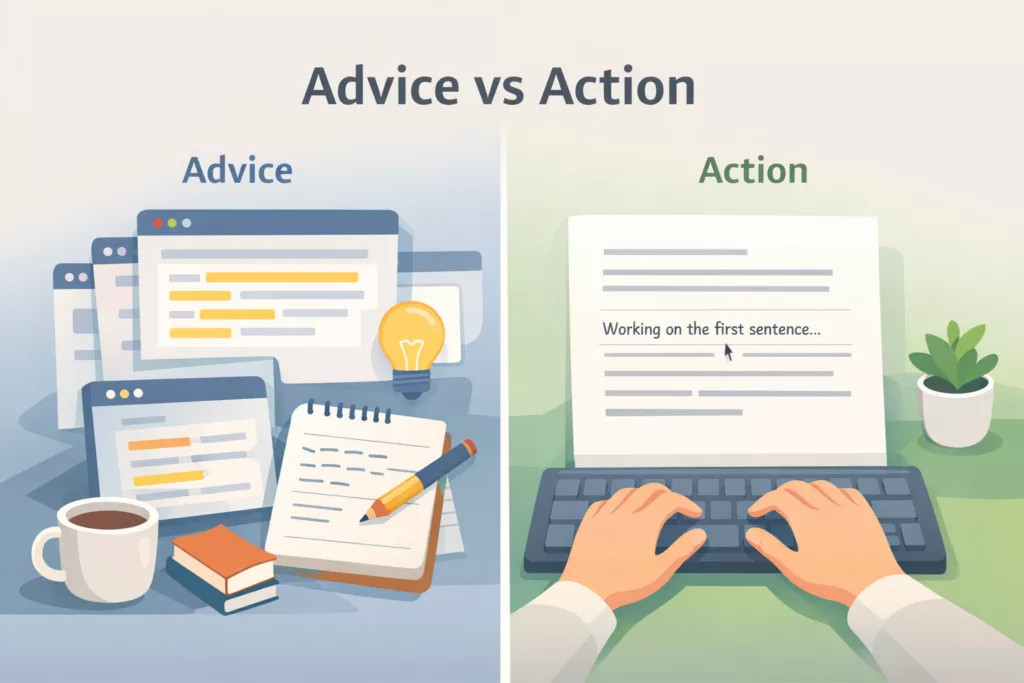
You sit down to write and open a few tabs first.
One article on hooks. Another on structure. A third on common mistakes. You save them. You take notes. It feels like you are doing the work.
That feeling is real.
Reading writing advice reduces uncertainty. It explains problems you could not name before. For a moment, you feel clearer and more confident.
Then you start writing, and the page still feels heavy. The words still come out slow. The progress you felt while reading does not show up in the draft.
This is the tension many beginners face.
Learning feels useful. Progress still feels stuck.
This article shifts the focus from consuming advice to practicing skills, because real clarity only shows up when you start doing the work.
TL;DR
Reading writing advice feels like progress because it reduces anxiety and makes you feel informed. But real improvement only happens when you practice. Use one structure, repeat it, and write in short sessions. Guidance helps most when it pushes you into action and limits your choices.
Table of Content
Why Writing Advice Feels Helpful but Often Stalls Progress?

Writing advice helps because it lowers anxiety.
When you read an article that explains hooks, structure, or clarity, things feel less messy. You finally have words for the problems you sensed but could not describe. That alone brings relief.
Advice also feels safe.
There is no risk in reading. No blank page to face. No awkward sentences to judge. You can stay in learning mode and avoid the discomfort that shows up once you start writing.
This is where many beginners get stuck in preparation mode.
Reading creates the illusion of forward motion. You are busy. You are focused. You feel motivated. But nothing new exists yet. No draft. No practice. No feedback.
The tricky part is that motivation often spikes here.
While reading, motivation feels high. You feel inspired and ready. But once the reading stops and writing begins, that motivation drops. The work suddenly feels heavier. This pattern is explored more deeply in Why Motivation Fails New Writers, because motivation rises during consumption and fades during execution.
That does not mean anything is wrong with you.
It means you are choosing comfort over growth without realizing it. Advice keeps you informed. Action makes you better. Progress begins the moment you move from understanding the work to doing it.
If effort feels high but results feel low, this explains why: why writing consistency feels hard at first.
Psychologists have noted that preparation often replaces action because it reduces anxiety, even when it delays progress, a pattern explored in behavioral research published by Psychology Today.
The Difference Between Knowing What to Do and Actually Doing It
Knowing what to do feels close to doing it, but the two are not the same.
You can understand structure and still struggle to use it. You can explain what a strong intro looks like and still stare at the first sentence. You can read feedback and agree with it, yet freeze when it is time to apply it.
This gap is where most beginners feel confused.
Advice lives in your head. Writing lives on the page. Clarity only shows up once you start moving words around, testing ideas, and seeing what actually works.
Writing exposes problems advice cannot solve.
You do not feel where an intro drags until you write one. You do not notice weak transitions until you try to connect two ideas. You do not understand endings until you attempt to close a piece and realize it falls flat.
These moments feel uncomfortable, but they are useful. They show you exactly what to work on next. No article can replace that feedback. Only execution reveals it.
This is why progress feels slow when you only read. Understanding creates awareness. Action creates skill.
The key takeaway is simple. Skill lives in movement, not understanding.
Once you stop collecting advice, the real question becomes how to turn writing into income. This explains it simply: how to get writing clients.
Research on learning shows that real improvement often feels uncomfortable, especially when knowledge shifts into practice, a gap well documented by Harvard Business Review.
If you want to move from reading into real practice, the Writing Basics hub pulls together the few fundamentals that actually help beginners make progress.
Why Repetition Matters More Than Variety for Beginners?
Many beginners believe progress comes from learning more.
More tips. More frameworks. More approaches. Each new idea feels like an upgrade. In reality, constant switching resets your learning.
Every time you change advice, you start over.
Repetition works differently. It builds pattern recognition. When you write the same type of piece again and again, you begin to notice what actually improves your writing. You see what breaks. You see what holds.
Familiar structure lowers friction.
You do not waste energy deciding how to start. You already know the shape of the work. That mental space goes toward writing better sentences instead of making choices.
Fewer variables lead to faster improvement.
When the format stays the same, feedback becomes clearer. You can tell if your intro improved. You can feel when transitions flow better. Progress becomes easier to measure.
This is why writing the same kind of article repeatedly helps beginners more than trying something new every time. Predictability builds confidence. Confidence makes writing easier. And easier writing leads to more practice.
Repetition is not boring. It is how skill compounds.
This focus on repetition over variety aligns with research on skill development, including work shared by James Clear, which shows how consistent practice compounds over time.
When Guidance Actually Shortens the Learning Curve?
The problem is not advice.
Advice becomes a problem only when it is consumed without action. Reading alone does not change how you write. Guided practice does.
Guidance works when it comes with movement. When you are asked to write, not just understand. When the next step is clear and small enough to start.
Limits matter here.
Too many choices slow beginners down. Clear guidance removes decisions. It narrows the focus to one structure, one task, one session. That simplicity makes practice possible.
Repetition matters too.
Good guidance does not send you chasing new ideas. It keeps you working on the same skill long enough for it to stick. Progress speeds up when you repeat the right actions instead of collecting more information.
This is the difference between instruction and support.
Instruction tells you what good writing looks like. Support helps you practice until you can create it yourself.
Most beginners do not need more theory. They need clarity around what to practice next, how often to repeat it, and what actually moves the needle.
That distinction is exactly what we will explore next in What New Writers Actually Need to Improve.
Key Takeaways
- Advice can feel productive, but it often keeps beginners in preparation mode.
- Knowing what to do is not the same as doing it. Skill comes from writing.
- Repetition beats variety because it builds pattern recognition and confidence.
- Guidance speeds progress when it includes action, limits choices, and encourages reps.
- The next step is simple: one structure, one session, one small action.
Progress Starts When Reading Turns Into Doing
Reading writing advice can help, but it cannot carry you forward on its own.
Understanding does not equal progress. It only prepares the ground. Real improvement starts when words hit the page and problems show themselves.
If you hesitate here, that is normal.
Doing feels heavier than reading. It asks for effort, not insight. That does not mean you are stuck. It means you are standing at the point where growth begins.
Commitment does not need to be big.
One structure is enough. One writing session is enough. One small action moves you further than another saved article ever will.
You do not need more information right now. You need a place to apply what you already know.
The next step is not about learning more. It is about choosing what to practice next and giving it your full attention.
A Simple Next Step
If this article resonated, take that as a sign of readiness.
Not readiness to learn more, but readiness to practice. You already understand enough to move forward. What matters now is choosing one thing to work on and giving it space.
Pick one structure. Set aside one short session. Write without trying to improve everything at once.
There is no rush here. No finish line to chase.
Progress comes from steady action, not perfect preparation. The next step is simply deciding to do the work, then showing up for it.
FAQs
Why do I feel productive reading writing advice even when I do not improve?
Because advice reduces anxiety and gives you language for your confusion. That mental clarity feels like progress, but skill only grows when you write.
How much writing practice do I need to actually improve?
Less than you think. A short session done often beats a long session done once. Aim for consistency over intensity.
Should beginners stop reading writing advice completely?
No. Keep reading, but only if it leads to action. Use advice to choose one practice task, then write right away.
What is the fastest way to improve as a beginner writer?
Repeat the same type of writing task for a while. Fewer variables make it easier to spot what is working and what needs fixing.
What should I practice if I feel overwhelmed by options?
Pick one structure and stick to it for a week. Write a simple piece with an intro, a few clear points, and a short ending. The goal is reps, not perfection.