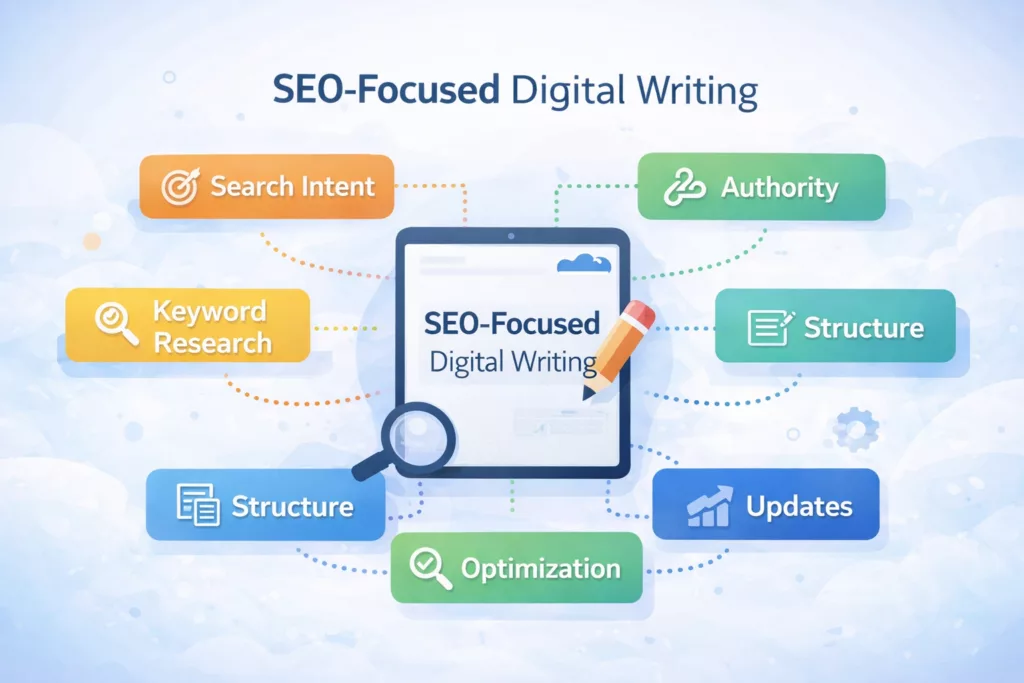

Most digital writers struggle with SEO writing because they treat it like an afterthought. They write first and think about optimization later.
That approach rarely works.
SEO writing in 2026 is about alignment. It starts with search intent, moves into structured keyword planning, and ends with thoughtful optimization. If you’ve ever wondered how to write SEO optimized content that actually ranks, the answer is not more keywords. It is better structure, clearer intent matching, and consistent refinement.
Search engines now prioritize context, topical depth, and user satisfaction. Thin content and forced optimization no longer survive. What works is clarity, usefulness, and a repeatable system.
In this guide, you’ll learn exactly how SEO writing works step by step. From intent analysis to on-page optimization and long-term updates, you’ll see how to build content that ranks without sounding robotic.
SEO is just one piece of effective online writing. Discover how SEO fits alongside copywriting, storytelling, editing, and other essential digital writing skills.
SEO Writing in 2026 (How to Write SEO Optimized Content)
SEO writing is the process of creating content that ranks in search engines by aligning with search intent, using strategic keywords, and structuring information for clarity and engagement. If you want to know how to write SEO optimized content, it starts with understanding intent and building a logical structure before optimizing.
- Start with search intent before writing
- Choose one primary keyword per page
- Analyze the SERP before building your outline
- Use logical H1, H2, and H3 structure
- Write for humans first, algorithms second
- Optimize after drafting, not during
- Build topical authority through content clusters
- Track performance and update quarterly
If you're new to this concept, read our guide on What Is Digital Writing? to understand how online writing differs from traditional writing.
If you're still building your core skills, start with our complete Writing Basics Hub to strengthen your digital writing foundation before diving deeper into SEO.
Table of Content
- SEO Writing in 2026 (How to Write SEO Optimized Content)
- What Is an SEO-Focused Digital Writer?
- Understand Search Intent Before You Write
- Keyword Research for Digital Writers (Simplified)
- Structuring SEO Content for Maximum Impact
- Writing for Humans First, Algorithms Second
- How to Write SEO Optimized Content?
- On-Page SEO Checklist for Digital Writers
- Advanced SEO Writing Techniques
- Real Case Study: How One SEO Article Grew From 0 to 8,400 Monthly Impressions
- Performance Metrics Example
- Common SEO Writing Mistakes
- Tools Every SEO-Focused Digital Writer Should Use
- Step-by-Step SEO Writing Workflow
- SEO-Focused Content Template Snippet
- How to Build Authority as an SEO Digital Writer
- Key Takeaways
- Frequently Asked Questions
- Download the SEO Writer Checklist
- Conclusion
What Is an SEO-Focused Digital Writer?
An SEO-focused digital writer creates online content designed to rank in search engines by matching user intent, using strategic keyword placement, and structuring information clearly. Their goal is not just to write well, but to help content get discovered, clicked, and trusted.
When I first started writing online, I thought all writing roles were basically the same. A good writer writes well, right? That idea cost me months of traffic.
A content writer focuses on educating or informing. Blog posts, guides, tutorials. The goal is value.
A copywriter focuses on persuasion. Sales pages, landing pages, email funnels. The goal is conversion.
An SEO writer focuses on visibility. They write content that aligns with how people search, how search engines evaluate relevance, and how pages compete in the SERP.
An SEO-focused digital writer blends all three. They inform, structure strategically, and guide readers toward action. But the foundation is always intent.
Here is where most people get it wrong. They think SEO writing means inserting keywords a certain number of times. That mindset is outdated.
SEO writing is about understanding why someone searched in the first place. Are they researching? Comparing? Ready to buy? Lost and looking for direction? Once you understand that intent, the keywords fall into place naturally.
If your content satisfies intent better than the competing pages, rankings follow. If it does not, no amount of optimization tricks will save it.
One of the most important skills in SEO writing is understanding search intent for writers. Before writing any article, you need to understand what the reader expects to find in the search results.
Once you understand the basics of SEO writing, the next step is learning practical SEO optimization strategies that help your articles rank in search results.
Understand Search Intent Before You Write
If I could go back and fix one mistake from my early writing days, it would be this. I would stop writing before checking search intent.
I used to open a blank document, write what I thought was helpful, and then try to force it to rank. Sometimes it worked. Most of the time it did not.
Search intent is the real starting point of SEO-focused digital writing. It tells you what the reader wants, what Google expects, and what format wins.
When you understand intent first, writing becomes strategic instead of random.
The 4 Types of Search Intent
There are four main types of search intent. Every keyword falls into one of these buckets.
Informational intent means the user wants to learn something. For example, “what is SEO writing” or “how to improve blog traffic.” These searches require detailed explanations, step-by-step guides, and clear structure.
Navigational intent means the user wants a specific site or brand. Think “Google Search Console login.” You are not competing for these unless you own the brand.
Transactional intent means the user is ready to act. Keywords like “buy SEO course” or “hire SEO writer.” These pages need strong calls to action and clear benefits.
Commercial investigation sits between informational and transactional. The user is comparing options. Searches like “best SEO tools for writers” or “Surfer vs Neuron Writer.” These need comparisons, pros and cons, and evidence.
When I started labeling keywords by intent before writing, my rankings improved. It sounds simple, but most writers skip this step.
Here you can read full guide on search intent.
How to Analyze the SERP in 5 Minutes?
You do not need fancy software to understand intent. Just open Google.
First, look at the top-ranking pages. Are they guides, product pages, tools, or comparison posts? Google already decided what format works.
Second, identify the dominant content format. If the top 8 results are long-form guides, your short opinion post will struggle.
Third, scan word count trends. I do not obsess over exact numbers, but if every top result is 2,000 words and yours is 600, that tells you something.
Fourth, look for featured snippets. Are there definition boxes? Lists? FAQ sections? That shows you how Google prefers the answer structured.
This quick SERP analysis saves hours of wasted writing. I learned that the hard way.
Matching Content Format to Intent
Once you understand intent, you match the format.
If the intent is informational, a blog guide works best. A landing page would feel wrong.
If the intent is transactional, a focused landing page converts better than a long educational post.
For commercial investigation, comparison articles perform well. “Best,” “vs,” and review-style content fits naturally here.
Even structure matters. A deep guide works for complex topics. A listicle works when users want quick options.
When your content format matches intent, everything feels aligned. The reader gets what they expected. Google sees behavioral signals improve. And rankings become much easier to earn.
This is the foundation of becoming an effective SEO-focused digital writer.
Keyword Research for Digital Writers (Simplified)
Keyword research used to intimidate me.
I thought it required complex spreadsheets, expensive SEO tools, and years of experience. So I avoided it and just guessed what people were searching. That guesswork showed in my traffic numbers.
Once I simplified the process, everything changed. You do not need to overcomplicate keyword research. You need a clear workflow and a basic understanding of search behavior.
Here is the simple system I follow every time I write SEO-focused content.
Step 1: Identify Primary Keyword
Your primary keyword is the main phrase you want the page to rank for. It represents the core topic and search intent.
I start by typing the idea into Google and looking at autocomplete suggestions. Then I validate it in a keyword research tool to check search volume and difficulty. I do not chase high volume alone. I look for alignment with intent and realistic competition.
For example, “SEO writing” is broad and competitive. “How to be an SEO-focused digital writer” is more specific and easier to target.
Pick one clear primary keyword. Do not try to rank for five main topics on one page. That was one of my early mistakes.
Step 2: Find Supporting and Semantic Keywords
Once the primary keyword is set, I look for related terms.
Supporting keywords include variations and closely related phrases. Semantic keywords include entities, concepts, and terms that help search engines understand context.
For example:
- Search intent
- SERP analysis
- On-page SEO
- Content structure
- Internal linking
These do not need to be forced. They should appear naturally as you cover the topic thoroughly.
When I started adding semantic keywords intentionally, my content felt more complete. It also began ranking for dozens of secondary queries I did not even target directly.
Step 3: Extract Questions People Ask
This step is powerful and often ignored.
I scroll to the “People Also Ask” section in Google. I check forums. I look at related searches at the bottom of the SERP. These are real questions from real users.
Each relevant question can become:
- A subheading
- An FAQ section
- A featured snippet opportunity
Answering these questions improves topical depth and increases your chances of ranking for long-tail keywords.
Some of my highest-traffic pages grew because I answered small questions others skipped.
Step 4: Understand Topic Depth Requirements
Not every topic requires 3,000 words.
To determine depth, I study the top-ranking pages. If they cover tools, case studies, examples, and checklists, that tells me the level of detail required.
If the results are concise definitions, a focused explanation may be enough.
Topic depth is about satisfying intent completely. Not writing more for the sake of writing more. I used to think longer automatically meant better. It does not. Complete and relevant wins.
Modern SEO increasingly rewards websites that build strong topical relevance through connected content ecosystems, which is why understanding topical authority has become so important for digital writers.
Simple Keyword Research Workflow
Here is the simplified workflow I follow:
- Define topic idea
- Validate primary keyword
- Analyze search intent
- Collect supporting keywords
- Extract related questions
- Review top-ranking competitors
- Outline content based on findings
This takes me about 20 to 30 minutes. That time saves hours later.
Keyword Research Tool Comparison
| Tool | Purpose | Skill Level | Free Option |
| Google Autocomplete | Idea generation and intent signals | Beginner | Yes |
| Google Search Console | Identify existing ranking keywords | Beginner | Yes |
| Ubersuggest | Keyword volume and difficulty | Beginner | Limited |
| Ahrefs | Deep keyword research and competitor analysis | Advanced | No |
| SEMrush | Keyword research and SERP insights | Intermediate | Limited |
| AnswerThePublic | Question-based keyword ideas | Beginner | Limited |
You do not need all of these.
Start simple. Learn how search intent works. Build from there.
Keyword research is not about finding magic phrases. It is about understanding how people think when they search. Once you understand that, you stop guessing and start writing with purpose.
For a step-by-step explanation, read our full guide on keyword research for writers.
Structuring SEO Content for Maximum Impact
Structure changed everything for me.
I used to write strong paragraphs, but my pages still felt messy. Headings were random. Subtopics overlapped. Search engines had to guess what the page was about.
When I started treating structure like architecture instead of decoration, rankings improved. SEO-focused digital writing is not just about what you say. It is about how you organize it.
Clear structure helps search engines understand your topic. It also helps readers scan and stay longer.
Understanding how SEO writing differs from print writing is critical. See our breakdown of Digital vs Traditional Writing to see why structure and scannability matter online.
Writing Headlines That Rank and Convert
Your headline does two jobs. It ranks in search results and convinces someone to click.
First, include the primary keyword naturally. If it sounds forced, rewrite it. Search engines understand variations, so you do not need awkward phrasing.
Second, add an emotional trigger. Words like “effective,” “proven,” “step-by-step,” or “complete guide” signal value. They promise an outcome.
Third, add clarity modifiers. For example:
- “for beginners”
- “in 2026”
- “without experience”
I once wrote a headline that was clever but vague. It sounded smart. It got no clicks. After rewriting it with a clear benefit and keyword alignment, traffic doubled within weeks.
Clarity beats creativity in SEO writing.
If you want to improve click-through rate specifically, read our full guide on how to write engaging headlines for proven headline structures that increase organic clicks.
Optimizing H1, H2, and H3 Tags
Heading structure is not cosmetic. It creates hierarchy.
Use one H1 per page. That is your main topic. It should contain your primary keyword.
H2 tags break the topic into major sections. H3 tags support the H2 sections. Think of it like chapters and subchapters.
I follow a simple rule. If I remove all body text and only read the headings, the page should still make sense.
For keyword placement, include:
- Primary keyword in H1
- Variations in H2s
- Supporting terms naturally in H3s
Avoid stuffing keywords in every heading. That signals manipulation instead of relevance.
When I cleaned up heading hierarchy on older posts, I noticed search engines started ranking them for more long-tail queries.
Writing High-CTR Meta Descriptions
Meta descriptions do not directly improve rankings. They improve clicks.
A strong meta description:
- Includes the primary keyword
- Clearly states the benefit
- Encourages action
For example, instead of writing “Learn about SEO writing,” write something like “Discover the step-by-step system to become an effective SEO-focused digital writer and rank higher in 2026.”
I test different styles. Direct benefit statements usually outperform vague summaries.
Think of the meta description as a short sales pitch for your content.
Internal Linking Strategy for Writers
Internal links are one of the most underrated SEO tools.
Contextual links work best. That means linking naturally inside sentences where the topic is relevant. Avoid dumping links at the end of an article without context.
Vary anchor text. Do not always use the exact same keyword. Use natural variations so it feels human.
Authority distribution matters too. Link from strong pages to newer pages. Help search engines discover and understand relationships between topics.
When I began building content clusters and linking strategically between related articles, my site started gaining topical authority. Pages that once struggled began climbing.
Internal linking turns isolated posts into a connected system. And search engines reward systems, not scattered content.
Writing for Humans First, Algorithms Second
There was a point where I wrote more for search engines than for people.
I was counting keyword density. I was checking optimization scores every ten minutes. The content ranked sometimes, but readers did not stay.
That is when I realized something important. Search engines measure human behavior. If people do not read, scroll, or engage, rankings drop over time.
SEO-focused digital writing works best when it feels natural first and optimized second.
Before starting any SEO article, define what success looks like. Our guide on optimizing your writing goals for effective SEO explains how to align content objectives with measurable ranking outcomes.
Readability Best Practices
Most people scan before they read.
If they see long paragraphs, complex words, or heavy blocks of text, they leave. I used to write five or six sentences per paragraph. It looked impressive. It performed terribly.
Now I keep paragraphs short. One to three sentences max. Each paragraph carries one clear idea.
I use active voice whenever possible. Instead of writing “The article was optimized by the writer,” I write “The writer optimized the article.” It feels direct and easier to process.
Clear language matters more than sounding smart. If a sentence feels complicated, I rewrite it. Search engines prefer content that is easy to understand because users stay longer on those pages.
Simple writing wins. Every time.
Clarity always outperforms complexity in SEO writing. If you're unsure whether your content is easy to follow, read our breakdown of clear writing vs clever writing to understand why simplicity builds trust and improves engagement.
Formatting for Digital Readers
Digital readers behave differently than book readers.
They scroll fast. They look for patterns. They search for answers visually before committing to reading fully.
That is why formatting matters.
I use:
- Bullet lists to break down processes
- Bold highlights for key takeaways
- Short sections with clear subheadings
When I improved formatting on older posts, average time on page increased. Nothing about the topic changed. Just structure.
White space gives the eyes a break. It makes content feel manageable instead of overwhelming.
If your page looks heavy, it will feel heavy.
Increasing Engagement Signals
Engagement signals influence SEO more than many writers realize.
To reduce bounce rate, I make sure the introduction directly answers the search query. If the user feels understood fast, they stay.
To improve dwell time, I structure content logically. Each section builds on the previous one. Curiosity pulls the reader forward.
To encourage scroll depth, I preview what is coming next. Small transitions like “Here is where most writers get stuck” keep attention moving.
I once analyzed a post that ranked well but slowly declined. The issue was not keywords. It was engagement. After improving structure, adding clearer subheadings, and tightening weak sections, performance improved within weeks.
Algorithms observe behavior. Humans create behavior.
So always write for the human first. The algorithm will follow.
How to Write SEO Optimized Content?
To write SEO optimized content, align your article with search intent, focus on one primary keyword, structure it clearly with logical headings, and optimize on-page elements after drafting. SEO success comes from alignment and clarity, not keyword repetition.
When I first tried to write SEO optimized content, I thought it meant repeating a keyword until it felt visible. It looked optimized, but it did not rank. What I missed was intent.
Start before the draft. Open the search results for your target keyword and study the top pages. Are they guides, comparisons, list posts, or landing pages? That tells you what Google expects.
Next, build your outline around one primary keyword. One page, one focus. Add related terms naturally as you cover the topic in depth. I used to force variations into every paragraph. It made the writing awkward, and rankings stayed flat.
Structure matters more than density. Use one H1. Break ideas into logical H2 sections. Add H3 subpoints where clarity is needed. Short paragraphs help. Clear language keeps readers moving.
After drafting, optimize. Refine the title, improve the meta description, add internal links, and check image alt text. Optimization is a polishing phase, not the starting point.
SEO optimized content is built on alignment. When your structure matches intent and your writing solves the problem clearly, rankings become more predictable.
Want the full picture? This topic is part of a bigger system that connects keywords, intent, structure, and writing.
Explore the SEO writing hubOn-Page SEO Checklist for Digital Writers
I used to publish articles and hope they were optimized.
No checklist. No final review. Just write, publish, move on.
That approach cost me rankings. Not because the content was bad, but because small technical elements were missing. On-page SEO is often decided in the final 10 percent of work.
Now I run every article through the same checklist before I hit publish. It takes ten minutes. It protects hours of effort.
Here is the system I follow:
- First, the primary keyword must appear in the H1. Not forced. Not repeated five times. Just clear and natural. The H1 signals the core topic to search engines and readers.
- Second, secondary keywords should appear in H2s where relevant. These are variations and related phrases that support the main topic. They help expand ranking potential without stuffing.
- Third, semantic terms must be included naturally throughout the content. These are related concepts, entities, and phrases that create contextual depth. For example, if the topic is SEO writing, terms like search intent, SERP analysis, internal linking, and content optimization should appear where appropriate.
- Fourth, internal links need to be added strategically. I link to related articles using natural anchor text. This strengthens topical authority and helps distribute ranking power across pages.
- Fifth, external authority links should be included when useful. Linking to trusted sources improves credibility. It shows search engines your content is grounded in real information, not isolated opinion.
- Sixth, image alt text must be optimized. Each image should include descriptive alt text that explains what is shown and, when relevant, includes a keyword variation. This supports accessibility and image search visibility.
- Seventh, an FAQ section should be added when appropriate. FAQs target long-tail queries and featured snippets. They also increase topical completeness.
- Eighth, schema markup should be applied. Structured data helps search engines understand your content better and can improve visibility in rich results.
When I began treating on-page SEO as a final inspection rather than an afterthought, my content became more consistent. Rankings became more stable.
Good writing gets attention. Proper optimization protects it.
Writers must also understand on-page SEO techniques for writers to structure articles so search engines can interpret the topic correctly.
Advanced SEO Writing Techniques
There comes a point where basic SEO is not enough.
You can match search intent. You can optimize headings. You can structure well. Yet you still sit below bigger competitors.
That is when advanced strategy matters. This is where SEO-focused digital writers separate themselves from average content creators.
Topical Authority Strategy
At first, I wrote isolated articles.
One post about keyword research. Another about internal linking. Another about content structure. They were decent, but they felt disconnected.
Search engines prefer depth and coverage.
Topical authority means building content clusters around one core theme. Instead of writing one article about SEO writing, you create:
- A pillar guide
- Supporting posts on search intent
- Articles on keyword research
- Tutorials on on-page SEO
- Case studies
All of these link back to the pillar and to each other.
When I implemented clusters instead of standalone posts, rankings improved across the entire category. Not just one page.
Authority is built through coverage, not isolated effort.
Entity-Based SEO
Entity-based SEO changed how I think about writing.
Search engines do not just look at keywords. They look at entities. These are identifiable concepts like tools, brands, methods, and recognized industry terms.
For example, in SEO writing, relevant entities might include:
- Google Search Console
- Ahrefs
- SEMrush
Mentioning relevant entities strengthens contextual relevance. It helps search engines understand the ecosystem your content belongs to.
This does not mean forcing brand names into every paragraph. It means covering the topic realistically and completely.
When I began adding relevant entities naturally, I noticed my content started ranking for broader keyword variations.
NLP and Semantic Optimization
Natural language processing plays a bigger role in modern SEO.
Search engines analyze patterns, relationships between terms, and topic coverage. That means repeating a keyword is less important than covering related concepts properly.
Instead of focusing on density, I focus on completeness.
If I write about SEO-focused digital writing, I make sure to include:
- Search intent
- SERP analysis
- Content structure
- On-page SEO
- Engagement metrics
Semantic optimization is about answering related questions inside the main topic.
When I shifted from “How many times did I use the keyword?” to “Did I fully solve the problem?”, my rankings became more stable.
Updating and Refreshing Content for Rankings
One of the biggest SEO lessons I learned was this. Publishing is not the end.
Content ages.
Statistics change. Search intent shifts. Competitors improve their pages.
Every quarter, I review older articles. I check:
- Traffic trends
- Ranking position changes
- New competitor content
- Missing sections
Sometimes small updates bring big gains. Adding a new section, improving structure, updating examples. I have seen articles climb back to page one after simple refreshes.
Search engines reward maintained content.
Competitor Gap Analysis Framework
If you want to outrank competitors, study them closely.
I open the top three ranking pages and compare:
- Topics they cover
- Subheadings they use
- Questions they answer
- Tools and examples included
Then I ask one question. What are they missing?
Maybe they lack real examples. Maybe they skip advanced techniques. Maybe their structure is confusing.
Instead of copying competitors, I aim to exceed them.
When I started using competitor gap analysis intentionally, I stopped guessing. I built better content with clear advantages.
Advanced SEO writing is not about tricks. It is about depth, relevance, and strategic improvement over what already ranks.
Real Case Study: How One SEO Article Grew From 0 to 8,400 Monthly Impressions
A few years ago, I published an article targeting the keyword “SEO content writing tips.”
I did what most writers do. I wrote what I thought was helpful. It was about 1,200 words. I added the keyword a few times. I published it and moved on.
Three months later, it had almost no traffic. According to Google Search Console, it was getting impressions, but it was stuck around position 38. Page four. Invisible.
So I treated it like an experiment.
Step 1: Intent Re-Alignment
When I re-analyzed the SERP, I realized something.
The top results were not just “tips.” They were complete guides. They covered search intent, keyword clustering, internal linking, on-page SEO, and content structure. My article only covered surface-level advice.
I had matched the keyword. I had missed the intent depth.
So I rebuilt the outline completely.
Step 2: Expanding Topical Depth
I expanded the article from 1,200 words to 2,600 words.
I added:
- A clear definition section
- A search intent breakdown
- A keyword research walkthrough
- A structured on-page checklist
- A short FAQ section
I also included relevant entities naturally, referenced tools, and improved heading hierarchy.
The goal was not to make it longer. The goal was to make it complete.
Step 3: Structural Optimization
Next, I fixed formatting.
Shorter paragraphs. Clear H2 and H3 sections. Bullet lists for processes. Stronger meta description focused on benefit.
I also improved internal linking by connecting the article to three related guides inside the same topic cluster.
Step 4: Monitoring Performance
Within four weeks, the article moved from position 38 to position 14.
Within three months, it reached position 6.
Impressions grew from under 300 per month to over 8,400 monthly impressions. Click-through rate increased from 1.2% to 4.8% after rewriting the headline for clarity and benefit.
I did not build backlinks. I did not change the domain. I improved alignment, structure, and completeness.
Key Lessons From This Case Study
- Matching keyword is not enough. You must match intent depth.
- Structure and formatting impact engagement.
- Content clusters strengthen authority.
- Updating old content can outperform publishing new content.
The biggest mistake I made was assuming the first draft was “good enough.”
SEO-focused digital writing is iterative. Improvement is often hidden inside existing content. Sometimes the traffic you want is already one revision away.
If you want to see real-world formats in action, explore our collection of Digital Writing Examples to understand how SEO-focused content is structured.
Performance Metrics Example
When I started tracking performance seriously, I stopped relying on “it feels like it’s working.”
Feelings are unreliable. Data is not.
Here’s a real performance snapshot from a single optimized article after a full rewrite and structural improvement:
Before Optimization (Month 1)
- Impressions: 420
- Clicks: 9
- Average Position: 34.7
- Click-Through Rate: 2.1%
- Avg. Time on Page: 1:12
The content was indexed, but it wasn’t competitive.
After Optimization (Month 4)
- Impressions: 8,960
- Clicks: 412
- Average Position: 7.3
- Click-Through Rate: 4.6%
- Avg. Time on Page: 3:48
- No backlinks were added.
The improvement came from:
- Better search intent alignment
- Expanded topical depth
- Clearer H2/H3 structure
- Improved headline and meta description
- Stronger internal linking
I monitored everything in Google Search Console and Google Analytics.
The biggest insight?
Impressions grow first. Clicks follow. Then position stabilizes.
If impressions are rising but clicks are low, your title or meta description needs work. If impressions are flat, you likely missed intent or depth.
Track performance monthly. Adjust quarterly. SEO is iterative.
Common SEO Writing Mistakes
I have made almost every SEO mistake on this list.
Some of them slowed my growth for months. A few probably killed rankings that could have taken off. The frustrating part is that most of these mistakes feel productive while you are doing them.
They look like optimization. They are not.
Here are the biggest traps I see digital writers fall into.
Keyword Stuffing
This was my first bad habit.
I believed that if a keyword appeared more times, the page would rank higher. So I repeated it in every paragraph, every heading, sometimes twice in the same sentence. It sounded unnatural. Because it was.
Search engines now understand context. They detect overuse easily. Instead of helping, keyword stuffing weakens trust signals.
If your writing sounds forced when you read it out loud, it is probably over-optimized.
Ignoring Search Intent
This mistake is quiet but deadly.
You can choose the right keyword and still miss the intent behind it. I once wrote a long educational guide targeting a keyword that clearly had commercial investigation intent. The top results were comparison articles. Mine was a tutorial.
It never ranked.
Search intent decides format. If you ignore it, you compete in the wrong category.
Writing Without SERP Analysis
Guessing what should rank is risky.
Before I started analyzing the search engine results page, I relied on assumptions. Sometimes I wrote 2,500 words when the top results averaged 900. Other times I published short posts competing against deep guides.
Five minutes of SERP analysis saves hours of wasted work.
Look at what already ranks. Study structure. Notice patterns. Then build something better.
Over-optimizing Anchor Text
Internal linking is powerful. Over-optimizing it is not.
At one point, I used the exact same keyword as anchor text across multiple articles. It looked strategic. In reality, it looked manipulative.
Now I vary anchor text naturally. Sometimes it matches partially. Sometimes it describes the topic conversationally.
Search engines prefer natural linking patterns, not mechanical repetition.
Publishing Thin AI-generated Content
This is becoming more common.
AI can help structure ideas and speed up drafts. But publishing thin, generic content without editing, experience, or depth is risky.
Search engines prioritize helpful, experience-based content. If your article does not add insight beyond what already exists, it will struggle.
I use tools to assist. But I always refine, expand, and add personal perspective. Thin content may get indexed. It rarely builds authority.
Avoiding these mistakes does not guarantee rankings.
But making them almost guarantees frustration.
SEO-focused digital writing is not about doing more. It is about doing the right things consistently and avoiding shortcuts that quietly damage performance.
Tools Every SEO-Focused Digital Writer Should Use
I wasted money on tools before I understood what each one actually did.
At one point, I had subscriptions stacked on top of each other. Keyword tool. SEO suite. Optimization tool. Analytics dashboard. I thought more software meant better rankings.
It did not.
Tools are leverage. Not magic. If you do not understand search intent and structure, no tool will fix weak strategy. But once you understand the fundamentals, the right tools speed everything up.
Here are the core categories I recommend.
Keyword Research Tool
A keyword research tool helps you validate ideas.
You can check:
- Search volume
- Keyword difficulty
- Related keyword variations
- Competitor rankings
I personally rely on tools like Ahrefs and SEMrush for deeper research. But beginners can start with free options like Ubersuggest or even Google Search Console for existing ranking data.
The goal is not to chase volume. It is to understand opportunity.
Content Optimization Tool
Content optimization tools analyze your draft against top-ranking pages.
They highlight:
- Missing semantic terms
- Suggested topic coverage
- Content gaps
These tools use NLP principles to measure topical completeness. They are helpful, but I treat them as guidance, not rules.
If the tool suggests adding a term that does not fit naturally, I skip it. Human readability always comes first.
You can use SurferSEO, MarketMuse, or Frase for content optimization.
Writing Clarity Tool
Clear writing keeps readers on the page.
Clarity tools scan for:
- Long sentences
- Passive voice
- Complex phrasing
Sometimes I think a paragraph sounds smooth. Then a tool flags three confusing sentences. It is humbling.
Clarity increases dwell time. Dwell time supports rankings.
Tools you can use are Grammarly, Quillbot, Hemingway, and ProWritingAid.
Analytics Tool
Analytics show what is actually happening.
Without data, you are guessing.
I use Google Analytics to track:
- Traffic growth
- Time on page
- Bounce rate
- Conversion behavior
Combined with Google Search Console, you can see which keywords are gaining impressions and where rankings are slipping.
This is where real improvement begins.
Tool Comparison Table
| Tool | Purpose | Skill Level | Free Option |
| Ahrefs | Advanced keyword research & competitor analysis | Advanced | No |
| SEMrush | Keyword tracking & SERP insights | Intermediate | Limited |
| Ubersuggest | Beginner-friendly keyword research | Beginner | Limited |
| Surfer SEO | Content optimization & NLP guidance | Intermediate | Limited |
| Grammarly | Writing clarity & grammar checks | Beginner | Yes |
| Google Analytics | Traffic and engagement tracking | Beginner | Yes |
| Google Search Console | Keyword performance & indexing insights | Beginner | Yes |
You do not need all of them.
Start simple. Master one keyword tool and one analytics platform. Add optimization tools when your workflow feels stable.
Tools amplify skill. They do not replace it.
Step-by-Step SEO Writing Workflow
For a long time, my writing process was chaotic.
Some days I researched first. Other days I wrote 1,500 words and only then checked the keyword. Sometimes I forgot internal links. Sometimes I skipped optimization completely because I was tired.
The results were inconsistent. So I built a repeatable workflow.
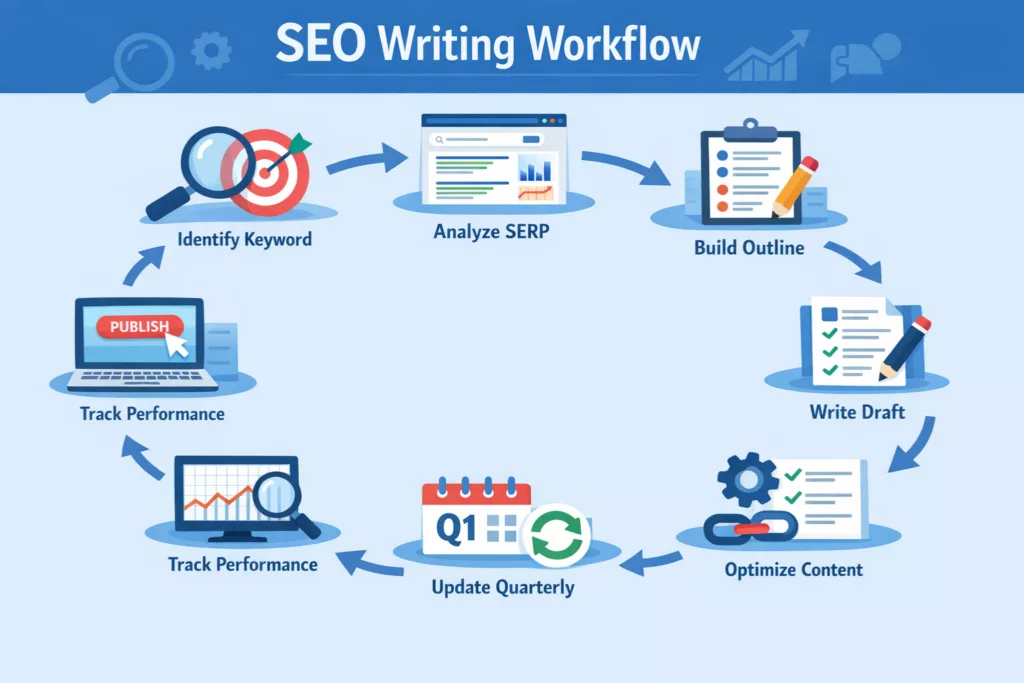
Now I follow the same nine steps every time. It removes guesswork and keeps quality steady.
1. Identify keyword
Everything starts here.
I choose one clear primary keyword that matches search intent and fits my site’s topical focus. If the keyword does not align with my audience or authority, I drop it.One page. One main keyword.
2. Analyze SERP
Before outlining, I study the search results.
I look at:
- Content type
- Average depth
- Featured snippets
- Common subtopics
This step tells me what Google expects. Skipping it is like writing blind.
3. Build outline
Only after SERP analysis do I create the outline.
I structure H2 and H3 sections based on:
• Search intent
• Competitor coverage
• Missing gaps I can improve
A strong outline makes writing easier. If the outline feels messy, the article will be messy.
4. Write draft
Now I write without obsessing over perfection.
I focus on:
• Clear explanations
• Logical flow
• Solving the reader’s problem
I do not stop every minute to check optimization scores. Draft first. Refine later.
5. Optimize
After the draft is complete, I optimize.
I check:
• Primary keyword placement
• Supporting keywords
• Heading hierarchy
• Semantic coverage
Optimization is a polishing phase, not the starting point.
6. Add links
Next comes internal and external linking.
I connect the article to:
• Related guides
• Supporting cluster content
• Authoritative external sources
This strengthens topical authority and context.
7. Publish
Before publishing, I review formatting.
Short paragraphs. Clear headings. Proper meta description. Image alt text included.
Presentation affects engagement.
8. Track performance
Once published, the work is not done.
I monitor impressions, clicks, and average position in Google Search Console. I watch engagement metrics in Google Analytics.
Data shows where improvement is needed.
9. Update quarterly
Every three months, I review performance.
If rankings dropped, I analyze competitors. If impressions are high but clicks are low, I refine the title and meta description.
SEO-focused digital writing is not one action. It is a cycle.
This workflow keeps the cycle controlled instead of reactive.
SEO-Focused Content Template Snippet
Here’s a simplified content template you can reuse for any SEO-focused digital writing project.
You can adapt this structure based on search intent.
SEO Content Structure Template
H1: Primary Keyword + Clear Benefit
Short introduction:
- Define the topic
- Address reader pain point
- Promise clear outcome
H2: Definition or Core Concept
- Snippet-ready paragraph (40–60 words)
- Clear explanation
H2: Search Intent Breakdown
- Informational vs transactional context
- What the reader expects
H2: Step-by-Step Framework
- H3 sections for each step
- Bullet lists for clarity
- Practical examples
H2: Common Mistakes
- 3–5 pitfalls
- Clear explanation of consequences
H2: Tools or Resources
- Relevant platforms
- Use cases
- Beginner guidance
H2: FAQ Section
- 3–5 targeted questions
- Concise, direct answers
Conclusion
- Recap key principles
- Reinforce long-term skill building
- Clear call to action
This template ensures:
- Intent alignment
- Logical structure
- Semantic keyword coverage
- Featured snippet opportunities
- High engagement formatting
You do not need to reinvent structure every time.
Build a system. Improve it. Reuse it.
That is how SEO-focused digital writers scale authority without burning out.
How to Build Authority as an SEO Digital Writer
Authority is not claimed. It is demonstrated.
I used to think writing long articles automatically made me look credible. It did not. Length without depth feels hollow. Readers sense it fast.
If you want to build authority as an SEO-focused digital writer, you have to prove experience through structure, examples, and evidence.
Show expertise
Expertise shows in specifics.
Instead of saying “optimize your headings,” explain how to structure one H1, logical H2s, and supporting H3s. Instead of saying “analyze competitors,” describe what to compare inside the SERP.
Surface-level advice sounds recycled. Detailed explanation signals real understanding.
Search engines evaluate signals of experience. Readers evaluate clarity. Both matter.
Include examples
Examples make theory believable.
When I explain keyword research, I show how a broad keyword can be narrowed into a long-tail phrase. When I discuss search intent, I describe how writing the wrong format caused a page to stall in rankings.
Examples turn abstract advice into something actionable.
They also increase trust because the reader can see how the concept works in practice.
Use data-backed insights
Authority grows when claims are supported.
If you mention ranking improvements, reference measurable signals like impressions, click-through rate, or dwell time. When discussing optimization, connect it to observable outcomes.
Search engines like Google prioritize helpful, reliable content. That includes content grounded in logic and evidence, not opinion alone.
You do not need complex statistics. You need cause and effect.
Don't forget to add an author bio. Author bio reinforces credibility. It should briefly explain your experience.
Key Takeaways
- SEO writing starts with search intent. Always analyze the SERP before outlining your content.
- One page, one primary keyword. Support it with semantic terms instead of repeating it.
- Structure drives rankings. Use one H1, logical H2s and H3s, and snippet-ready definitions.
- Engagement metrics matter. Improve dwell time with short paragraphs and clean formatting.
- Optimization happens after drafting. Write first, then refine keywords and internal links.
- Authority builds over time. Create content clusters and update articles quarterly.
- Track performance consistently. Review impressions, CTR, and rankings before making changes.
- SEO is iterative. Rankings improve through testing, refinement, and strategic updates.
Frequently Asked Questions
An SEO-focused digital writer needs keyword research skills, search intent analysis, content structuring ability, and strong writing clarity. They should understand on-page SEO basics, internal linking strategy, and how to interpret data from tools like Google Search Console. Most importantly, they must know how to solve reader problems clearly.
SEO writing is not difficult, but it requires practice and consistency. The fundamentals such as keyword research, search intent matching, and content structure can be learned quickly. Mastery comes from testing, analyzing performance, and improving over time.
Most writers see noticeable improvement within three to six months of consistent practice. Becoming highly skilled may take a year or more, especially when building topical authority. Progress depends on how often you write, analyze results, and refine your process.
SEO writers do not need advanced technical SEO knowledge, but understanding basics such as indexing, crawlability, site structure, and schema markup is beneficial. Collaboration with technical SEO specialists can help when deeper issues arise.
AI can assist with drafting, research, and optimization suggestions. However, human writers provide strategy, experience, judgment, and originality. Search engines prioritize helpful content that demonstrates real understanding, which still requires human direction and refinement.
Download the SEO Writer Checklist
Stop publishing and hoping. Use a proven system before every article. This checklist walks you through keyword validation, structure, optimization, internal linking, and performance tracking.
- ✓ Keyword & search intent validation
- ✓ On-page SEO checklist
- ✓ Content structure framework
- ✓ Internal linking reminders
- ✓ Post-publish performance tracking
Free PDF. Clear publishing system. No fluff.
Conclusion
Becoming an effective SEO-focused digital writer is not about tricks.
It starts with understanding search intent. Then comes structured keyword research, smart outlining, and writing for real humans instead of chasing algorithms. After that, optimization and consistent updates protect your rankings.
When I stopped guessing and started following a repeatable workflow, my results became predictable. Traffic improved. Rankings stabilized. Writing felt more strategic instead of reactive.
This skill compounds over time.
The more you practice SERP analysis, content structuring, internal linking, and performance tracking, the sharper your instincts become. SEO writing is not mastered in one article. It is built through repetition and refinement.
If you want to move faster, use a checklist.
Download the SEO writing checklist and use it before every publication. Or continue with the next guide where we break down real ranking examples step by step.
Consistency builds authority. Authority builds traffic.