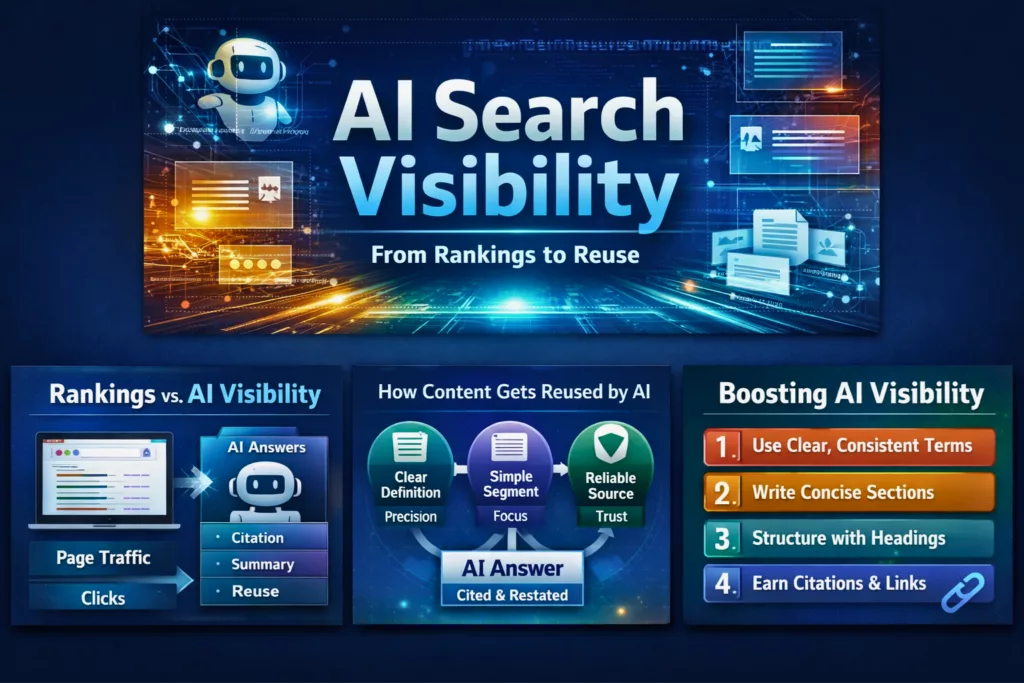
AI search visibility means your content gets cited, summarized, or reused inside AI answers, not ranked as a page.
AI systems select explanations, not websites.
That is why content can rank well in Google and still never appear in AI results, while a small site with no traffic gets cited repeatedly. The rules changed, but most people are still playing the old game.
In this guide, you will learn what AI search visibility really means, how AI tools decide what to reuse, and why clarity now matters more than clicks.
If you want your content to show up inside AI answers instead of staying invisible, keep reading.
For the full framework behind this shift, start with How to Optimize Content for AI Search Tools.
TL;DR: What AI Search Visibility Means?
AI search visibility means your content gets cited, summarized, or reused inside AI answers. Unlike Google rankings, AI systems select specific explanations they can trust and restate. Clear definitions, consistent terminology, and clean structure make reuse more likely, which helps visibility compound over time even without clicks.
Table of Content
- TL;DR: What AI Search Visibility Means?
- What AI Search Visibility Actually Means?
- How AI Systems Find and Reuse Content?
- Citations vs Rankings: The Core Shift
- Why AI Search Is Different From Google?
- What Makes Content Visible Inside AI Answers?
- Common Myths About AI Search Visibility
- How AI Search Visibility Compounds Over Time?
- Key Takeaways
- Frequently Asked Questions
- Conclusion
What AI Search Visibility Actually Means?
When people hear “visibility,” they still think about rankings. Page one. Top three. Blue links.
AI search does not work like that anymore. In AI systems, visibility means your information gets selected. Not your page. Not your domain.
A specific explanation, definition, or sentence gets pulled into an answer.
That shift changes everything.
I made this mistake early on. I kept optimizing posts like Google was the only audience. Titles were tight. Keywords were placed right. Rankings looked fine.
Yet my content never showed up inside AI answers.
That was the clue.
AI tools do not rank pages the way Google does. They assemble answers. They scan across many sources, extract useful pieces, and stitch them together.
If your content does not offer a clean, reusable explanation, it gets skipped.
Indexing still matters, but it is only the entry point. Being indexed means AI systems can see your content. It does not mean they will use it.
Reuse is the real filter.
I have seen pages with no strong rankings get cited repeatedly inside AI answers. I have also seen high-ranking pages ignored because they were hard to summarize.
That is the difference.
AI looks for information it can restate without breaking meaning. Clear definitions. Direct explanations. Cause-and-effect logic.
If a paragraph cannot survive being lifted out of context, it usually does not get reused. This is why summaries, citations, and references matter more than clicks.
AI tools do not care if users visit your site. They care if your content improves the answer. That feels uncomfortable at first. We spent years measuring success by traffic.
But inside AI search, visibility compounds without visits. One strong explanation can appear across hundreds of answers, tools, and interfaces.
I have watched a single definition get reused again and again. No ranking spike. No traffic spike. Yet constant exposure.
That is AI search visibility. It rewards clarity over cleverness. Structure over style. Precision over persuasion.
If your content explains something cleanly, AI systems trust it. If it wanders, hedges, or buries the point, it disappears.
This is not about writing more. It is about writing so machines can understand what matters.
Once I started writing with reuse in mind, things clicked. Short sections. One idea per block. No filler.
That is when AI visibility started showing up consistently. Not because the content was louder. Because it was easier to use.

How AI Systems Find and Reuse Content?
AI systems do not read the web the way people do. They scan for patterns. Large language models break content into chunks. Sentences. Phrases. Sections. They look for stable meaning that holds up when removed from the page.
I did not understand this at first. I thought longer posts meant better coverage. What I learned is that AI does not reward length. It rewards clarity.
Clear explanations get reused more often because they reduce risk. If a sentence explains one idea cleanly, the model can restate it without guessing.
Ambiguous writing causes problems. AI avoids it because it increases the chance of distortion.
This is where structure starts to matter. Headings act like signposts. Definitions act like anchors.
When a section clearly answers one question, AI knows exactly where to look. When ideas are mixed together, extraction becomes harder.
I tested this by rewriting the same concept two ways. One version flowed like a story. The other used short sections with direct definitions.
The structured version showed up inside AI answers. The narrative one did not. That was the lesson.
AI tools extract quotable segments. They look for sentences that can stand alone without setup. This is why definitions, comparisons, and cause-and-effect statements get reused. They do not depend on tone or context.
A strong segment usually has three traits:
- It names the concept clearly
- It explains what it does or why it matters
- It avoids soft language
When all three show up, AI trusts the segment. This also explains why fluff fails. Transitional phrases, filler, and vague framing weaken extraction.
AI does not care how the paragraph feels. It cares whether the meaning survives compression.
Once I started writing with this in mind, reuse increased. Not because I tried to please machines, but because the writing became cleaner. Short sections. One idea. One outcome.
That format makes it easy for AI systems to find what they need and reuse it accurately. That is how AI visibility actually forms.
For a deeper look at how large language models process and reuse information, see IBM’s overview of natural language processing.
Citations vs Rankings: The Core Shift
Search visibility used to mean one thing. Rank higher than the next page. AI search flipped that model.
AI answers do not sort pages into positions. They pull information from many places and show the sources that shaped the answer. That is why citations replaced rankings as the primary signal.
This change exists for a simple reason. AI systems aim to explain, not direct traffic.
A ranked list pushes users to click. A cited answer shows where the information came from.
Citations act as trust markers. When an AI tool references a source, it signals that the explanation held up during synthesis. The content was clear enough, stable enough, and specific enough to support the answer.
I noticed this when one short section of an article started appearing as a cited source across different tools. The page itself never ranked well. But that explanation kept getting reused.
That is authority in AI systems. Citation-worthy content shares a few traits. It defines terms without hedging. It explains cause and effect clearly. It avoids opinion where facts are expected.
Most content misses this because it tries to persuade instead of explain. AI does not need persuasion. It needs usable information.
Once content earns a citation, something interesting happens.
Reuse compounds.
That same explanation can appear in new answers, new tools, and new interfaces without any additional work. One citation becomes many references over time.
This is very different from rankings, which reset with every algorithm update. Citations persist as long as the explanation remains useful.
That is the core shift.
Visibility no longer depends on beating other pages. It depends on being useful to the answer itself. When you write for citation, not position, AI systems notice.
Why AI Search Is Different From Google?
Google was built around pages. AI search is built around answers. That single difference explains almost everything.
Google decides which pages deserve attention and then sends users there. AI systems decide which information deserves inclusion and assemble the answer directly. The page becomes secondary.
This shift changes which SEO tactics still matter. Clear structure still helps. Logical headings still help. Clean site architecture still helps.
But tactics designed only to influence rankings lose power. Keyword stacking. Inflated introductions. Writing for crawlers instead of clarity.
AI systems ignore most of that.
AI tools look for sections that do one job well. They do not reward pages that try to cover everything at once. Traditional SERPs create hierarchy. One page wins. The rest fade.
AI search flattens that structure.
Multiple sources can appear inside the same answer. A small site can sit next to a large brand if the explanation is strong enough. Visibility stops being a zero-sum game.
I have seen short, focused explanations surface inside AI answers while longer guides were ignored. The difference was not authority or backlinks. It was clarity.
This is why AI search feels unfamiliar at first.
You are no longer competing for position. You are competing for usefulness. Once you understand that shift, writing decisions become simpler.
Explain one thing clearly. Structure it so it can stand alone. Let the system reuse it.
That is how AI search operates differently from Google.
Google explains its traditional search model in detail in How Google Search Works, which highlights why AI-driven systems behave differently.
What Makes Content Visible Inside AI Answers?
AI systems reuse content they can trust. Trust comes from clarity. Clear terminology is the starting point. When you name a concept once and stick to the same phrasing, AI systems know what they are dealing with. When wording shifts, meaning blurs, and reuse drops.
I used to vary language for style. It read better to people. It performed worse in AI search.
Consistent phrasing helps models lock onto meaning. It reduces interpretation and keeps the idea stable.
Definitions matter more than most people expect. Simple definitions give AI something it can restate without changing intent. If a definition needs surrounding context to make sense, it often gets skipped. If it stands on its own, it travels.
Topical depth still matters, but filler breaks visibility. AI does not reward length for its own sake. Depth comes from covering a concept fully, not broadly. Explain what it is, why it matters, and how it behaves. Then stop.
I learned this after trimming sections that felt helpful but did not add meaning. Once the noise was gone, reuse increased. The core explanation became easier to extract.
Structure ties everything together.
Predictable structure helps AI parse content faster. Headings signal intent. Short sections isolate ideas. Lists clarify relationships.
When structure stays consistent across a site, visibility improves over time. AI systems learn where definitions live and where explanations begin.
This is not about writing for machines instead of people. It is about writing so ideas survive outside their original page.
When terminology stays tight, definitions stay simple, depth stays focused, and structure stays predictable, AI systems can do their job.
That is when content starts appearing inside answers.
Common Myths About AI Search Visibility
AI search created a lot of noise fast. Most of it comes from old assumptions carried into a new system.
The first myth is that you need to rank number one before AI will notice you.That is not how AI systems work.
AI tools do not scan SERPs from top to bottom. They scan content pools. If an explanation fits the answer, it gets used whether the page ranks or not. I have seen unranked pages cited repeatedly while top results were ignored.
The second myth is that AI only uses big brands. Brand authority helps, but it is not required.
AI systems care about explanation quality. If a smaller site explains a concept more clearly than a large one, that explanation often wins. This is one of the few places where clarity beats reputation consistently.
The third myth is that long content always wins.
Length does not equal usefulness.
Long content only helps when every section adds meaning. AI systems skip filler. They extract the clearest segment and move on. In many cases, a short, well-structured explanation outperforms a full guide.
The final myth is that SEO is dead.
It is not. SEO did not disappear. It shifted.
Technical basics still matter. Structure still matters. Internal linking still matters. What changed is the goal. You are no longer optimizing for clicks alone. You are optimizing for reuse.
Once these myths fall away, AI search visibility becomes easier to understand. You stop chasing positions and start building explanations that last.
How AI Search Visibility Compounds Over Time?
AI search visibility does not spike. It accumulates.
When an explanation gets reused once, it becomes easier to reuse again. AI systems recognize stable information and return to it. That is how visibility compounds without effort.
I noticed this with one short section I wrote to clarify a single concept. At first, it appeared in one AI answer. Weeks later, the same explanation showed up in different tools, phrased slightly differently but sourced the same way.
That is reuse in motion. This kind of visibility does not depend on traffic. Many users never click through. At first, that feels like a loss.
Then you realize the exposure keeps happening anyway. Your explanation becomes part of the system’s memory. It surfaces wherever that question appears. No ranking chase. No refresh cycle.
One strong explanation can surface everywhere because AI systems generalize. If a definition fits one question cleanly, it often fits related ones as well. The same core idea gets adapted across contexts.
That reach grows quietly.
Semantic clarity creates a long-tail effect. When terminology stays consistent and meaning stays tight, AI can connect your content to more prompts over time. Slightly different questions still trigger the same explanation.
This is why consistency matters more than frequency. You do not need more posts. You need fewer, clearer ones.
AI visibility compounds because it builds on trust. Once trust forms, reuse expands naturally. That is the long game of AI search.
OpenAI provides technical context on how AI models generate and structure responses in its guide on GPT model behavior.
Key Takeaways
- AI search visibility is about being cited and reused, not ranking a page.
- AI systems pull specific segments that explain one idea clearly.
- Being indexed helps, but reuse is what creates real visibility.
- Clear terminology and simple definitions get reused more often.
- Structure matters because AI tools parse headings and short sections faster.
- Citations act like trust signals and can compound across many AI answers.
- Visibility can grow without direct traffic when your explanations travel.
Frequently Asked Questions
What is AI search visibility?
AI search visibility means your content is cited, summarized, or reused inside AI-generated answers. Instead of ranking pages, AI systems select specific explanations they can trust and restate.
How is AI search visibility different from Google rankings?
Google ranks pages and sends users to websites. AI search focuses on answers. It pulls information from multiple sources and may show your content without sending any traffic.
Do I need to rank on Google to appear in AI answers?
No. AI systems do not rely on SERP positions. Content can be reused inside AI answers even if it does not rank well in traditional search results.
Why do AI tools cite some content but ignore others?
AI tools reuse content that explains one idea clearly, uses consistent terminology, and can stand alone without extra context. Vague or cluttered content is harder to reuse.
Does long-form content perform better in AI search?
Length alone does not help. AI systems extract the clearest segment, not the longest page. Focused explanations often outperform long articles with filler.
Can AI search visibility grow without traffic?
Yes. AI visibility compounds through reuse. Your content can appear across many answers and tools even if users never click through to your site.
Conclusion
AI search visibility is not about chasing rankings. It is about being understandable, reusable, and trustworthy to machines that summarize the web.
When your content explains concepts clearly, AI tools reuse it. That reuse becomes visibility.
If you want AI systems to surface your work, focus less on position and more on precision.