

SEO optimization gets thrown around like some kind of magic formula. Use the right keywords. Add a few links. Boom… Google traffic.
At least that’s what many guides claim.
But after years of writing online, I’ve learned something different. SEO optimization isn’t a trick. It’s a set of simple habits that help search engines understand your content and help readers find it.
Some strategies matter a lot. Others barely move the needle.
In this article, I’ll walk through the essential SEO strategies that actually make a difference. These are the things I focus on every time I publish an article.
If you’re a digital writer trying to grow traffic without chasing every SEO trend, this guide will help you focus on what really works.
SEO Optimization (Quick Summary)
SEO optimization is the process of improving your content so search engines understand it and show it in relevant search results. For writers, SEO optimization focuses on clear topics, search intent, structured content, and helpful explanations that solve the reader’s problem.
- Focus on search intent to understand what readers want from the query
- Use your target keyword naturally in titles, headings, and content
- Structure articles with clear headings and short paragraphs
- Add internal links to connect related articles on your site
- Create helpful content that answers a specific question
- Publish consistently and improve articles over time
Core Elements of SEO Optimization
Effective SEO optimization usually includes five core elements that help search engines understand and rank content.
- Keyword targeting – choosing a clear topic people are searching for
- Search intent alignment – matching the reader’s goal behind the query
- Content structure – using headings and clear formatting
- Internal linking – connecting related articles across the website
- Helpful content – answering the reader’s question clearly and completely
Table of Content
- SEO Optimization (Quick Summary)
- What SEO Optimization Really Means for Writers?
- Why Most SEO Advice Confuses New Writers?
- Essential SEO Strategy #1: Start With Search Intent
- Essential SEO Strategy #2: Use Keywords the Natural Way
- Essential SEO Strategy #3: Structure Content for Easy Reading
- Essential SEO Strategy #4: Build Internal Links
- Essential SEO Strategy #5: Write Content That Actually Helps Readers
- SEO Strategies That Matter Less Than People Think
- My Simple SEO Workflow for Every Article
- Key Takeaways
- Frequently Asked Questions
- Conclusion
- Want to Improve Your SEO Writing?
What SEO Optimization Really Means for Writers?
When I first heard the term SEO optimization, I honestly thought it meant learning a bunch of technical tricks. Keywords, algorithms, ranking factors. It sounded complicated. Like something only marketers or developers understood.
Over time I realized something surprising. For writers, SEO optimization is mostly about helping search engines understand what your content is about.
That’s it.
Search engines like Google try to match a reader’s question with the best page that answers it. If your article clearly explains a topic, uses the right keywords, and is organized well, search engines can recognize it.
Think of SEO as translation.
You write for people. SEO helps search engines interpret that writing so they know when to show it in search results.
Early in my writing journey, I made the classic mistake many beginners make. I tried to write for search engines instead of readers. I stuffed keywords everywhere. I worried about keyword density. I checked SEO plugins every few minutes.
The result? My articles felt stiff and robotic.
Ironically, that approach made the content worse for both readers and search engines.
Good SEO actually starts with something very simple. Clear writing.
When your writing is easy to follow, search engines can understand it better. Headings show structure. Keywords signal the topic. Internal links show how pages relate to each other.
Everything starts with clarity.
I like to explain SEO optimization for writers this way: you’re giving search engines a roadmap. Titles, headings, and keywords act like signs along the road. They help Google figure out where your content fits.
Another thing beginners often misunderstand is how search engines evaluate content.
Many people assume Google counts keywords or measures tiny technical details. In reality, modern search engines focus heavily on helpful content. They look at signals like:
- Does the article answer the search question clearly?
- Do readers stay on the page and continue reading?
- Is the content structured in a way that’s easy to scan?
- Does the page show expertise and experience on the topic?
These signals tell Google whether the article actually helped someone.
That’s why experienced writers often outperform people chasing technical SEO tricks. The best SEO content usually reads like a helpful guide written by someone who understands the topic.
Another reason SEO feels confusing is because there’s so much noise online. Every week someone claims there’s a new ranking hack or secret strategy. Beginners see this and assume SEO must be extremely complex.
Most of it isn’t necessary.
In practice, SEO optimization for writers comes down to a few consistent habits:
- Choose a clear topic.
- Understand what readers are searching for.
- Use the main keyword naturally.
- Structure the article with helpful headings.
- Write content that solves the reader’s problem.
That’s the foundation.
Once I stopped chasing complicated SEO tactics and focused on writing clear, useful articles, something interesting happened. My pages started ranking more consistently.
Not because I discovered a secret trick.
Because search engines could finally understand what my content was trying to say.
Most SEO strategies begin with solid keyword research that reveals what people search for online.
For a detailed breakdown of article-level optimization, read the guide to on-page SEO for writers.
If you're new to this topic, you may want to start with our complete guide to SEO writing, which explains how to create content that ranks in search engines.
Why Most SEO Advice Confuses New Writers?
When I first started learning about SEO, I remember feeling like I had opened a door into a completely different world. Suddenly there were dozens of new terms. Keyword difficulty. Domain authority. Backlink profiles. Crawling. Indexing. Technical audits.
It felt like I needed a marketing degree just to write a blog post.
The strange thing is that most writers don’t actually need most of that information, especially at the beginning. But if you search online for SEO advice, the majority of guides jump straight into complicated tactics.
That’s where the confusion begins.
Many SEO articles are written for marketers, agencies, or advanced SEO professionals. Those people work with large websites, technical audits, and competitive markets. Their strategies make sense for that environment.
But a writer starting a blog or content site doesn’t need that level of complexity.
Instead of explaining simple SEO concepts, many guides dive into things like backlink strategies, advanced keyword clustering, or technical optimization. Beginners read this and assume every article must follow the same process.
That’s where overwhelm kicks in.
I remember opening my first keyword research tool and seeing hundreds of numbers and filters. Search volume. Keyword difficulty. Competition scores. Trend graphs. It looked more like financial software than a writing tool.
At that point I thought SEO was mostly about analyzing data.
But after writing and publishing hundreds of articles, I realized something different. The most effective SEO for writers is usually very practical and very simple.
- You pick a topic people are searching for.
- You write the best explanation you can.
- You structure the article clearly.
- You make sure search engines understand the topic.
That’s practical SEO.
Advanced SEO is something different. It involves technical site optimization, large-scale content strategies, backlink campaigns, and detailed competitive analysis. Those things matter for big websites competing in crowded markets.
But they’re not where a new writer should start.
Trying to master advanced SEO too early creates a weird problem. Writers spend more time studying SEO tactics than actually writing articles.
I’ve seen this happen many times. Someone spends weeks researching keyword tools, watching SEO tutorials, and analyzing competitors. But they publish almost nothing.
Meanwhile, another writer focuses on publishing helpful articles consistently. That second writer often ends up getting traffic faster.
Not because they understand SEO better. Because they’re applying the fundamentals.
The fundamentals are boring compared to flashy SEO strategies, but they work incredibly well. Choose a clear topic. Match the reader’s search intent. Use headings that guide the reader. Write content that answers the question completely.
Those simple habits do more for SEO than most beginners expect.
Another reason SEO advice gets confusing is that many guides focus on optimization before content exists. They talk about perfect keyword placement, perfect SEO scores, and perfect optimization formulas.
Real writing rarely works that way.
Most of the time you write the article first. Then you improve the structure, adjust the headings, add internal links, and refine the keyword placement. SEO becomes part of the editing process rather than the starting point.
Once I started thinking about SEO this way, everything became easier. Instead of trying to follow dozens of complicated tactics, I focused on one question.
Will this article genuinely help someone searching for this topic?
If the answer is yes, you’re already doing most of what SEO requires.
SEO strategies only work when your content is built the right way. Without a solid writing foundation, optimization won’t help much.
Understand SEO writing from start to finishEssential SEO Strategy #1: Start With Search Intent

If there’s one SEO lesson that changed how I write articles, it’s this: start with search intent.
I didn’t understand this concept at first. Like many writers, I believed SEO was mainly about finding a keyword and placing it in the article. If the keyword appeared in the title, headings, and text, the page should rank.
That assumption turned out to be wrong.
Search engines don’t rank pages just because they contain a keyword. They rank pages that best match the reason someone searched for that keyword.
That reason is what we call search intent.
Search intent simply means the goal behind the search. What is the person trying to accomplish when they type a phrase into Google?
Once you start thinking about SEO this way, ranking content becomes much more logical.
For example, if someone searches “what is SEO writing,” they’re probably looking for a clear explanation. They want to understand the concept. That’s informational intent.
If someone searches “best SEO writing tools,” the goal is different. They’re likely comparing tools before choosing one. That’s commercial intent.
Then there’s transactional intent. This is when someone wants to take action right away, like buying a course, hiring a service, or signing up for software.
These three types of search intent show up constantly in search results:
- Informational intent: People want to learn something or understand a topic.
- Commercial intent: People are researching products or services before making a decision.
- Transactional intent: People are ready to take action, buy something, or sign up.
Understanding which intent sits behind a keyword makes your writing much more effective.
Early in my writing career I ignored this. I wrote long guides for keywords where people were actually looking for quick answers. Other times I wrote short articles when readers expected detailed comparisons. The content didn’t match the searcher’s goal, so it struggled to rank.
Once I started analyzing search intent before writing, things improved quickly.
The easiest way to identify search intent is surprisingly simple. Just look at the top results on Google. Search the keyword and study the first page. Notice what type of content appears most often.
Are the top results tutorials and explanations? Are they product comparisons? Are they service pages or landing pages?
Google already shows you the type of content it believes satisfies the search.
For example, if you search a phrase like “SEO writing tips,” you’ll likely see blog posts and guides explaining how to improve SEO writing. That signals informational intent.
But if you search something like “best SEO writing tools,” most results will be lists comparing software. That signals commercial intent.
When your article matches the same intent, you give it a much better chance of ranking.
I usually take a few minutes to check search results before outlining an article. It’s one of the simplest SEO habits I’ve developed, and it prevents a lot of wasted effort.
Here’s a quick example.
Let’s say you want to write an article targeting the keyword “optimize your writing for SEO.”
If the top results show tutorials and step-by-step guides, that means readers want a practical explanation. A detailed guide that explains the process clearly will align with search intent.
But if you wrote a short opinion piece about SEO instead, the content probably wouldn’t match what searchers expect.
Search intent acts like a compass. It points your article in the direction readers are already looking.
Once you understand this, many SEO decisions become much easier.
If you want to understand this concept in more depth, read our guide on search intent for writers, where we break down how to identify what readers actually want from a search query.
Essential SEO Strategy #2: Use Keywords the Natural Way
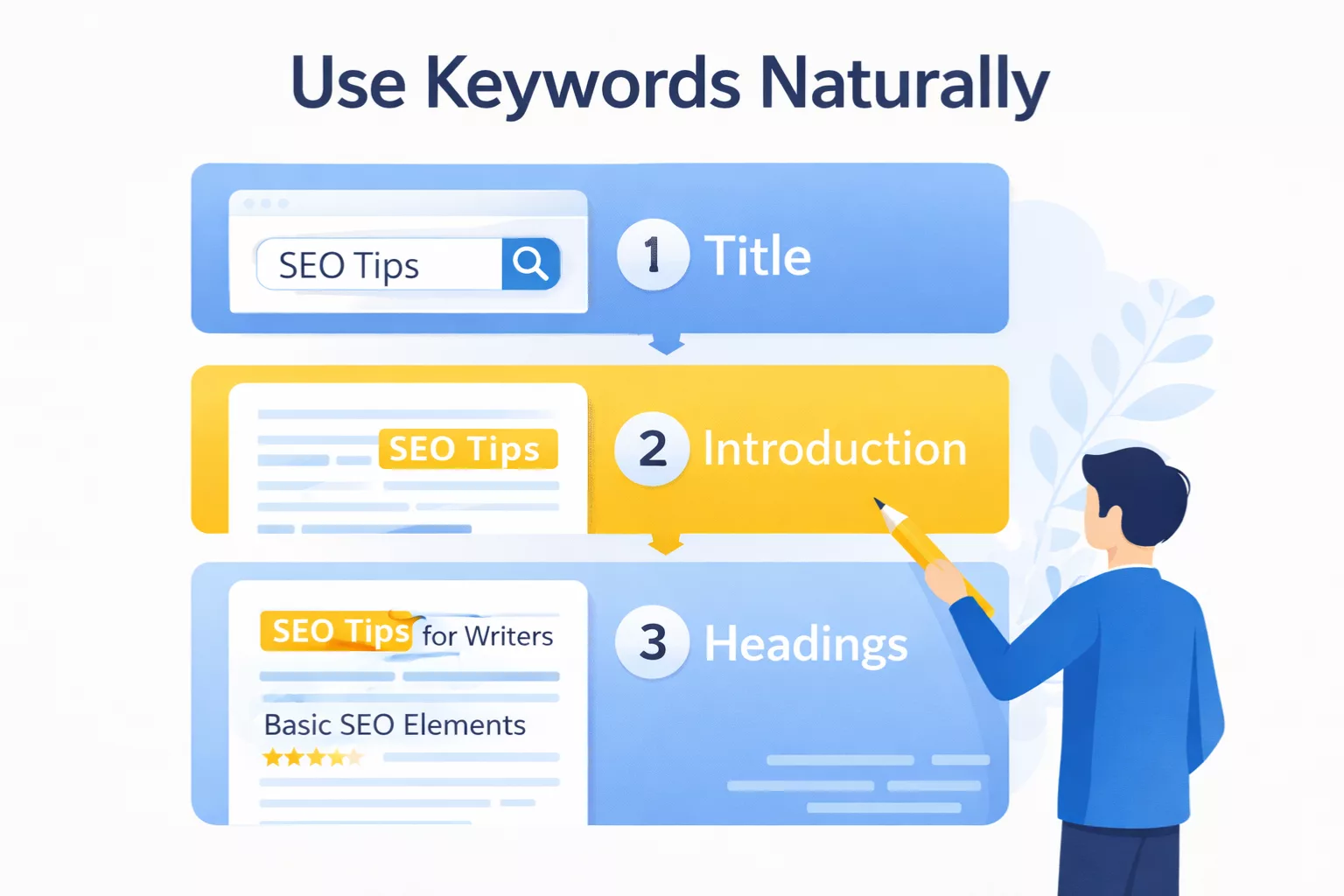
When most writers first hear about SEO, the first thing they learn about is keywords. And honestly, that makes sense. Keywords help search engines understand what your article is about.
But this is also where many beginners go wrong.
They assume SEO success depends on placing the keyword everywhere possible. Title, headings, every paragraph, maybe even every sentence. I tried this years ago and the result was… pretty awful writing.
The article sounded forced.
Readers can feel that immediately, and search engines notice it too.
Before talking about keyword placement, it helps to understand what a target keyword actually is. A target keyword is simply the main phrase you want your article to rank for in search results.
For example, if someone searches “SEO optimization tips,” and your article explains that topic clearly, that phrase might be your target keyword.
Everything in the article should revolve around that topic.
Once you know your target keyword, the goal isn’t to repeat it constantly. The goal is to signal the topic clearly so search engines and readers understand the focus of the article.
There are a few natural places where keywords help the most.
The first place is the title.
Your title tells both readers and search engines what the page is about. Including the keyword in the title makes the topic obvious.
The next important place is the introduction. When the keyword appears early in the article, search engines quickly understand the subject.
Headings are another helpful signal. If your headings include related keywords or variations of the main phrase, it reinforces the topic.
And of course the keyword should appear naturally within the body content. Not because you’re trying to hit a certain number, but because you’re genuinely discussing the topic.
That’s where many writers run into the old problem called keyword stuffing.
Years ago, some websites ranked by repeating keywords excessively. Articles looked like this:
“SEO optimization tips are important if you want SEO optimization tips that improve your SEO optimization tips.”
It reads terribly.
Modern search engines are much smarter. They don’t need constant repetition to understand a topic. In fact, unnatural keyword use can make content perform worse.
Instead, search engines now rely heavily on semantic keywords.
Semantic keywords are words and phrases related to the main topic. They help search engines understand the broader meaning of your content.
For example, if your article is about SEO optimization, related phrases might include:
- search intent
- keyword research
- content optimization
- internal linking
- search rankings
When these related ideas appear naturally in the article, they create context. Google can see that the page covers the topic in a complete way.
Over time I developed a very simple method for using keywords naturally.
- First, I choose one clear target keyword for the article.
- Second, I include it in the title, introduction, and one or two headings where it fits naturally.
- Third, I focus on explaining the topic clearly rather than worrying about repetition.
When you explain a topic thoroughly, the keyword and related phrases usually appear naturally anyway.
That’s why good SEO writing often looks like normal writing. The keyword is present, but it doesn’t dominate the article.
The real goal isn’t to satisfy an SEO formula.
The goal is to make the topic obvious for both readers and search engines while keeping the writing smooth and helpful.
Google’s own documentation also explains how search works and how pages are evaluated. You can explore the basics in their guide to how Google Search works.
Essential SEO Strategy #3: Structure Content for Easy Reading
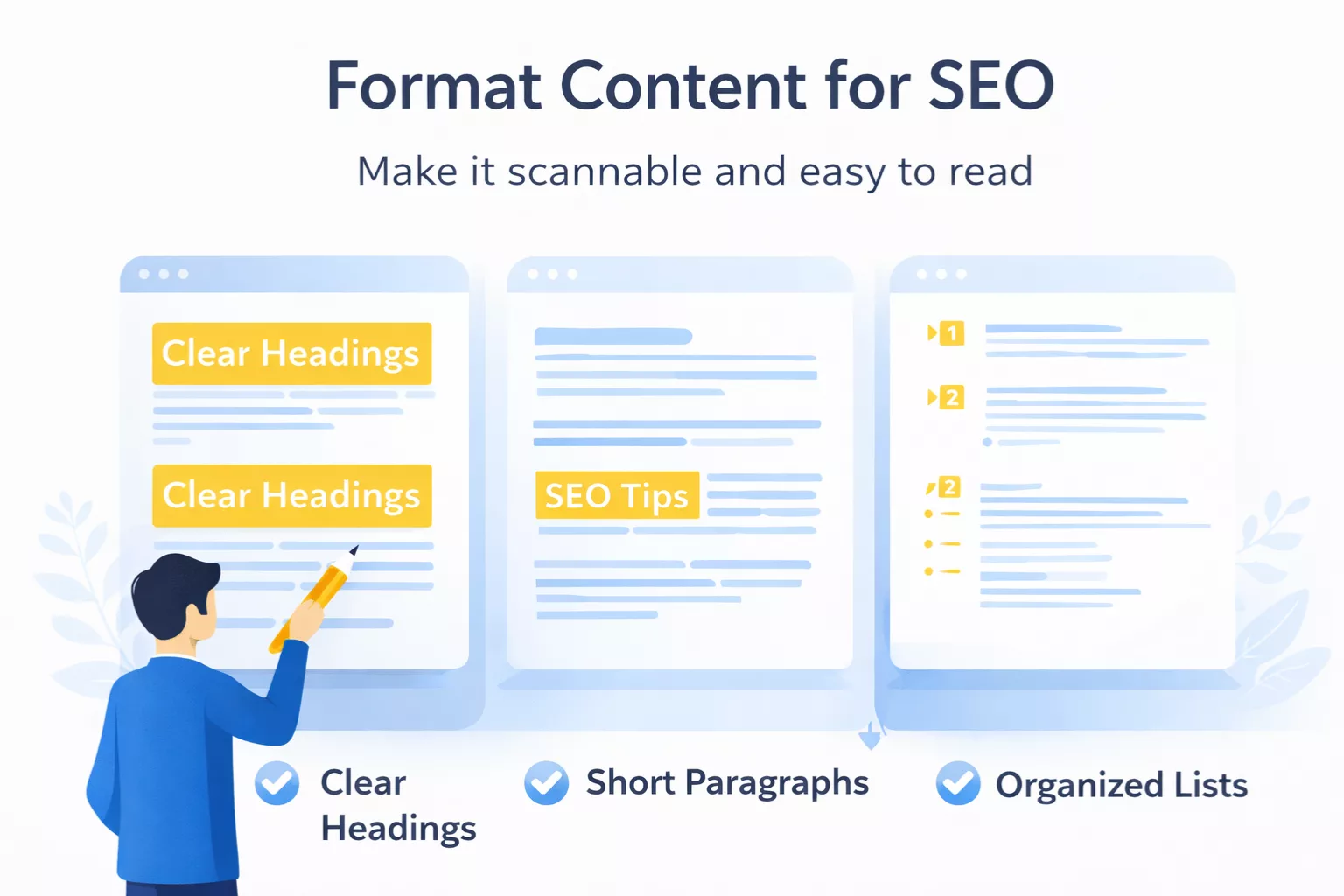
One SEO lesson took me longer to understand than it should have. It wasn’t about keywords. It wasn’t about tools. It was about how the article looks on the page.
Structure matters more than most writers realize.
Early on I wrote articles the same way I wrote essays in school. Long paragraphs. Few headings. Everything explained in one continuous block of text.
It looked fine in a document.
But on a screen it was exhausting to read.
Online readers behave very differently from people reading books or reports. Most visitors don’t read every word. They scan first. Their eyes move quickly down the page looking for sections that answer their question.
If the article looks dense or messy, many people leave within seconds.
That behavior affects SEO more than many writers expect. Search engines track how users interact with pages. If readers arrive and leave quickly, that can signal that the content didn’t help them.
But when readers stay, scroll, and continue reading, it sends a different signal. The article likely answered their question.
That’s why readability plays a quiet but important role in SEO performance.
One of the simplest ways to improve readability is through headings.
Headings break your content into clear sections. They tell readers what each part of the article covers. Someone scanning the page can quickly jump to the section that matches their question.
Search engines also rely on headings to understand structure. When headings contain relevant keywords or related phrases, they help clarify the topic of the page.
Think of headings as signposts inside your article.
They guide readers and search engines through the content.
Another thing that improves readability immediately is using short paragraphs.
Large blocks of text feel intimidating on a screen. Even if the content is valuable, readers often skip over long paragraphs because they look difficult to read.
Short paragraphs create breathing space.
I usually keep paragraphs to one or two ideas. Often just two or three sentences. This makes the article feel lighter and easier to move through.
Lists and bullet points also help readers process information faster.
When you explain several related ideas, a list makes them easier to see. Readers don’t need to dig through paragraphs to find key points.
Lists also break visual patterns on the page. That small change can keep readers engaged longer.
For example, when explaining steps, tools, or key tips, a simple list often works better than long explanations.
The goal isn’t to simplify the topic. It’s to make the information easier to absorb.
Over time I noticed something interesting when I improved article structure. Readers stayed on the page longer. They scrolled further. Some even explored other articles on the site.
The content itself hadn’t changed dramatically.
But the organization made the information easier to use.
That’s really what good structure does. It removes friction between the reader and the answer they’re looking for.
When someone lands on your article, they should immediately see where to find the information they need.
Headings guide them. Short paragraphs keep the reading comfortable. Lists highlight important ideas.
All of these small structural choices add up to a better reading experience, and that experience quietly supports your SEO performance.
Good SEO content also depends on strong writing fundamentals. If you want to improve clarity and readability, these digital writing techniques can help you structure articles so they are easier to read on screens.
Essential SEO Strategy #4: Build Internal Links

Internal linking was one of the SEO strategies I completely underestimated when I started writing online. I thought links were mainly for navigation. A way for readers to move from one article to another.
But internal links do something much more important behind the scenes.
They help search engines understand the structure of your website.
An internal link simply means linking from one page on your site to another page on the same site. For example, if you write an article about SEO writing and link to another article about keyword research on your blog, that’s an internal link.
It sounds simple, but the impact is bigger than most writers realize.
Search engines discover and evaluate pages by following links. When one article links to another, it signals that those pages are related. Over time, this creates a map of topics across your website.
Without internal links, that map becomes weak.
Imagine publishing dozens of articles that never connect to each other. Each article stands alone. Search engines can still find them, but the relationship between topics becomes harder to understand.
Internal links solve that problem.
They show how different pieces of content fit together. An article about SEO writing might link to pages about search intent, keyword research, content structure, and internal linking itself.
Suddenly search engines can see that your site covers a broader topic.
This idea becomes even stronger when you build what many SEO professionals call hub pages.
A hub page focuses on one core topic and links to multiple related articles. Each of those supporting articles links back to the hub. The structure creates a clear topic cluster.
For example, imagine a hub page about SEO writing. That page could link to articles like:
- How to find keywords for blog posts
- Understanding search intent for writers
- How to structure SEO-friendly articles
- On-page SEO basics for bloggers
Each supporting article expands one specific part of the topic.
When these pages link to each other, search engines see a strong topical relationship. Instead of isolated articles, the site becomes a structured resource around a theme.
Internal links also help readers move through your content naturally.
If someone reads an article about keyword usage and you mention search intent, linking to an article that explains search intent allows the reader to continue learning without searching again.
This improves the experience for readers and keeps them engaged with your site longer.
One thing I’ve learned over time is that internal links work best when they appear naturally inside the content.
Some of the most effective places to add internal links include:
- When you mention a related concept that another article explains in detail.
- When you introduce a topic that readers may not fully understand yet.
- When you want to guide readers toward a deeper explanation or next step.
The link should feel like a helpful suggestion, not a forced SEO tactic.
A good example of internal linking in a content cluster might look like this. Imagine writing an article about SEO optimization strategies. While explaining search intent, you link to a detailed article about understanding search intent for writers.
Later in the same article, you mention content structure and link to another guide explaining how to structure SEO-friendly articles.
Each link points readers to helpful content and strengthens the connection between pages.
Over time, these small connections build a network across your site. Search engines understand the topics better. Readers discover more of your content.
All because the articles are no longer isolated. They work together as part of a larger structure.
Essential SEO Strategy #5: Write Content That Actually Helps Readers

If I had to choose one SEO strategy that matters more than anything else, it would be this one. Write content that actually helps readers.
That might sound obvious. But you’d be surprised how many articles online exist mainly to target keywords rather than help someone solve a problem.
I’ve written a few of those myself in the past. The article technically covered the topic. The keyword appeared in the title. The headings looked optimized.
But the content itself wasn’t very useful.
It explained things in a vague way. It repeated ideas without giving real examples. Sometimes it felt like the article was written mainly to exist, not to help someone understand something.
Search engines have become much better at recognizing that difference.
Modern SEO revolves heavily around helpful content. Google wants to show pages that genuinely answer the question behind a search. Not pages that just repeat a keyword or summarize information poorly.
That’s why experience and usefulness have become more important signals.
When an article clearly explains a topic, uses practical examples, and guides the reader step by step, it stands out. Readers stay longer. They keep scrolling. Sometimes they explore other pages on the site.
Those small signals tell search engines the content did its job.
One of the easiest ways to make content more helpful is by using real examples.
Instead of explaining ideas in abstract terms, show how they work in practice.
For example, when teaching SEO writing, I could simply say that headings help structure an article. That’s technically correct, but it’s not very memorable.
A better explanation shows what that structure looks like in a real article. Readers immediately understand how to apply the idea.
Examples also build trust.
When readers see that you’re explaining something clearly and practically, the article feels more credible. It doesn’t read like a generic guide copied from dozens of other posts.
Clear explanations matter just as much.
Many articles assume readers already understand basic terms. They jump straight into advanced tactics without explaining the foundation. Beginners quickly get lost.
When writing helpful content, I try to slow down and explain ideas in plain language. If a concept requires multiple steps, I walk through those steps carefully.
That approach often makes the article longer, but it also makes it easier for readers to follow.
Another habit that improves SEO performance is focusing on one specific problem per article.
When writers try to cover too many topics at once, the content becomes scattered. Search engines struggle to identify the main purpose of the page.
But when an article clearly solves a single problem, the focus becomes stronger.
For example, instead of writing a broad article about “everything related to SEO,” a better approach is writing specific guides such as:
- how to find keywords for blog posts
- how to structure SEO-friendly articles
- how to optimize titles for search engines
Each article becomes a focused solution.
Over time these focused articles connect through internal links and form a larger content cluster. But each page still solves one clear problem.
That combination works extremely well for both readers and search engines.
When someone searches for a question and lands on your article, they should feel like the page was written specifically to help them understand that topic.
If the answer is clear, practical, and easy to apply, you’re already doing one of the most powerful forms of SEO.
Google has made it clear that search rankings increasingly reward useful content that genuinely helps readers. Their helpful content guidelines explain how search engines prioritize pages that answer real questions clearly.
SEO Strategies That Matter Less Than People Think
When you start learning about SEO, it’s easy to believe every small optimization matters. Change a word in the title. Adjust keyword density. Update a few sentences. Maybe Google will reward the page.
I used to think that way too.
Every time I published an article, I kept going back to tweak small things. Move the keyword here. Add another variation there. Adjust the heading slightly.
It felt productive.
But after doing this for a while, I realized most of those changes barely moved the needle. The articles that performed well didn’t rank because of tiny tweaks. They ranked because the topic matched what people were searching for and the content actually helped them.
One thing beginners often worry about is over-optimizing keywords.
They believe the keyword needs to appear a certain number of times. Some tools even give you a score based on how often the keyword appears compared to other pages.
The problem is that this encourages awkward writing.
When you focus too much on keyword frequency, the article stops sounding natural. The same phrase repeats again and again. Readers notice it immediately.
Search engines notice it too.
Modern search algorithms understand language much better than they did years ago. They don’t need constant repetition to understand the topic of a page.
That’s why keyword density has become far less important than people think.
Years ago, SEO guides talked about exact percentages. Some recommended a specific keyword density to help pages rank. That idea still floats around online, but it’s largely outdated.
Today search engines rely more on context and related terms. If your article clearly explains the topic, the main keyword and related phrases will appear naturally anyway.
Another habit that wastes a lot of time is constantly updating small SEO elements.
I’ve seen writers repeatedly adjust titles, meta descriptions, or headings hoping to trigger a ranking boost. Sometimes updates help, but minor edits rarely transform a page.
What usually matters more is the overall quality and usefulness of the content.
If the article doesn’t fully solve the reader’s problem, changing a few keywords won’t fix that.
Another distraction in the SEO world is chasing algorithm updates.
Every time Google releases an update, social media fills with speculation. Some people claim certain strategies stopped working overnight. Others claim they discovered the new ranking formula.
For beginners this creates unnecessary anxiety.
In reality, most algorithm updates aim to improve the same core goal. Google wants to show helpful, trustworthy content that answers the searcher’s question.
That principle hasn’t changed.
Writers who focus on clear explanations, helpful examples, and well-structured content rarely need to panic when updates happen.
The biggest lesson I learned about SEO is surprisingly simple.
Consistency beats tricks.
Publishing helpful articles regularly does far more for a website than chasing every new tactic. Over time those articles build topical depth, internal links connect them together, and search engines begin to understand what your site is about.
Many successful blogs grow this way. Not because the writer discovered a secret SEO hack, but because they consistently created useful content.
When you focus on that habit, most of the smaller SEO worries start to fade away.
My Simple SEO Workflow for Every Article
Over the years I’ve tried many different SEO processes. At one point I had long checklists, multiple tools open, and a complicated workflow before I even started writing.
Eventually I realized something. The more complex the process became, the harder it was to stay consistent.
Now I follow a much simpler SEO workflow for every article. It focuses on the fundamentals that actually make a difference.
The goal isn’t perfection. The goal is to publish helpful content consistently while making sure search engines understand the topic.
The process usually starts with choosing one clear keyword.
That keyword represents the main question or topic the article will answer. I avoid trying to target multiple different ideas in the same article. When a page focuses on one clear topic, the structure becomes easier to build.
For example, instead of writing a broad article about “everything related to SEO,” I choose something more specific like “SEO optimization strategies” or “how to structure SEO content.”
A clear keyword gives the article direction.
Once I have the keyword, the next step is understanding search intent.
Before outlining anything, I usually search the keyword in Google and look at the first page of results. This takes only a few minutes, but it tells me a lot about what readers expect.
- Are the top results step-by-step guides?
- Are they quick explanations?
- Are they product comparisons or lists?
The patterns on the results page reveal the intent behind the search. Matching that intent increases the chances that the article will perform well.
After that, I create a simple outline.
This step saves a lot of time during writing. Instead of staring at a blank page, I already know the sections I want to cover.
The outline usually includes the main heading, several H2 sections, and a few notes about what each section should explain. Nothing complicated. Just a clear path for the article.
Then comes the part many writers worry about too much: actually writing the article.
When I write the first draft, I focus on readers first.
I explain the topic clearly. I use examples when possible. I try to answer the question in a way that someone new to the topic can understand.
At this stage I’m not obsessing over SEO details. The goal is to produce helpful content that solves the reader’s problem.
Once the draft is finished, I move into a short optimization step.
This is where I add the basic SEO elements.
I check that the keyword appears naturally in the title and introduction. I review the headings to make sure they guide the reader through the topic. I add internal links to related articles where it makes sense.
Sometimes I adjust the structure slightly so the article flows better.
These small changes help search engines understand the page while keeping the writing natural.
Finally, the article gets published.
One thing many writers forget is that SEO doesn’t end at publication. Over time I occasionally revisit older articles to improve them.
Maybe I add a clearer explanation. Maybe I link to newer content on the site. Sometimes I expand a section if readers seem to need more detail.
But I try not to obsess over constant updates.
The real growth usually comes from repeating the process. Choose a clear keyword. Match the search intent. Write helpful content. Publish consistently.
When you follow that workflow over and over again, the results compound.
Key Takeaways
- SEO optimization helps search engines understand your content so they can show it to the right readers.
- Search intent is the foundation of SEO writing. Your article should match what the reader is trying to learn or solve.
- Keywords work best when used naturally. Focus on clear explanations rather than repeating the keyword.
- Content structure improves SEO. Headings, short paragraphs, and lists make articles easier to read and scan.
- Internal links strengthen your site structure and help search engines understand topic relationships.
- Helpful content consistently performs better than pages written mainly to target keywords.
- Simple workflows beat complicated SEO tactics. Focus on clear topics, helpful writing, and consistent publishing.
Frequently Asked Questions
What is SEO optimization in simple terms?
SEO optimization means improving your content so search engines can understand it and show it in relevant search results. For writers, this includes using clear keywords, matching search intent, structuring articles with headings, and creating helpful content that answers readers’ questions.
Why is SEO optimization important for writers?
SEO optimization helps writers attract readers through organic search traffic. When articles are optimized for search engines and structured clearly, they have a better chance of appearing in search results and reaching people looking for that topic.
How do you optimize content for SEO?
To optimize content for SEO, start by choosing a clear keyword, understand the search intent behind the query, structure the article with headings and short paragraphs, use the keyword naturally in the content, and add internal links to related pages on your site.
What is the difference between SEO writing and SEO optimization?
SEO writing focuses on creating content that matches search intent and answers reader questions. SEO optimization refers to improving the structure, keywords, links, and formatting of that content so search engines can understand and rank it more easily.
How long does SEO optimization take to work?
SEO optimization usually takes time before results appear. Depending on the competition and the authority of the website, it can take several weeks or months for optimized content to start ranking and attracting organic traffic.
For a broader overview of SEO fundamentals, the Google SEO Starter Guide explains the core principles that help websites appear in search results.

Conclusion
SEO optimization doesn’t have to be complicated.
In my experience, the best strategy is simple: understand what readers are searching for and create content that answers their questions clearly.
Focus on search intent. Use keywords naturally. Structure your articles so they’re easy to read.
Do that consistently, and your content has a much better chance of ranking.
If you’re building a writing site or growing a blog, mastering these essential SEO strategies will give you a strong foundation for long-term traffic.
Want to Improve Your SEO Writing?
SEO optimization becomes much easier when you understand how writing and search intent work together. Once you learn the fundamentals, every article you publish becomes another opportunity to attract readers through search.
If you're building a writing site or blog, start by learning how SEO writing works and how to structure content that search engines can understand.